What Does GCSE French Actually Test?
What does GCSE French actually test? Learn how marks reward listening, reading, speaking, writing, grammar, vocabulary and accurate communication.
A French revision book can create a comforting illusion: if you memorise every vocabulary list, perhaps the marks will take care of themselves. Then a listening extract begins, the speaker uses familiar words in an unfamiliar sentence, and certainty disappears.
So, what does GCSE French actually test? The short answer is both knowledge and skill. You need prescribed vocabulary, grammar and sound-spelling knowledge, but examiners reward your ability to use that knowledge: understanding messages, selecting relevant details, communicating clearly, applying language accurately and responding to unfamiliar material.
For GCSEs in England first assessed in summer 2026, the balance is explicit. The assessment objectives give 35%35\%35% to understanding and responding to spoken language, 45%45\%45% to understanding and responding to written language, and 20%20\%20% to accurate grammar and vocabulary. Those objectives are set nationally, although each exam board turns them into tasks in slightly different ways.
GCSE French assessment at a glance
Before revising, check your own exam board specification and tier. Do not assume that an old paper, a classmate's task format or a resource made for another board matches your examination.
Your preparation should cover:
- listening for meaning, detail, opinions and time frames;
- speaking clearly and responding appropriately;
- reading for explicit and implied meaning;
- writing relevant, comprehensible French;
- applying prescribed vocabulary and grammar accurately;
- recognising sound-symbol correspondences;
- dictation, reading aloud and translation;
- adapting known language when a question is unfamiliar.
The reformed French GCSE taught in England from September 2024 is first assessed in summer 2026. Students take all assessments at either foundation or higher tier. AQA and Pearson Edexcel both organise the qualification around listening, speaking, reading and writing components worth 25%25\%25% each, but their task details and mark allocations are not identical. Qualifications used in Wales can follow different arrangements, so the specification used by your school remains the final authority.
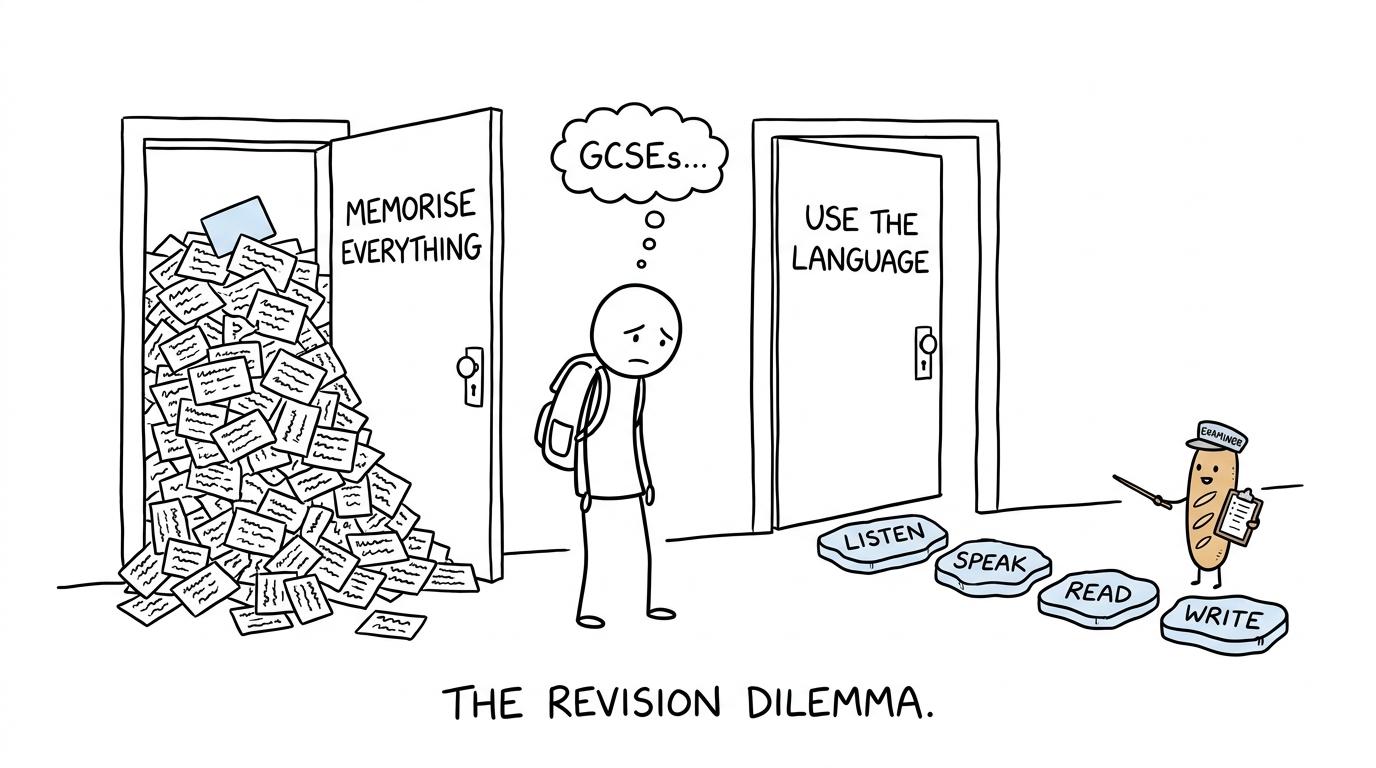 A student choosing between memorising everything and using French through four practical skills
Content knowledge is the toolkit, not the finished job
Vocabulary matters. If you do not recognise a verb, adjective or connective, understanding becomes harder. Grammar matters because it tells you who did something, when it happened and whether an idea is positive, negative or conditional.
But GCSE French is not primarily a quiz about topic facts. Thematic contexts such as people, lifestyle, popular culture and the wider world give language a setting. Examiners are generally interested in whether you understand and communicate within that setting, not whether you have memorised a collection of cultural trivia.
The distinction is similar to GCSE maths. Knowing a formula is content knowledge; recognising when and how to use it is a skill. Students preparing for several subjects can see the same pattern in the GCSE Maths topics by exam board and tier: a topic list tells you what may appear, but not whether you can handle it under exam conditions.
In French, prescribed vocabulary reduces some uncertainty, yet it does not remove the need to think. Reading assessments can require you to infer a plausible meaning for an unfamiliar word from its sentence. Dictation may also include a small amount of vocabulary outside the prescribed list. The examiner is testing whether your knowledge forms a usable language system.
What listening and reading marks reward
Listening and reading are not passive recognition tests. You must process French and give the response the question requests.
Listening rewards precise understanding
A listening question may assess whether you can:
- identify the main message;
- pick out a specific detail;
- distinguish an opinion from a fact;
- recognise past, present or future reference;
- notice negatives, comparisons and changes of mind;
- respond accurately in English or through a non-verbal selection;
- transcribe spoken French in dictation.
Hearing one familiar word is rarely enough. A distractor may repeat vocabulary from an answer option before the speaker qualifies or rejects the idea. Marks come from following the complete message.
Dictation adds another layer. You must connect sound to spelling, recognise word boundaries and apply grammatical clues. A correct general impression may earn comprehension credit where the mark scheme allows it, but accurate transcription is also deliberately rewarded.
Reading rewards evidence, not guesswork
Reading questions assess your ability to locate and interpret information in written French. Translation from French into English tests whether you can preserve meaning rather than replace each French word mechanically with its most familiar English equivalent.
The strongest habit is to treat every answer as an evidence decision: which words in the text support it, and does the whole sentence agree? This is close to the diagnostic thinking explained in MathsGenie's guide to finding your weakest GCSE topics. Record whether a lost mark came from missing vocabulary, grammar, inference or careless reading. Each cause needs a different fix.
What speaking examiners are listening for
Speaking marks are not awarded simply for sounding confident or delivering the longest possible answer. Depending on the board and task, examiners reward communication, relevance, comprehensibility, pronunciation, interaction, development, grammatical accuracy and the appropriate range of language.
The newer assessments include activities such as reading aloud, role play, discussion of visual material and unprepared interaction. These tasks reveal different abilities:
- Reading aloud tests clear, comprehensible pronunciation and your understanding of sound-spelling relationships.
- Role play tests whether you fulfil the required communicative purpose, including asking or answering questions where instructed.
- Visual discussion tests description, response and the ability to develop an interaction.
- Unprepared conversation tests whether your French remains usable when you cannot recite a complete script.
A memorised paragraph can still provide useful language. The problem begins when it does not answer the question. Examiners mark the response produced, not the effort invested in learning a script.
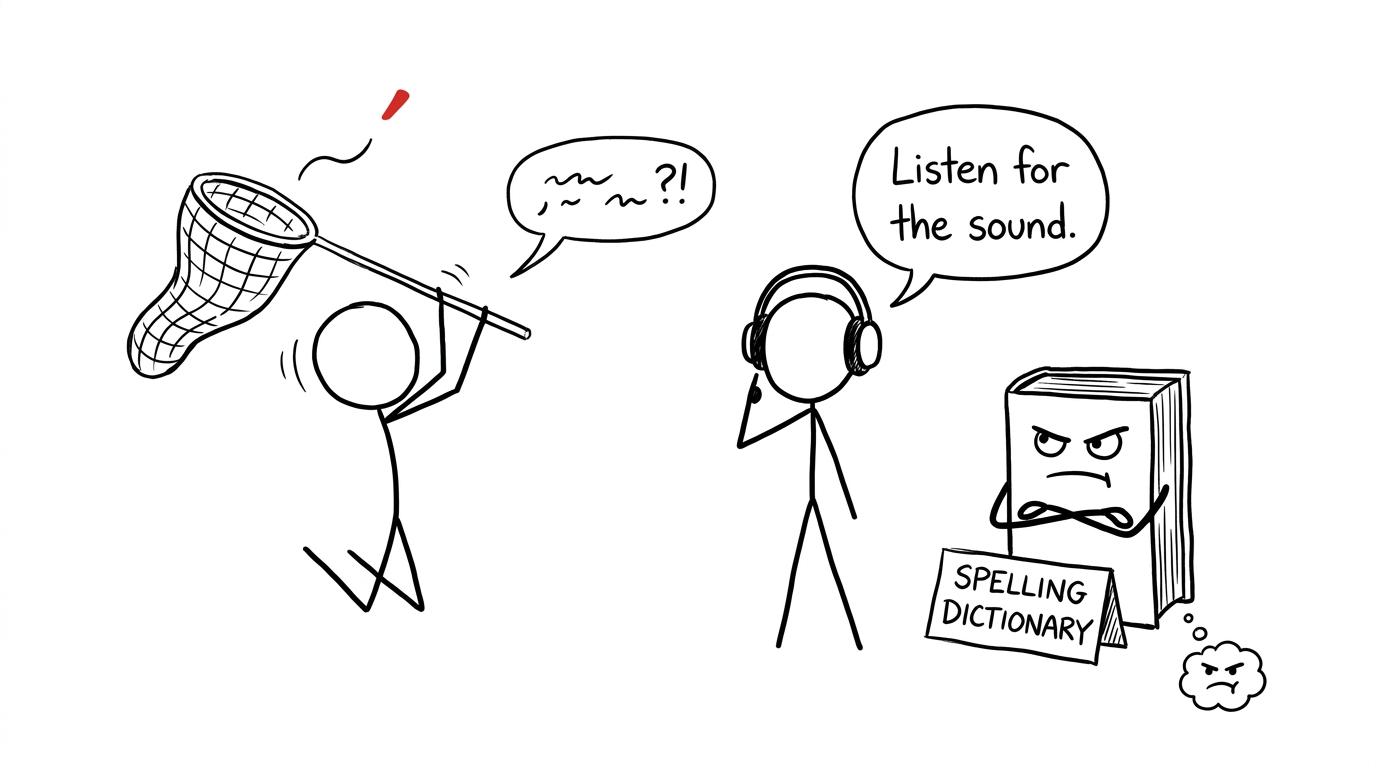 A student chasing a French accent while another listens calmly for the sound
What writing examiners actually reward
Writing is where students often confuse complexity with quality. Ambitious language can help when it is accurate and relevant, but complexity is not a substitute for communication.
Across tasks, marks can reward:
- covering the required content or bullet points;
- communicating ideas clearly;
- developing answers with reasons, details or opinions;
- using vocabulary suited to the purpose;
- controlling grammar and spelling;
- referring accurately to different time frames where appropriate;
- translating meaning from English into French.
The exact balance depends on the question and mark grid. A short task may prioritise successful communication; a longer higher-tier response may offer more opportunity to demonstrate range and development. In every case, read the instructions before deciding what you want to say.
Translation is especially revealing. It tests knowledge, but also control. You must select a suitable structure, preserve the original meaning and produce accurate French. A sentence that is elegant but changes the message has not completed the task.
What the assessment objectives mean for revision
The national weighting offers a useful warning. Only 20%20\%20% is assigned directly to demonstrating accurate application of prescribed grammar and vocabulary, while 80%80\%80% concerns understanding and responding to spoken or written language. This does not mean accuracy is unimportant. Grammar and vocabulary support every component, and individual tasks can combine assessment objectives.
It means that revision should move through three stages:
- Know it: retrieve vocabulary, grammar and sound-spelling patterns.
- Use it: listen, read, speak and write without copying a model.
- Check it: compare your response with a mark scheme or official criteria.
This resembles the approach behind using GCSE past papers properly. A paper is evidence. The valuable part comes afterwards, when you identify why marks were lost and repair that weakness.
If you also have maths exams, avoid building two completely different revision systems. MathsGenie's GCSE Maths revision hub lets you apply the same learn-practise-mark-retest cycle to your numerical subjects. A simple revision planner can allocate separate sessions for language retrieval, French skill practice and maths topic work without allowing one subject to consume the week.
A practical revision checklist
Use this audit after each French practice task:
- Did I understand exactly what the question required?
- Did I answer every compulsory element?
- Can I identify the words or sounds that support my answer?
- Did a negative, tense or opinion change the meaning?
- Was my spoken or written response comprehensible?
- Which vocabulary or grammar gap caused difficulty?
- Was the problem knowledge, application, timing or carelessness?
- When will I retest that specific weakness?
Keep the correction small and precise. “Revise French” is not an actionable target. “Practise recognising negative phrases in listening” is. The same principle is central to efficient GCSE revision for busy students: reduce the task until it is clear enough to begin and specific enough to measure.
Common mistakes that cost GCSE French marks
Memorising answers instead of adaptable language
A polished script may collapse when the examiner changes the wording. Learn reusable verbs, structures, opinions and connectives, then practise combining them in new contexts.
Ignoring the command or bullet point
Relevant French earns more than impressive French aimed at the wrong task. Tick off each required element and check whether you need to describe, explain, ask, translate or justify.
Treating listening as vocabulary spotting
One recognised word does not prove an answer. Wait for the complete idea and listen closely for negatives, contrasts and corrections.
Assuming pronunciation is only about accent
You are not expected to imitate a particular French person. You are expected to speak clearly enough to be understood and apply taught sound-symbol relationships, particularly in reading-aloud tasks.
Practising with the wrong specification
Legacy papers remain useful for some comprehension and language practice, but their structure may not match the GCSE assessed from 2026. Confirm the board, specification and tier before treating any paper as a mock.
Marking only as right or wrong
Classify each lost mark. Was it vocabulary recall, grammatical control, misunderstanding, irrelevant content, spelling, pronunciation or timing? Maths students can sharpen this habit through GCSE predicted papers, mark schemes and video solutions, where every error becomes a clue for the next revision session.
Turn knowledge into marks
GCSE French does not ask you to choose between content and skills. Content is what you know; skill is what you can do with it when the recording starts, the text is unfamiliar or the examiner asks a question you did not predict.
Build vocabulary and grammar carefully. Then place them under pressure through listening, speaking, reading, writing, dictation and translation. Mark the result honestly and revise the cause of each lost mark.
Use the same disciplined routine across your timetable. For maths, MathsGenie provides free revision lessons, practice questions, past papers, predicted papers, mini tests, mark schemes and video solutions. Start with the GCSE Maths revision area, use the night-before GCSE maths plan when exams are close, and let each marked task decide what you practise next.