

What Does GCSE Design and Technology Actually Test?
What does GCSE Design and Technology actually test? Understand how knowledge, maths, design decisions, practical skills and evaluation earn marks.
A student can memorise every timber, polymer and manufacturing process on the specification, then still wonder why their marks do not match their knowledge. That is because the answer to what does GCSE Design and Technology actually test is broader than recall. It tests whether you can use technical knowledge to investigate needs, make defensible design decisions, produce a purposeful prototype and evaluate evidence.
Across AQA, Edexcel, OCR and Eduqas, the qualification is normally split equally between a written examination and non-exam assessment (NEA). The precise paper structure and NEA criteria vary, so always use your own board's specification and mark scheme. The underlying message, however, is consistent: knowing facts matters, but applying them is where many marks are earned.
The quick assessment checklist
GCSE Design and Technology rewards four connected abilities:
- identifying and investigating genuine design possibilities;
- designing and making prototypes that are fit for purpose;
- analysing and evaluating designs, outcomes and wider issues;
- demonstrating and applying technical, designing and making knowledge.
It also tests mathematical skills in a design context. At least 15%15\%15% of the marks in the written examination must reward maths at a level of demand no lower than Key Stage 333. This can include ratios, percentages, material quantities, costs, area, volume, graphs, data and angular measures.
The subject is untiered, so there is no separate foundation or higher tier paper. Every student needs breadth of knowledge, but also the judgement to choose and apply that knowledge appropriately.
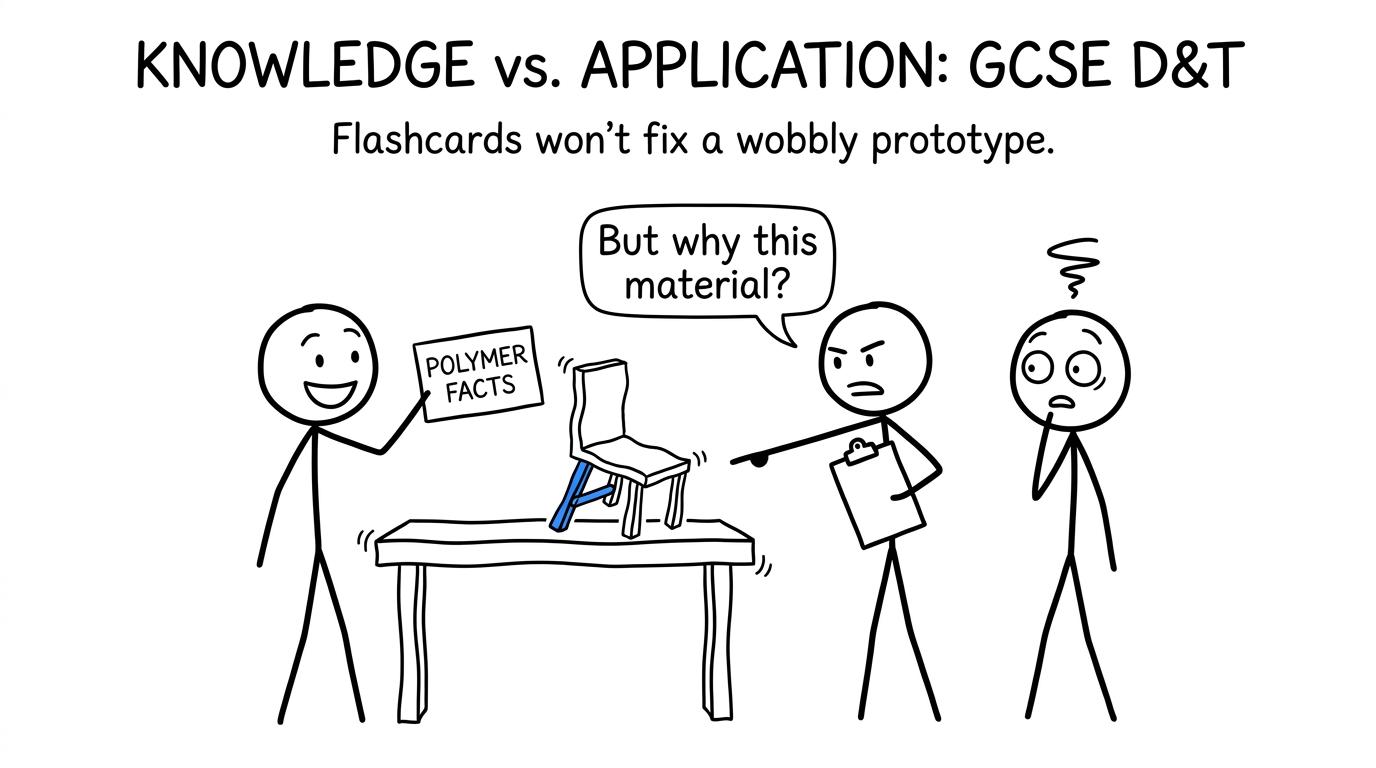 A student discovers that remembering material facts is not the same as applying them
Content knowledge or skills: what is the real balance?
The short answer is both, but not as two separate worlds.
Official assessment objectives used across the main specifications divide the qualification like this:
| Assessment objective | What it assesses | Overall weighting |
|---|---|---|
| AO1 | Identifying, investigating and outlining design possibilities | 10%10\%10% |
| AO2 | Designing and making prototypes that are fit for purpose | 30%30\%30% |
| AO3 | Analysing and evaluating design decisions, outcomes and wider issues | 20%20\%20% |
| AO4 | Demonstrating and applying technical, designing and making knowledge | 40%40\%40% |
At first glance, AO4 may make the GCSE look knowledge-heavy. Yet its wording matters: you must demonstrate and apply knowledge and understanding. An examiner may ask you to select a material, explain a production method, interpret a product or justify a response to a particular user need. A memorised definition is useful only if it helps answer the question actually asked.
AO1 and AO2 are assessed through the NEA. AO3 is split between analysing your own design work in the NEA and evaluating designs or wider issues in the examination. The written component and NEA are each worth 50%50\%50% of the qualification.
What the written examination is really testing
The written paper assesses technical principles, designing and making principles, analysis and evaluation. Depending on the board, you may encounter multiple-choice questions, short responses, calculations, graphical tasks and extended writing.
Accurate knowledge is the starting point
You still need secure subject content. This may cover material properties, forces, structures, mechanisms, electronic systems, energy, modern and smart materials, manufacturing processes, sustainability, production scales, tolerances and quality control.
Examiners cannot reward an explanation built on an incorrect technical fact. But isolated facts are rarely the finish line. Stronger responses connect a property or process to the product, user, manufacturing scale or environmental issue in the question.
A good revision question is therefore not only, “What does this term mean?” Ask:
- Where would this knowledge be useful?
- What limitation might affect the decision?
- Why would it suit one product better than another?
- What evidence would allow a designer to decide?
Application separates recall from understanding
Suppose a question supplies a product, user profile or production context. The context is not decoration. It tells you which knowledge to select.
If you identify a material property, connect it to the product's function. If you recommend a process, consider the material, required accuracy and scale of manufacture. If you discuss sustainability, trace a meaningful consequence rather than merely stating that something is “better for the environment”.
This is similar to GCSE maths problem solving. You are not rewarded simply for remembering a formula; you must recognise when it applies and interpret the result. MathsGenie's GCSE maths revision hub develops that habit through lessons, question banks, worksheets and exam-style practice.
Analysis and evaluation require reasoning
Analysis breaks information into meaningful relationships. Evaluation uses criteria or evidence to reach a judgement.
In longer responses, examiners are looking for developed reasoning rather than a list of disconnected advantages and disadvantages. A useful chain is:
claim →\rightarrow→ relevant evidence or technical reason →\rightarrow→ consequence →\rightarrow→ judgement linked to the context.
Balance can strengthen an answer, but only when both sides are relevant. Writing equal amounts for and against is not automatically evaluation. A clear conclusion supported by technical reasoning is more valuable than a vague final sentence.
What the NEA rewards beyond a polished prototype
The NEA is not simply a competition to make the most attractive object. It assesses a design process and the evidence that your decisions address needs and wants.
Investigation must influence the design
Research earns its place when it changes what you understand or do. Examiners reward purposeful investigation of users, existing products, dimensions, materials, environments and constraints. Collected information should lead to a design brief, measurable specification or later decision.
A page of copied information does not automatically demonstrate insight. The important question is: what did you learn, and how did it affect the design direction?
Designing is a decision-making skill
Design marks are not awarded merely because several sketches exist. Ideas need to respond to the brief and communicate enough detail to be understood. Development should show that testing, modelling, user feedback or technical investigation caused the design to improve.
Iteration is not the same as redrawing an idea neatly. It is a cycle of creating, testing, learning and changing. Examiners need visible evidence of that cycle.
Making is judged through purpose, control and accuracy
Practical skill matters. So do appropriate material selection, safe and controlled processes, quality, accuracy and the extent to which the prototype realises the intended design.
A sophisticated process used badly is not necessarily stronger than a suitable process used precisely. The best evidence shows that your manufacturing choices served the product rather than being included to make the portfolio appear complicated.
Evaluation must be based on testing
Comments such as “it looks good” or “the user liked it” are too general on their own. Effective evaluation refers to the specification, reports relevant test results, identifies limitations and explains realistic improvements.
Testing should match the intended function. User feedback can help, but it does not replace objective evidence when measurable performance matters. Evaluation is strongest when it reveals what the prototype actually does, not what you hoped it would do.
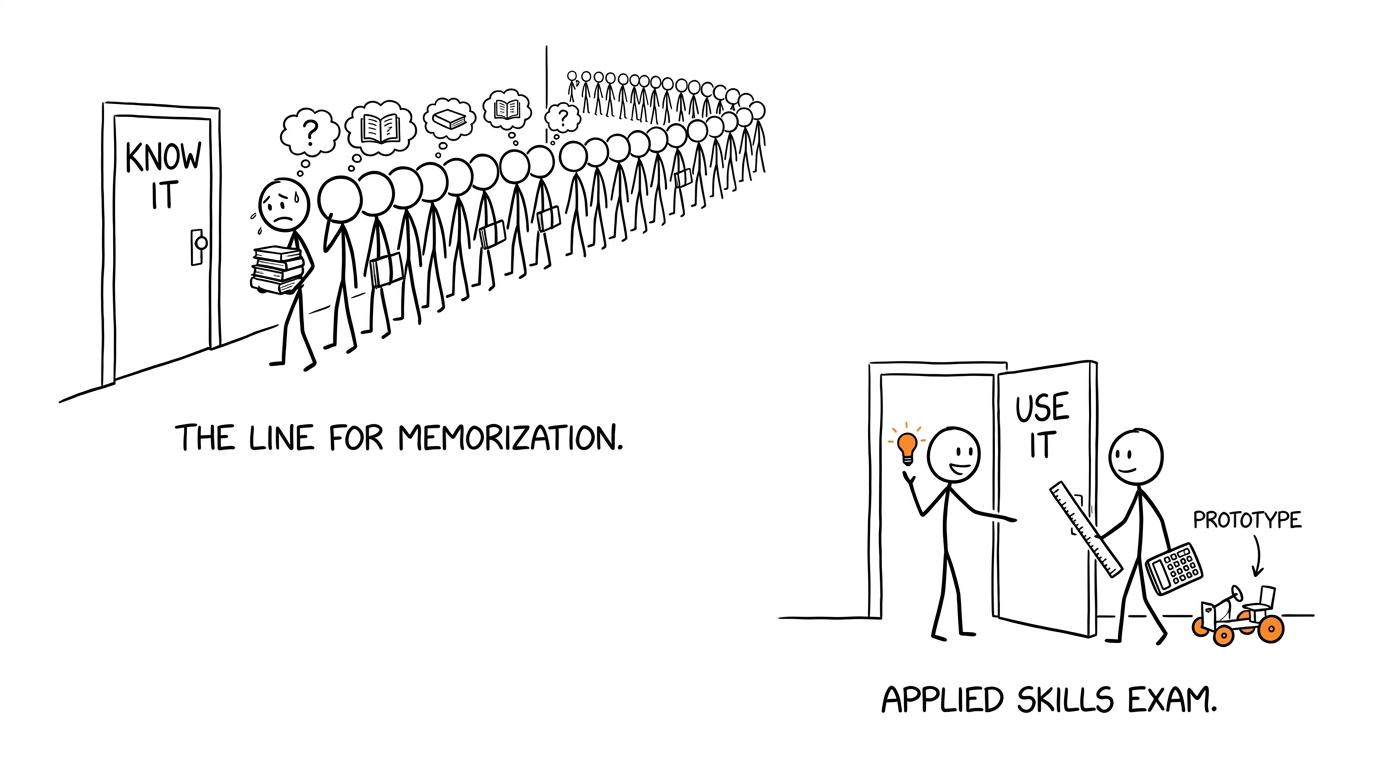 The two routes from knowing facts to using them in context
Why maths matters in GCSE Design and Technology
Maths is not inserted into the paper as an unrelated topic. Official requirements say mathematical skills must be assessed within a Design and Technology context. The calculation may help determine a cost, scale a drawing, interpret test data or estimate the material required.
The assessed areas can include:
- decimal and standard form calculations;
- ratios, fractions and percentages;
- surface area and volume;
- tables, charts and frequency data;
- plotting and interpreting graphs;
- angular measures and representations of two-dimensional and three-dimensional forms;
- areas of triangles and rectangles, and volumes of cubes or cuboids.
For scale drawings and material mixtures, revisit ratio revision. When quantities become very large or small, the standard form revision guide can help.
Area and volume are especially relevant when estimating sheets, coatings, packaging capacity or material use. Strengthen these skills with surface area revision and MathsGenie's broader shape and measure resources. If a product or drawing changes scale, similar shapes, area and volume explains the relationships:
area scale factor=k2\text{area scale factor}=k^2area scale factor=k2 volume scale factor=k3\text{volume scale factor}=k^3volume scale factor=k3Always show your method, retain units during the calculation and check whether the answer is reasonable in the product context. A calculator cannot notice that a model has accidentally become the size of a building.
How to revise for the marks examiners award
Build revision around actions rather than reading alone.
Learn, apply, then judge
For each technical topic, use three prompts:
- Know: Can I define the material, process, component or principle accurately?
- Apply: Can I connect it to a product, user or manufacturing context?
- Judge: Can I compare options and justify the most suitable choice?
This prevents flashcards from becoming the whole revision strategy. Flashcards help retrieval, but past questions reveal whether you can use the knowledge.
Use command words deliberately
“State” usually needs a concise answer. “Explain” requires a reason or developed link. “Analyse” requires relationships and consequences. “Evaluate” requires evidence-based judgement. “Calculate” requires a clear method and appropriate units.
Do not write an essay for a short recall question, but do not offer a one-word response when the command asks for reasoning.
Mark the cause of each lost mark
When reviewing practice, classify the error:
- missing knowledge;
- knowledge not applied to the context;
- undeveloped explanation;
- unsupported judgement;
- mathematical or unit error;
- misread command word;
- incomplete NEA evidence.
The label determines the repair. If the problem is application, rereading notes may not be enough; you need another contextual question.
MathsGenie's GCSE maths topics by board and tier can help you locate mathematical weaknesses, while predicted GCSE maths papers provide timed practice with mark schemes and solutions.
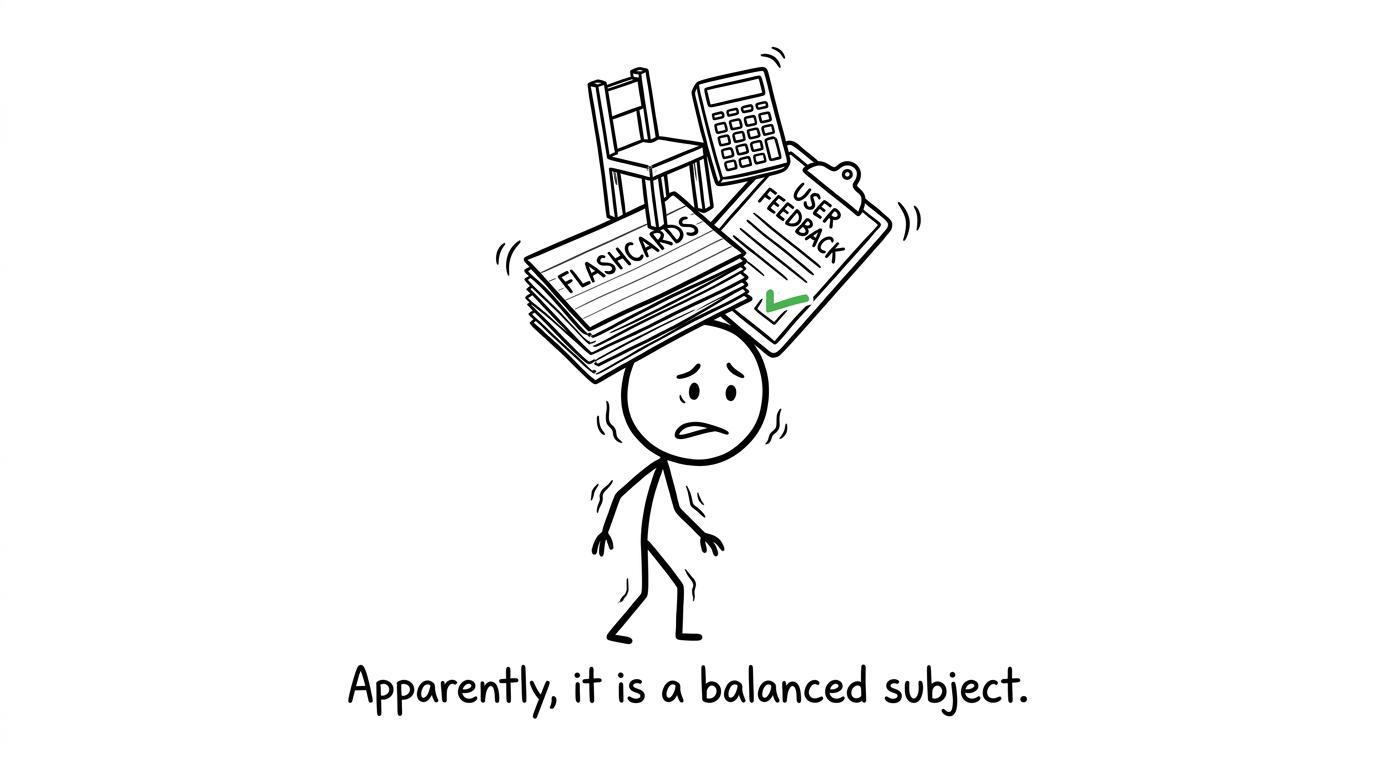 A student attempts to balance every part of Design and Technology revision
Common mistakes that lose Design and Technology marks
Listing properties without application. Naming strength, toughness or durability is not enough when the question asks why a material suits a product. Connect the property to a specific demand.
Ignoring the user or context. A technically possible design may still be unsuitable because of accessibility, cost, ergonomics, maintenance or manufacturing scale.
Treating iteration as presentation. Additional drawings earn little if they do not show decisions, testing and improvement.
Using generic evaluation language. Replace “worked well” with relevant evidence from tests and specification criteria.
Forgetting units or conversions. Area needs square units and volume needs cubic units. Convert dimensions before substituting them into a formula.
Rounding too early. Keep accurate values through a calculation and round at the end unless the question instructs otherwise.
Writing everything you know. Examiners reward relevant responses, not the length of your memory dump. Select knowledge that answers the exact command and context.
Turn knowledge into evidence
So, what does GCSE Design and Technology actually test? It tests whether you can move from knowing to doing: from a technical fact to a justified choice, from research to a specification, from an idea to a tested prototype, and from data to a credible judgement.
That movement is also at the heart of maths revision. Begin with MathsGenie's free revision lessons, then practise focused questions and inspect the mark schemes. Use mini tests to expose gaps before building stamina with past papers and predicted papers. Where video solutions are available, compare not only the final answer but the reasoning that earned it.
The goal is not to remember everything at once. It is to make each piece of knowledge useful: first in practice, then under examination pressure.











