

Using Mocks to Practise Exam Conditions
Using mocks to practise exam conditions turns GCSE maths mocks into useful diagnostics. Learn realistic routines, review errors and target revision.
Using mocks to practise exam conditions means completing a paper under realistic rules, then using the results to guide revision. For a student facing a quiet hall and a ticking clock, that distinction matters: the mock is a rehearsal and a diagnostic, not a verdict.
The mark matters, but valuable information sits underneath it: where time disappeared, which methods were forgotten and how pressure affected your work. A useful mock turns those observations into specific next steps.
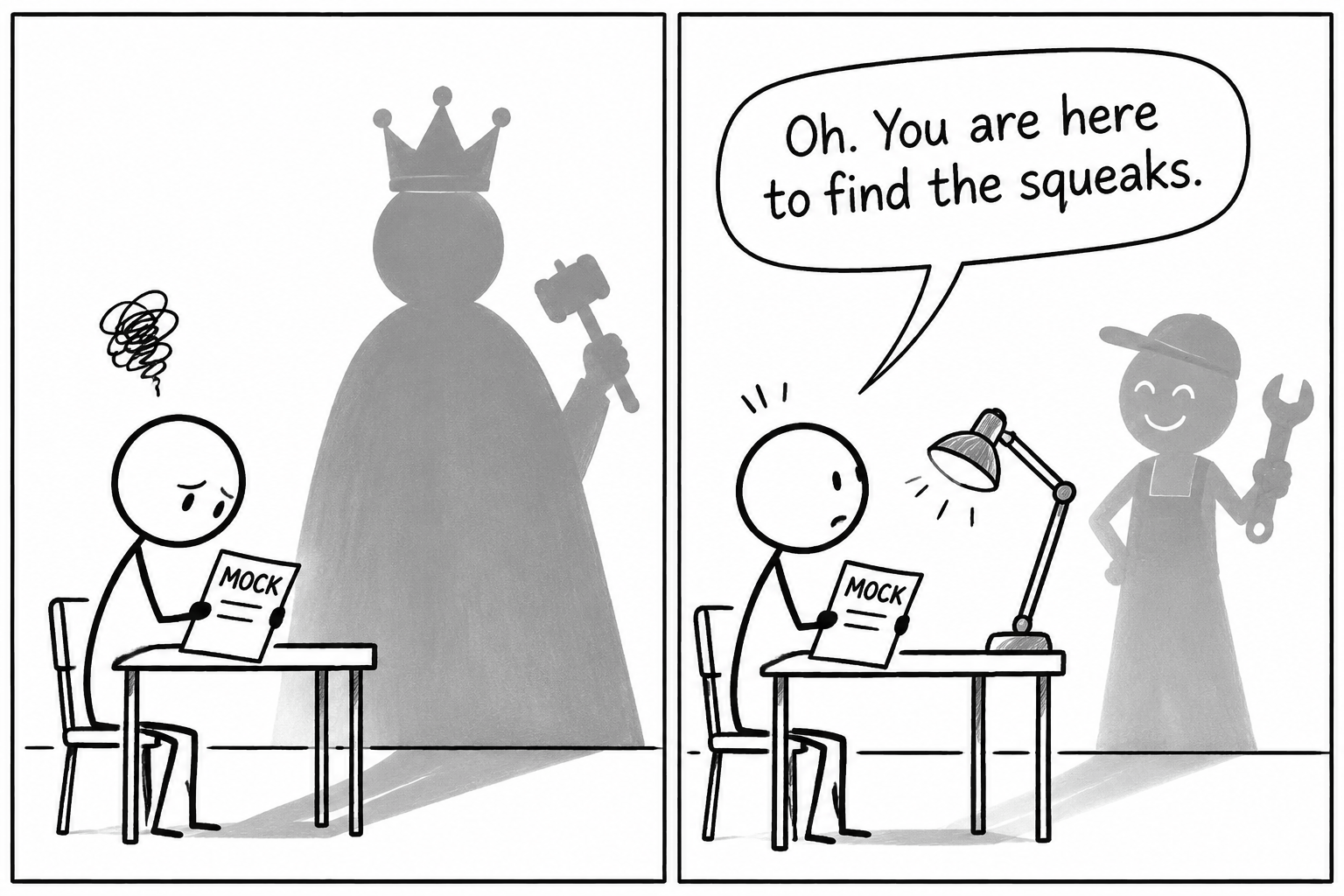 A mock paper changes from a frightening judge into a helpful mechanic
Your mock exam checklist
Before sitting a practice paper:
- Choose the correct exam board and tier.
- Use the exact time printed on the paper.
- Find somewhere quiet, without notes or interruptions.
- Prepare permitted equipment, including a calculator when allowed.
- Attempt questions without checking solutions.
- Mark the paper after time finishes.
- Record mistakes by topic and cause.
- Turn the findings into a revision plan.
Start with MathsGenie's GCSE Maths revision hub to find relevant papers and topic resources.
Make the first mock realistic
At home, revision can feel comfortable. Notes are nearby, videos can be paused and difficult questions can wait. A mock removes those supports, revealing what you can currently manage independently.
Clear your desk and put away your phone. Use only permitted equipment. For a calculator paper, check that your calculator works and that you know its basic functions. For a non-calculator paper, keep it out of reach.
Follow the time stated on the paper. Use a visible clock rather than checking your phone. If your school has confirmed access arrangements, practise with those arrangements, including any approved extra time or supervised rest breaks.
Complete the paper in one sitting. Staying engaged after your initial concentration fades is part of the rehearsal.
Read deliberately and manage your time
Read each question carefully, noticing command words, units and available marks. Underline essential information if it helps.
If you become stuck, write a relevant method or first step, then move on. Correct working may earn method marks even when the final answer is missing or wrong.
A useful timing guide is:
average time per mark=total available minutestotal marks.\text{average time per mark}=\frac{\text{total available minutes}}{\text{total marks}}.average time per mark=total markstotal available minutes.Treat this as a rough guide. Short questions may take less time, leaving space for demanding problems. Notice when one question consumes a disproportionate share of the paper.
Understand what the result reveals
A disappointing result can tempt you to label yourself as bad at maths. That label offers little help with tomorrow's revision. Instead, separate mistakes into causes.
| Type of error | What it may reveal | Next action |
|---|---|---|
| Knowledge gap | A topic or rule was not understood | Relearn it through lessons and questions |
| Method gap | The process broke down | Practise the complete method |
| Reading error | A unit or instruction was missed | Annotate important information |
| Time or pressure error | Work was rushed or abandoned | Try shorter timed sets |
Use the official mark scheme where available. Award marks honestly and annotate corrections beside your original work. Record why an answer went wrong, not just its correct replacement.
MathsGenie's paper marking tool can support your review. If complete papers feel overwhelming, the guidance on when to start GCSE past papers can help you build towards them.
Revise what the evidence shows
Choose two or three priorities after each mock. Trying to repair every weakness immediately makes it harder to give any topic enough attention.
If probability trees and circle theorems cost marks, focus your next sessions there. Use revision lessons and practice questions to rebuild understanding, then attempt questions without notes.
Edexcel students can use GCSE Maths mini tests for focused practice. Students following other specifications should choose suitable resources through the GCSE hub.
Add specific tasks to the MathsGenie revision planner. “Complete a timed probability set and correct every error” gives you a clearer task than “revise maths”. Return to the topic later to check whether the method has stayed with you.
Make the next paper a useful comparison
Your next attempt should test whether your revision worked. A targeted paper can check repaired topics; a full paper also tests pacing and stamina across mixed content.
Use the GCSE Mock Exam Builder for targeted practice. Keep conditions consistent, then compare more than scores. Were fewer questions blank? Was working clearer? Did previously weak topics improve? Did the same reading errors return?
The useful cycle is:
attempt→diagnose→revise→retest.\text{attempt}\rightarrow\text{diagnose}\rightarrow\text{revise}\rightarrow\text{retest}.attempt→diagnose→revise→retest.Edexcel students can also use GCSE Maths predicted papers alongside past papers, mark schemes and video solutions. Predicted papers provide additional practice, but cannot guarantee what will appear in an exam.
Common mock exam mistakes
Making practice easier than the exam
Pausing the timer or checking notes changes what the paper measures. Save help for the review, when you can investigate difficulties properly.
Spending too long on one question
Leave space, move on and return if time remains. Persistence should not prevent you from attempting accessible questions elsewhere.
Hiding your working
Clear working helps an examiner follow your method and helps you identify mistakes afterwards. Show the stages of a multi-step solution.
Copying corrections without checking understanding
After reviewing a solution, close it and attempt a similar question independently. Recognising a method on the page is different from recalling it yourself.
Treating a grade as permanent
A mock reflects performance on particular content at a particular moment. Use it to identify priorities rather than set a ceiling on your final result.
Take one clear next step
You may finish mock season with gaps. What matters is knowing which gaps deserve attention and how you will address them.
Choose one realistic paper, review it carefully and schedule focused revision before trying again. MathsGenie's free lessons, practice questions, past papers, mark schemes, video solutions and planning tools help turn each mock into a practical next step.















