

University GCSE Astronomy Requirement: Does It Matter?
University GCSE astronomy requirement explained: discover when your grade may be seen, when it matters and which qualifications universities prioritise.
A GCSE result can feel permanent when you are waiting for it. One number appears on a certificate, and it is easy to imagine an admissions tutor examining it years later through a metaphorical telescope.
The short answer to the university GCSE astronomy requirement question is reassuring: UK university courses do not generally specify GCSE Astronomy as an entry requirement. However, universities can see the grade because UCAS applicants must normally declare all completed and pending qualifications from secondary education onwards. Your result may therefore form part of your academic record, even when it is not central to the decision.
What matters most is the wording on the course page for your year of entry. Requirements vary between universities, subjects and application cycles.
The quick answer: when does GCSE Astronomy matter?
Use this checklist to put the grade in perspective:
- It is rarely a named requirement. Current astrophysics and physics course pages typically emphasise A Level Mathematics and Physics, alongside GCSE English Language and sometimes GCSE Mathematics.
- It must normally be declared. UCAS instructs applicants to enter all previous and current qualifications, including GCSEs, resits and unsuccessful results.
- It can support a relevant application. A strong Astronomy grade may provide useful evidence of sustained interest in astrophysics, physics or space science.
- It does not usually replace required subjects. GCSE Astronomy is not a substitute for a specified A Level in Mathematics or Physics.
- The official course page is decisive. Requirements can change, so check the entry information for the exact course and entry year.
If you are still preparing for the qualification, the GCSE Astronomy revision hub brings together free Edexcel past papers, exam questions, worksheets and revision resources.
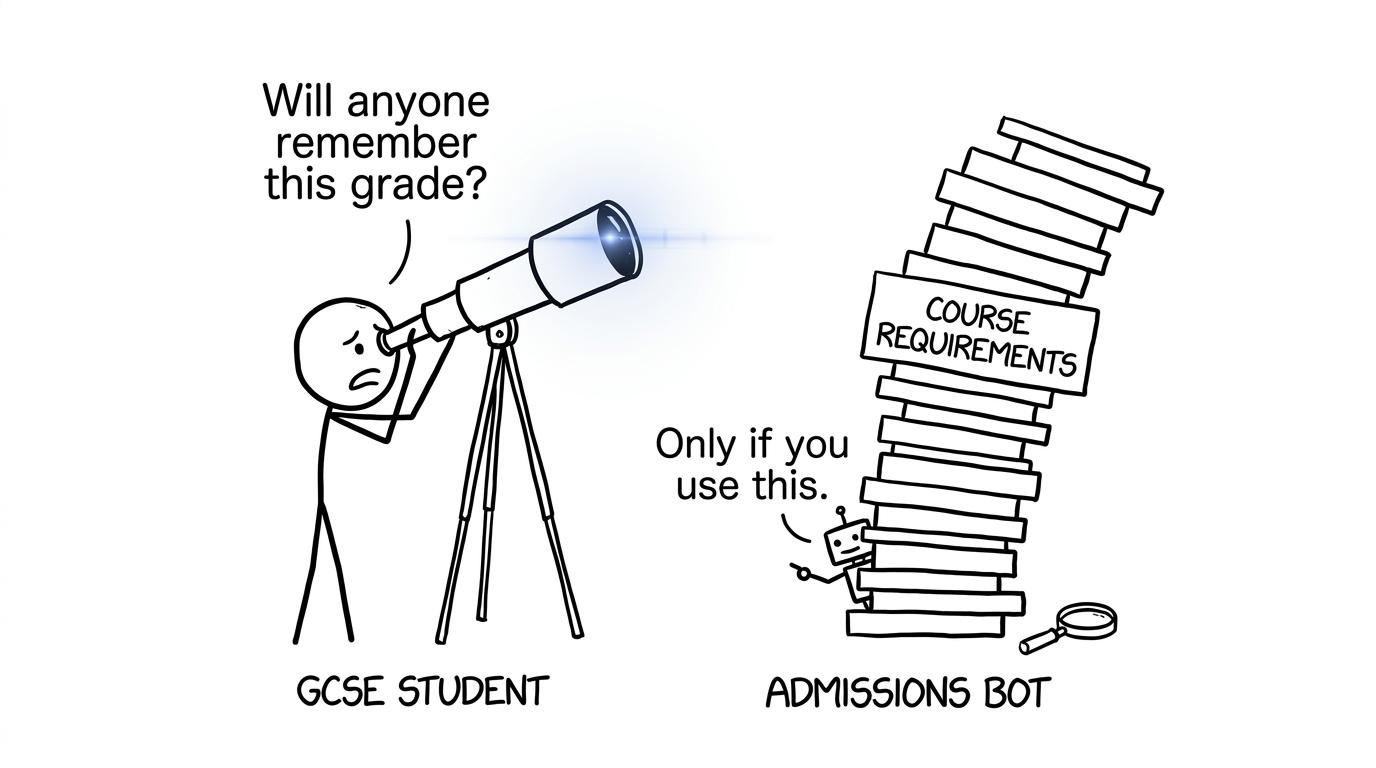 A student asks whether anyone will remember their astronomy grade while an admissions robot searches course requirements
Will universities actually see your GCSE Astronomy grade?
Usually, yes. Seeing a result and requiring it are two different things.
UCAS guidance states that applicants should enter all qualifications taken from secondary education onwards. That includes completed GCSEs, qualifications awaiting results, resits and qualifications with an unsuccessful grade. If you took the Pearson Edexcel GCSE in Astronomy, it should therefore appear with the rest of your qualifications.
This does not mean an admissions tutor gives every GCSE equal weight. A course may use several layers of information:
- whether you meet its published minimum GCSE conditions;
- whether you have the required Level 3 subjects and predicted grades;
- your overall academic profile;
- contextual information, where applicable;
- any admissions test, interview, portfolio or other selection requirement.
For many courses, GCSE English Language and Mathematics act as minimum checks. Your A Levels, Scottish Highers, T Levels, BTEC qualifications or other Level 3 study then carry more direct importance because they are closer to university-level work.
Astronomy remains visible, but it is usually part of the background rather than the gate at the entrance.
Is there a university GCSE Astronomy requirement for astrophysics?
A course about stars seems like the obvious place to require Astronomy. Yet current UK astrophysics entry requirements show a different pattern.
For 2026 entry, examples from universities including UCL, Manchester, St Andrews, Warwick, Aberystwyth, Edinburgh and Exeter place their subject emphasis on Mathematics and Physics at A Level or an equivalent level. Their general GCSE conditions tend to concern English Language, Mathematics or a suitable science. The precise grades and accepted qualifications differ considerably.
That pattern makes sense. University astrophysics relies heavily on mathematical modelling and physics. GCSE Astronomy introduces valuable ideas such as planetary motion, observing techniques, stellar evolution and cosmology, but it is not offered by every school. Making it compulsory would exclude many capable applicants who never had the opportunity to take it.
A good Astronomy result can still strengthen the story told by your application. It shows that your interest did not begin when you opened a university prospectus. But enthusiasm supports the formal requirements; it does not override them.
What GCSE Astronomy actually demonstrates
The current Pearson Edexcel specification is a full grades 9-1 GCSE assessed through two externally examined papers. It includes naked-eye astronomy, telescopic astronomy, observational skills, calculations, graphical questions and extended responses.
Success can therefore indicate several useful qualities:
- interpreting observations and data;
- applying scientific ideas rather than merely recalling facts;
- communicating extended explanations;
- handling scale, graphs and calculations;
- maintaining curiosity about a specialised subject.
These are meaningful strengths. They are simply different from satisfying a compulsory entry condition.
When your Astronomy grade could matter more
There are a few situations in which the result deserves closer attention.
The course explicitly mentions it
If a course page names GCSE Astronomy, follow that wording exactly. Check whether it is required, recommended or accepted as one of several science qualifications. Do not assume that a general statement from another university applies.
If anything is unclear, contact the university admissions team before applying. A short written answer from the institution is safer than advice based on an old prospectus or discussion forum.
You are applying for a closely related degree
For astronomy, astrophysics, physics or space science, the qualification is academically relevant. It may help you explain how your interest developed and what you learnt from observation, data or scientific reasoning.
Keep the emphasis thoughtful. Listing topic names is less useful than explaining how the subject prepared you to think. UCAS applications for current cycles use structured personal-statement questions, so answer the question asked rather than forcing Astronomy into every section.
A university reviews the wider GCSE profile
Some selective courses consider GCSE attainment as one part of a broader assessment. Universities may also interpret results contextually, considering factors such as school performance or personal circumstances. Policies differ, and contextual consideration does not automatically remove specific GCSE subject requirements.
In this situation, Astronomy may contribute to your overall profile. It is still unlikely to outweigh a missing compulsory qualification.
You apply before receiving A Level results
When predicted grades are part of an application, achieved GCSEs provide confirmed evidence of earlier performance. A strong result in a relevant optional subject can be positive, although the university will still focus on its published conditions and your current studies.
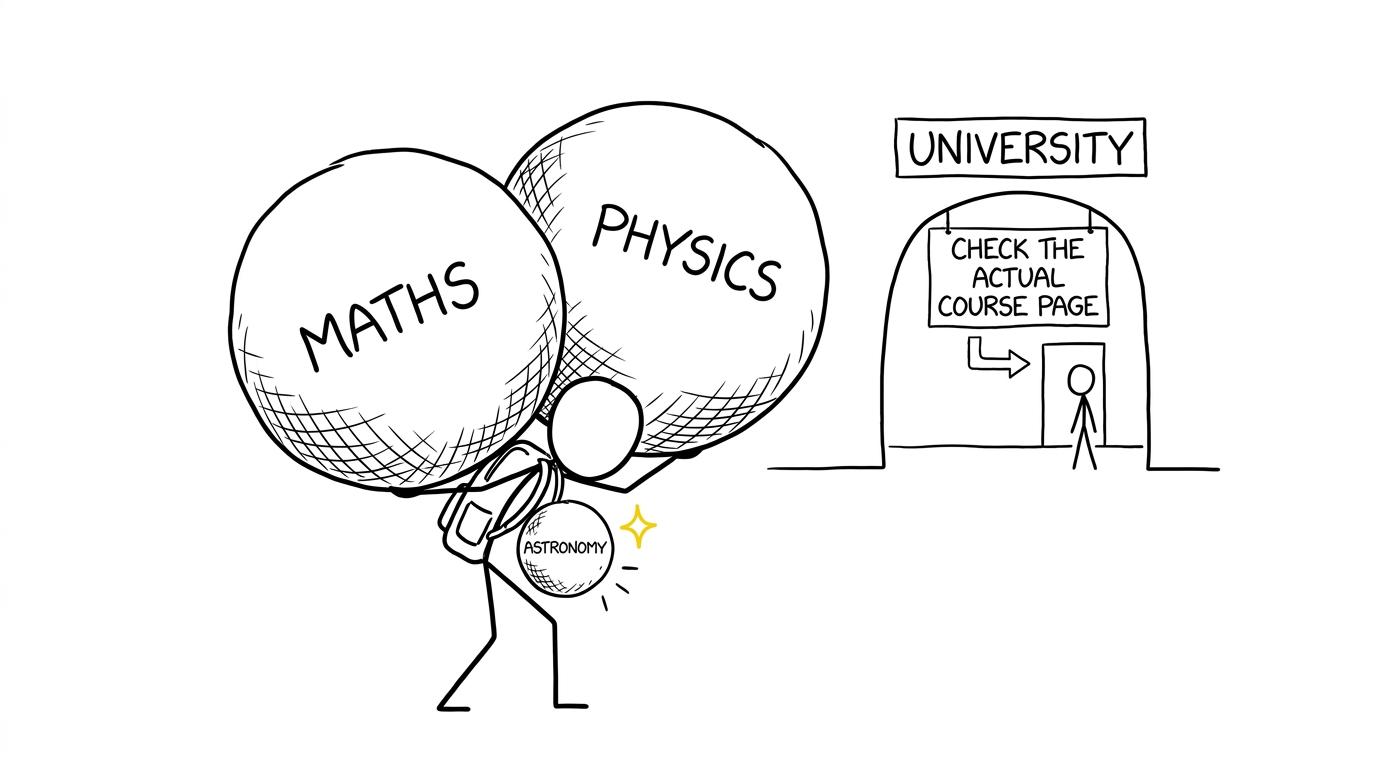 A student carries large Maths and Physics planets and a smaller sparkling Astronomy planet towards a university doorway
What universities usually prioritise instead
The useful question is not only, “Will they notice Astronomy?” It is, “Which results control whether I am eligible?”
For many undergraduate courses, priority falls roughly into these categories:
- required Level 3 subjects;
- the offer grades or UCAS Tariff specified by the provider;
- minimum GCSE English Language and Mathematics grades;
- additional subject-specific GCSE conditions;
- selection tests, interviews or portfolios where required.
For astrophysics, A Level Mathematics and Physics commonly sit near the centre of the entry requirements. This is why securing core mathematical skills now is a practical investment in later choices.
Start with the GCSE Maths revision hub, where you can choose Edexcel, AQA, OCR or Eduqas resources at the appropriate foundation or higher tier. The GCSE Maths topics by exam board and tier guide can help you identify exactly what belongs in your revision plan.
If A Level Mathematics is your next step, it is worth viewing it as preparation rather than merely another certificate. Algebra, trigonometry, graphs and proportional reasoning become part of the language used to describe physical systems. Later, Edexcel A Level Maths past papers can help you practise applying that language under exam conditions.
How to act on this information now
Admissions research matters, but it should not consume the time meant for revision. Use a simple process.
Check courses carefully
Choose several possible courses and read their official entry pages. Record:
- required subjects;
- typical and contextual offers;
- GCSE minimum grades;
- additional assessments;
- the stated entry year.
Requirements can change between application cycles. Save the page and check it again when you are ready to apply.
Protect the subjects with formal requirements
If a possible course requires GCSE Mathematics or English Language, those grades need deliberate attention. For a future physics or astrophysics route, strong mathematical foundations also make the transition to A Level more manageable.
A calm timetable is more valuable than vague worry. The GCSE maths revision timetable guide explains how to combine topic sessions, timed questions and review. If exams are approaching, the one-month GCSE maths revision plan offers a more concentrated structure.
Revise through feedback
Complete a paper, mark it and turn each lost mark into a next action. Students taking AQA can use the AQA GCSE Maths past papers, while Edexcel students can add Edexcel GCSE Maths predicted papers after building confidence with official papers.
MathsGenie's revision lessons, practice questions, mini tests, mark schemes and video solutions make the feedback loop straightforward: learn, practise, mark, repair and retest.
Common mistakes when thinking about GCSE Astronomy and university
Assuming “visible” means “required”
Universities may receive your Astronomy result through UCAS without using it as a minimum entry condition. Read the course requirements rather than treating every declared grade as equally decisive.
Believing Astronomy replaces Physics
A relevant GCSE does not normally replace A Level Physics where the course specifies Physics. The same principle applies to Mathematics and other named subjects.
Checking the university rather than the course
Requirements can differ within one institution. A physics degree, engineering degree and humanities degree may have very different GCSE conditions. Check the exact course.
Using outdated entry information
Archived pages and forum answers can become inaccurate. Match the requirements to your intended year of entry and confirm unusual circumstances with admissions staff.
Neglecting core GCSEs because Astronomy feels more relevant
A specialised subject may feel closely connected to your ambitions, but GCSE Mathematics and English Language appear far more often in general university entry requirements. Give your revision time to the qualifications that keep the widest range of routes open.
Keep the grade in proportion
Your GCSE Astronomy grade can be seen, and in a closely related application it may add useful evidence of interest and academic range. But for most UK university courses, it is not a named requirement. Even astrophysics courses generally place greater formal weight on Mathematics, Physics and specified GCSE English or Mathematics conditions.
So revise Astronomy seriously, but do not let one optional GCSE become larger in your imagination than it is in an admissions policy. Check the real requirements, protect your core subjects and build the strongest profile available to you.
MathsGenie can help you take the next practical step. Use the free revision lessons and practice questions to repair weak topics, mini tests to check progress, and past papers, predicted papers, mark schemes and video solutions to prepare for the exam itself. A university application is built over time. Today, it begins with the next question you are willing to practise.










