

Typing vs Handwriting Notes: GCSE English Literature
Typing vs handwriting notes GCSE English Literature: see what memory research suggests and build a practical revision routine for stronger exam recall.
A typed document can look reassuring. Every quotation is aligned, every heading is colour-coded, and nothing has been crossed out. Yet when the document is closed, surprisingly little may remain. This is the real issue behind typing vs handwriting notes GCSE English Literature: handwriting appears to have a modest advantage for learning, but neither method guarantees recall. What matters most is whether you select, reformulate and retrieve ideas rather than simply record them.
For most students, the strongest approach is hybrid. Type when speed, organisation and searching matter. Handwrite when you need to condense an argument, recall quotations or rehearse the kind of thinking you will perform in the exam.
The short answer: which method sticks better?
Recent research broadly favours handwritten notes, but the conclusion needs care.
A recent meta-analysis of studies involving university students found that taking and reviewing handwritten notes produced a small achievement advantage, while typing allowed students to record substantially more material. Other studies have found little or no meaningful difference between the two methods. Research involving adolescents has also shown that the result can depend on the exact memory task.
There is no definitive experiment proving that every GCSE English Literature student will remember Shakespeare better with a particular brand of pen. Much of the available evidence comes from university lectures rather than GCSE classrooms. The sensible conclusion is therefore not that typing is bad. It is that handwriting often encourages useful learning behaviours:
- selecting the most important information;
- summarising rather than transcribing;
- reformulating ideas in your own words;
- staying away from digital distractions;
- slowing down enough to think about meaning.
Typing can support those behaviours too. It simply makes copying everything easier.
A practical checklist
Use this decision rule during revision:
- Type master notes, quotation banks and essay feedback that you need to organise or search.
- Handwrite short summaries, quotation recall cards and essay plans.
- Close both and retrieve the information without looking.
- Check accuracy against the text, lesson material or teacher feedback.
- Revisit it later rather than repeating everything in one evening.
- Practise in your exam format, whether that is handwriting or an approved word processor.
That final step matters. Notes store information outside your head. Exams ask you to produce knowledge and analysis without that support.
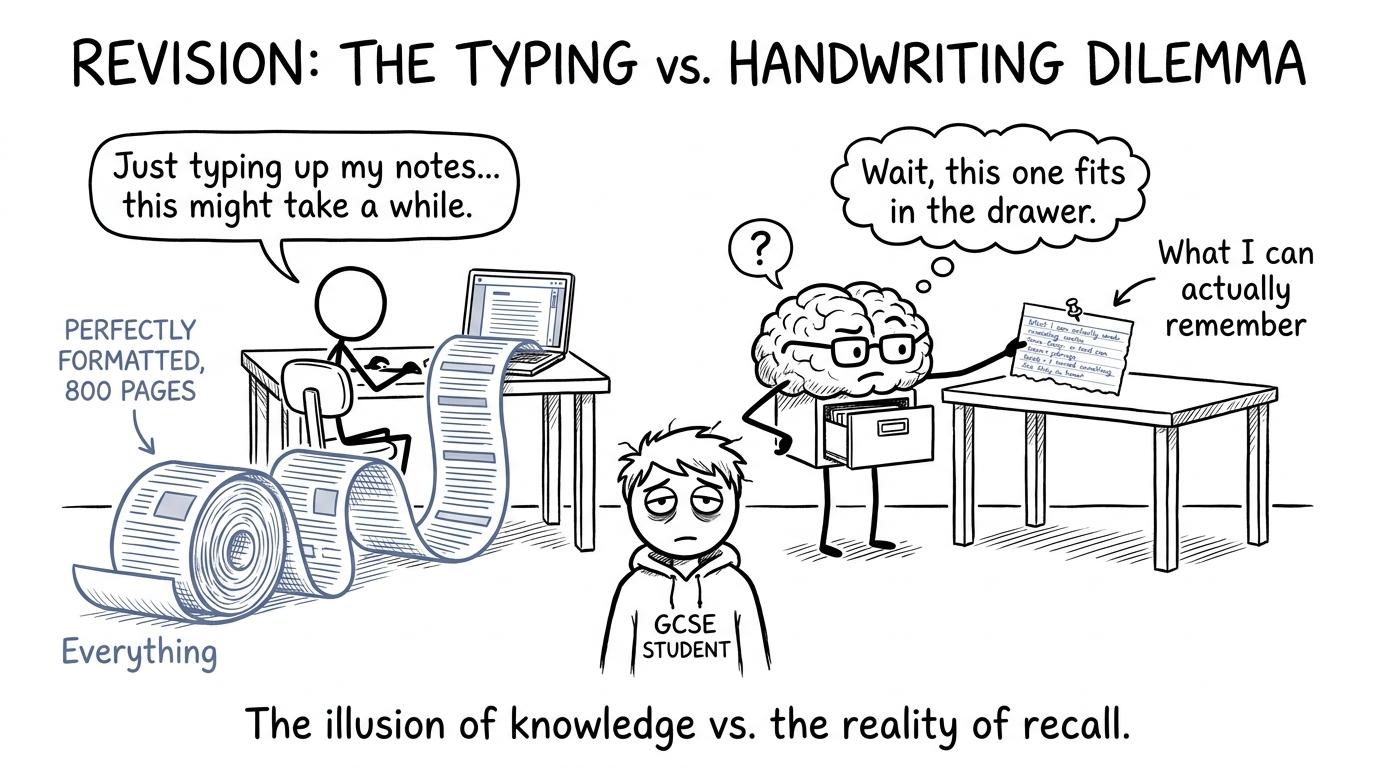 A memory filing clerk choosing between perfect typed notes and a useful handwritten card
How memory actually changes the answer
Memory is not a recording saved when you finish a page. Learning involves encoding information, retaining it and later retrieving it. A note-taking method can help with encoding, but the ability to retrieve an idea is strengthened by attempting to recall it.
This distinction explains why beautiful notes can create false confidence. When a quotation is visible, it feels familiar. Familiarity is not the same as being able to reproduce the quotation, connect it to a theme and analyse the writer’s choices under time pressure.
The same principle applies to maths. Reading a completed solution can feel easy because the method is in front of you. Attempting a question independently reveals whether you can actually select and use that method. MathsGenie’s guide to turning GCSE maths notes into active recall develops this idea for mathematical revision.
Encoding: why handwriting may help
Handwriting is usually slower than typing. That apparent weakness can become useful because you cannot record every sentence. You must decide what matters.
Imagine that a teacher explains how a character changes across a play. A fast typist may capture almost every word. A student writing by hand is more likely to reduce the explanation to a claim, a short quotation and a link to the writer’s purpose. That act of selection can produce deeper processing.
Brain-imaging research has also found more extensive patterns of connectivity during handwriting than typewriting. Such findings are interesting, but they should not be turned into a promise about GCSE grades. Brain activity alone does not show that handwriting will always produce better exam performance. The behavioural task still matters.
Retrieval: the step with greater practical value
Once notes exist, stop improving them for a moment. Cover them and answer a prompt such as:
- What does this quotation reveal about the character?
- Which word carries the strongest implication?
- How does the idea develop elsewhere in the text?
- What relevant context changes the interpretation?
- Which alternative reading could I defend?
Then check your response. This is retrieval practice: bringing information back from memory rather than putting information into another set of notes. Evidence reviews consistently identify retrieval and spacing as promising approaches for durable learning, although classroom implementation should still reflect the subject, age group and learner.
For maths students, the equivalent is attempting a question before opening the lesson or solution. The GCSE Maths revision hub brings together topic lessons, practice questions, papers and revision tools for that cycle.
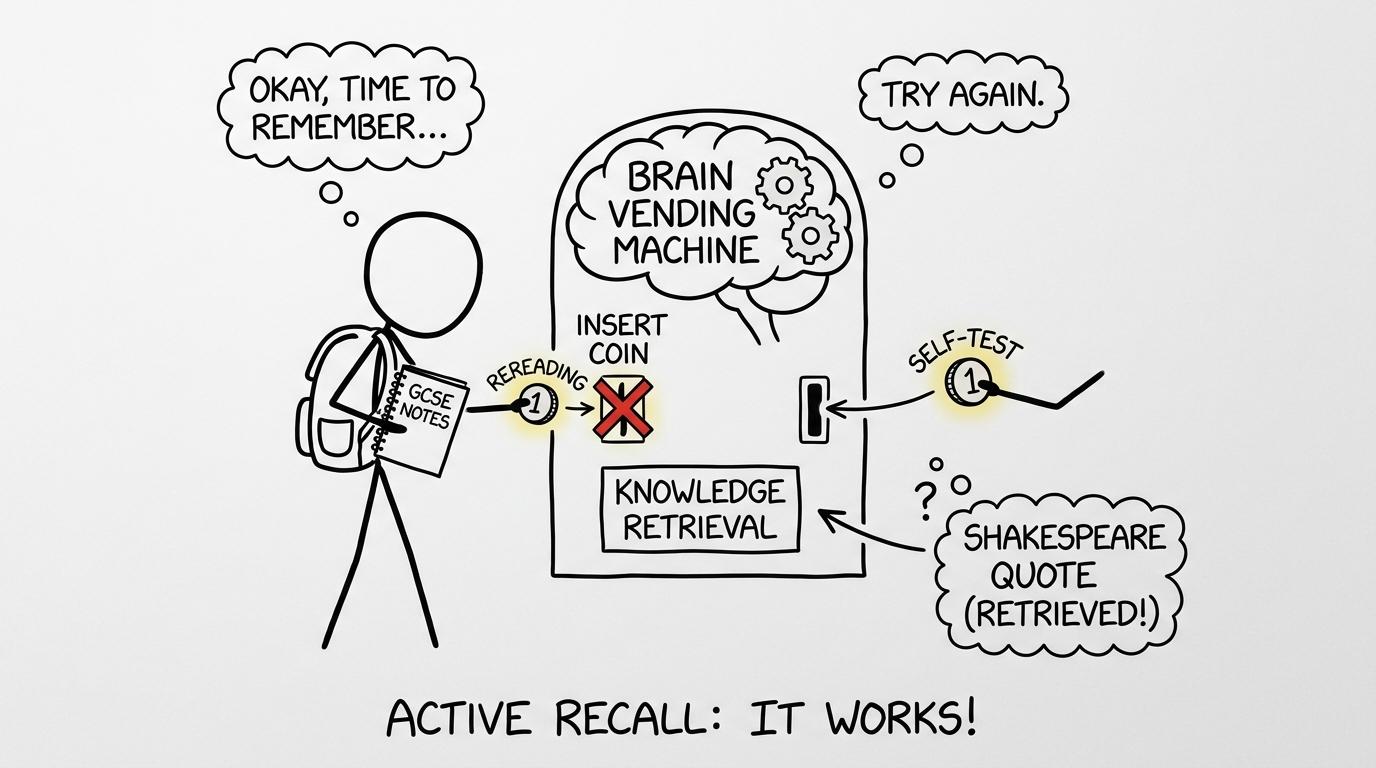 A brain vending machine accepting self-testing instead of rereading
The best hybrid system for English Literature
The most useful question is not, “Which tool wins?” It is, “What job am I asking this tool to do?” A keyboard and a pen solve different revision problems.
Type your searchable master notes
Create one concise digital document for each text. Organise it by character, theme or section of the text, depending on what fits your specification. Include:
- short, accurate quotations;
- where each quotation appears;
- language, form and structural observations;
- relevant contextual connections;
- possible interpretations;
- feedback from previous essays.
Avoid turning this into a transcript of every lesson. GCSE English Literature assessment rewards a critical response, textual references and analysis of language, form and structure. Context also matters, but it should illuminate the text rather than become a detached history paragraph.
AQA, Edexcel, OCR and Eduqas do not use identical paper structures or set texts, so check your specification and teacher guidance. For example, AQA states that its GCSE English Literature assessments are closed book. Do not assume that a searchable document will be available when you need the knowledge.
Convert the master notes by hand
On a blank sheet, reduce one theme or character to a compact revision page. Include only the ideas you could realistically use in an essay. The limitation is deliberate: it forces prioritisation.
Do not copy the digital document sentence by sentence. Close it first, write what you remember, and then use the master version to identify omissions or inaccuracies. This turns handwriting into retrieval rather than decoration.
Practise analysis, not quotation collecting
Knowing a quotation is useful, but a quotation is evidence rather than a complete argument. Your revision prompts should ask you to explain how the writer creates meaning and why an interpretation is convincing.
Short quotations are often easier to recall and integrate naturally. Learn them with their meaning and location, not as isolated strings of words. Where exact quotation is uncertain, never invent wording. Return to the text and correct it.
Space the retrieval
Revisit the same ideas on different days. The next attempt should begin with closed notes. A useful sequence might move from quick quotation recall to an essay plan and then to a timed paragraph or essay.
The principle transfers directly to maths revision. MathsGenie’s guide to stopping forgotten GCSE maths content shows how spacing, retrieval and mixed practice can become a repeatable routine.
Match revision to the exam you will sit
If you normally handwrite GCSE English Literature exams, include handwritten essay plans and timed responses. You need to know whether you can maintain legibility, organise paragraphs and sustain analysis within the available time.
If a word processor is your approved normal way of working, practise typing extended responses under the same constraints. Current JCQ guidance allows centres to provide a word processor where it reflects a candidate’s normal way of working and is appropriate to their needs. It is not simply a last-minute preference. Speak to your school, SENCO or exams officer early if you believe you need an access arrangement.
This is also why maths revision should eventually resemble maths assessment. Use the Edexcel GCSE Maths revision pathway for lessons and targeted questions, or complete AQA GCSE Maths past papers if that is your board. The medium is useful only when it prepares you for the performance required.
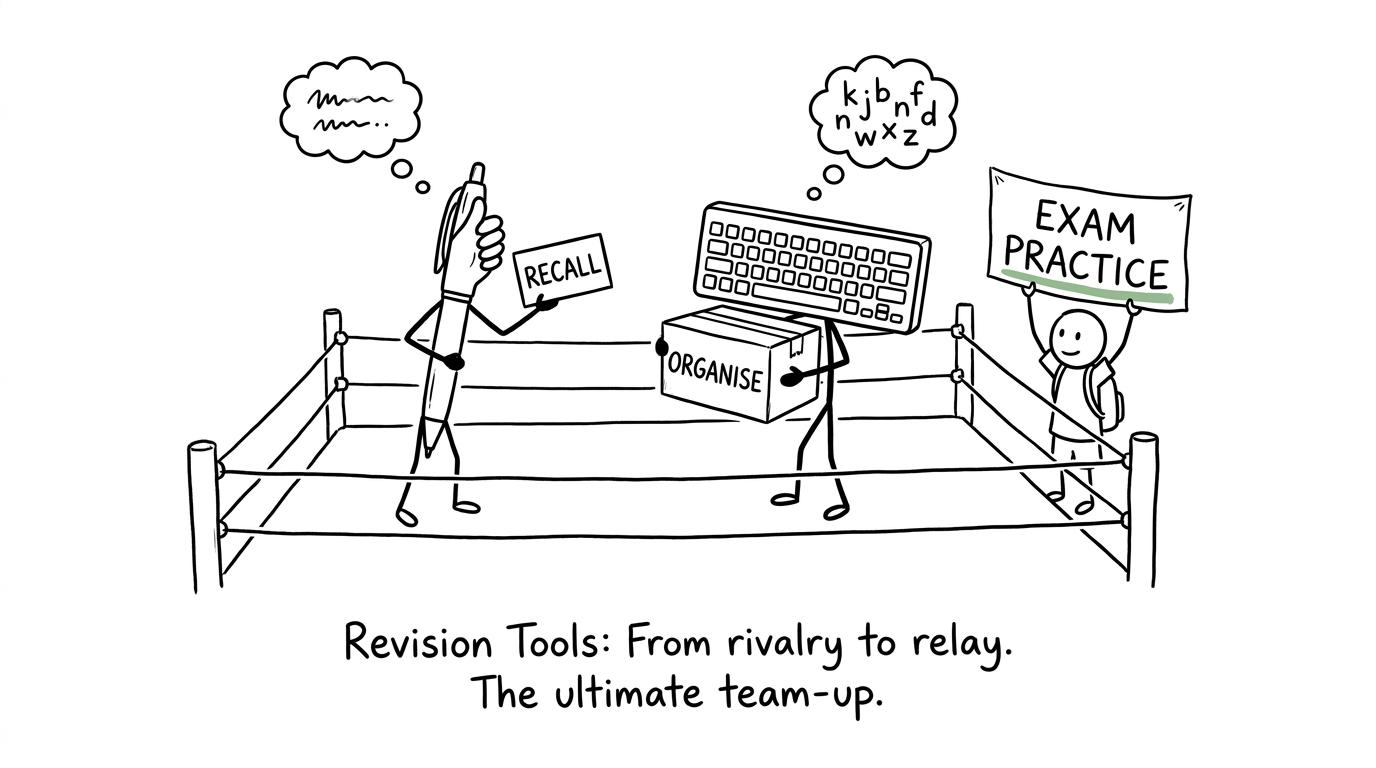 A pen and keyboard forming a revision relay team
Common mistakes with typed and handwritten notes
Copying without making decisions
Whether you type or handwrite, copying a textbook is still copying. Pause after each section and summarise the central claim from memory.
Mistaking neatness for knowledge
Colour, layout and headings can improve navigation. They do not prove recall. Test yourself before spending another hour formatting.
Handwriting everything again
Rewriting complete notes may feel active because your hand is moving. If the original remains visible, however, retrieval is minimal. Use a blank page and recall first.
Collecting too many quotations
A large quotation bank can become impossible to maintain. Prioritise a flexible set of short, accurate quotations that support several themes or interpretations.
Ignoring essay construction
English Literature is not only a memory test. You must respond to the question, sustain an interpretation, use evidence and analyse the writer’s methods. Build essay plans and timed writing into revision.
Using notes instead of practice
This mistake is just as costly in maths. Revision should eventually move from explanation to independent performance. Learn a method through MathsGenie, complete practice questions, and then test it with mini tests or papers. The guide to using Edexcel past papers properly explains how to convert errors into focused revision rather than merely recording a total mark.
A revision routine that works across English and maths
English and maths appear different, but effective revision in both follows a similar loop:
- learn or organise a small amount of content;
- close the supporting material;
- retrieve or apply it independently;
- check against reliable feedback;
- record one precise correction;
- return to the skill on another day.
In English, that could mean recalling quotations and planning an interpretation. In maths, it means attempting exam-style questions, checking the mark scheme and correcting the exact step that lost marks.
Do not let note-making consume the time needed for practice. MathsGenie explains when to start GCSE past papers, while its A Level Maths revision hub supports the same learn, practise and test cycle for students progressing beyond GCSE.
Choose the method that makes you think
Handwriting probably has a small overall advantage when it forces you to select, condense and reformulate. Typing is valuable for building organised, searchable resources. But the notes that stick best are the notes you repeatedly close.
Use a keyboard to create order. Use a pen to compress and rehearse. Then use neither while you retrieve, plan and practise under realistic conditions.
For maths revision, make MathsGenie your free practice base. Begin with revision lessons, move into topic questions and mini tests, and then use past papers, predicted papers, mark schemes and video solutions to expose what you can genuinely do. Notes may start the process. Independent recall and practice are what make it last.










