Typing Answers Under Timer: GCSE Modern Hebrew
Typing answers under timer GCSE Modern Hebrew practice can build speed and structure. Learn when typing helps, when it misleads, and how to train well.
The clock can expose a problem that ordinary revision hides. You know the vocabulary. You understand the question. Yet the answer arrives too slowly, or its structure disappears as the final minutes run out.
So, does typing answers under timer GCSE Modern Hebrew practice improve your performance? Yes, it can improve the speed of recalling, organising and producing an answer, but only if typing matches how you will complete the real examination. If you will handwrite your GCSE Modern Hebrew paper, typed practice should support handwritten timed practice, not replace it.
The useful question is not simply whether typing is faster. It is whether your practice trains the exact skills that the exam rewards.
The short answer and revision checklist
Timed typing is most useful when you:
- use a word processor as your normal way of working in examinations;
- practise without spellcheck, predictive text or automatic corrections;
- answer genuine exam-style prompts rather than copying prepared passages;
- separate planning time from writing time;
- review accuracy, coverage and structure after every attempt;
- compare typed performance with handwritten performance if you expect to write by hand;
- increase the time pressure gradually rather than racing from the first session.
It is less useful when you type quickly but avoid checking verb forms, spelling, agreement or whether every bullet point has been covered.
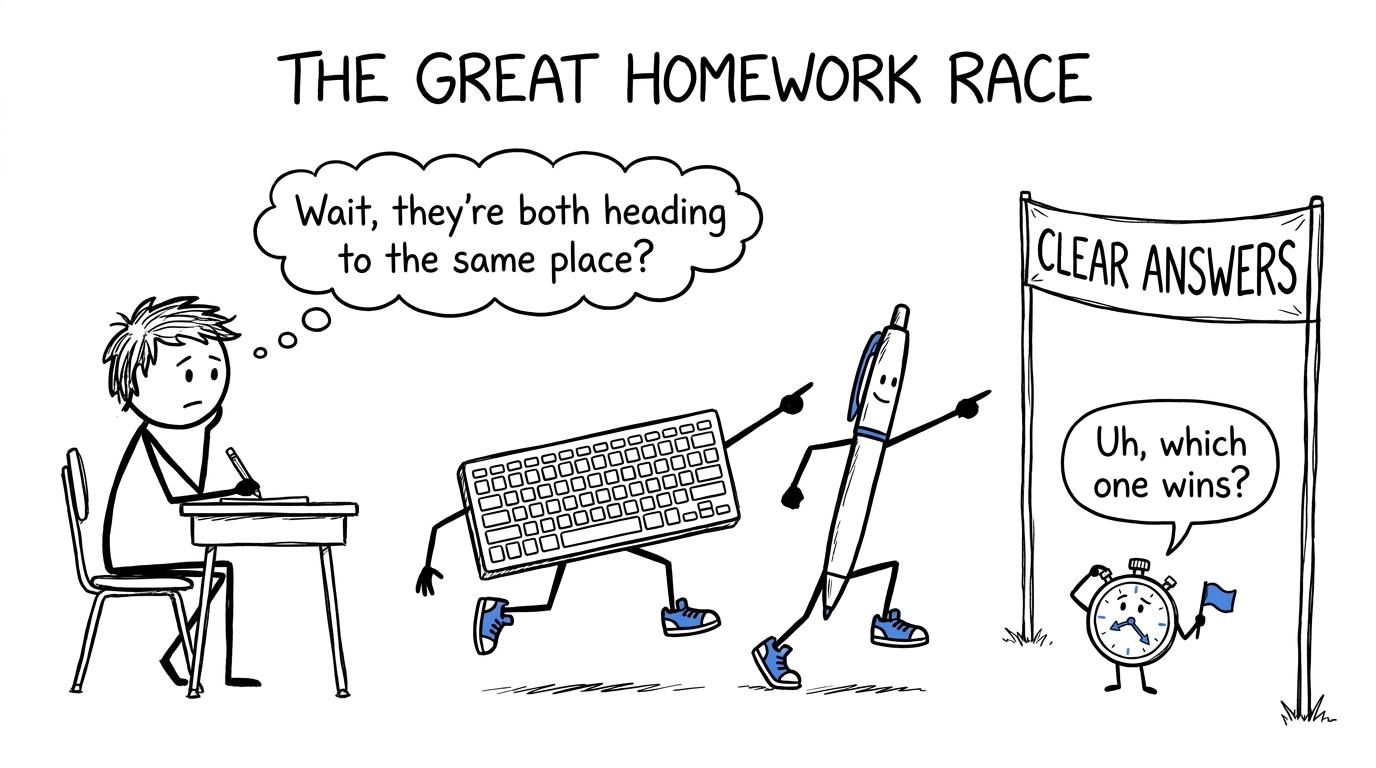 A keyboard and pen compete in a revision race towards clear answers
What timed typing actually trains
Typing under a timer does not train one single skill. It combines several processes, and identifying the slowest one matters.
Retrieval speed
A blank screen forces you to retrieve vocabulary, grammatical structures and linking phrases without immediately consulting notes. That is active recall. Over repeated sessions, familiar language may become easier to access because you have practised producing it rather than merely recognising it.
However, the timer does not create knowledge. If you repeatedly pause because the vocabulary is missing, more pressure will not solve the problem. Stop, relearn the language, then retest it later without support.
Keyboard fluency
Typing can help if locating Hebrew letters is taking attention away from composing an answer. Regular, short practice may reduce the mental effort spent searching the keyboard, leaving more attention for meaning and accuracy.
This advantage is specific to typing. It will not automatically make your handwriting faster. Research comparing handwriting and typing produces mixed findings depending on the task, age group and measure used. Handwriting can support aspects of learning and recall, while typing can increase production speed for a fluent keyboard user. There is no sound basis for claiming that typing alone guarantees a better GCSE Modern Hebrew result.
Planning and structure
The most valuable improvement may happen before the first sentence. Under time pressure, you learn to decide:
- which idea answers each bullet point;
- which tense or time frame is needed;
- where an opinion or justification belongs;
- which ambitious structures you can use accurately;
- how much time to protect for checking.
That process is transferable. A maths student also benefits from deciding how to allocate time, recognising when a method is going nowhere and preserving time to check. The same disciplined cycle sits behind using GCSE past papers properly: attempt, mark, diagnose, repair and retest.
Match practice to the GCSE Modern Hebrew assessment
For AQA GCSE Modern Hebrew, Paper 444 assesses writing and contributes 25%25\%25% of the qualification. The published assessment structure gives Foundation Tier candidates 111 hour for 505050 marks and Higher Tier candidates 111 hour 151515 minutes for 606060 marks.
Foundation Tier includes short and structured writing, translation into Modern Hebrew and a photo-based message task. Higher Tier includes structured writing, an extended open-ended task and translation into Modern Hebrew. Because the tasks differ in length and demand, practising one generic block of continuous typing is not enough.
Use AQA GCSE Modern Hebrew past papers to practise the actual task types, instructions and mark allocations. Always check the specification and arrangements confirmed by your school for your examination series.
If you will handwrite the examination
Use typing as a low-friction way to practise retrieval and organisation, but complete most final rehearsals by hand. Your handwriting pace, spelling production and physical stamina must survive the real time limit.
A sensible balance is:
- type early attempts while building ideas and language;
- rewrite selected answers by hand without copying directly;
- complete handwritten question sets under realistic conditions;
- finish with full handwritten papers where appropriate.
Typing may help you think faster, but only handwriting measures how quickly you can produce your actual script.
If you use a word processor in examinations
JCQ guidance allows centres to provide a word processor where it reflects the candidate's normal way of working. It is not simply a last-minute preference. In the usual arrangement, spelling and grammar checks and predictive text are switched off.
Ask your SENCo or examinations officer what applies to you. Then practise on a setup that resembles the real arrangement: the same input method, no online dictionary, no translation tool, no automated correction and no saved language bank. Convenience during practice can create false confidence if it will disappear in the examination.
 A calm student stops a dramatic exam clock from causing panic
A practical timed typing routine
Improvement comes from feedback, not from repeatedly watching the clock. Use a small cycle that reveals why you are slow.
Begin without a timer
Choose one authentic writing prompt. Plan and answer it carefully without time pressure. This establishes what accurate work looks like before speed becomes the priority.
Check whether you addressed every required point and whether the answer communicates clearly. Record recurring language gaps rather than attempting to memorise the whole response.
Add a generous time limit
Repeat with a different prompt and a timer that gives you enough space to think. Divide the available period into three parts:
- planning;
- producing the answer;
- checking and correcting.
The timer should make decisions visible, not cause panic. If you immediately start typing and leave no checking time, you have found a structural weakness before the examination finds it for you.
Reduce the time gradually
As accuracy stabilises, shorten the limit towards realistic exam conditions. Do not reduce it after a weak attempt merely to make practice feel harder. Pressure should follow control.
Short, repeatable sessions usually reveal more than an occasional exhausting rehearsal. This principle also supports a manageable GCSE one-month revision plan, where targeted practice and timed papers have distinct roles.
Review more than word count
A longer response is not automatically a stronger response. After each attempt, record:
- whether every bullet point was answered;
- where retrieval pauses occurred;
- repeated vocabulary or sentence openings;
- avoidable spelling and grammatical errors;
- time spent planning, writing and checking;
- one specific change for the next session.
The aim is to make the error actionable. “Too slow” tells you very little. “Lost time locating letters”, “could not recall past-tense forms” or “rewrote the opening repeatedly” gives you a next step.
How to measure whether typing is helping
Run a simple comparison over several sessions. Use prompts of similar difficulty and keep the available time consistent. Alternate between typing and handwriting if handwriting is your expected examination method.
Compare four outcomes:
- task completion;
- accuracy;
- clarity and organisation;
- unused or missing checking time.
Do not compare typed and handwritten word totals alone. A fast but inaccurate response has not solved the exam problem.
After several attempts, ask which bottleneck appears most often. If ideas are slow in both formats, the issue is planning or language knowledge. If typing is much slower, keyboard fluency needs work. If handwriting alone causes unfinished answers, handwritten pacing requires priority.
This diagnostic mindset is equally valuable in GCSE maths. The GCSE Maths revision hub provides topic practice and papers for identifying whether lost marks come from knowledge, accuracy or timing. Students following Edexcel can then test their decisions with Edexcel GCSE Maths past papers.
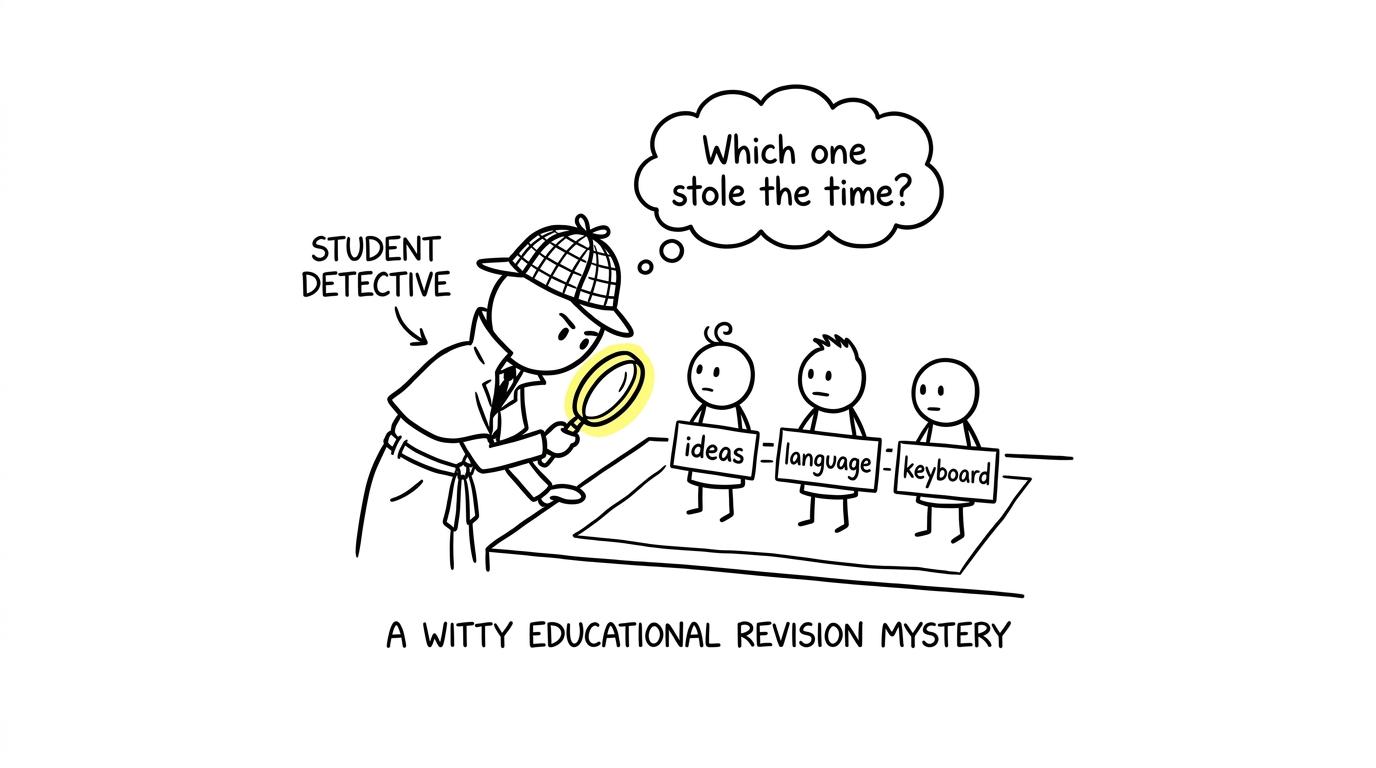 A revision detective investigates what is stealing time
Common mistakes with timed typed practice
Using tools unavailable in the examination
Autocomplete, online dictionaries and translation software make an answer faster without making you faster. Switch them off. Practice conditions should become increasingly similar to the assessment conditions confirmed by your school.
Treating speed as the only result
Students can become faster by simplifying every sentence or ignoring errors. Measure communication, range and accuracy alongside completion time.
Typing memorised model answers
A rehearsed paragraph may look fluent while hiding weak retrieval. Use unfamiliar prompts and adapt language to the precise task.
Starting every session at full pressure
If you are learning the keyboard layout or rebuilding grammar, constant exam-speed practice can reinforce mistakes. Build accuracy first, then compress the time.
Never analysing the finished answer
A timer tells you when you stopped. It does not tell you why marks were lost. Review using the assessment criteria and teacher feedback. Maths students can learn the same habit through using mark schemes as a revision coach.
Replacing handwriting when the exam is handwritten
Typed fluency and handwritten fluency overlap, but they are not identical. If your final response will be handwritten, your revision must include realistic handwritten practice.
Make timing part of a wider revision system
The clock is useful because it reveals friction. It should not dominate every session.
Combine timed production with vocabulary retrieval, grammar correction, reading authentic prompts and careful teacher feedback. Schedule those activities deliberately rather than choosing whichever feels easiest. The structure in a GCSE maths revision timetable can be adapted across subjects: short skill sessions during the week, followed by a longer timed assessment and review.
That is the broader lesson for students balancing Modern Hebrew with GCSE maths. Speed improves when knowledge, method and practice conditions begin to agree. In maths, use revision lessons and practice questions before moving to timed papers. In Modern Hebrew, build language and keyboard or handwriting fluency before demanding full exam pace.
From faster practice to better exam decisions
Typing answers under a timer can improve GCSE Modern Hebrew speed and structure when it trains genuine retrieval, planning and checking. It is especially relevant for students whose approved normal way of working is a word processor. For everyone else, it is a useful supporting method, but handwritten timed work remains essential if the final examination is handwritten.
Start with one genuine prompt. Remove digital assistance. Record where the time goes. Then change one thing and retest.
For your maths preparation, bring the same discipline to MathsGenie. Use free revision lessons and practice questions to rebuild weak topics, then test them with past papers, predicted papers, mini tests, mark schemes and video solutions. The timer is not there to frighten you. Used properly, it simply shows you what to practise next.