Typing Answers Under Timer: GCSE Biology Speed
Typing answers under timer GCSE Biology: discover when it improves speed, where it falls short, and how to build stronger exam-ready responses.

A timer can make revision feel productive before it has made it useful. The keys move quickly, the countdown creates urgency and a finished answer appears on screen. Yet the real question behind typing answers under timer GCSE Biology practice is simpler: will it help you write faster and structure answers more effectively in the actual exam?
The short answer is yes, but only in the right circumstances. Timed typing can improve retrieval speed, planning and awareness of how long an answer takes. It is less useful for developing handwriting stamina, drawing biological diagrams or reproducing the physical conditions of a handwritten paper. If you will handwrite your exam, typed practice should support timed handwritten practice rather than replace it.
The distinction matters. Speed is not merely how quickly words appear. It is how quickly you can select relevant biology, arrange it logically and express it precisely enough to earn marks.
The quick verdict
Timed typed practice is most valuable when you use it to:
- recall biological knowledge without notes;
- practise responding to command words;
- plan longer written answers quickly;
- identify where hesitation is costing time;
- develop concise chains of biological reasoning;
- review and improve an answer after the timer stops.
It should not be your only method if you expect to sit a handwritten exam. You will still need to practise handwriting, interpreting unfamiliar data, completing calculations and working through full papers under realistic conditions.
The best approach is usually a mixture: typed drills for rapid thinking and editing, followed by handwritten questions or complete papers for exam transfer.
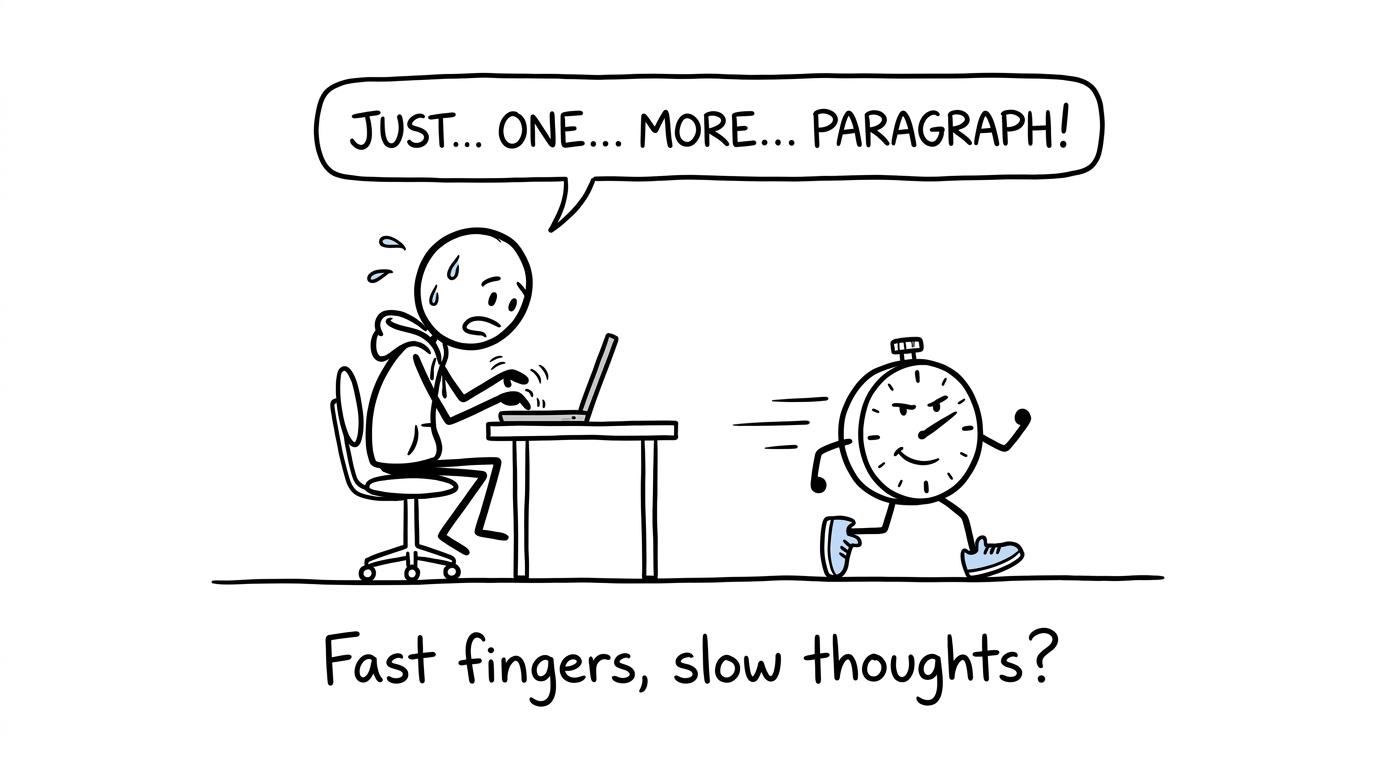 A student races a timer while typing, as the timer asks whether fast fingers mean fast thoughts
What timed typing can actually improve
Faster retrieval of biological knowledge
A student can know photosynthesis, homeostasis or inheritance perfectly when reading a revision guide, then struggle to produce the same knowledge from a blank page. Recognition and retrieval are different tasks.
Typing an answer from memory forces retrieval. Adding a timer introduces a realistic constraint: you must decide what matters without waiting for the perfect sentence. Repeated practice may make relevant facts easier to access, although that improvement comes from active recall and feedback rather than from the keyboard itself.
This principle transfers beyond biology. In maths, looking at a completed solution can feel familiar without proving that you could produce it independently. MathsGenie's GCSE maths revision lessons combine explanations with questions so that recognition can become recall.
Quicker decisions about answer structure
Longer biology responses often become slow because students start writing before deciding where the answer is going. They remember one fact, add another and then discover that the explanation lacks a clear chain.
A short planning stage can help you identify:
- the command word;
- the biological process or idea being tested;
- the evidence supplied in the question;
- the logical order of your points;
- any conclusion or judgement required.
Typed practice makes restructuring easy. That is helpful while learning what a strong answer looks like. However, do not become dependent on dragging sentences around. In a handwritten exam, your initial plan needs to do more of that organisational work.
Better awareness of time
Students often misjudge time in both directions. Some spend too long polishing a small response. Others rush a longer question because its wording looks intimidating.
A timer replaces intuition with evidence. Record how long you take to plan, draft and check each response. You can also monitor a simple completion measure:
completion rate=marks attemptedmarks available×100%\text{completion rate} = \frac{\text{marks attempted}}{\text{marks available}} \times 100\%completion rate=marks availablemarks attempted×100%This does not tell you whether the answers were correct, but it reveals whether your pacing allows you to attempt the paper. Always use the duration and total marks printed on the specific paper when setting a realistic practice schedule, because formats differ between exam boards, qualifications and specifications.
Why faster typing does not automatically mean faster exam answers
A keyboard removes some of the physical effort of handwriting. If you type fluently, your words may appear more quickly. But biology exam speed has several components:
response time=reading+thinking+planning+writing+checking\text{response time} = \text{reading} + \text{thinking} + \text{planning} + \text{writing} + \text{checking}response time=reading+thinking+planning+writing+checkingTyping mainly changes the writing component. It does not automatically improve your understanding of the question, subject knowledge or ability to interpret data.
A student who types rapidly but misreads “evaluate” is not working efficiently. Nor is a student who produces a long paragraph containing little creditworthy biology. Mark schemes reward relevant scientific content and reasoning, not the number of words produced.
This is why typed answers should be checked against the mark scheme. Ask whether each sentence contributes knowledge, application, evidence or reasoning. Delete decorative phrases that do none of these things.
Match your practice to the real GCSE Biology exam
If you will handwrite the paper
Use typing for short retrieval drills, early attempts at structuring extended responses and quick review sessions. Then transfer the skill to paper.
A balanced cycle might be:
- type a response under timed conditions;
- compare it with the relevant mark scheme;
- note missing biology and unnecessary wording;
- answer a different question on paper;
- check whether the improved structure survives without editing tools.
The final stage matters because exam performance depends partly on context. Handwriting requires physical stamina, legibility and the ability to plan without effortless cutting and pasting.
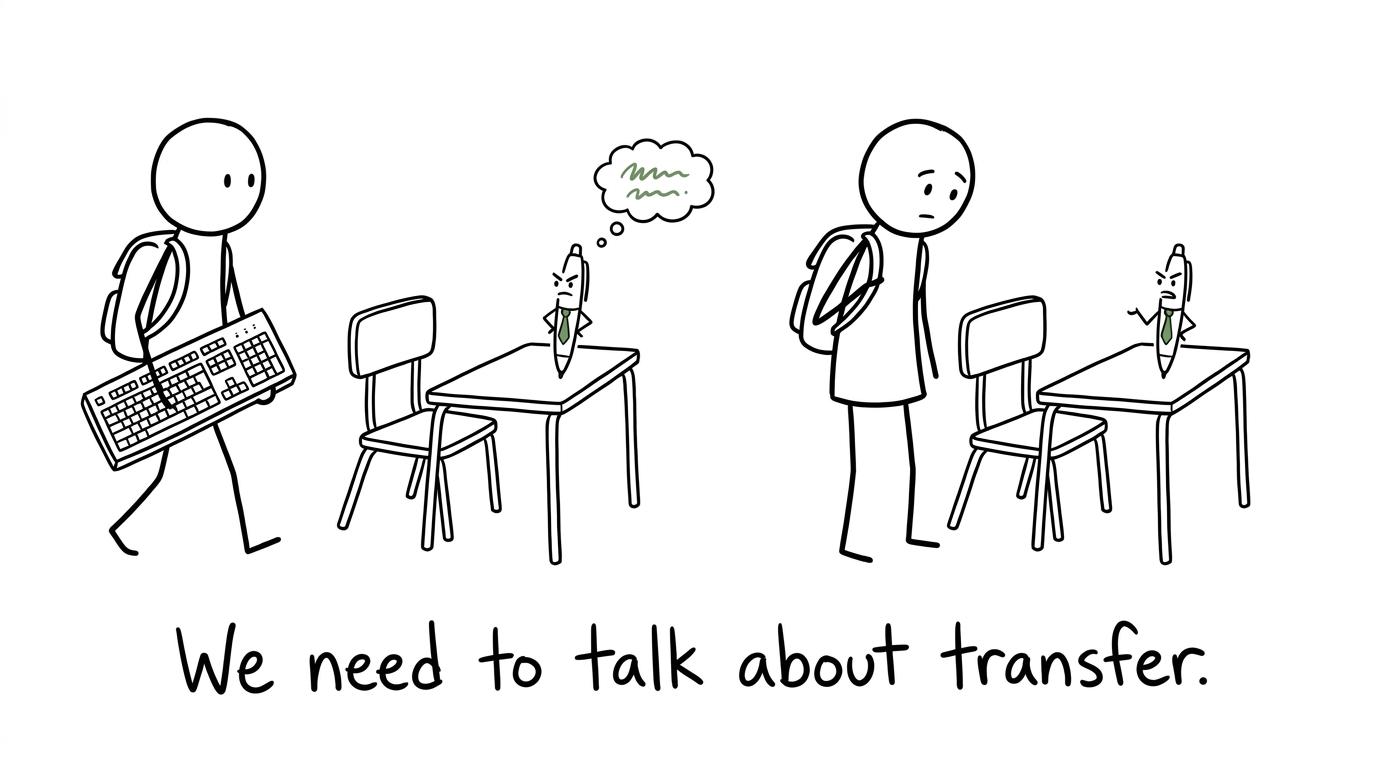 A student brings a keyboard to an exam desk and meets a stern-looking pen
If you normally use a word processor in exams
Typed timed practice becomes more representative if a word processor is your approved access arrangement and normal way of working. Recreate the conditions set by your school or college as closely as possible. That may mean practising without spelling or grammar assistance, internet access, stored notes or other features unavailable in the examination.
Do not assume that preferring to type automatically allows you to use a laptop in a public examination. Access arrangements are managed by your centre under current Joint Council for Qualifications requirements. Speak to your teacher, examinations officer or special educational needs co-ordinator well before the exam period if you are unsure.
Keep diagram and calculation practice separate
GCSE Biology is not entirely prose. Papers may require calculations, graphs, data interpretation and labelled biological diagrams. A typing drill cannot fully reproduce those tasks.
Keep regular paper-based practice for:
- drawing and labelling diagrams;
- plotting or interpreting graphs;
- showing calculation steps;
- writing units correctly;
- annotating information in a question.
The same idea applies to maths revision. Digital lessons are useful, but you also need to produce complete solutions. MathsGenie's grade 444 GCSE topics, grade 777 GCSE topics and wider revision pages let you move from explanation to independent written practice.
A practical timed typing routine
A useful session does not need to be long. It needs a clear purpose and reliable feedback.
Choose one skill to measure
Do not try to measure speed, knowledge, spelling, structure and evaluation all at once. Choose a focus such as:
- selecting relevant facts;
- building a logical explanation;
- using data from the question;
- responding accurately to a command word;
- finishing within a sensible time allowance.
Work without notes
Start with a blank document and remove distractions. Read the question once for meaning, then again for its command word and context. Set a timer based on the paper and marks you are practising, rather than using one fixed rule for every question.
Your aim is not to type continuously. A brief pause to plan can prevent a much longer, unfocused answer.
Review after the timer
Speed without review merely automates your current habits. Once time is up, mark or annotate the answer using the official mark scheme for that paper. Record the result honestly.
| Measure | What to record |
|---|---|
| Time | Minutes used for planning and writing |
| Completion | Whether every part was attempted |
| Content | Relevant marking points included or missed |
| Structure | Whether ideas followed a logical sequence |
| Precision | Vague phrases, missing terminology or unsupported claims |
| Transfer | Whether you could reproduce the skill by hand |
Look for patterns across several sessions. One unusually fast response tells you very little. Repeated difficulty with the same command word or question type gives you something specific to fix.
Add realistic paper practice
After focused drills, complete sections or full papers. In maths, GCSE past papers and mark schemes provide this change from isolated skills to mixed exam decisions. MathsGenie's predicted GCSE maths papers can add fresh practice once you have used the available past papers carefully.
Predicted papers are practice resources, not promises about exact future questions. Their value lies in making you retrieve, choose and apply methods under pressure.
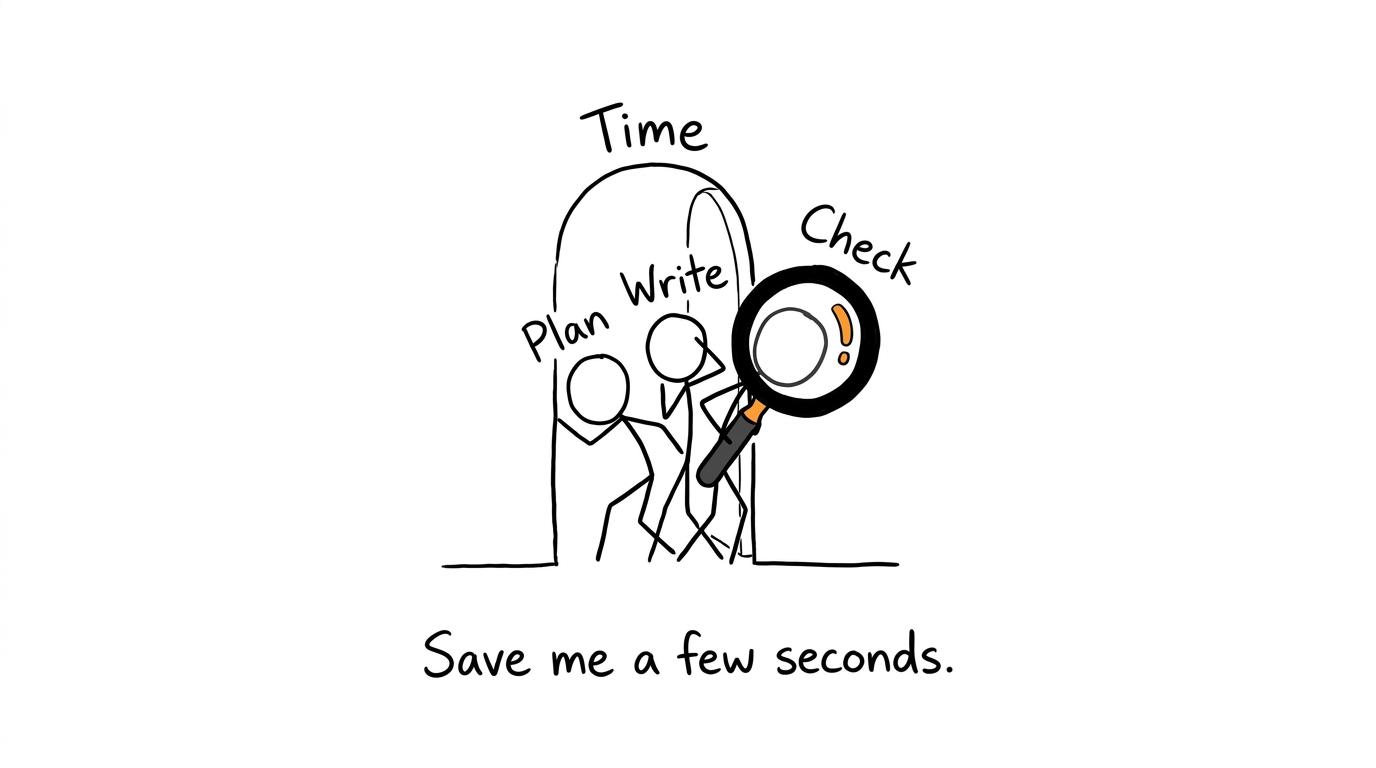 Plan, Write and Check squeeze through a doorway labelled Time
How biology timing practice helps with maths exams
The subjects demand different forms of communication, but the underlying self-management is similar. In a maths paper, speed comes from recognising the topic, selecting a valid method, carrying it out accurately and checking whether the answer is reasonable. Typing explanations will not improve algebraic fluency directly, but the habit of working to a time budget and reviewing mistakes can transfer.
For maths, replace typed biology paragraphs with written calculations and complete solutions. Use MathsGenie's GCSE maths revision resources to target weak topics, then test pacing with past or predicted papers. Students moving beyond GCSE can follow the same cycle through the A Level maths revision resources.
The medium should match the skill. Type when you want rapid retrieval or easy structural editing. Write when you need realistic exam practice. Use full papers when you need to make decisions across mixed topics.
Common mistakes with typing answers under a timer
Measuring words instead of marks
A higher word count can feel like progress, but concise scientific reasoning is often more effective than a long answer. Judge responses through the question, specification and mark scheme.
Editing after time has expired
Keep the timed version unchanged before making improvements. Otherwise, you lose the evidence of what you could actually produce within the limit.
Practising only familiar questions
Repeating comfortable topics can increase apparent speed without improving adaptability. Mix knowledge, application, data and practical-method questions.
Ignoring command words
“Describe”, “explain”, “compare”, “calculate” and “evaluate” ask for different kinds of responses. Fast writing cannot rescue an answer that performs the wrong task.
Never transferring back to handwriting
If the real assessment is handwritten, regular handwritten practice is essential. Check legibility and stamina as well as knowledge.
Treating every slow answer as a timing problem
Sometimes the timer is not the issue. Slow writing may reveal uncertain content knowledge, weak vocabulary or difficulty interpreting the question. Diagnose the cause before trying to force greater speed.
Build speed that survives exam day
Typing answers under timer GCSE Biology practice can improve speed and structure when it trains retrieval, decision-making and concise reasoning. It is not a shortcut around knowing the content, interpreting command words or practising in the medium you will use in the examination.
Think of the timer as a measuring tool, not a judge. It shows where the process slows down. The mark scheme then shows whether the result deserves credit. Together, they turn vague pressure into a specific revision decision.
For maths exams, use the same disciplined cycle: learn the method, answer independently, check the mark scheme and repeat under realistic conditions. Start with MathsGenie's free revision lessons and practice questions, then move into past papers, predicted papers, video solutions and focused topic work. The goal is not simply to work faster. It is to make good decisions soon enough to show everything you know.