

A Three-Month GCSE Maths Revision Plan
A three-month GCSE Maths revision plan with weekly topics, past papers, rest days and practical ways to catch up when revision slips behind.
Revision plans often begin with optimism and end under a pile of crossed-out dates. You assign every topic to a neat box, miss one Tuesday, and suddenly the whole timetable seems broken.
A three-month GCSE Maths revision plan should work differently. Its purpose is not to predict every evening perfectly. It is to help you identify weak topics, practise them regularly, use past papers intelligently and recover when life disrupts the schedule.
This plan divides approximately twelve weeks into three stages: rebuilding knowledge, developing exam technique and preparing under timed conditions. It works for foundation and higher tier students, but your topics and questions must match your exam board and tier.
Your three-month plan at a glance
| Stage | Weeks | Main purpose |
|---|---|---|
| Diagnose and rebuild | 1-4 | Find gaps, revise methods and answer focused questions |
| Practise and connect | 5-8 | Mix topics and begin regular exam-question practice |
| Prepare for papers | 9-12 | Complete timed papers, analyse errors and target final weaknesses |
Plan four or five maths sessions each week, rather than filling every evening. Include at least one rest day and one flexible slot that can absorb missed work. A useful session lasts around 303030-606060 minutes, depending on your concentration, workload and proximity to the exams.
For a broader look at organising your week, read the GCSE Maths revision timetable guide.
Week one: begin with topic triage
Imagine a student opening a long topic list and deciding to start at the top. It feels organised, but it assumes every topic needs equal attention. Usually, it does not.
Topic triage means deciding where revision will have the greatest value. Divide topics into three groups:
- Red: you cannot remember the method or usually cannot begin.
- Amber: you understand the idea but make errors or need prompts.
- Green: you can answer unfamiliar questions accurately without support.
Use recent assessments, classwork and a short set of mixed questions as evidence. Do not rate a topic green because it looks familiar. Recognition is not the same as being able to solve a question.
Then choose three red topics and two amber topics for the first fortnight. Keep green topics alive through occasional mixed practice, but spend most of your early revision time where it can change your performance.
Your first week might look like this:
| Day | Session |
|---|---|
| Monday | Diagnose topics and choose priorities |
| Tuesday | Learn one red topic and complete practice questions |
| Wednesday | Rest or revise another subject |
| Thursday | Learn a second red topic and complete practice questions |
| Friday | Revisit Tuesday's topic without notes |
| Saturday | Complete mixed questions and mark them |
| Sunday | Rest and prepare the next week |
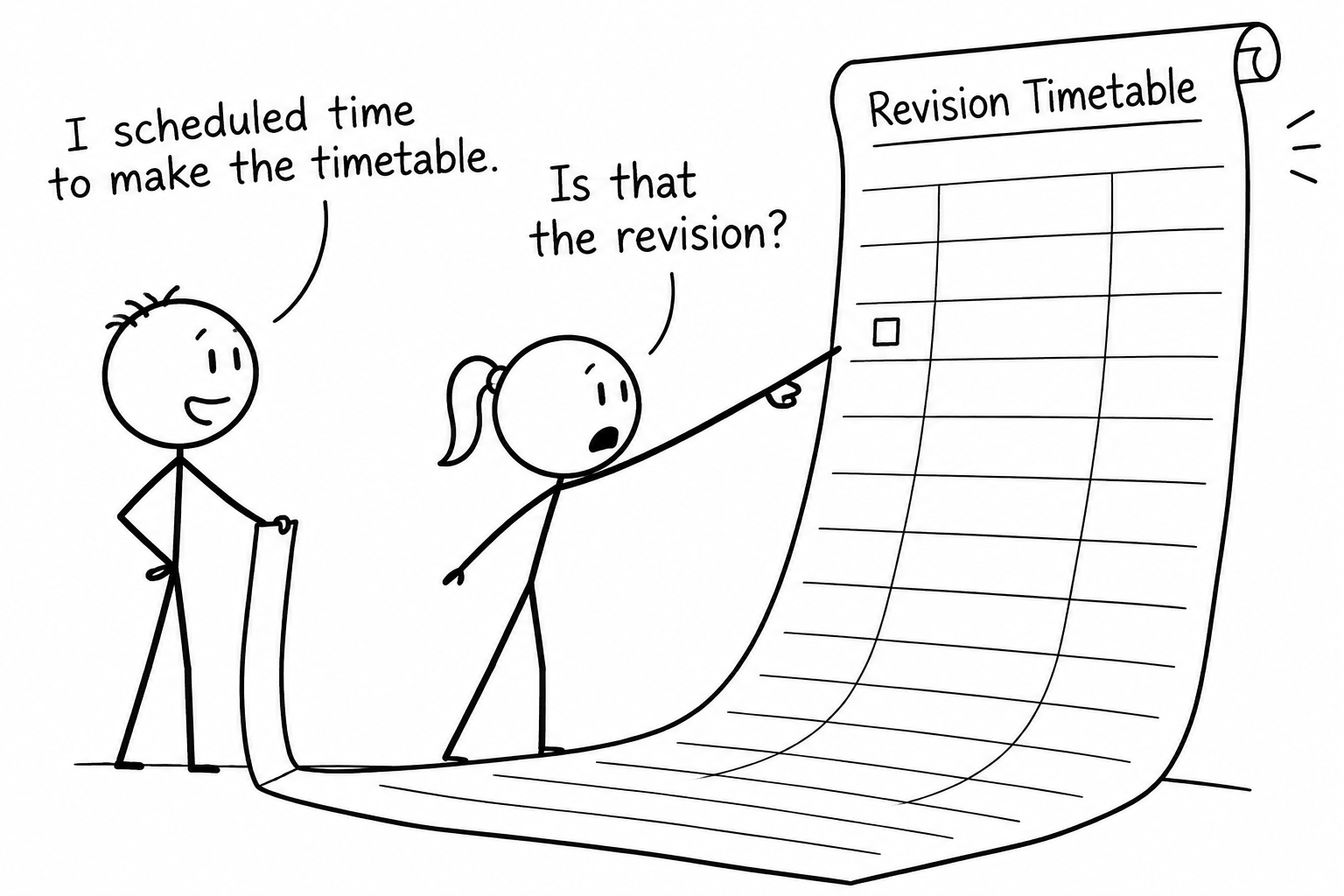 Two students discover that planning revision can become a revision task of its own
Weeks 1-4: rebuild the methods
The first month is about accuracy before speed. For each priority topic, follow a simple cycle:
- Review the method using a revision lesson or video.
- Close the explanation and write down what you remember.
- Answer practice questions without looking at the solution.
- Mark every answer carefully.
- Record errors and return to the topic several days later.
A mistake log makes this process more useful. For each error, record the topic, what went wrong and the action needed. For example, “forgot to reverse the inequality after multiplying by a negative number” is more helpful than “inequalities wrong”.
Try not to spend the whole month watching explanations. A method can feel clear while someone else performs it. The real test comes when you face an empty answer space and must decide what to do.
By the end of week four, reassess your red, amber and green lists. Some topics should move. Others may remain red and need a different explanation, support from a teacher or smaller prerequisite steps.
Build a weekly structure you can repeat
A realistic GCSE Maths revision timetable gives each session a job. You do not need to decide what “revise maths” means every time you sit down.
A balanced week could contain:
- two focused topic sessions;
- one retrieval session covering earlier work;
- one mixed or exam-question session;
- one flexible catch-up slot;
- at least one complete rest day.
Within a 454545-minute topic session, you might use approximately 101010 minutes to recall the method, 252525 minutes for questions and 101010 minutes for marking and corrections. These are guidelines, not rigid rules. A difficult topic may need several shorter visits.
You now have the structure; if arranging twelve weeks by hand feels like another revision task, build the schedule in the MathsGenie Revision Planner instead.
Weeks 5-8: mix topics and introduce past papers
During the second month, continue repairing weak areas but begin mixing topics. This matters because an exam does not tell you which technique belongs to each question. You must recognise whether a problem involves percentages, simultaneous equations, similarity or another part of the specification.
Start with selected exam questions or sections of papers. Complete one longer mixed session each week, then spend another session reviewing it. Marking is part of revision, not an administrative task at the end.
When checking your work, separate errors into four types:
- Knowledge: you did not know the method.
- Recognition: you knew the method but did not identify it.
- Accuracy: arithmetic, algebra or notation caused the mistake.
- Exam technique: you misread the question, omitted working or stopped too early.
The category determines your next action. A knowledge gap needs teaching and focused practice. A recognition problem needs mixed questions. Accuracy errors require slower checking. Exam-technique problems need careful use of mark schemes and complete written solutions.
Do not count a corrected answer as secure immediately. Add it to a short retry list and attempt a similar question later without notes.
Weeks 9-12: use full papers deliberately
In the final month, complete full papers under increasingly realistic conditions. Use papers for your exam board, specification and tier, whether that is Edexcel, AQA, OCR or Eduqas. Check whether calculators are permitted and follow the paper's stated time limit.
A productive paper cycle has four parts:
- Complete the paper without notes.
- Mark it using the official mark scheme.
- redo incorrect questions before viewing worked solutions where possible.
- Choose two or three weaknesses for the following week.
Your mark matters, but the diagnosis matters more. Two students can receive the same mark for very different reasons. One may have several missing topics; the other may understand the content but lose marks through rushed algebra and incomplete working.
Avoid completing paper after paper without review. One carefully analysed paper can reveal more than several papers marked only with ticks and crosses. Where available, use MathsGenie's practice questions, mark schemes and video solutions to revisit the precise skills exposed by each attempt.
In the final few days, reduce the volume. Review key methods and familiar errors, organise your equipment and protect your sleep. Last-minute exhaustion is not a useful revision technique.
How to adjust when you fall behind
Missing a session does not mean the GCSE revision plan has failed. It means the plan has met real life.
Use this recovery process:
- Do not double everything tomorrow. This creates an unrealistic session and often leads to another missed day.
- Move essential work first. Prioritise red topics, marked-paper corrections and scheduled papers.
- Drop low-value tasks. Recopying notes or decorating resources can wait.
- Use the flexible slot. This is why one was included.
- Reset each Sunday. Plan from your current position, not from the version of the week you hoped to have.
If you miss an entire week, do not compress two weeks into one. Shift the most important topics forward and remove lower-priority repetition. A plan is a decision-making tool, not a debt ledger.
Common revision-plan mistakes
Planning every available hour
A timetable without rest has no room for homework, illness or ordinary tiredness. Leave breathing space deliberately.
Revising only comfortable topics
Green topics feel satisfying because progress is visible. Improvement usually comes from spending more time with carefully chosen red and amber topics.
Treating videos as practice
Explanations help you learn, but independent questions show whether you can use the method. Every learning session should lead to retrieval or practice.
Saving past papers until the final week
Begin with sections or selected questions during the second month. This gives you time to act on what the papers reveal.
Ignoring the mark scheme
A correct final answer does not always show whether your working would earn method marks, while an incorrect answer may still contain valuable steps. Learn how solutions are credited.
Turn the plan into your next twelve weeks
The student with a crossed-out paper timetable does not need more motivation. They need a plan that can survive missed evenings, changing priorities and the evidence revealed by past papers. Knowing the structure is the first step; following it consistently is what carries you towards the exam.
You have seen how topic triage, weekly practice, rest days and timed papers fit across three months. Your turn: build your three-month schedule in the MathsGenie Revision Planner.















