

Terminating Decimals GCSE Maths Explained
Terminating decimals GCSE maths explained with a simple denominator test, clear worked examples, common mistakes and exam-style questions to practise.
A fraction appears on the page. You divide the numerator by the denominator, look at the calculator display and wonder whether the decimal ends or merely has not repeated yet.
That uncertainty is what makes terminating decimals GCSE maths questions feel harder than they are. The key fact is simple: a terminating decimal has a finite number of decimal places. For a fraction in its simplest form, the decimal terminates precisely when the denominator has no prime factors other than 222 and 555.
Imagine a student called Sam who keeps checking the denominator too early. Once Sam learns to simplify first, the topic finally clicks. This article follows that same route: understand the rule, apply it carefully and then practise it in exam-style questions.
The terminating decimals checklist
When you are given a fraction, use this method:
- Simplify the fraction fully.
- Find the prime factors of the denominator.
- If the only prime factors are 222 and 555, the decimal terminates.
- If there is any other prime factor, the decimal recurs.
- If required, convert the fraction into a decimal by division or by creating a denominator that is a power of 101010.
You can recap the wider conversion skills in the Fractions, Decimals and Percentages lesson.
What is a terminating decimal?
A terminating decimal stops after a finite number of decimal places. Examples include:
0.4,0.75,1.625 0.4,\quad 0.75,\quad 1.625 0.4,0.75,1.625A recurring decimal continues indefinitely with a repeating digit or group of digits. For example:
13=0.333… \frac{1}{3}=0.333\ldots 31=0.333…The digits shown by a calculator may stop because the screen has limited space. That does not prove that the decimal terminates. The denominator test gives a reliable mathematical answer.
Terminating decimals are rational numbers because they can be written as fractions. For example:
0.375=3751000=38 0.375=\frac{375}{1000}=\frac{3}{8} 0.375=1000375=83GCSE specifications require students to work interchangeably with terminating decimals and their corresponding fractions. This is relevant across exam boards including Edexcel, AQA, OCR and Eduqas, although the wording and question style can differ.
Why only 222 and 555 matter
Every terminating decimal can be written as a fraction with a denominator of 101010, 100100100, 100010001000 or another power of 101010.
The prime factorisation of 101010 is:
10=2×5 10=2\times5 10=2×5Therefore:
10n=2n×5n 10^n=2^n\times5^n 10n=2n×5nA simplified denominator containing only factors of 222 and 555 can be multiplied to become a power of 101010. That is why the fraction has a terminating decimal form.
For instance:
8=23 8=2^3 8=23We can multiply 888 by 125125125 to make 100010001000, so a fraction with denominator 888 can be rewritten using a power of 101010.
By contrast:
12=22×3 12=2^2\times3 12=22×3The factor 333 can never be removed by multiplying by more factors of 222 and 555. A simplified fraction with denominator 121212 must therefore produce a recurring decimal.
If prime factorisation is the part slowing you down, use the Prime Factors, HCF and LCM lesson before returning to this test.
Terminating decimals worked examples
Deciding whether a fraction terminates
Determine whether 38\frac{3}{8}83 has a terminating decimal form.
The fraction is already in its simplest form. Prime factorise the denominator:
8=23 8=2^3 8=23The only prime factor is 222, so the decimal terminates.
To find its value, make the denominator 100010001000:
38=3×1258×125=3751000=0.375 \frac{3}{8}=\frac{3\times125}{8\times125}=\frac{375}{1000}=0.375 83=8×1253×125=1000375=0.375Using both allowed prime factors
Determine whether 720\frac{7}{20}207 terminates and write it as a decimal.
The fraction is in its simplest form, and:
20=22×5 20=2^2\times5 20=22×5The denominator contains only 222 and 555, so the decimal terminates. Multiplying the numerator and denominator by 555 gives:
720=35100=0.35 \frac{7}{20}=\frac{35}{100}=0.35 207=10035=0.35Identifying a recurring decimal
Consider 712\frac{7}{12}127. The fraction is already simplified, and:
12=22×3 12=2^2\times3 12=22×3The denominator contains the prime factor 333. Therefore, the decimal does not terminate. In fact:
712=0.58333… \frac{7}{12}=0.58333\ldots 127=0.58333…For the related higher-tier skill of converting repeating decimals back into fractions, visit the Recurring Decimals to Fractions revision page.
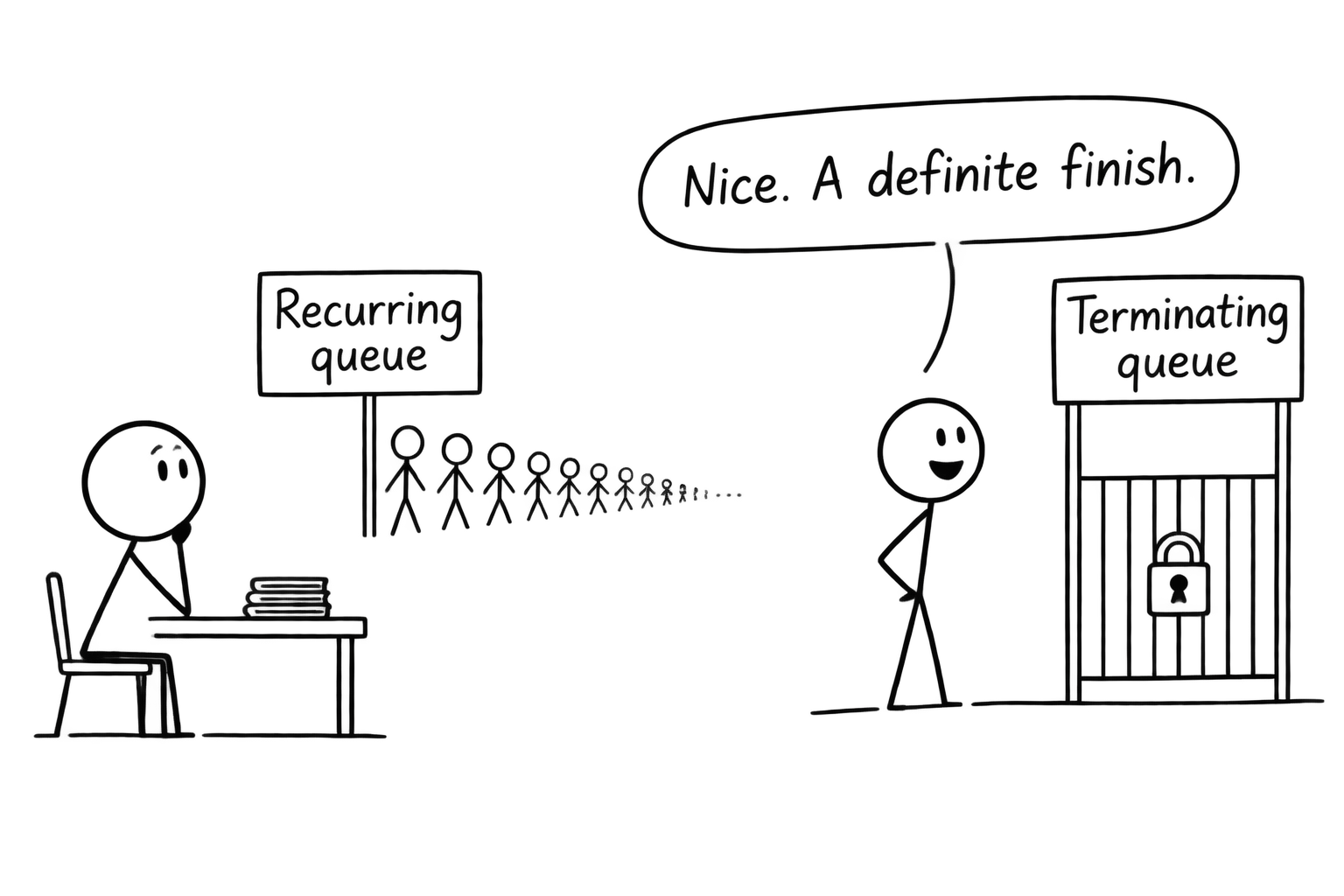 A student chooses between a never-ending recurring queue and a terminating queue with a definite finish
The step Sam kept missing
Sam looks at:
615 \frac{6}{15} 156The denominator has prime factors 333 and 555, so Sam initially calls it recurring. But the test applies only after the fraction has been simplified:
615=25=0.4 \frac{6}{15}=\frac{2}{5}=0.4 156=52=0.4The simplified denominator is 555, so the decimal terminates. This is the moment the method becomes dependable: simplify first, inspect second.
You now have the complete method; use the Maths Genie lesson and Question Bank when you want to apply it without having to find suitable questions yourself.
Converting a terminating decimal into a fraction
The reverse process uses place value.
Convert 0.1250.1250.125 into a fraction.
There are three decimal places, so write the number over 100010001000:
0.125=1251000 0.125=\frac{125}{1000} 0.125=1000125Now simplify. Both numbers can be divided by 125125125:
1251000=18 \frac{125}{1000}=\frac{1}{8} 1000125=81A useful check is to inspect the final denominator:
8=23 8=2^3 8=23It contains only the prime factor 222, exactly as the terminating-decimal rule predicts. The Fractions, Decimals and Percentages revision guide provides a concise recap of conversions between these forms.
Common mistakes with terminating decimals
Forgetting to simplify
This is the most important error. For example, the denominator of 1435\frac{14}{35}3514 contains the prime factor 777, but:
1435=25 \frac{14}{35}=\frac{2}{5} 3514=52The simplified denominator contains only 555, so the decimal terminates.
Looking only at whether the denominator is even
An even denominator does not guarantee a terminating decimal. Consider:
16 \frac{1}{6} 61Since 6=2×36=2\times36=2×3, the denominator contains 333, and the decimal recurs.
Assuming a large denominator must recur
The size of the denominator is irrelevant. For example:
125=53 125=5^3 125=53Therefore, a simplified fraction with denominator 125125125 terminates.
Trusting a rounded calculator display
A calculator may display a finite collection of digits even when the exact decimal continues. Use prime factors when the question asks whether a fraction terminates.
Giving a decimal when the question asks for a reason
For a reasoning question, show that you simplified the fraction and identified the denominator's prime factors. A correct conclusion without working may not secure every available mark.
Terminating decimals questions
Try these without looking at the answers first.
- Decide whether 940\frac{9}{40}409 gives a terminating or recurring decimal.
- Decide whether 1130\frac{11}{30}3011 gives a terminating or recurring decimal.
- Write 1325\frac{13}{25}2513 as a decimal.
- Write 0.320.320.32 as a fraction in its simplest form.
- Explain whether 1875\frac{18}{75}7518 has a terminating decimal form.
Answers
- Since 40=23×540=2^3\times540=23×5, the decimal terminates.
- Since 30=2×3×530=2\times3\times530=2×3×5, the factor 333 means the decimal recurs.
- 1325=52100=0.52\frac{13}{25}=\frac{52}{100}=0.522513=10052=0.52
- 0.32=32100=8250.32=\frac{32}{100}=\frac{8}{25}0.32=10032=258
- First simplify:
Since 25=5225=5^225=52, the decimal terminates. Its value is:
625=24100=0.24 \frac{6}{25}=\frac{24}{100}=0.24 256=10024=0.24Continue with the Fractions, Decimals and Percentages exam booklet if you want a printable set with answers.
Make the method automatic
Sam's difficulty was not understanding division. It was applying the test in the wrong order. Knowing the rule helps, but following the same order under exam pressure requires focused practice: simplify, factorise, decide and then convert if asked.
Your turn. Start the Maths Genie Fractions, Decimals and Percentages lesson, then answer a focused set in the Question Bank.















