Tell Parents You're Struggling With GCSE Economics
Tell parents you're struggling with GCSE Economics calmly. Use a clear script, evidence and a practical support plan to prevent an unhelpful lecture.

Falling behind often feels private until the moment you say it aloud. You may worry that admitting it will cause disappointment, extra pressure or a long conversation about effort. Yet if you need to tell parents you're struggling with GCSE Economics, the best approach is usually direct and practical: choose a calm moment, explain the specific difficulty, show what you have already tried and ask for one or two forms of support.
You do not need a perfect speech. You need an honest opening sentence and a small plan. The aim is not to prove that everything is fine. It is to turn a hidden problem into something that can be addressed.
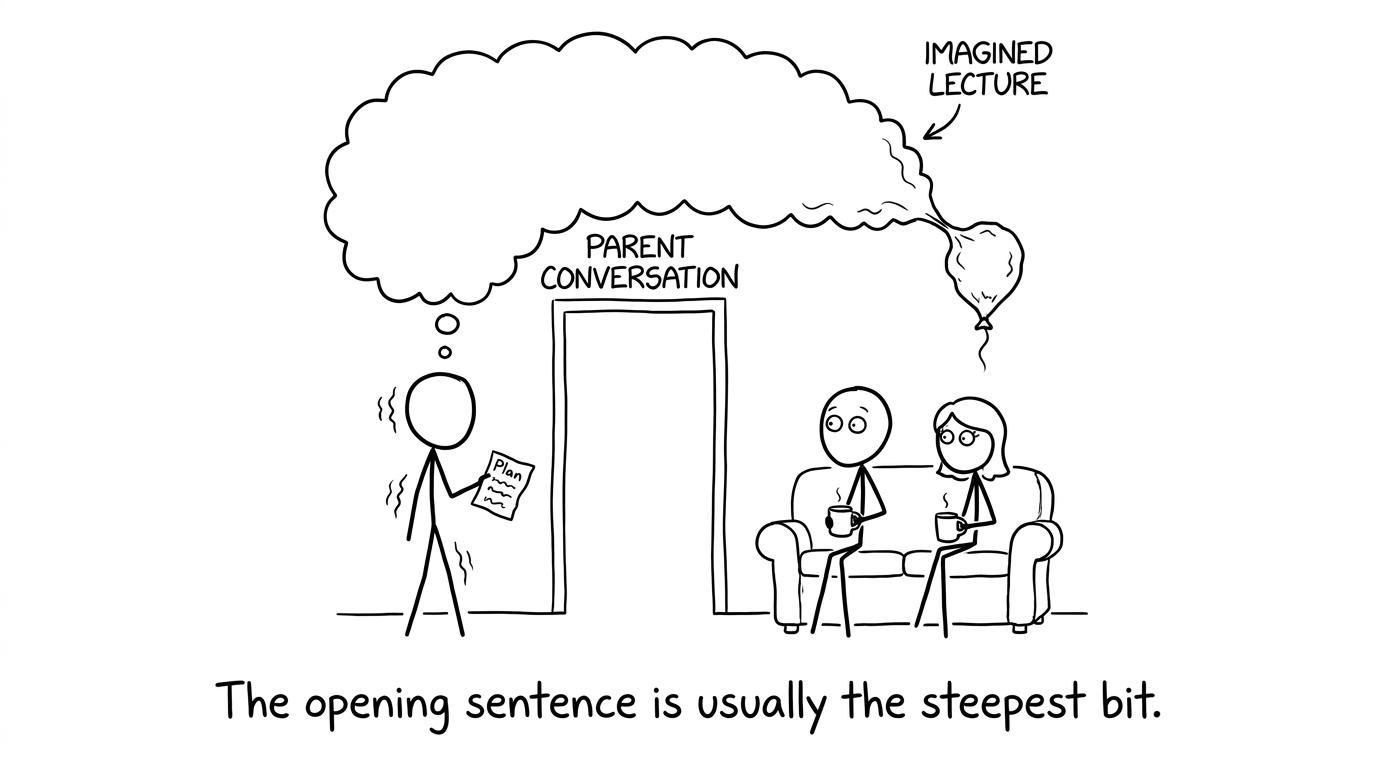 A student discovers that starting the conversation is the steepest part
A quick conversation checklist
Before speaking to your parents, prepare five things:
- The problem: which topics, skills or exam questions are difficult?
- The evidence: what do recent assessments, homework or teacher comments show?
- What you have tried: revision notes, practice questions, videos or asking for help.
- What you need: time, resources, a teacher conversation or help organising revision.
- The next check-in: when will you review whether the plan is working?
This preparation changes the tone. Instead of beginning with the frighteningly broad statement, “I am bad at Economics”, you can explain that you understand definitions but struggle to apply them to longer questions, or that calculations and graphs are costing you marks.
Specific problems invite useful responses. Labels invite arguments.
Understand what is actually going wrong
GCSE Economics is not simply a test of remembering terminology. Depending on your exam board and current specification, questions can require knowledge, application, analysis, evaluation and quantitative skills. AQA and OCR specifications organise these demands differently, so check the specification and assessment materials for the course your school teaches.
Your difficulty may sit in one of several areas:
- remembering economic terms accurately
- applying knowledge to the context in a question
- developing chains of reasoning
- evaluating different effects or viewpoints
- managing longer responses under timed conditions
- interpreting tables, percentages and graphs
- revising consistently rather than only before assessments
Look through a recent piece of marked work. Do not focus only on the total mark. Read the teacher's annotations and compare your answer with the mark scheme. A low mark is a result; the comments may reveal the cause.
If quantitative material is part of the problem, MathsGenie's free GCSE maths revision resources can help you rebuild the underlying skills separately. That matters because it is difficult to reason confidently about economic data while also worrying about how to read the numbers.
Choose a moment that lowers the temperature
Timing cannot guarantee a calm response, but poor timing can make a useful conversation much harder. Avoid beginning when someone is rushing out, dealing with another problem or already frustrated. Ask for a short conversation instead:
“Could we talk about Economics for ten minutes this evening? I am falling behind in part of the course, and I want to make a plan before it gets worse.”
This opening does three jobs. It identifies the subject, sets a manageable time boundary and shows that you want to act. Parents may still be concerned, but concern is easier to work with when the conversation has a clear purpose.
If speaking face to face feels overwhelming, send a short message asking for a suitable time. Do not try to explain the whole situation by text unless that is genuinely the safest and clearest way for you to communicate.
Use a simple script to prevent a lecture
A useful conversation can follow four stages.
Say what is happening
Describe the problem without exaggerating or minimising it:
“I understand some of the content, but I am losing marks when I have to apply it and explain longer chains of reasoning.”
Avoid claims such as “I know nothing” or “I am definitely going to fail”. They may express how you feel, but they do not help anyone identify the next action.
Show the evidence
Bring one or two useful pieces of information: a recent assessment, a list of weak topics or feedback from your teacher. You are not building a case against yourself. You are making the problem visible.
You might sort topics into three groups: secure, developing and needs help. For mathematical content, you could use MathsGenie's percentages revision lesson, ratio practice resources and averages revision to check whether the difficulty comes from Economics or an underlying numerical skill.
Explain what you have tried
Mention genuine actions, even if they have not worked fully. Perhaps you reread notes but discovered that passive reading did not prepare you for exam questions. Perhaps you attempted a past paper and could not interpret the mark scheme.
Honesty is more useful than pretending you have completed hours of revision. It allows your parents to distinguish between a knowledge gap, an ineffective method and a problem with time or concentration.
Ask for specific help
“Help me” is difficult to act upon. A clearer request might be:
- help me arrange a conversation with my teacher
- give me a quiet revision period twice a week
- help me create a realistic timetable
- check in with me once a week rather than every evening
- help me find the correct specification and past papers
Parents sometimes lecture because they are worried and do not know what practical role to take. A specific request gives that concern somewhere constructive to go.
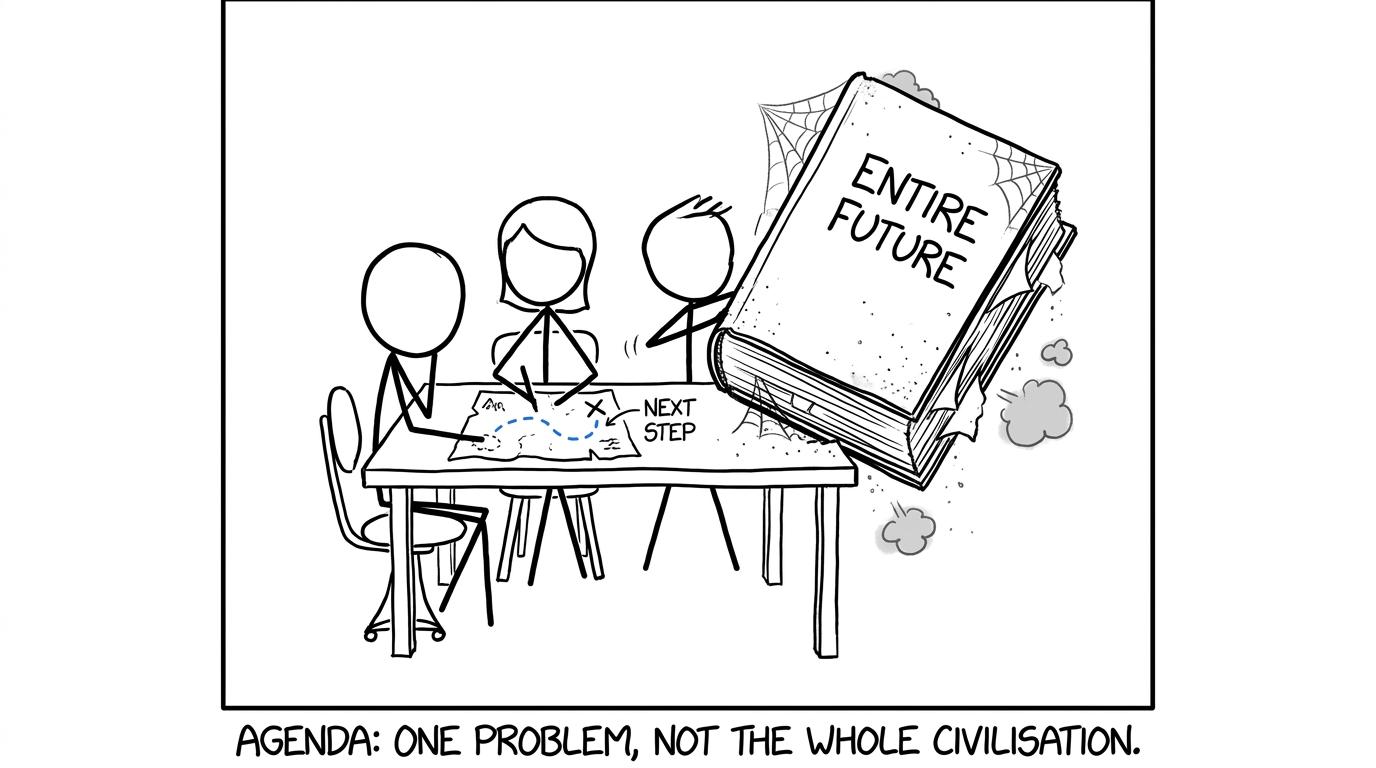 A student and parent keep the entire future off a deliberately small agenda
Keep the discussion focused when emotions rise
You cannot control another person's first reaction. You can, however, keep returning to the purpose of the conversation.
If the discussion turns into criticism, try:
“I understand why you are worried. I am bringing this up because I want to improve. Can we agree on what I should do this week?”
If too many old issues enter the conversation, narrow it again:
“Could we deal with Economics first and talk about the other concern separately?”
If voices rise or you feel unable to continue, suggest a pause. Pausing is not avoiding the issue when you set a time to return to it. A calmer second conversation can be more productive than forcing the first one to reach a conclusion.
Where speaking to a parent does not feel safe or possible, talk to another trusted adult. This could be a teacher, form tutor, head of year, school counsellor or safeguarding lead. Struggling with a subject should not be something you have to manage entirely alone.
Turn the conversation into a revision plan
A plan should be small enough to follow. Start with the next seven days rather than constructing an elaborate timetable for every evening until the exam.
Choose two or three actions, such as:
- ask your teacher which weakness should be addressed first
- complete a short set of questions on one Economics topic
- review one marked response alongside its mark scheme
- practise one supporting maths skill
- attempt a timed question and bring it to your teacher
For mathematical confidence, begin with the topic rather than immediately attempting an entire paper. MathsGenie's types of graphs lesson can support data interpretation, while compound interest and depreciation revision helps with percentage-based financial contexts.
Once individual skills feel more secure, use GCSE maths past papers and mark schemes to practise selecting methods under exam conditions. The purpose is not to turn Economics revision into maths revision. It is to remove avoidable numerical uncertainty so that you can concentrate on the economic reasoning.
Arrange a brief check-in with your parents after a week or two. Review what you completed, what improved and what still needs teacher support. Progress may first appear as better organisation, more complete answers or greater confidence with one question type. It does not always arrive immediately as a dramatic change in grade.
Common mistakes when telling parents you are struggling
Waiting until the problem becomes a crisis
It is tempting to delay the conversation until after another assessment. But earlier conversations allow more time for teacher feedback, targeted practice and changes to your routine.
Starting during an argument
Introducing school concerns while everyone is already upset makes it easy for the subject to become part of a wider disagreement. Request a separate conversation where possible.
Giving no detail
Saying only “Economics is going badly” may cause your parents to imagine the worst. Explain whether the issue is content, calculations, extended writing, revision habits or exam timing.
Promising an unrealistic transformation
A plan to revise for several hours every night may sound reassuring but is unlikely to survive alongside homework, other GCSE subjects, sleep and ordinary life. Consistent, focused sessions are more credible.
Asking parents to become the teacher
Their most valuable role may be helping you create the conditions for improvement. Subject-specific feedback should usually come from your Economics teacher and the official resources for your course.
Hiding evidence that would clarify the problem
A disappointing paper is uncomfortable to share, but it can make the conversation more objective. Use it to locate weak question types, not as proof of your ability or worth.
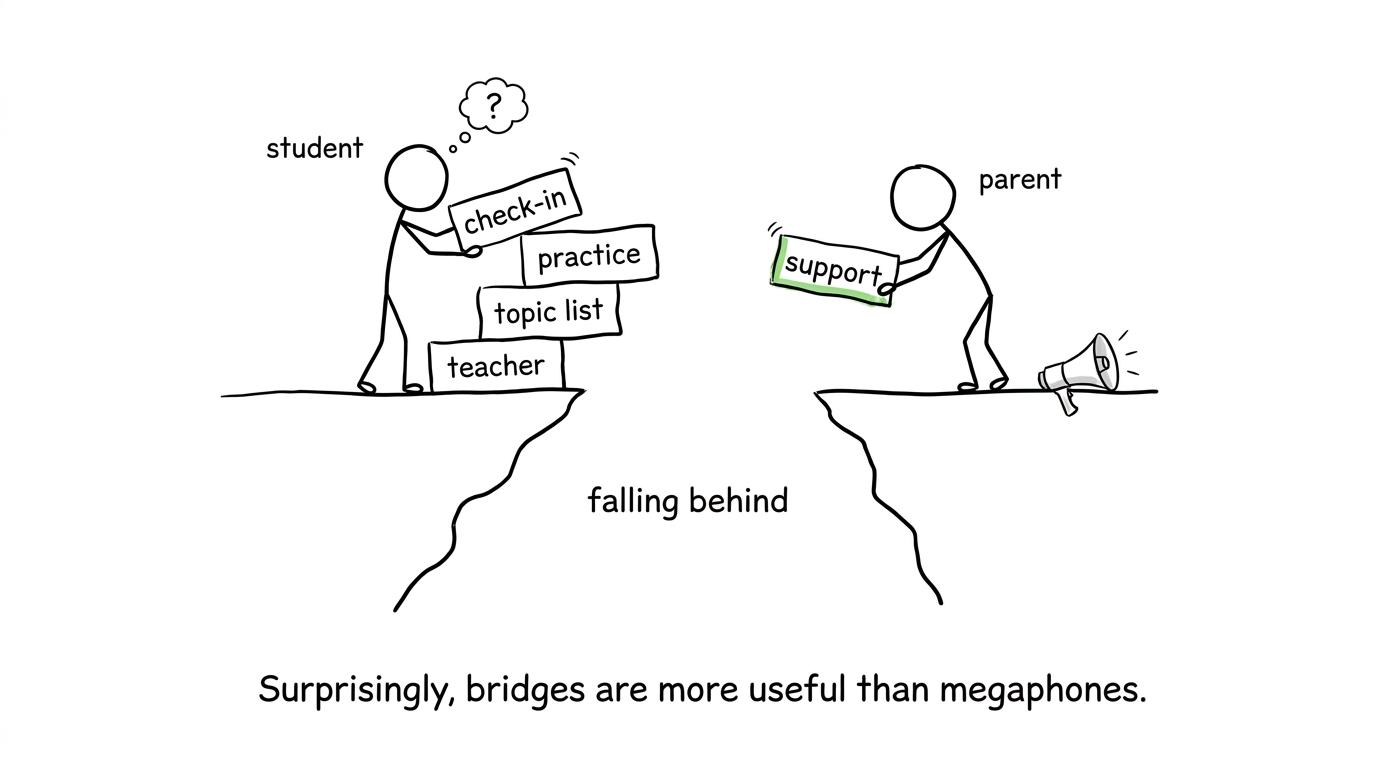 A parent contributes a practical block instead of using a megaphone
The conversation is a starting point, not a verdict
Telling your parents that you are struggling does not mean accepting that you cannot succeed. It means noticing that your current approach needs support. That is a mature response to evidence.
Open with one honest sentence. Name the precise difficulty. Ask for a practical next step. Then use your teacher's guidance, your exam board's current materials and regular practice to move forward.
MathsGenie can support the quantitative side of that plan with free revision lessons, video explanations, practice questions, mini tests, past papers, mark schemes and predicted GCSE maths papers. Start with the skill that is creating friction, practise it in a focused way and return to your Economics work with one less obstacle in the way.