

Tangents to Circles GCSE Maths Mock Revision
Tangents to circles GCSE maths revision made clear. Learn the key theorems, follow two worked questions and avoid common mock exam mistakes.
A December mock can make a familiar diagram suddenly feel unfamiliar. You see a circle, a line touching its edge and several angles. The theorem you revised last week seems to disappear.
For tangents to circles GCSE maths questions, the solution usually begins with one small fact: a tangent is perpendicular to the radius at the point of contact. That creates an angle of 90∘90^\circ90∘. From there, you combine ordinary geometry with one or two circle theorems.
This guide follows the revision a Year 11 student might do before December mocks. It explains what to recognise, works through two exam-style questions and shows how to write reasons that can earn marks. You can then use the GCSE Mock Exam Builder to turn that knowledge into targeted exam practice.
Your tangents to circles revision checklist
Before attempting mixed questions, make sure you can:
- identify a tangent and its point of contact;
- draw or notice the radius leading to that point;
- use the fact that a radius meets a tangent at 90∘90^\circ90∘;
- recognise that two tangents from the same external point have equal lengths;
- use the alternate segment theorem;
- combine tangent facts with Pythagoras, isosceles triangles and angle rules;
- state a geometrical reason for every important step.
These facts are commonly assessed as part of circle theorems, usually on higher tier papers. Exact content can vary by exam board and specification, so use your teacher's guidance when deciding what belongs in your mock.
For a wider recap, read MathsGenie's guide to learning GCSE circle theorems before returning to the focused tangent questions below.
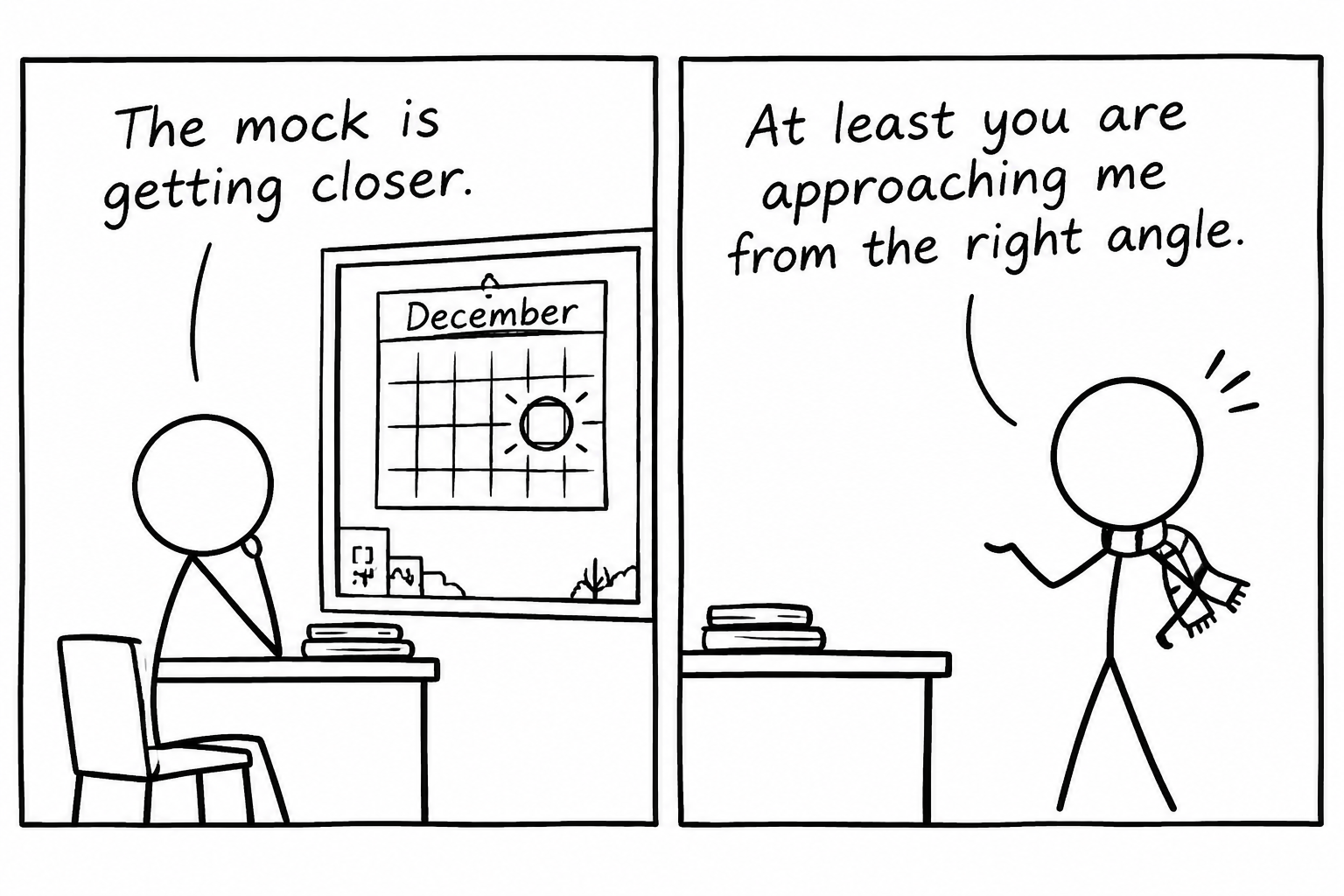 A student and a scarf-wearing circle make a right-angle joke while December approaches
The tangent facts you need to know
A radius and tangent meet at a right angle
A tangent touches a circle at exactly one point. If OOO is the centre and AAA is the point of contact, the radius OAOAOA is perpendicular to the tangent at AAA.
Therefore:
∠OAP=90∘\angle OAP=90^\circ∠OAP=90∘where PPP is any point on the tangent line.
The location matters. You cannot assume that every angle involving a tangent is 90∘90^\circ90∘. The right angle is specifically between the tangent and the radius drawn to the point of contact.
Tangents from the same external point are equal
Suppose two tangents from an external point PPP touch a circle at AAA and BBB. Their lengths are equal:
PA=PBPA=PBPA=PBThis often creates an isosceles triangle PABPABPAB. Its base angles are equal, allowing you to use angle sums to find missing values.
Notice the precise wording: the tangents must come from the same external point. Two unrelated tangent segments are not automatically equal.
The alternate segment theorem
The angle between a tangent and a chord equals the angle in the alternate segment. In other words, if a tangent meets the circle at AAA and ABABAB is a chord, the angle between the tangent and ABABAB equals the angle subtended by chord ABABAB at the opposite circumference.
This theorem can feel less obvious because the equal angles appear in different parts of the diagram. A useful habit is to identify the chord first. Then trace the angle standing on that same chord in the opposite segment.
A reliable method for tangent questions
When the diagram looks busy, use the same sequence each time:
- Mark the point of contact. Find where the tangent touches the circle.
- Find the radius. Look for the line joining that point to the centre, or draw it if construction lines are allowed.
- Mark 90∘90^\circ90∘. Do this only between the radius and tangent.
- Check for equal tangents. Look for two tangent segments beginning at one external point.
- Look for a chord. This may signal the alternate segment theorem.
- Use ordinary geometry. Apply angles in a triangle, angles on a straight line, isosceles triangle facts or Pythagoras as needed.
- Write the reason. A correct value without its theorem may not gain every available mark in a proof or reasoning question.
This is not a trick. It is a routine, and routines are valuable in mocks because they still work when you are nervous.
Exam-style question: finding a tangent length
A circle has centre OOO and radius 5 cm5\text{ cm}5 cm. A tangent from point PPP touches the circle at AAA. The distance OPOPOP is 13 cm13\text{ cm}13 cm. Find the length APAPAP.
The radius OAOAOA is perpendicular to tangent AP‘,sotriangleAP`, so triangle AP‘,sotriangleOAPisright−angledatis right-angled atisright−angledatA$.
Use Pythagoras:
OP2=OA2+AP2OP^2=OA^2+AP^2OP2=OA2+AP2Substitute the known lengths:
132=52+AP213^2=5^2+AP^2132=52+AP2 169=25+AP2169=25+AP^2169=25+AP2 AP2=144AP^2=144AP2=144As APAPAP is a length, take the positive square root:
AP=12 cmAP=12\text{ cm}AP=12 cmThe crucial step was not Pythagoras itself. It was recognising why Pythagoras could be used: the radius and tangent form a right angle at the point of contact.
Exam-style question: combining equal tangents and angles
Tangents from point PPP touch a circle at AAA and $B`. The angle between the tangents is:
∠APB=52∘\angle APB=52^\circ∠APB=52∘Find ∠PAB\angle PAB∠PAB and the angle ∠AOB\angle AOB∠AOB at the centre.
Because tangents from the same external point are equal:
PA=PBPA=PBPA=PBTriangle PABPABPAB is therefore isosceles. Its two base angles are equal. Let each base angle be xxx.
Using the angle sum of a triangle:
2x+52∘=180∘2x+52^\circ=180^\circ2x+52∘=180∘ 2x=128∘2x=128^\circ2x=128∘ x=64∘x=64^\circx=64∘Therefore:
∠PAB=64∘\angle PAB=64^\circ∠PAB=64∘To find ∠AOB\angle AOB∠AOB, join OOO to AAA and BBB. Each radius is perpendicular to its tangent, so:
∠OAP=∠OBP=90∘\angle OAP=\angle OBP=90^\circ∠OAP=∠OBP=90∘The angles in quadrilateral OAPBOAPBOAPB add to 360∘360^\circ360∘:
∠AOB+90∘+52∘+90∘=360∘\angle AOB+90^\circ+52^\circ+90^\circ=360^\circ∠AOB+90∘+52∘+90∘=360∘ ∠AOB=128∘\angle AOB=128^\circ∠AOB=128∘A strong exam response includes the reasons: equal tangents from the same point, base angles in an isosceles triangle, radius perpendicular to tangent, and angles in a quadrilateral.
Common slips in tangents to circles exam questions
Putting the right angle in the wrong place
The tangent is perpendicular to the radius at the point of contact. Marking 90∘90^\circ90∘ elsewhere can undermine the whole solution.
Treating a tangent like a chord
A chord joins two points on the circumference. A tangent touches the circle once. Check which line the question is actually describing before choosing a theorem.
Claiming that all tangent lengths are equal
Only tangents drawn from the same external point are guaranteed to be equal. State that full reason rather than writing simply “tangents are equal”.
Using the alternate segment theorem with the wrong chord
Match the tangent-chord angle to an angle standing on the same chord in the opposite segment. Do not choose an angle merely because it looks similar.
Giving a number without a reason
When a question says “give a reason”, “show that” or “prove”, include the theorem in words. Clear reasoning also makes it easier to recover method marks if your final arithmetic goes wrong.
Rounding too early
Keep exact values during intermediate steps. If a decimal answer is required, round only at the end and follow the accuracy stated in the question.
How to revise before your December mock
Start with recognition, not speed. Spend one short session naming the tangent, radius, chord and point of contact on several diagrams. Then practise one theorem at a time before moving to mixed questions.
Next, complete tangents to circles exam questions without notes. Mark your work and classify each error: theorem choice, diagram reading, algebra, arithmetic or missing reason. The category matters more than the raw score because it tells you what to practise next.
Finally, create an exam-style set using MathsGenie's Mock Exam Builder features. The builder lets you assemble a mock from past-paper questions, sit it under timed conditions and mark it afterwards. Include tangent questions alongside connected geometry topics so that you must decide which method applies rather than being told in advance.
One weak question does not mean you are weak at circle theorems. It means the diagram found a gap. Review the gap, answer a similar question and return to it several days later.
Turn the theorem into marks
Tangents to circles become manageable when you stop seeing the whole diagram at once. Find the point of contact. Mark the radius-tangent angle of 90∘90^\circ90∘. Check for equal tangents or a chord. Then use the geometry you already know.
That calm sequence is what you want available in December. Revisit the GCSE circle theorems guide, then build a targeted GCSE practice paper. Complete it without notes, use the marking guidance honestly and make your next practice set respond to what you found.















