

GCSE Circle Theorems: The Easiest Way to Learn
GCSE circle theorems made simple: learn the fastest patterns, key proofs and common mistakes, with worked examples and Maths Genie practice links.

Circle theorems are one of those topics that feel unfair at first. You look at a neat circle, a few chords, a tangent, maybe a radius, and the question expects you to “just see” the angle. In GCSE exams, that gap between what you see and what you’re meant to notice is where marks quietly disappear.
The easiest way to learn circle theorems isn’t by trying to memorise a list harder. It’s by training your eye to spot a small set of patterns, and then practising writing reasons in the exact language mark schemes reward. Once you do that, circle questions stop feeling like riddles and start feeling like routine.
If you want the core revision page and targeted practice straight away, start here: Circle Theorems (Revision).
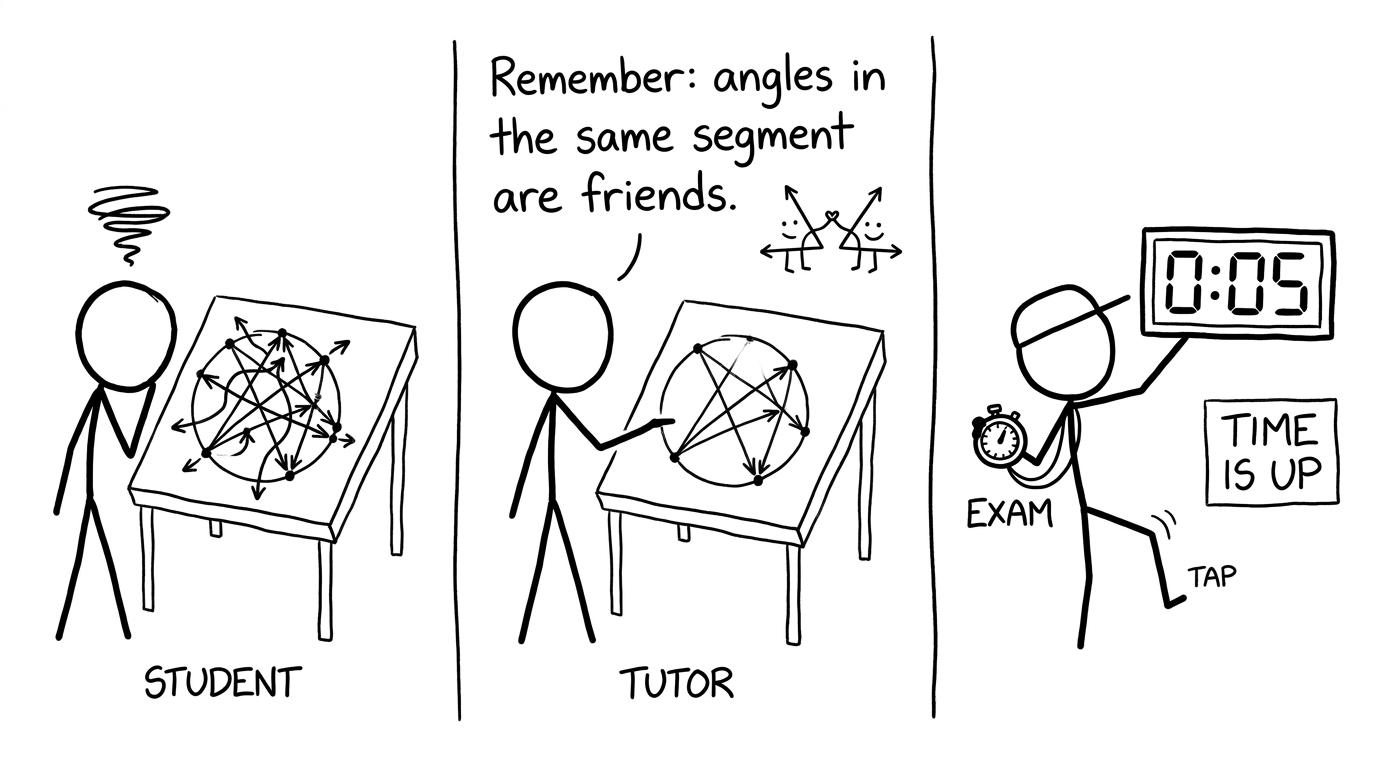 Student vs circle diagram, same segment friends
The easiest way to learn circle theorems (a quick checklist)
Use this as your “before I start” checklist in every GCSE circle theorems question:
- Mark the centre OOO and draw in any radii you need (lightly). Radii create isosceles triangles, which create equal angles.
- Look for a diameter. If an angle subtends a diameter, it’s a right angle.
- Look for a tangent. A tangent tells you “90∘90^\circ90∘ to the radius” and often unlocks alternate segment.
- Find a cyclic quadrilateral. If four points lie on the circle, opposite angles add to 180∘180^\circ180∘.
- Check if two angles stand on the same chord. “Same segment” is one of the quickest wins.
- Only then do you calculate or prove.
To practise in the exact style you’ll see in exams, use the dedicated worksheet: GCSE Circle Theorems Questions (PDF). When you’re ready to push into proof-style marks, use: Proof of Circle Theorems Questions (PDF).
Circle theorems as patterns, not sentences
Most students learn circle theorems like flashcards: theorem name on one side, statement on the other. That approach often fails under pressure because exam diagrams rarely look like the examples you revised.
A better GCSE approach is to learn each theorem as a visual trigger:
- Diameter trigger: “Does this angle look like it’s facing across the circle?”
- Centre trigger: “Is there a central angle and a matching angle on the edge?”
- Chord trigger: “Do two angles subtend the same chord?”
- Cyclic trigger: “Can I pick out four points on the circumference?”
- Tangent trigger: “Do I have a line touching the circle once?”
This matters because circle questions aren’t really about circles. They’re about recognising which mini-structure you’ve been given.
If you like having one place to consolidate the full set with examples, keep your tab open on Circle Theorems (Revision) and bounce between that and practice questions.
 Stop memorising, start spotting
The core GCSE circle theorems you actually use
You may have seen long lists. In reality, most GCSE questions recycle a tight group, sometimes chained together.
Angle at the centre is twice the angle at the circumference
If AAA, BBB, CCC are points on the circle and OOO is the centre, then angles standing on the same arc satisfy:
∠AOC=2∠ABC. \angle AOC = 2\angle ABC. ∠AOC=2∠ABC.This shows up in “prove” questions and also as a stepping stone to find missing angles.
Angle in a semicircle
If ACACAC is a diameter and BBB is on the circle, then:
∠ABC=90∘. \angle ABC = 90^\circ. ∠ABC=90∘.This is one of the fastest marks available in the entire GCSE syllabus.
Angles in the same segment (same chord)
If two angles stand on the same chord, they are equal:
∠ABC=∠ADC \angle ABC = \angle ADC ∠ABC=∠ADCwhen both angles subtend chord ACACAC.
Opposite angles in a cyclic quadrilateral
If AAA, BBB, CCC, DDD lie on the same circle, then:
∠ABC+∠ADC=180∘. \angle ABC + \angle ADC = 180^\circ. ∠ABC+∠ADC=180∘.Often, the hard part is simply noticing the quadrilateral is cyclic.
Tangent to a circle is perpendicular to the radius
If ATATAT is a tangent at point AAA and OAOAOA is a radius, then:
OA⊥AT, OA \perp AT, OA⊥AT,so the angle is 90∘90^\circ90∘.
Alternate segment theorem
The angle between a tangent and a chord equals the angle in the opposite segment. In practice, it’s usually written as:
If ATATAT is tangent at AAA and ABABAB is a chord, then the angle between ATATAT and ABABAB equals the angle in the opposite arc, e.g.
∠TAB=∠ACB. \angle TAB = \angle ACB. ∠TAB=∠ACB.Mark schemes love the exact phrase “alternate segment theorem”.
A method that works on almost every GCSE circle theorems question
When students ask for the “easiest way”, they usually mean “tell me what to do first”. Here is the routine that works across Edexcel, AQA, OCR and Eduqas GCSE papers.
Step 1: Add one helpful line
- Draw a radius to a tangent point to create a 90∘90^\circ90∘.
- Draw two radii to create an isosceles triangle.
- Extend a line only if it helps you access straight-line angles.
Step 2: Write a reason for every angle you claim
In circle theorems, method marks often come from reasons, not numbers. Write the reason as you go:
- “Angles in the same segment are equal”
- “Angle in a semicircle is 90∘90^\circ90∘”
- “Opposite angles in a cyclic quadrilateral sum to 180∘180^\circ180∘”
- “Tangent is perpendicular to radius”
Step 3: Finish with basic angle facts
Once the circle theorem has unlocked the structure, the rest is usually:
- angles in a triangle sum to 180∘180^\circ180∘
- angles on a straight line sum to 180∘180^\circ180∘
- vertically opposite angles are equal
Worked example 1: Same segment + triangle angles
Problem (typical GCSE): Points AAA, BBB, CCC, DDD lie on a circle. Given ∠ABC=68∘\angle ABC = 68^\circ∠ABC=68∘ and ∠ADB\angle ADB∠ADB stands on chord ABABAB. Find ∠ADB\angle ADB∠ADB.
Solution:
Both ∠ACB\angle ACB∠ACB and ∠ADB\angle ADB∠ADB would stand on chord ABABAB, but we are told directly that ∠ADB\angle ADB∠ADB stands on chord ABABAB, and we can compare it with an angle that also stands on chord ABABAB.
If ∠ABC\angle ABC∠ABC stands on chord ACACAC that wouldn’t help, so the key is to ensure we match the same chord. A standard version of this question intends ∠ACB=68∘\angle ACB = 68^\circ∠ACB=68∘ (standing on chord ABABAB). When an angle stands on chord ABABAB, it subtends arc ABABAB.
So, using the intended structure:
∠ADB=∠ACB=68∘ \angle ADB = \angle ACB = 68^\circ ∠ADB=∠ACB=68∘because angles in the same segment are equal.
Exam tip: In a real diagram, label the chord you’re using (here, ABABAB) and physically trace from one end to the other. In GCSE circle theorems, many mistakes are just “wrong chord”.
Worked example 2: Cyclic quadrilateral + straight line
Problem: AAA, BBB, CCC, DDD lie on a circle. ∠ABC=112∘\angle ABC = 112^\circ∠ABC=112∘. Find ∠ADC\angle ADC∠ADC.
Solution:
Since ABCDABCDABCD is a cyclic quadrilateral, opposite angles sum to 180∘180^\circ180∘:
∠ABC+∠ADC=180∘. \angle ABC + \angle ADC = 180^\circ. ∠ABC+∠ADC=180∘.Substitute ∠ABC=112∘\angle ABC = 112^\circ∠ABC=112∘:
112∘+∠ADC=180∘ 112^\circ + \angle ADC = 180^\circ 112∘+∠ADC=180∘ ∠ADC=180∘−112∘=68∘. \angle ADC = 180^\circ - 112^\circ = 68^\circ. ∠ADC=180∘−112∘=68∘.That’s a clean two-mark path on most GCSE mark schemes: one for the theorem, one for the subtraction.
Worked example 3: Tangent, radius, then alternate segment
Problem: A circle has centre OOO. ATATAT is a tangent at AAA. ABABAB is a chord. Given ∠OAB=35∘\angle OAB = 35^\circ∠OAB=35∘, find the angle between the tangent ATATAT and the chord ABABAB.
Solution:
First, note that OAOAOA is a radius to the point of tangency, so:
OA⊥AT, OA \perp AT, OA⊥AT,meaning the angle between OAOAOA and ATATAT is 90∘90^\circ90∘.
We’re given ∠OAB=35∘\angle OAB = 35^\circ∠OAB=35∘, which is the angle between OAOAOA and ABABAB.
So the angle between the tangent ATATAT and the chord ABABAB is:
90∘−35∘=55∘. 90^\circ - 35^\circ = 55^\circ. 90∘−35∘=55∘.You could then connect this to the alternate segment theorem: the angle between tangent ATATAT and chord ABABAB equals the angle in the opposite segment (an angle on the circumference subtending chord ABABAB). In many GCSE questions, that second step is what links the tangent information to the rest of the circle.
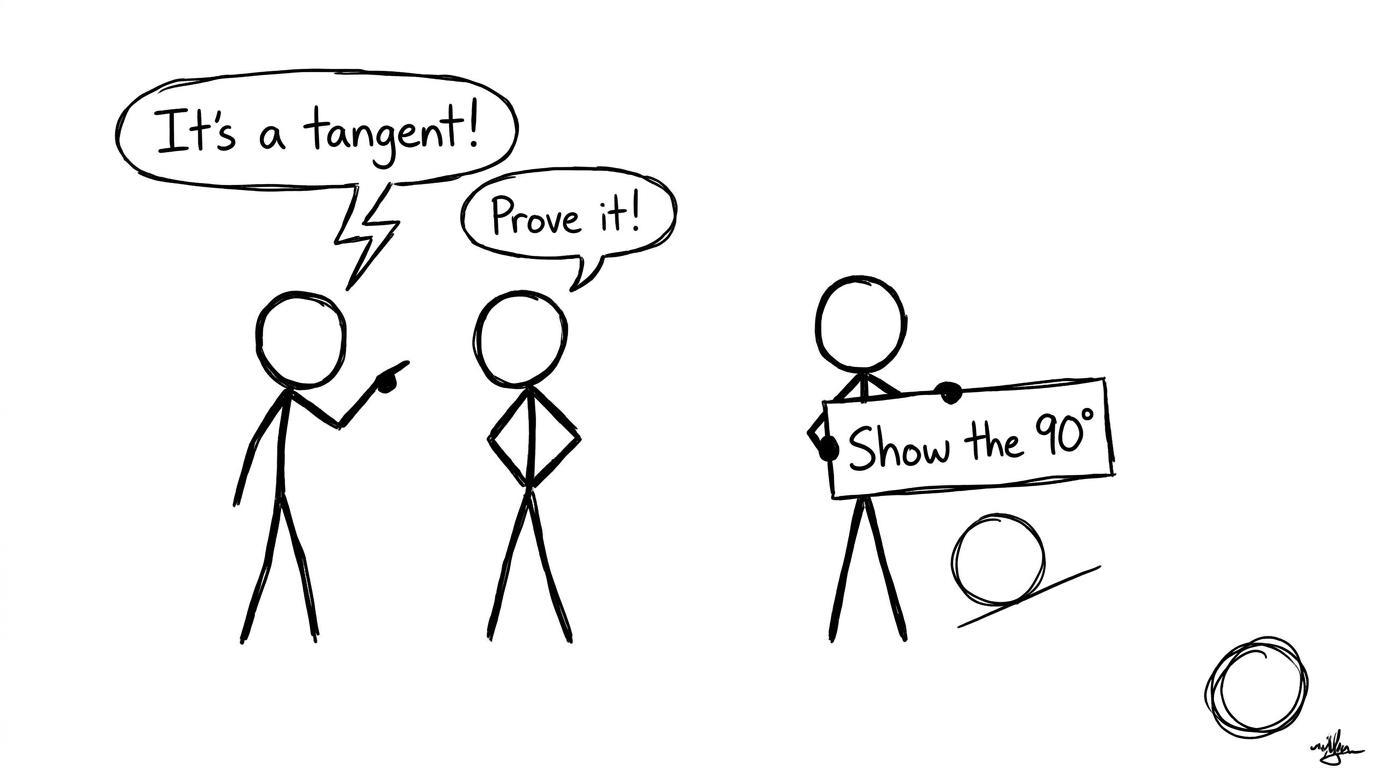 Show the 90 degrees
How circle theorems evolve into A Level circles
If you’re also doing A Level, circle theorems still matter, just in a quieter way. A Level circle work often lives in coordinate geometry and algebra, but the same discipline applies: identify structure, state what it implies, then compute.
On Maths Genie, A Level students can connect the geometry to the algebra using: AS Level Circles (PDF) and practise question sets here: A Level Year 1 Circles Questions.
The story is similar: at GCSE you learn the patterns. At A Level you learn to express patterns in equations.
Common mistakes (and how to stop making them)
Mixing up “same segment” and “cyclic quadrilateral”
Students often see four points on a circle and immediately use “same segment”, even when the angles don’t stand on the same chord. Fix this by naming the chord first: if both angles subtend chord ACACAC, then “same segment” is valid. If the relationship is about opposite angles inside a four-point shape, that’s cyclic quadrilateral.
Forgetting to justify the cyclic quadrilateral
In harder GCSE questions, it’s not always stated that the quadrilateral is cyclic. You must notice that all four vertices lie on the circumference. If one point is not clearly on the circle, don’t assume. Examiners won’t award method marks for a theorem applied to the wrong structure.
Using alternate segment theorem backwards
Alternate segment is easy to mis-state. The angle between the tangent and chord equals the angle in the opposite segment, not “any angle somewhere else on the circle”. Make yourself point to the chord, then look to the far side of the circle for the matching angle.
Losing simple angle facts at the end
Circle theorems often unlock the problem, then students throw away the last mark by adding incorrectly. Keep a mini checklist: triangle =180∘=180^\circ=180∘, straight line =180∘=180^\circ=180∘, around a point =360∘=360^\circ=360∘. These are the finishing moves.
Writing vague reasons
“Circle theorem” is not a reason. In GCSE mark schemes, the wording matters. Write the actual one: “angles in the same segment are equal” or “tangent is perpendicular to radius”. If you’re unsure what phrasing wins marks, practise with Maths Genie questions and check against mark schemes.
Bringing it together: make GCSE circle theorems feel inevitable
The easiest way to learn circle theorems is to stop treating them like isolated facts and start treating them like a small set of patterns you can spot under pressure. In GCSE exams, marks go to students who can do two things calmly: recognise the trigger, and write the correct reason.
To build that calm confidence, use Maths Genie as your loop: read the method, practise the questions, check the mark scheme, then repeat with slightly harder problems. Start with Circle Theorems (Revision), then complete GCSE Circle Theorems Questions (PDF). When you’re ready for the highest-value marks, move onto Proof of Circle Theorems Questions (PDF) and practise writing reasons like a mark scheme.
If you want to pressure-test your revision in real exam conditions, add past papers and mark schemes into your week (especially close to mocks). Maths Genie’s free revision lessons, practice questions, video solutions, mark schemes, and predicted papers are built for exactly this moment: turning “I sort of remember it” into “I can do it in an exam”.










