

Switch GCSE English Literature to English Language?
Switch GCSE English Literature to English Language mid-year: learn who decides, what catch-up is required, and how to keep maths revision on track too.
A subject choice can feel permanent until, suddenly, it does not. Perhaps English Literature is taking more time than expected. Perhaps you have discovered that a college course asks specifically for English Language. Meanwhile, maths mocks are approaching and you cannot afford weeks of uncertainty.
So, can you switch GCSE English Literature to English Language after the course has started? Sometimes, but it is not an automatic right or a simple form change. Your school or exam centre must agree, your timetable and exam entry must be workable, and you must catch up with the English Language content and compulsory spoken language endorsement.
There is also an important possibility to check first: many students in England already study English Language and English Literature as two separate GCSEs. If that applies to you, you may actually be asking to drop Literature, not switch from one qualification to another.
The answer at a glance
Before changing anything, confirm the following:
- Are you already studying both English GCSEs?
- Which nation, exam board and specification apply to you?
- Will your school permit a mid-year curriculum change?
- Can English Language fit into your existing timetable?
- How much teaching and assessment have you missed?
- Can you complete the spoken language endorsement?
- Has the exams officer entered you for the correct qualification?
- Would dropping Literature affect sixth-form or college entry?
- Can you catch up without sacrificing essential maths revision?
Your first conversation should be with your English teacher, head of English or year leader. If the proposal appears realistic, the school’s exams officer must then check the entry arrangements and deadlines.
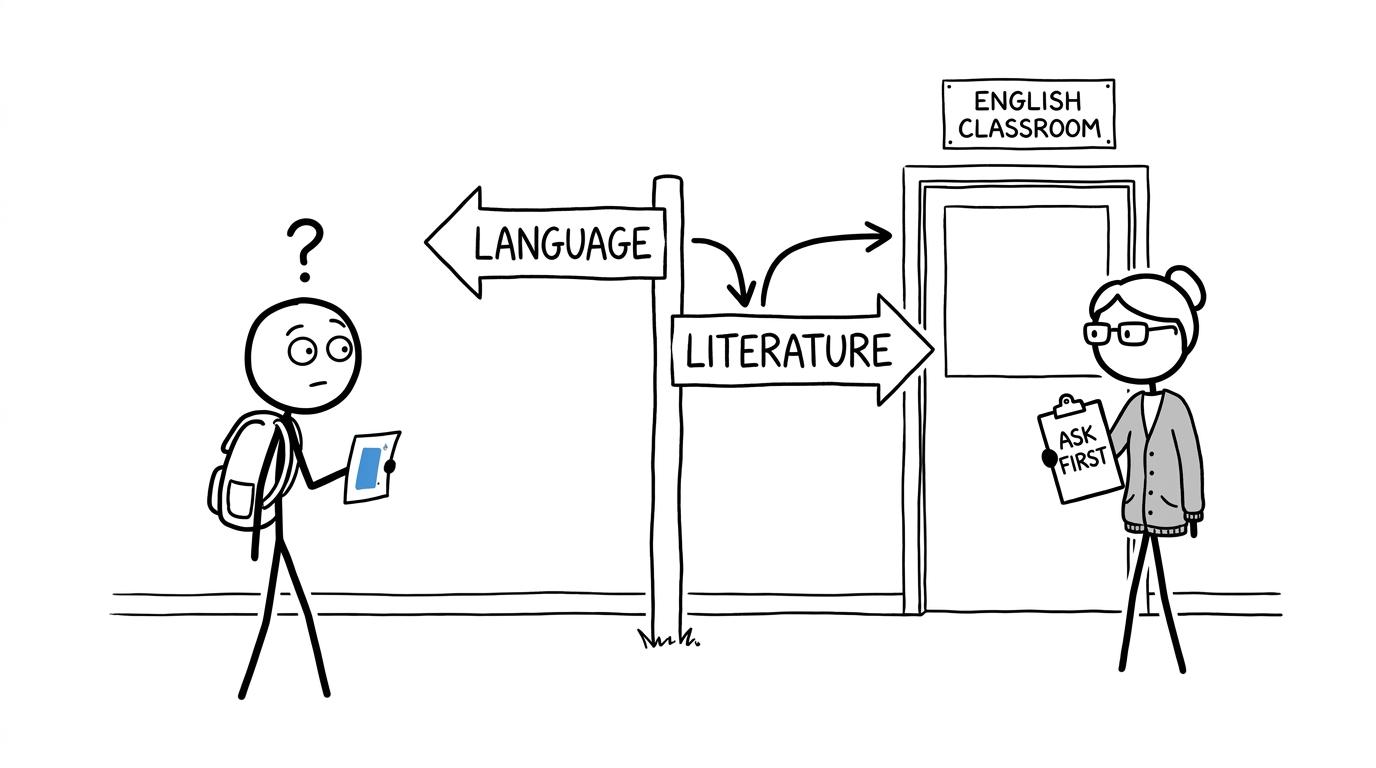 A student discovers that Language and Literature may lead to the same English classroom
English Language and Literature are separate GCSEs
GCSE English Language and GCSE English Literature are separate qualifications. They have different specifications, assessment objectives, exam papers and grades.
English Language generally develops your ability to:
- understand and interpret unseen fiction and non-fiction;
- analyse writers’ language and structural choices;
- compare ideas and perspectives;
- evaluate texts using relevant evidence;
- write clearly for different purposes and audiences;
- use accurate spelling, punctuation and grammar.
English Literature focuses on detailed study of set texts. In England, the required content includes Shakespeare, a nineteenth-century novel, poetry and modern fiction or drama, although the precise texts and paper structure depend on the exam board.
The overlap is useful. Both subjects involve close reading, evidence, analysis and controlled writing. But success in Literature does not mean you can enter an English Language exam without learning its question formats and writing demands.
You can inspect the relevant papers and revision materials through the GCSE English Language revision hub, selecting the correct resources for AQA, Edexcel, OCR, Eduqas or WJEC.
Why the word “switch” can be misleading
In many schools, English Language is part of the core Key Stage 4 programme and English Literature is taught alongside it. Students may move between teaching groups, but they remain entered for both qualifications.
That creates three different situations:
| Your current position | What you may actually be requesting |
|---|---|
| You study Literature only | Add English Language and possibly withdraw from Literature |
| You study both qualifications | Drop Literature while continuing Language |
| You are changing school or exam centre | Transfer onto a different board or specification |
These are not administratively identical. Dropping one qualification does not automatically create an entry for another. Nor does it guarantee extra English Language lessons.
Ask your school to show you your current subject entries. A timetable label such as “English” is not enough because schools often teach the two courses within the same lessons.
Who decides whether a mid-year change is possible?
Your school or registered exam centre decides whether it can support the change. A student cannot personally alter an exam-board entry.
The decision is likely to involve your English teacher, head of department, year leader, senior leadership team and exams officer. Depending on school policy, your parent or carer may also need to approve the request.
Curriculum and timetable capacity
The school must decide whether the right teaching group exists and whether moving you would disrupt other subjects. English Language may be taught alongside Literature rather than in a separate class, so there may be no simple lesson swap available.
Staff also need to judge whether there is enough time to teach what you have missed. A change early in Year 10 is very different from one shortly before the Year 11 examinations.
Examination entry deadlines
Exam entries are submitted by schools and colleges to awarding organisations. The Joint Council for Qualifications advises centres to use each awarding organisation’s current information for entry codes, deadlines, late entries and withdrawals.
Changes may still be technically possible after the standard deadline, but late fees or other restrictions can apply. A possible late entry is not the same as a school agreeing that the academic plan is sensible.
Do not rely on a verbal “probably”. Ask for written confirmation of:
- your exam board and specification code;
- the examination series;
- the papers for which you will be entered;
- any outstanding internal assessment requirement;
- the date by which the decision must be finalised.
School and national requirements
Rules differ across England, Wales, Scotland and Northern Ireland, and qualifications are not organised identically in every nation. This article mainly describes the GCSE system used in England and by centres offering AQA, Edexcel, OCR or Eduqas qualifications.
In England, English is a compulsory Key Stage 4 curriculum subject, but that does not create a universal right to replace one particular GCSE entry with another. Schools also make decisions based on their curriculum, staffing and pupil needs.
What you need to catch up in English Language
A successful change is not merely an entry on a computer. It is a catch-up plan.
Across the main English exam boards, GCSE English Language is principally assessed through written examinations. Exact paper lengths, question orders and weightings differ, so practise with the specification your centre actually uses.
Your audit should cover:
- fiction reading and analysis;
- non-fiction and literary non-fiction;
- comparison or synthesis where required;
- evaluation of writers’ methods;
- creative or imaginative writing;
- transactional, persuasive or viewpoint writing;
- technical accuracy;
- timing and question selection;
- the spoken language endorsement.
The spoken language component is particularly easy to overlook. Students normally give a prepared presentation, respond to questions and use spoken Standard English. It is reported separately as Pass, Merit, Distinction or Not Classified and does not contribute to the numerical GCSE grade, but it remains a required component of the course.
Ask whether your school has already completed this assessment. If it has, staff need to explain whether another assessment opportunity can be arranged or whether an existing result can legitimately be carried forward.
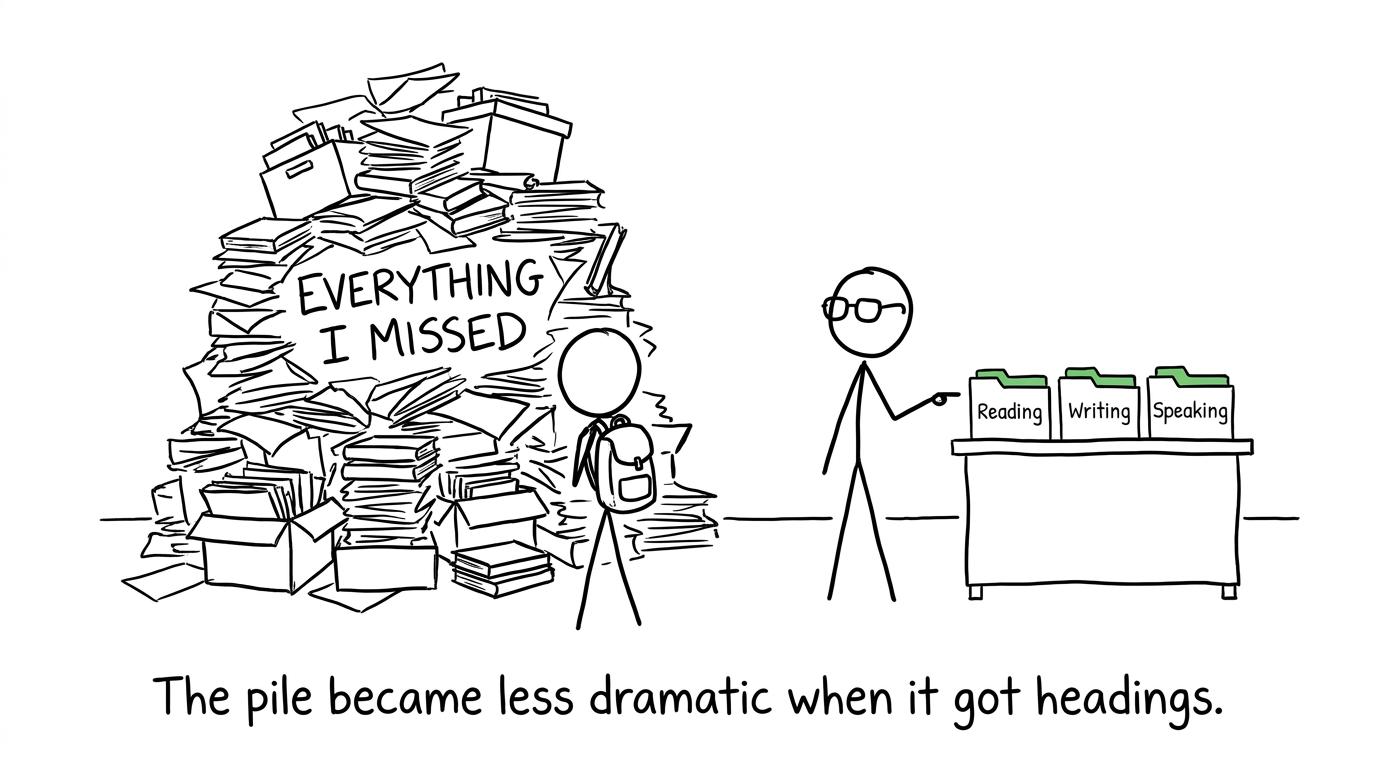 A large catch-up pile becomes manageable when divided into reading, writing and speaking
Build a realistic catch-up plan
Do not begin by downloading every paper you can find. First obtain a topic and assessment checklist from your teacher.
A useful sequence is:
- identify exactly what your class has already covered;
- learn the structure of each paper;
- complete one untimed question from each major section;
- ask your teacher to mark or discuss the responses;
- record the two or three largest weaknesses;
- practise those skills before attempting a complete timed paper;
- complete the spoken language assessment when instructed.
Past papers become valuable once you understand what each question is asking. The principle is the same as good maths revision: attempt, mark, diagnose, repair and attempt again. The guide to using GCSE past papers properly explains how to turn errors into specific next actions rather than simply collecting scores.
Protect your GCSE maths revision
A subject change can absorb surprising amounts of attention. Emails, meetings and catch-up work all feel urgent, while regular maths practice quietly disappears.
Keep the administrative decision separate from your daily revision. Until the school confirms the change, continue attending every scheduled lesson and completing required work.
For maths, maintain a small minimum routine through the GCSE Maths revision hub. Three or four short sessions can be more sustainable than postponing everything until the English question is resolved.
A balanced week might include:
- two focused English Language catch-up sessions;
- three short maths topic sessions;
- one timed English response or maths mini test;
- one evening without revision.
If time is tight, use the 20-minute GCSE maths revision routine. Edexcel students can also use GCSE Maths mini tests for short, focused checks.
Later in the year, move towards full past papers and, where appropriate, Edexcel GCSE Maths predicted papers. Predicted papers should test your preparation, not replace specification coverage or official past papers.
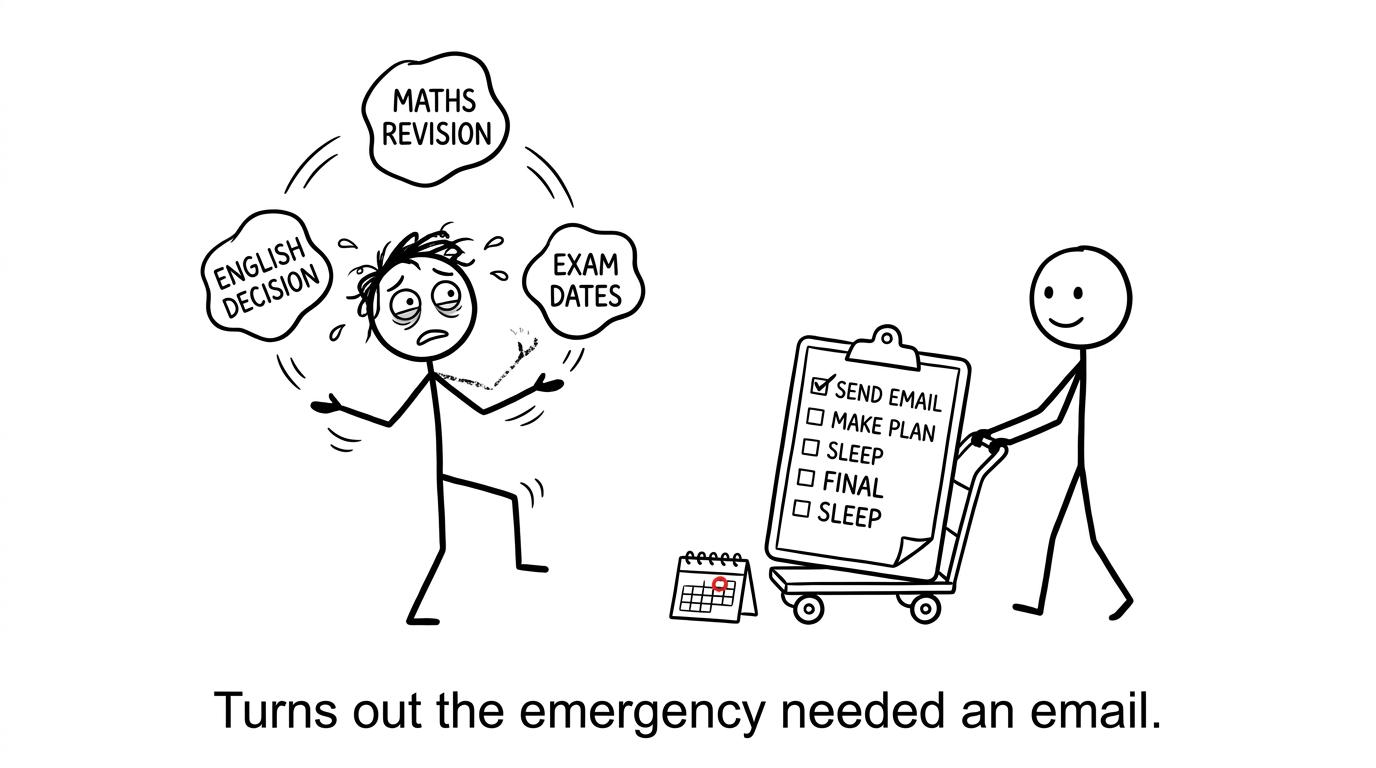 A student juggles an English decision, maths revision and exam dates while the solution arrives on a checklist
Common mistakes when requesting the change
Assuming Language and Literature are interchangeable
They share skills, but they are separate qualifications. You need the correct teaching, specification and exam entry.
Not checking whether you already study Language
Many students are entered for both. In that situation, dropping Literature reduces your qualification load but does not add a new GCSE.
Waiting until the examination entry deadline
Raise the issue as soon as possible. Schools need time to assess the academic case, timetable implications, spoken endorsement and exam administration.
Choosing a subject based only on which seems easier
English Language relies heavily on unseen reading, purposeful writing and decisions made under time pressure. It may suit you better, but it is not automatically easier.
Ignoring entry requirements
Post-16 funding rules and individual course entry requirements are not the same thing. In England, the current funding condition can be met by grade 444 or above in either English Language or English Literature, but a particular sixth form, apprenticeship or employer may specifically request English Language. Check the published requirements directly.
Sacrificing every other subject to catch up
English catch-up matters, but so do maths, science and your remaining GCSEs. Use a written weekly plan and review it with a teacher if the workload becomes unrealistic.
Make the decision concrete
The uncertainty is often more exhausting than the eventual answer. Replace “Can I switch?” with a short list of precise questions:
- What am I currently entered for?
- What would the school change?
- What content and assessment have I missed?
- Who will teach or mark my catch-up work?
- When will the exams officer confirm my entry?
- What happens if the request is refused?
Once those questions have answers, the decision becomes manageable. If the switch is approved, follow the agreed English Language catch-up plan. If it is not, ask what support is available within your current programme and why the school considers that route safer.
Then return your attention to the work that changes grades: regular, specific practice. MathsGenie gives you free revision lessons, practice questions, mini tests, past papers, predicted papers, mark schemes and video solutions. Use the guidance on when to start GCSE past papers, choose the resource matching your board and tier, and keep moving one clearly identified weakness at a time.










