Switch GCSE Design and Technology to Food and Nutrition
Switch GCSE Design and Technology to Food and Nutrition mid-year: learn what schools consider, what you must catch up and how to make a strong request.
Choosing a GCSE can feel theoretical until the course begins. Then the weekly reality arrives: the projects, practical lessons, written work and assessment demands. If Design and Technology no longer feels right, you may be wondering whether you can switch GCSE Design and Technology to Food and Nutrition after lessons have started.
The short answer is: possibly, but your school decides. There is no automatic right to change, and the later you ask, the harder it usually becomes. Your school must consider its timetable, class capacity, available equipment, safety arrangements, exam-board entry and whether you can realistically catch up with the Food Preparation and Nutrition course.
A successful switch requires more than enthusiasm for cooking. You need a practical catch-up plan, support from the relevant teachers and a clear understanding of the non-exam assessment, usually called NEA.
Your mid-year switching checklist
Before making a formal request, find out:
- whether your school permits GCSE subject changes after the course begins;
- which exam board and specification the Food Preparation and Nutrition class follows;
- how much theory and practical work the class has completed;
- whether there is space in the class and room in the timetable;
- which practical skills you have missed;
- when the school begins controlled NEA work;
- whether your Design and Technology NEA has already started;
- how the change could affect your other subjects and revision time;
- who must approve the request, such as the subject leader, examinations officer or senior leader.
Do not leave your current lessons while a decision is pending. Until the school confirms a change, you remain responsible for your existing course.
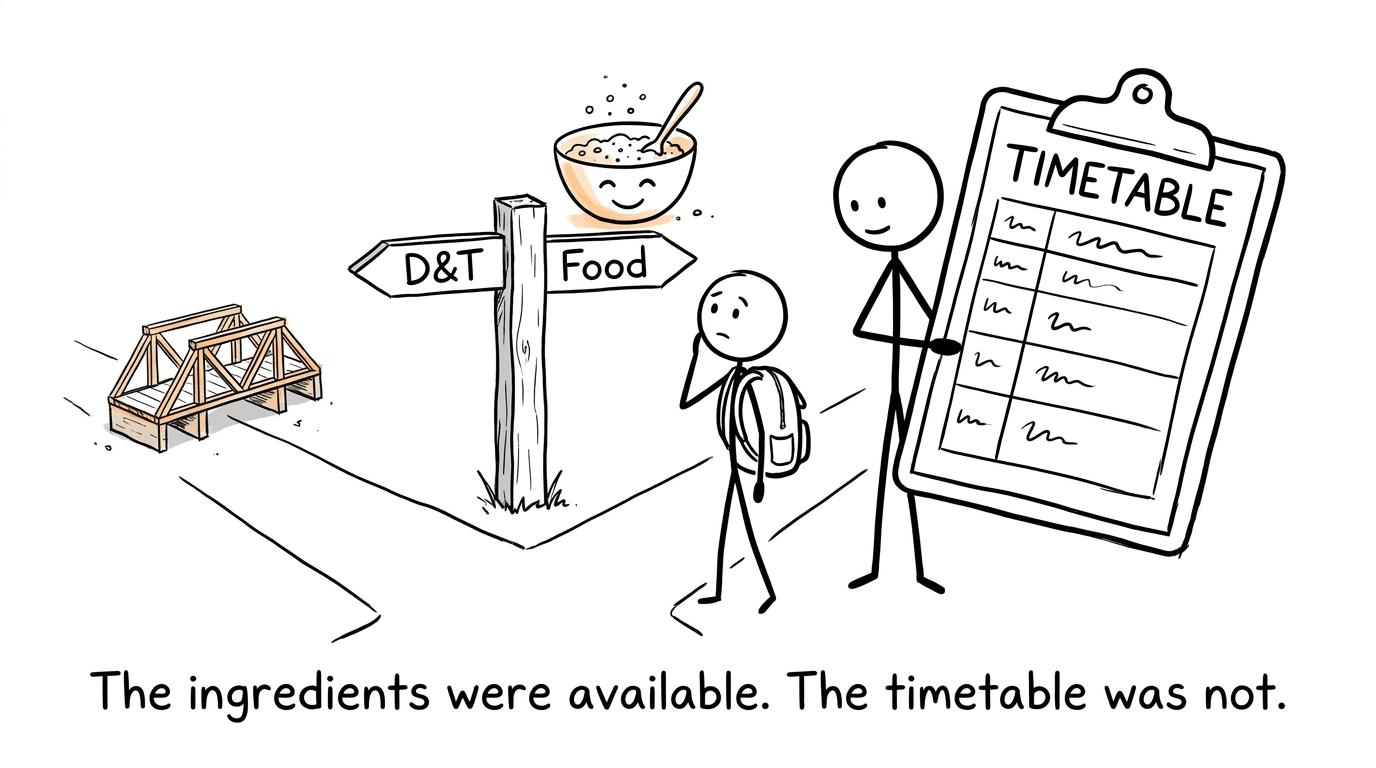 A student discovers that changing GCSE subjects depends on the timetable
Is switching GCSE subjects actually allowed?
GCSE specifications set out what candidates must learn and complete, but schools organise their own curriculum and subject-change procedures. That means the decision is normally made by your school rather than directly by AQA, Edexcel, OCR or Eduqas.
A school is likely to examine four questions.
Can the timetable accommodate the change?
Food Preparation and Nutrition may run in a different option block from Design and Technology. Moving classes could create a clash with another GCSE. Even when the lessons occupy the same block, the food room may already be at its safe working capacity.
Staffing and facilities matter too. Practical food lessons need suitable equipment, ingredients, supervision and arrangements for allergies or dietary needs. A spare chair does not necessarily mean a practical place is available.
Can you recover the missed learning?
Food Preparation and Nutrition is not simply a cooking course. Its content includes nutrition, food science, food safety, provenance, preparation techniques, cooking methods, sensory evaluation and the functional properties of ingredients.
Ask the teacher for a list of everything covered so far. A workable recovery plan should identify specific topics, practical techniques and deadlines. “I will catch up” is a hope; a weekly plan is evidence.
Can the school enter you correctly?
Your school’s examinations officer manages entries and administrative deadlines. If entries have already been submitted, alterations may still be administratively possible in some circumstances, but fees, internal deadlines and awarding-body rules may apply. The examinations officer must check the current arrangements for your examination series.
This is one reason to ask early. An option change during the first part of Year 10 is generally more manageable than one made after substantial Year 11 assessment work has begun.
Can you complete valid assessment work?
Work from Design and Technology cannot simply be relabelled as Food Preparation and Nutrition. They are separate qualifications with different subject content, assessment objectives and NEA tasks.
Your new teacher must also be confident that your work can be completed under the required assessment conditions. You should never assume that missed controlled assessment can be recreated independently at home.
The assessment gap you would need to close
Under the current regulatory framework in England, GCSE Food Preparation and Nutrition allocates 50%50\%50% of the qualification to a written examination and 50%50\%50% to NEA. The NEA is divided into two distinct areas:
- a food investigation worth 15%15\%15% of the qualification;
- a food preparation assessment worth 35%35\%35% of the qualification.
The preparation assessment involves planning, preparing, cooking and presenting dishes. The precise paper length, task administration and documentation depend on the specification used by your school, so always read the correct current specification rather than relying on notes from another exam board.
GCSE Design and Technology also commonly has a 50%50\%50% written examination and a 50%50\%50% design-and-make NEA. That similarity can be misleading. The content and evidence are not interchangeable: a prototype and design portfolio do not satisfy a food investigation or practical food assessment.
This distinction is often what determines whether a late switch remains realistic. If the destination class has only completed introductory teaching, catching up may be possible. If formal NEA work is well under way, the barriers become much greater.
What you need to catch up in Food Preparation and Nutrition
Request the class curriculum map and divide the missed content into three groups.
Theory knowledge
You may need to cover nutrients, dietary requirements, energy needs, food safety, microorganisms, food provenance and the physical or chemical behaviour of ingredients. The exact organisation varies between specifications, but all approved courses combine food knowledge with application and evaluation.
Practical competence
Your teacher may need evidence that you can work safely and independently with equipment. Relevant skills can include knife control, sauce making, dough production, using raising agents, controlling cooking methods, presenting dishes and organising a practical session.
Watching a demonstration is useful, but it does not replace supervised practice. Ask which skills must be completed in school and whether extra sessions are genuinely available.
Written analysis and evaluation
Food practical work also produces evidence. You may be expected to justify choices, record methods, analyse results, consider nutrition, conduct sensory evaluation and suggest improvements. Clear writing and accurate data handling matter alongside cooking skill.
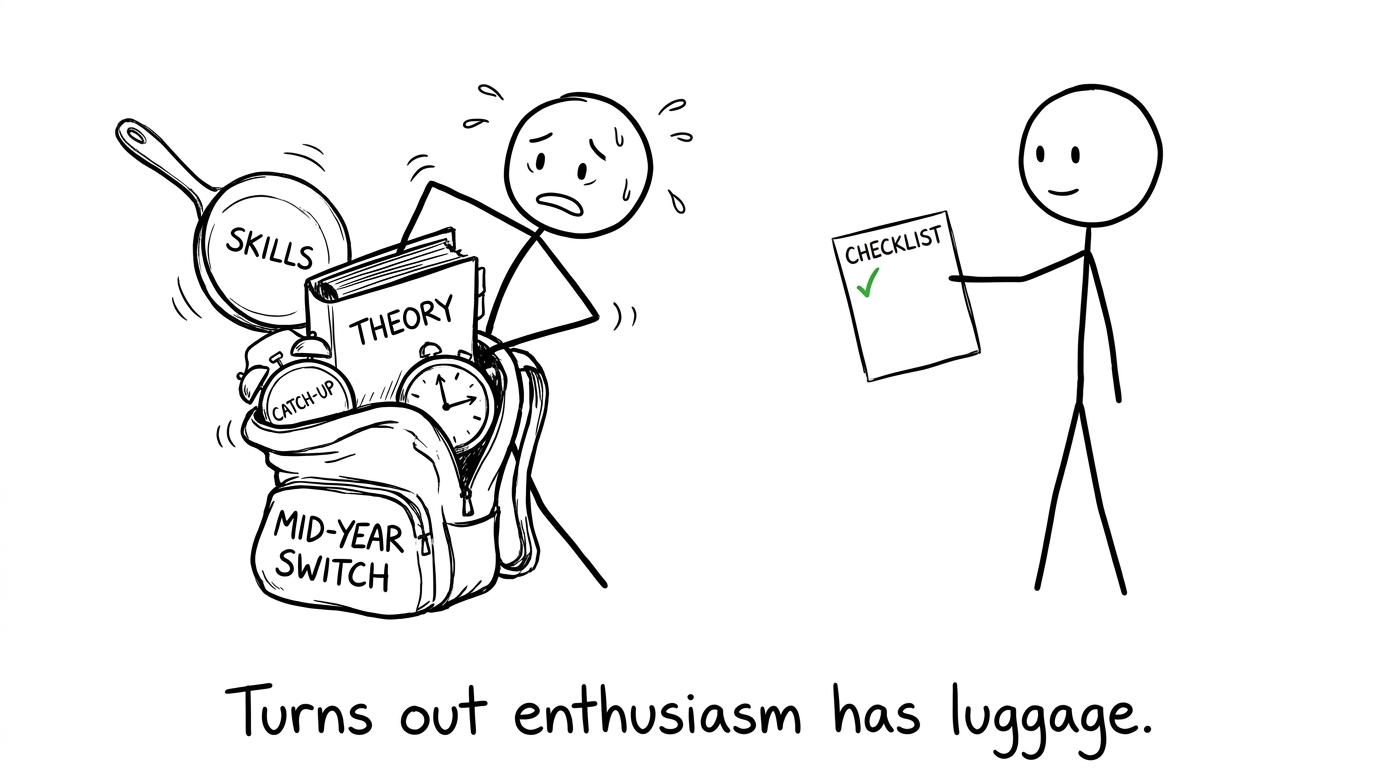 A mid-year subject change arrives with theory, skills and catch-up work
How maths supports Food Preparation and Nutrition
Changing an option subject does not reduce the importance of GCSE maths. Food work regularly draws on measurement, proportion, percentages, averages, graphs and time planning.
You may need to scale ingredient quantities using ratio, interpret nutritional information, compare costs or summarise sensory data. The relationship between two quantities can be expressed as:
scale factor=required number of portionsoriginal number of portions\text{scale factor}=\frac{\text{required number of portions}}{\text{original number of portions}}scale factor=original number of portionsrequired number of portionsThis is not a worked answer to memorise. It is a reminder that secure proportional reasoning makes practical decisions easier and reduces avoidable errors.
Use the free GCSE maths revision lessons to identify gaps in percentages, ratio, averages and statistical diagrams. Short, regular practice is usually more sustainable than adding one large maths session to an already demanding catch-up programme.
MathsGenie mini tests can help you check whether a topic is secure without consuming an entire evening. When examinations get closer, use GCSE past papers and mark schemes to practise selecting methods under timed conditions.
How to make a convincing subject-change request
Begin with the teacher or member of staff responsible for options at your school. Explain calmly why you want to move and ask what evidence is needed. Avoid presenting the switch as a demand or criticising your current teacher.
A strong request should cover:
- why Food Preparation and Nutrition is a better academic fit;
- what you understand about its theory and practical assessment;
- how many lessons or topics you have missed;
- when you will complete catch-up work;
- how you will protect time for English, maths and science;
- whether your parent or carer supports the request.
Ask the Food Preparation and Nutrition teacher what a realistic trial task or knowledge check might involve. The aim is not to prove that you already know the course. It is to show that you understand the size of the commitment.
It is equally important to listen to the answer. A refusal may reflect class safety, staffing, timetable structure or assessment rules rather than a judgement about your ability.
Build a catch-up plan that protects maths revision
A subject change can create a burst of motivation, followed by a crowded calendar. Plan before that happens.
List each missed topic and practical skill, then assign it a realistic school-supported deadline. Keep formal assessment separate from ordinary revision: your teacher must tell you what can be completed independently and what must take place under controlled conditions.
Next, protect recurring time for maths. The MathsGenie revision planner can help turn a broad goal into manageable topic sessions. Use GCSE predicted papers at the appropriate stage of the year, but do not treat them as a substitute for learning the full specification.
If you are unsure where to begin, return to the MathsGenie home page and choose resources matched to your current tier and target grade. Video solutions are most valuable when you first attempt the question yourself, mark it honestly and then correct the method.
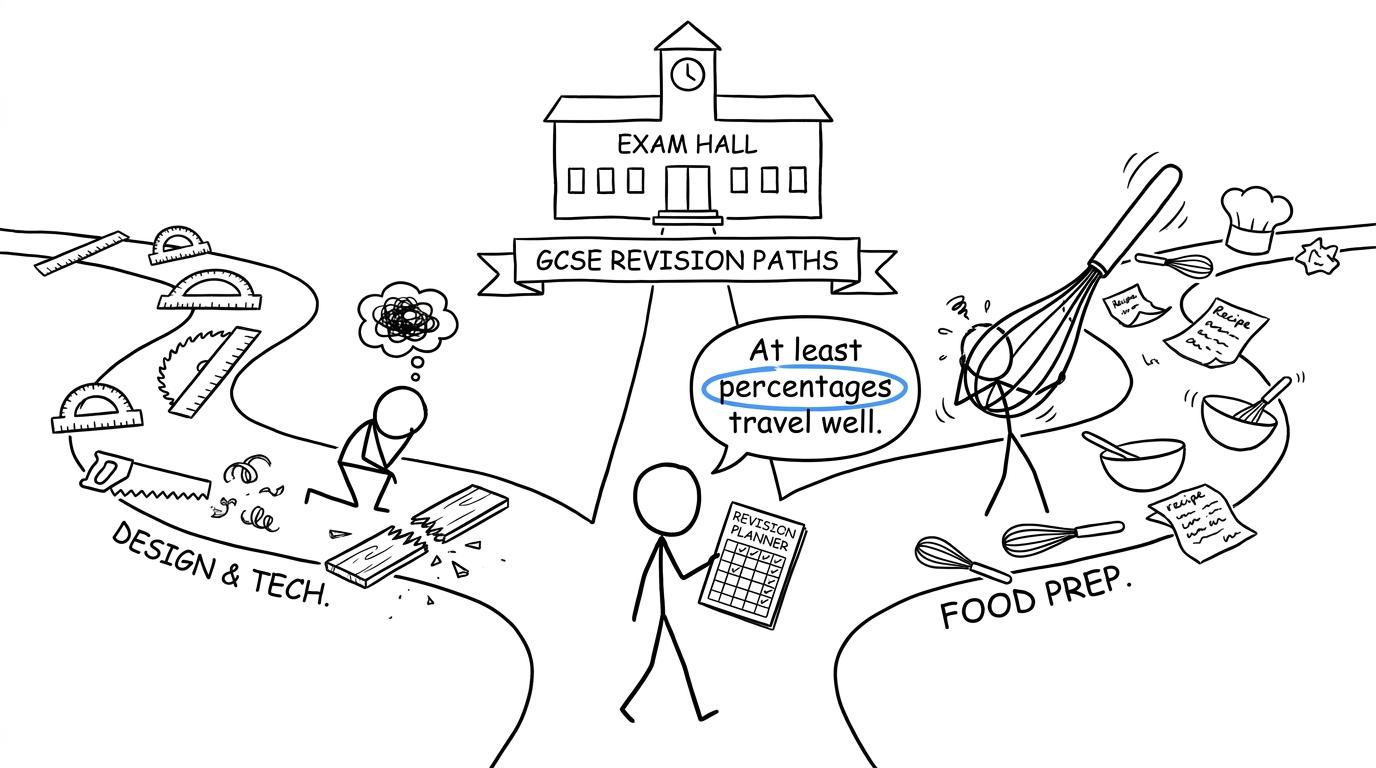 Different practical subjects still share useful revision skills
Common mistakes when requesting a mid-year switch
Assuming enjoyment is the only requirement
Liking cooking is a good starting point, but the GCSE includes scientific investigation, extended documentation, nutrition and evaluation. Read the course outline before deciding.
Waiting until NEA is well under way
The passage of time matters because assessment opportunities cannot always be reconstructed. Ask as soon as you have a serious concern, not after months of hoping it disappears.
Comparing only the examination weightings
Both subjects may divide assessment between an examination and NEA, but their knowledge, practical skills and evidence requirements are different. Existing D&T marks or portfolio pages will not normally transfer to the new qualification.
Planning catch-up work without the teacher
You cannot decide for yourself how formal NEA will be completed. Any plan must respect the specification, supervision requirements and your school’s internal arrangements.
Sacrificing every other subject
A switch is not successful if catching up causes maths, English and science revision to collapse. Keep using targeted MathsGenie GCSE resources, practice questions and mark schemes alongside the new subject workload.
Make the decision with open eyes
It may be possible to switch from GCSE Design and Technology to GCSE Food Preparation and Nutrition mid-year, particularly when the request is made early and the timetable, class capacity and assessment schedule allow it. But the decision belongs to your school, and enthusiasm must be matched by a credible plan for missed theory, supervised practical skills and NEA.
Speak to the relevant teachers promptly. Ask for the exact specification, curriculum map and assessment timetable. Then decide whether the catch-up load is manageable without weakening your core subjects.
Whatever your school decides, keep your maths progress steady. Use MathsGenie’s free revision lessons, practice questions, mini tests, past papers, predicted papers, mark schemes and video solutions to prepare methodically. A subject decision may change your timetable, but a calm revision routine keeps the rest of your GCSE journey moving forward.