Switch Exam Board GCSE Arabic: Is It Possible?
Want to switch exam board GCSE Arabic mid-course? Learn what your school controls, what may change and how to revise for the final specification.
A course can feel settled until one announcement changes the map. Your teacher mentions a different specification, unfamiliar papers appear, and suddenly the notes you trusted seem less certain.
If your school wants to switch exam board GCSE Arabic mid-course, the short answer is that a change may be administratively possible, but it is the school or examination centre, not an individual student, that normally chooses the qualification and submits the entry. The important question is not simply whether the board can change. It is whether the new qualification is available, whether your centre is approved to offer it, and how much its content and assessment differ from what you have already prepared.
You do not usually need to restart everything. Language knowledge travels well. Exam technique is less portable, so that is where careful adjustment matters most.
Your immediate checklist
Before changing any revision materials, ask your Arabic teacher or examinations officer to confirm:
- the full title of the old and new qualifications
- each specification and entry code
- whether the new course is a regulated GCSE or an International GCSE
- the examination series in which you will be entered
- the assessment components you must complete
- whether the qualification is tiered
- the speaking assessment format and window
- which content, vocabulary and grammar remain to be taught
- whether existing access arrangements need to be reviewed
- when the school will provide new specimen or past papers
That information turns a vague announcement into a manageable plan.
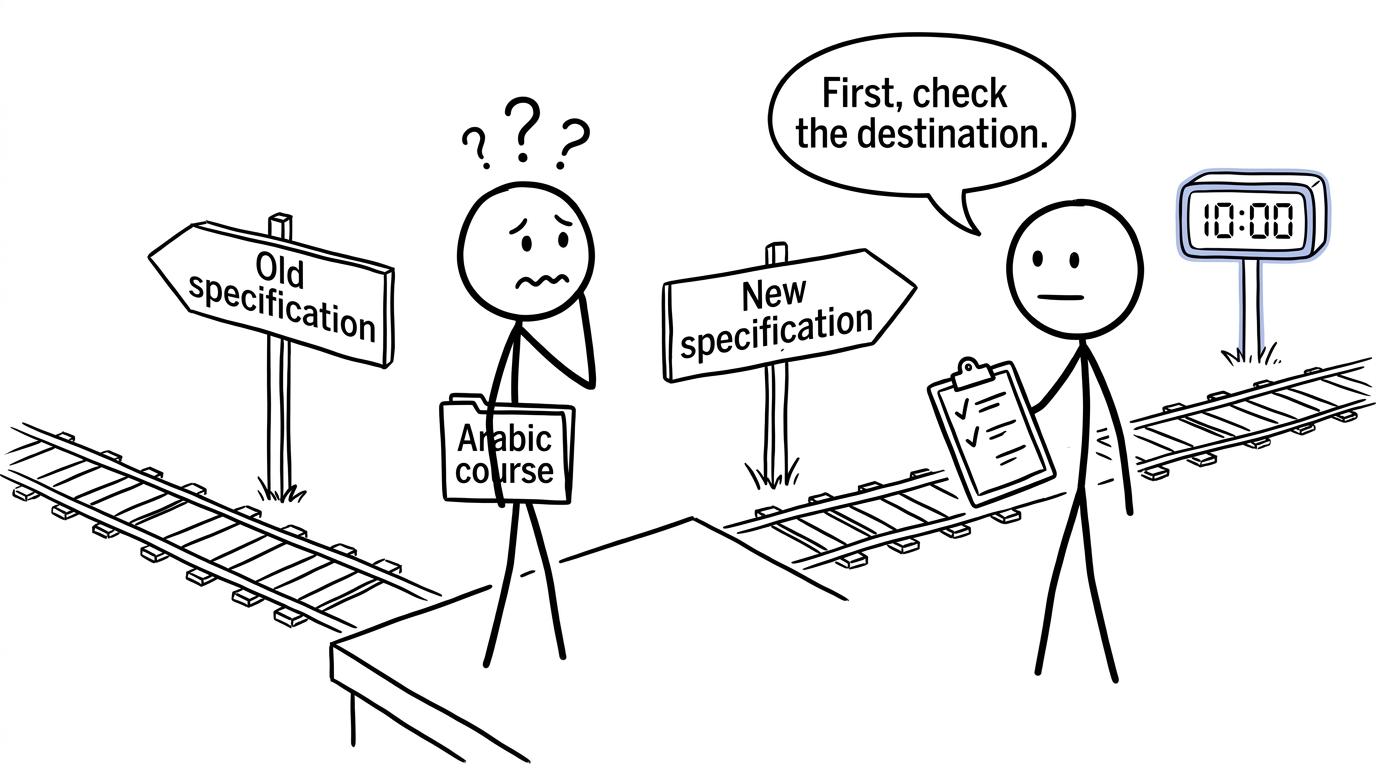 A student checking the destination before changing GCSE Arabic specifications
Can a school switch exam board for GCSE Arabic?
A school can generally reconsider which qualification it teaches, provided the replacement is available, the centre satisfies the awarding organisation's requirements and valid entries are made by the relevant deadlines. Whether changing partway through a particular course is sensible depends on timing and specification compatibility.
Students cannot normally select a different board independently while remaining in the same school class. Examination entries are managed by approved centres, and awarding organisations do not accept GCSE entries directly from students. A private candidate would still need to find an approved centre willing and able to make the entry and conduct any required assessment.
There is also an important current detail. For the regulated GCSE in Arabic in England, Pearson Edexcel lists specification 1AA0, including Foundation and Higher entries for the summer 202720272027 series. Arabic does not appear on the current GCSE qualification lists found for AQA, OCR or Eduqas. Therefore, if a school says it is changing the “exam board” for Arabic, ask for the precise qualification title. It may actually be moving between a regulated GCSE and an International GCSE, or between two international qualifications.
Those are not merely different brands of the same paper. They can have different regulators, assessment structures, topic requirements and centre approval rules.
What happens after the decision is made?
Once the school confirms the replacement qualification, teachers should compare the two specifications and update their teaching plan. The examinations officer then manages entries, codes, deadlines and any administrative contact with the awarding organisation.
For the student, the change should lead to four practical actions.
Your final qualification becomes the source of truth
Revise from the specification for the qualification you will actually sit. Old notes can still be useful, but they should be checked against the new content list rather than treated as complete.
Create three categories:
- secure overlap: knowledge assessed by both qualifications
- changed emphasis: familiar content tested in a different way
- new gap: content or tasks not covered before the switch
This is the same diagnostic habit that strengthens maths revision. MathsGenie's guide to finding your weakest GCSE topics explains why evidence is more useful than guessing.
The new assessment format must be practised
Knowing Arabic and knowing how a particular Arabic paper works are related, but they are not identical. A change may affect:
- the number and order of papers
- the balance of listening, speaking, reading and writing
- the language used in instructions and responses
- translation requirements
- speaking prompts and preparation rules
- permitted materials
- paper timings and mark allocations
- the availability of Foundation and Higher tiers
Under Pearson Edexcel GCSE Arabic 1AA0, the four skills are assessed separately and each contributes one quarter of the qualification. Students complete listening, speaking, reading and writing, and must be entered for one tier across all four papers. Mixed-tier entry is not allowed.
Do not assume another qualification uses that structure. Obtain its current specification and sample assessment materials before building a revision timetable.
Your school must confirm the tier
If the final qualification is Pearson Edexcel GCSE Arabic, your centre chooses either Foundation or Higher for all four papers. Pearson states that this decision must be made before the speaking assessment.
A board or qualification change should therefore include a fresh conversation about tier. Ask which tier you will enter and what evidence informed the decision. Practising Higher questions while being entered for Foundation, or the reverse, wastes valuable time and can create unnecessary anxiety.
Access arrangements may need checking
If you receive extra time or another access arrangement, speak to the school's special educational needs coordinator and examinations officer promptly. When a student changes centre, current JCQ guidance says the new centre must ensure that the evidence remains valid, that the arrangement reflects the student's normal way of working, and that any required application is completed.
A change of specification within the same school is not necessarily a change of centre, but it is still sensible to confirm that every approved arrangement covers the final entry and each relevant assessment.
Changing board is not the same as changing examination centre
These ideas are easily confused.
A qualification change means being entered for a different specification or awarding organisation. A transferred candidate arrangement generally means sitting timetabled examinations at a different approved centre while the original entry remains with the entering centre.
JCQ permits transferred-candidate arrangements only in defined circumstances, such as certain house moves after entries or particular exceptional situations. This process does not automatically change your exam board, specification or entry. If the entry itself must change, the awarding organisation has to be contacted through the centre.
If you have moved school mid-course, ask two separate questions:
- Which qualification will I be entered for?
- Which centre will conduct each assessment?
Arabic speaking arrangements make early clarification especially important.
How much of your previous learning still counts?
Usually, more than it first appears.
Core vocabulary, grammatical control, reading fluency, listening discrimination, accurate writing and the ability to sustain spoken Arabic remain valuable. The sunk-cost fear, the feeling that months of work have vanished, is often larger than the true content gap.
What may not transfer neatly is your rehearsed response to a specific task. A familiar speaking conversation cannot automatically prepare you for a different prompt structure. A writing plan built around one mark scheme may overlook what another paper rewards.
The sensible response is not to relearn the whole language. It is to audit the differences, then direct most of your time towards new content and changed task formats.
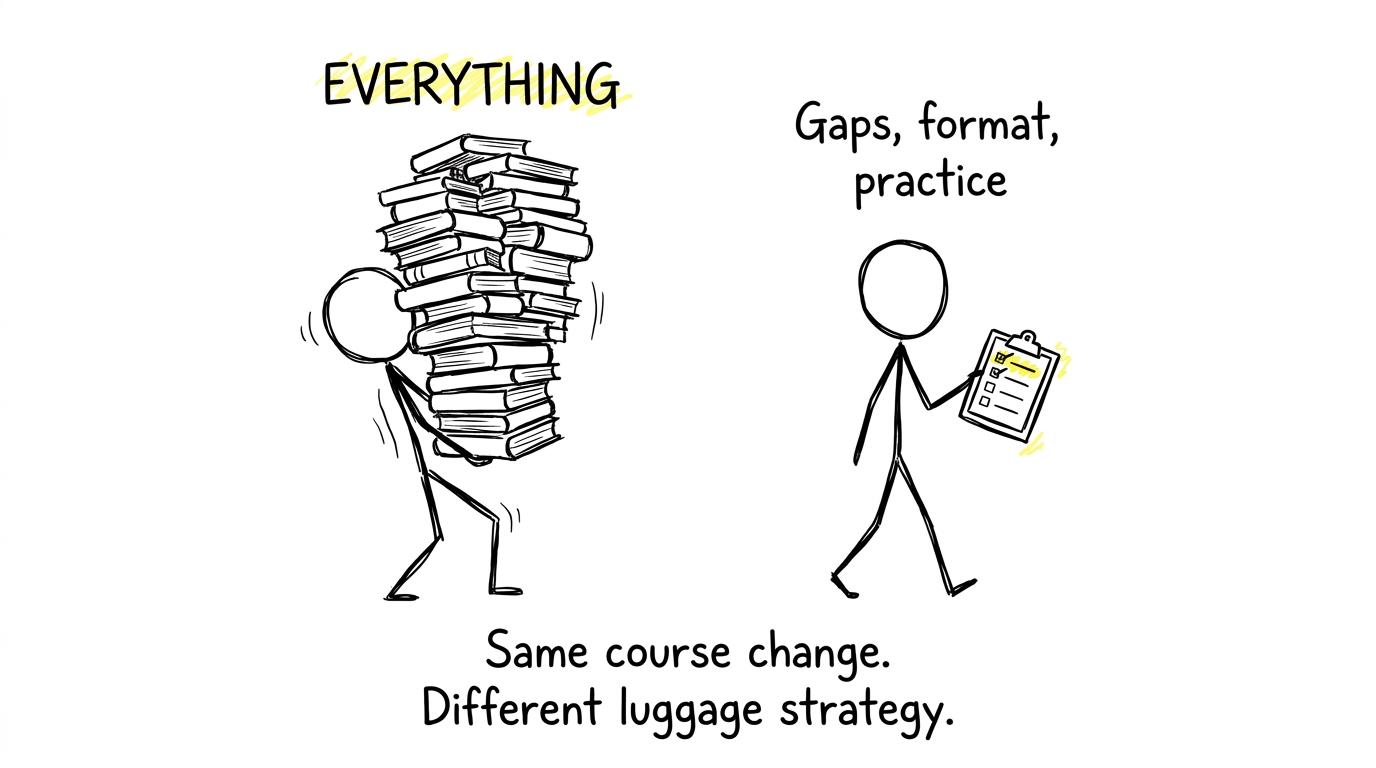 Two students choosing very different revision luggage after a course change
A calm adjustment plan
Build a specification gap list
Ask your teacher for a side-by-side comparison covering themes, grammar, vocabulary, paper structure and assessment objectives. Turn every genuine gap into a small revision task.
“Prepare for the new board” is too vague. “Practise the new speaking task twice this week” is actionable.
Use only correctly matched papers
Label every Arabic paper with its qualification title, code, tier and year. Archive old-board material separately. It can still support general language practice, but it should not be mistaken for a realistic mock of the final examination.
This principle matters in maths too. The GCSE Maths revision hub lets students choose the correct board and resources rather than mixing paper formats accidentally.
Learn the new mark scheme early
Do not wait until the final weeks to discover how the replacement qualification awards marks. Review specimen responses and mark schemes with your teacher. Look for what is rewarded in communication, accuracy, range, pronunciation or task completion, depending on the component.
A mark scheme is not merely a way to judge completed work. It tells you what successful work must contain. Maths students can see the same process in MathsGenie's guide to using Edexcel GCSE Maths past papers properly.
Protect your other GCSE subjects
An Arabic course change can absorb every spare evening if you let uncertainty set the timetable. Give the adjustment a defined block, then preserve revision for maths and your other subjects.
The GCSE one-month maths revision plan provides a repeatable structure based on diagnosis, targeted practice and timed papers. If you take Edexcel maths, use Edexcel GCSE Maths past papers with their mark schemes and solutions. Near the examination, Edexcel GCSE Maths predicted papers can provide fresh exam-style practice.
The wider lesson is simple: when one subject changes, structure protects the rest.
Common mistakes after a mid-course switch
Assuming the qualification names are interchangeable
GCSE Arabic and International GCSE Arabic can differ significantly. Record the exact title and specification code rather than relying on the word “Arabic”.
Continuing with the old paper format
Old questions may develop language skills, but they do not automatically prepare you for the final assessment. Prioritise the new specification's official materials.
Revising everything again
This feels thorough but wastes time. Identify overlap first, then focus on genuine gaps and changed tasks.
Ignoring speaking until later
Speaking assessments can take place before the main written papers. Confirm the format, preparation rules and assessment window immediately.
Treating an announcement as a confirmed entry
A teacher's plan is not the same as a completed examination entry. Ask the examinations officer to confirm the qualification, specification code, tier and series once entries are finalised.
Letting the change derail maths revision
Keep a separate, board-specific maths routine. MathsGenie's GCSE Maths night-before plan is useful near the exam, but steady revision should begin much earlier with lessons, practice questions, mini tests and past papers.
Make the final specification your map
A mid-course change is disruptive because it removes familiarity. It does not remove what you have learned.
Confirm the exact qualification, identify what overlaps, isolate the real gaps and practise the final assessment format. Your school should manage approval, entry and administration; your task is to make your revision match the paper you will actually sit.
Then give the rest of your GCSE programme the same clarity. Use MathsGenie as your free maths revision base: learn through revision lessons and video solutions, strengthen methods with practice questions and mini tests, and test yourself using board-specific past papers, mark schemes and predicted papers. Start at the MathsGenie GCSE Maths revision hub and turn uncertainty into a plan you can follow.