Study Playlists GCSE Astronomy Focus: Do They Help?
Study playlists GCSE astronomy focus: learn when music aids revision, when lyrics distract, and how to test your best soundtrack before exams begin.

The playlist is ready. The headphones are charged. You have even found a track called something like Deep Galactic Focus. Yet the page on orbital motion remains unread.
So, do study playlists GCSE astronomy focus sessions genuinely help? The most accurate answer is: sometimes, but not because a playlist magically improves learning. Instrumental music may make revision feel easier to begin and can mask distracting background noise. However, research does not show a reliable general improvement in memory or complex thinking. Music with lyrics is more likely to interfere, especially when you are reading, recalling terminology or interpreting a demanding question.
The playlist can support the routine. It cannot do the revision.
The quick focus checklist
Before pressing play, ask:
- Is the task routine practice or difficult new learning?
- Does the music contain lyrics that compete with reading?
- Is the volume low enough to become background sound?
- Will you leave the playlist alone rather than keep choosing tracks?
- Have you tested whether silence produces better marks?
- Can you complete some practice without music, as you will in the exam?
If a playlist helps you sit down and begin, it has value. If selecting it becomes the main event, it is probably a ritual rather than a focus tool.
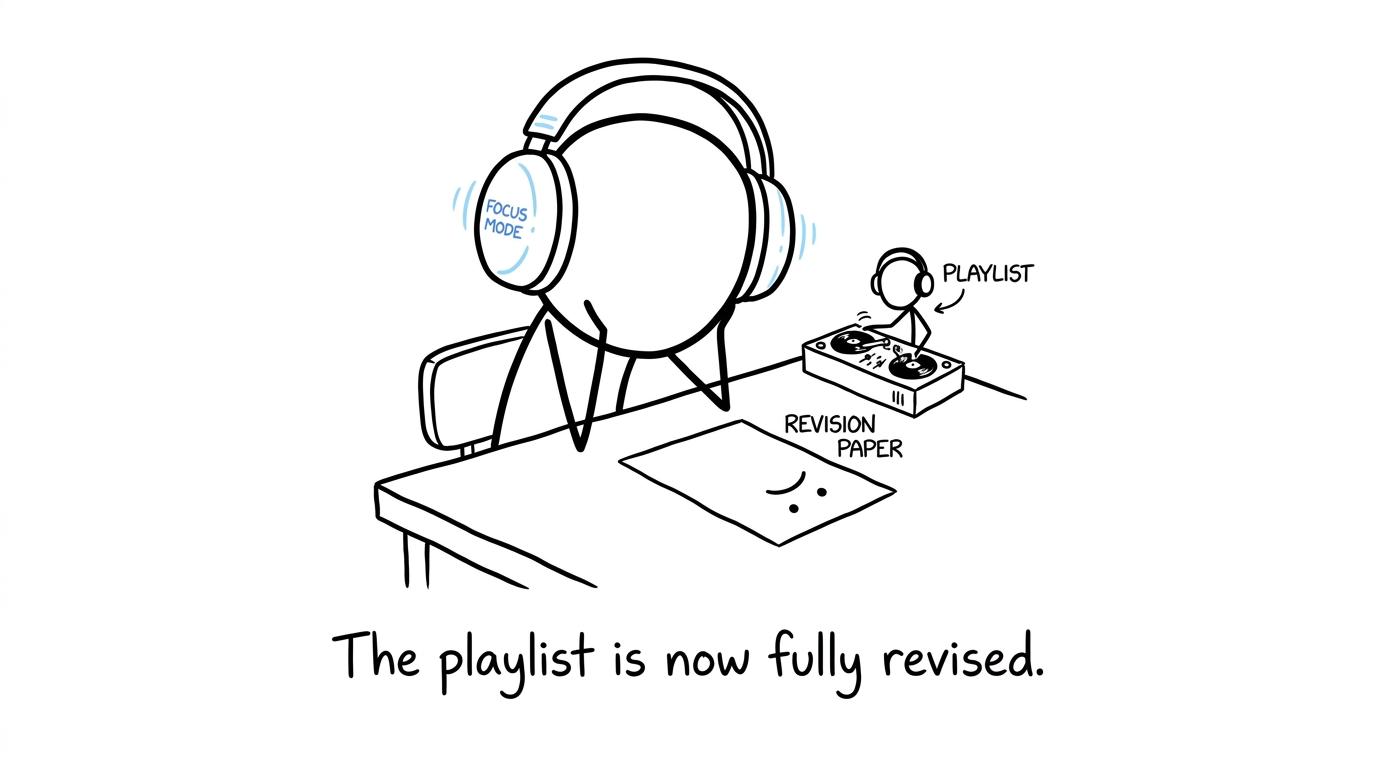 A student perfects a focus playlist while the revision paper waits
What the research actually suggests
Research into background music and cognitive performance is mixed because the effect depends on the person, task and music. That uncertainty matters. A result from a short laboratory task cannot guarantee what will happen during your own GCSE revision.
A systematic review published in Music & Science examined 959595 articles containing 154154154 experiments. Across most conditions, background music had no clear effect. Where disadvantages appeared, they were more common in memory and language tasks, with lyrical music generally more disruptive than instrumental music. Difficult tasks also appeared more vulnerable to interference.
A separate study published in the Journal of Cognition compared silence, instrumental lo-fi music and music with lyrics. Among the college students tested, lyrics reduced performance in verbal memory, visual memory and reading comprehension. Instrumental music produced no credible overall improvement or deterioration. Arithmetic performance showed no credible difference between conditions.
More recent research has found that specially designed instrumental focus music may improve mood and processing speed in particular attention tasks. That is interesting, but it does not establish that any curated playlist improves long-term learning, astronomical recall or GCSE marks.
The sensible conclusion is modest:
- Lyrics are the clearest risk, particularly during reading and recall.
- Instrumental music is usually less intrusive, but it is not a proven academic shortcut.
- Silence remains the safest condition for demanding learning.
- Individual testing matters more than a playlist's title or popularity.
There is also an important limitation: this evidence was not designed specifically around GCSE Astronomy students. Claims about astronomy revision therefore need to remain cautious.
Why GCSE Astronomy places unusual demands on attention
Pearson Edexcel GCSE Astronomy, specification 1AS01AS01AS0, combines scientific knowledge with calculations, graphs, observations and extended written responses. It has two equally weighted written papers: Naked-eye Astronomy and Telescopic Astronomy. Each lasts 111 hour 454545 minutes and carries 100100100 marks.
That mixture means one revision session can involve several kinds of thinking. You might read about stellar evolution, remember specialist vocabulary, interpret observational data and then complete a calculation. A soundtrack that feels harmless during straightforward questions may become distracting during a dense explanation.
Astronomy also relies on mathematical fluency. Large and small distances commonly require powers of ten, making standard form revision useful. Graphs, angles and periodic patterns can draw on skills developed through topics such as trigonometric and exponential graphs.
When a question combines several steps, working memory is already busy. Lyrics add another stream of language for the brain to process. Even if you are not consciously listening, familiar words can attract attention.
When a study playlist may genuinely help
Starting a revision session
The strongest benefit may be behavioural rather than cognitive. A familiar instrumental track can act as a cue: headphones on, phone away, questions open. It reduces the friction between intending to revise and actually beginning.
That is not trivial. A ritual is useful when it leads directly to action. The danger begins when you spend longer refining the ritual than practising the subject.
For a broader structure, use the GCSE one-month revision plan to decide what you will do before selecting any music.
Blocking unpredictable noise
In a busy home, library or shared room, quiet instrumental audio may be less distracting than conversations, televisions or doors opening. Predictable sound can mask unpredictable sound.
Keep the volume low. The aim is not to create an exciting listening experience. It is to make the environment less noticeable.
Completing familiar, repetitive practice
Music is less likely to cause trouble when the task is already secure. Examples include organising notes, reviewing familiar flashcards or completing routine questions where the method is well established.
Move towards silence when you encounter unfamiliar material, complex reasoning or repeated mistakes. MathsGenie's guide to efficient GCSE maths revision follows the more important loop: learn, practise, mark and fix.
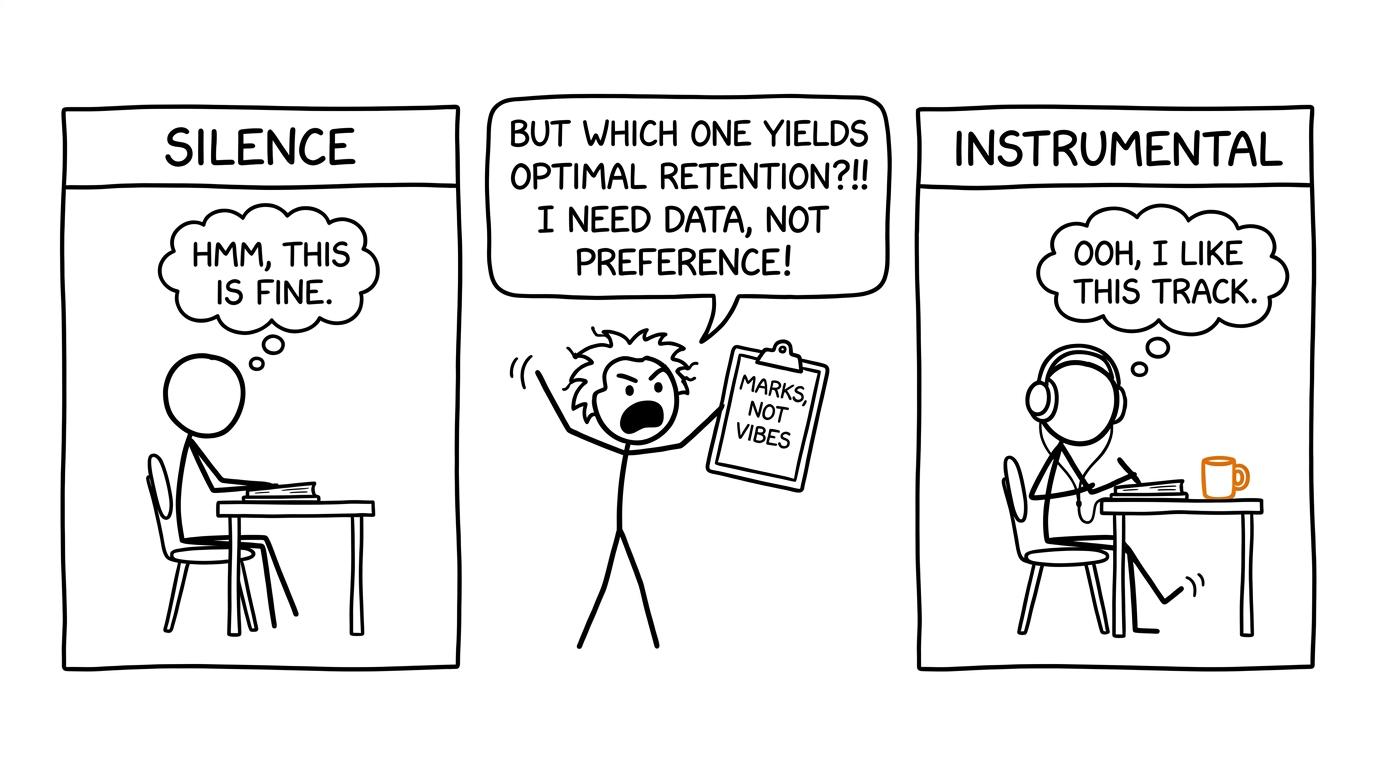 A student compares silence and instrumental music using marks rather than vibes
When the playlist becomes a distraction
Reading explanations with lyrics playing
Both song lyrics and textbook explanations use verbal processing. This makes lyrical music a poor companion for definitions, extended answers and unfamiliar scientific accounts. A song in a language you understand is especially likely to compete for attention.
Learning a difficult calculation
Instrumental music can still interfere when a task is cognitively demanding. If you are rearranging a formula, tracking units and interpreting data simultaneously, silence gives the problem more room.
Use the GCSE Maths revision hub to practise calculation skills through lessons, question banks, worksheets and solutions. The resource matters more than the soundtrack.
Constantly changing tracks
Skipping songs, checking titles and adjusting the volume are task switches. Each one pulls attention away from the page. A useful playlist should be familiar, long enough for the session and boring enough to leave alone.
Mistaking enjoyment for learning
Music may improve mood without improving retention. A pleasant session can still be unproductive if it consists mainly of rereading. Focus should leave evidence: completed questions, corrected errors and information recalled without notes.
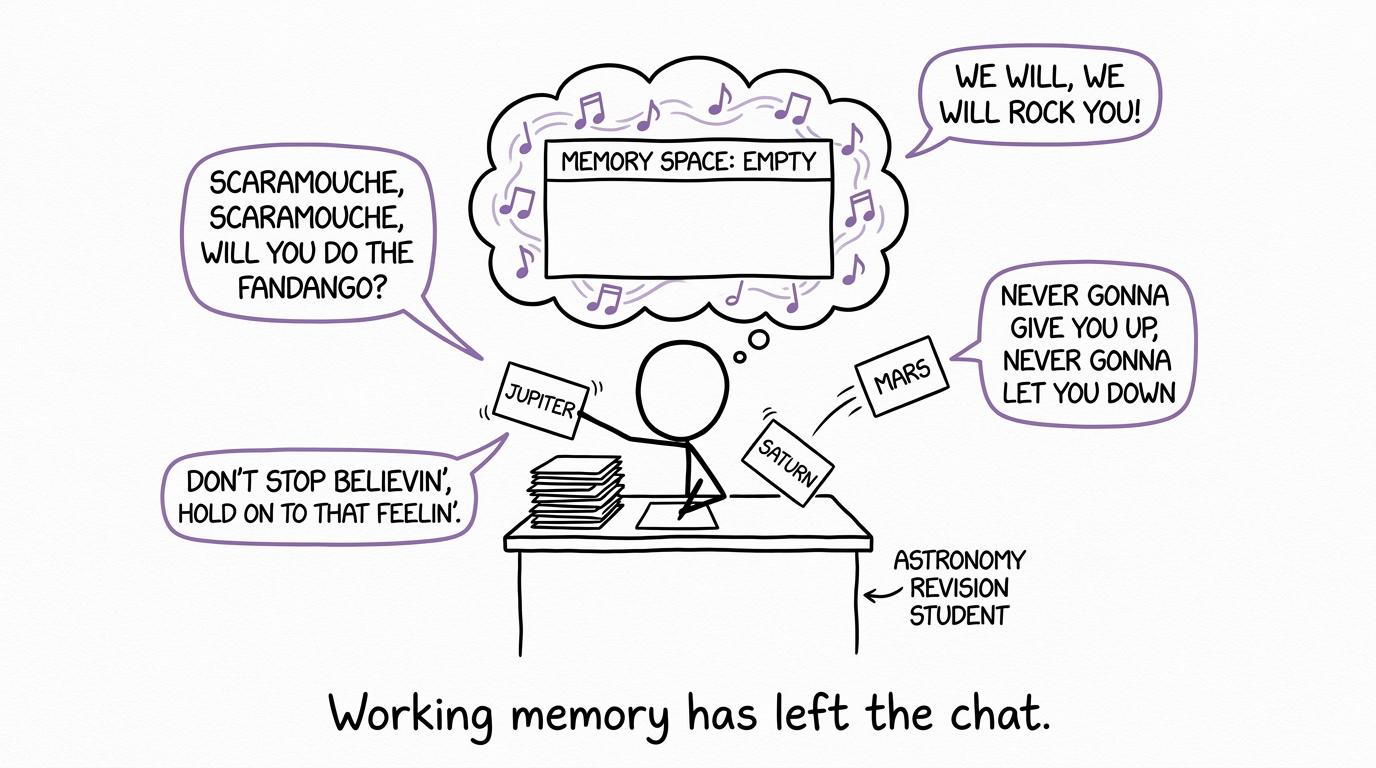 Song lyrics attempt to steal labels from astronomy revision cards
How to test your own astronomy focus
You do not need to guess whether music helps you. Run a small comparison over several sessions.
Choose two sets of questions that are similar in topic and difficulty. Complete one in silence and one with low-volume instrumental music. Keep the time limit, equipment and location as similar as possible. Avoid testing lyrical music if your task involves substantial reading or memory.
Record:
- marks earned;
- questions attempted;
- time taken;
- avoidable mistakes;
- how often you changed tracks or checked your phone;
- how much you can recall the next day.
A simple accuracy measure is:
Accuracy=marks earnedmarks available×100%\text{Accuracy} = \frac{\text{marks earned}}{\text{marks available}} \times 100\%Accuracy=marks availablemarks earned×100%Do not make a decision after one unusually good session. Compare several attempts and look for a consistent pattern. Marks and next-day recall are stronger evidence than whether the session felt smooth.
The same evidence-first approach is explained in MathsGenie's guide to finding your weakest GCSE topics. Diagnose what happened, change one variable and re-test.
Build a playlist that interferes less
If music helps you begin or masks noise, design it to demand as little attention as possible:
- choose instrumental tracks without spoken samples;
- use familiar music rather than surprising new releases;
- keep the volume low and steady;
- avoid dramatic changes in tempo or intensity;
- download the playlist to prevent notifications and browsing;
- make it longer than your planned revision block;
- start it once, then put the device out of reach.
Consider using different conditions for different tasks. Instrumental sound may suit routine practice, while silence is better for new content, retrieval and timed papers.
Crucially, practise in silence regularly. GCSE examinations do not provide a soundtrack. Exam-condition practice helps attention become less dependent on a particular cue. MathsGenie's advice on when to start GCSE past papers can help you build from short sections towards complete timed papers.
Common mistakes with revision playlists
Curating instead of revising
Choosing artwork, rearranging tracks and searching for the perfect playlist can feel productive because it is connected to revision. Set up one simple playlist and reuse it.
Using songs with memorable lyrics
Familiar lyrics are easy to follow automatically. Save them for breaks, journeys or low-demand organising rather than reading and recall.
Playing music too loudly
If the music repeatedly captures your attention, it is foreground entertainment rather than background sound. Lower it or switch it off.
Never testing silence
Preference is not the same as performance. Compare marked work completed under both conditions.
Depending on music for every session
You need to recall facts, interpret questions and calculate accurately in a quiet examination room. Include silent retrieval and timed practice each week.
Focusing on atmosphere rather than feedback
A playlist cannot tell you why marks were lost. Practice questions and mark schemes can. Nearer the maths examinations, use Edexcel GCSE Maths predicted papers under timed, silent conditions, then use the solutions to direct your next session.
The verdict: useful tool or comforting ritual?
Study playlists are often both. They can be a useful cue that lowers the effort of starting, masks disruptive noise and makes routine practice more tolerable. But their direct academic benefit is uncertain, and lyrics can actively harm reading and memory performance.
Treat music as part of your environment, not your revision method. Your method should remain active: recall information, answer questions, mark honestly and revisit mistakes. For maths skills that support astronomy and your main GCSE maths papers, MathsGenie brings free revision lessons, practice questions, mini tests, mark schemes, video solutions, past papers and predicted papers into one clear revision journey.
Choose one topic from the MathsGenie GCSE Maths hub, decide whether the task needs silence or gentle instrumental sound, and begin. The best playlist is ultimately the one you stop noticing while the work gets done.