Study Playlists GCSE Art and Design Focus: Do They Help?
Study playlists GCSE Art and Design focus: learn when music may help, when lyrics distract, and how to test a playlist without weakening maths revision.
A playlist can make revision feel as though it has begun before any work has actually happened. Headphones on. Sketchbook open. The right atmosphere, apparently, has arrived.
But do study playlists GCSE Art and Design focus genuinely improve concentration? The honest answer is: sometimes, for some tasks. Music may improve mood, reduce mind-wandering and make repetitive practical work easier to begin. Yet it is not a reliable cognitive upgrade. Lyrics can interfere with reading, memory and written annotation, while even instrumental music may distract you during difficult decisions.
The useful question is therefore not, “Does music work?” It is, “Does this music help me complete this particular task accurately?”
The quick playlist checklist
Before pressing play, ask:
- Is the task practical and familiar, or does it demand careful reading and reasoning?
- Does the music contain lyrics that compete with your internal voice?
- Can you leave the playlist alone without skipping tracks?
- Are you measuring completed work rather than how focused you feel?
- Can you also work in silence, as you may need to during supervised assessment or a maths exam?
If music helps you start and then disappears into the background, it may be useful. If choosing, skipping or singing along becomes part of the session, the playlist is probably the task.
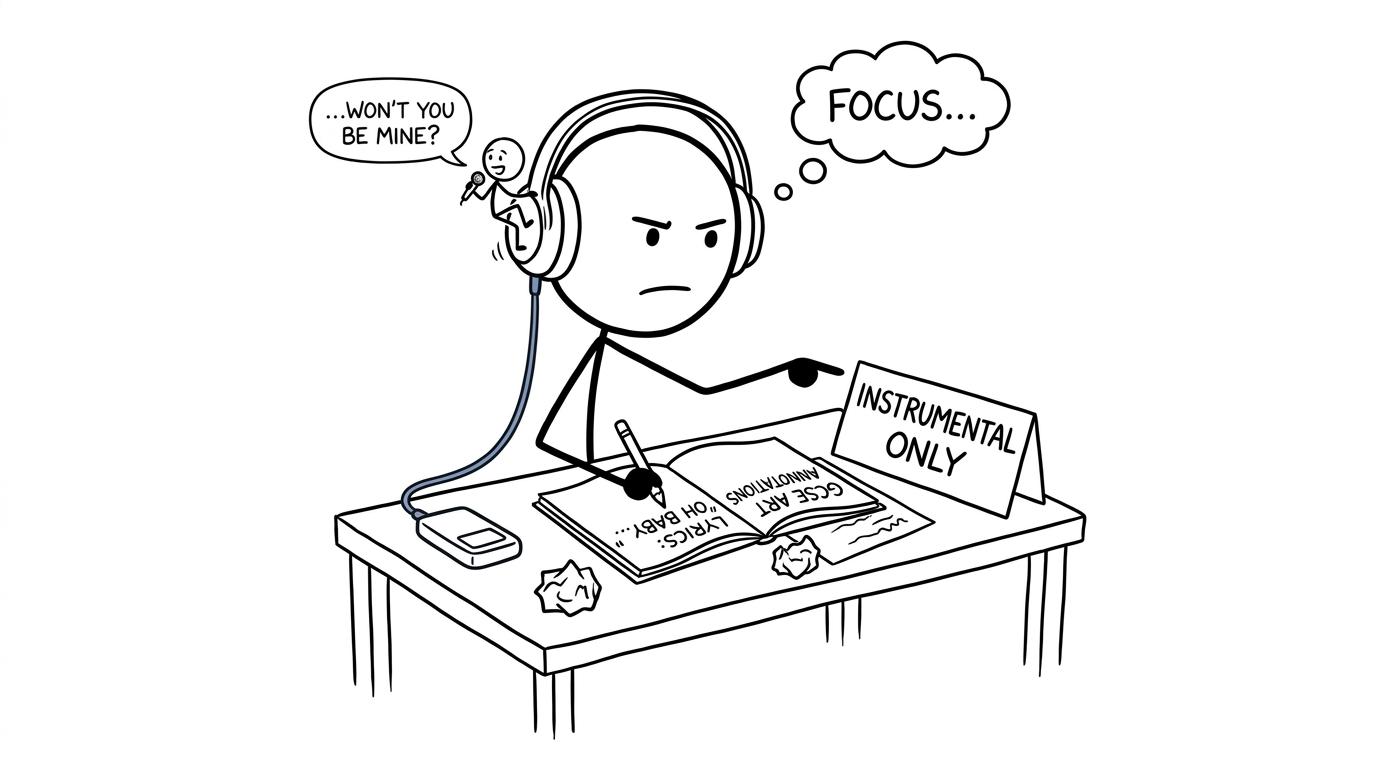 A song lyric tries to invade a student's annotation page
What the research says about music and focus
Research into background music does not support a simple promise that one genre automatically creates concentration. Systematic reviews find mixed, task-dependent results. In many experimental conditions, background music makes no meaningful difference. Where it does cause difficulty, music with lyrics tends to be more disruptive than instrumental music, particularly for reading, language and memory tasks.
A controlled study published in 2023 compared silence, instrumental lo-fi and lyrical music across reading, arithmetic, and verbal and visual memory tasks. Performance was generally strongest in silence, followed by instrumental music, with lyrical music causing the clearest interference. Instrumental music did not reliably improve performance, even though participants sometimes believed that it helped.
That distinction matters. Feeling productive and producing better work are not always the same thing.
Other research offers a more qualified positive picture. A 2024 sustained-attention study found that preferred background music reduced mind-wandering and increased reported task focus during a vigilance task. Earlier research also suggests that preferred music can help attention during easy, repetitive work, although improvements in perceived focus do not always produce better objective performance.
The sensible conclusion is neither “always use music” nor “always work in silence”. Music may regulate mood and alertness, but its effect depends on the student, the soundtrack and the mental demands of the task.
Why GCSE Art and Design needs different kinds of focus
GCSE Art and Design is not one continuous creative activity. Across Edexcel, AQA, OCR and Eduqas, students must provide evidence across four common assessment objectives: developing ideas, refining work, recording observations and presenting a personal response.
Those objectives involve very different mental processes.
Practical and repetitive work
Instrumental music may be least intrusive while you are completing a familiar practical process, mounting work, organising materials, applying repeated marks or developing a technique you already understand. These activities can become monotonous, so music may provide enough stimulation to help you remain at the desk.
This does not mean the playlist improves artistic quality. Its value may simply be behavioural: it lowers the resistance to starting and helps you continue through a routine stage.
Artist research and annotation
Silence is usually the safer default when reading about artists, evaluating sources or writing annotations. Lyrics occupy some of the same language-processing capacity needed to understand and form sentences. Familiar songs may be especially intrusive because your mind predicts the next words automatically.
If you repeatedly reread a paragraph, write shallow comments or lose the connection between a source and your intentions, turn the music off before assuming the work is too difficult.
Generating and refining ideas
Claims that music boosts creativity need caution. Studies use different definitions of creativity and have produced conflicting findings. Instrumental music has supported performance in some divergent-thinking experiments, while other experiments have found that background music disrupted insight-based creative problem-solving.
GCSE Art and Design is broader than either laboratory task. Developing a response involves investigation, judgement, experimentation and reflection. A playlist might improve your mood while you generate possibilities, but it cannot make those possibilities relevant, personal or well refined.
Supervised assessment conditions
Do not build a routine that depends completely on headphones. GCSE Art and Design includes an externally set assignment with supervised unaided time, although the precise administration and permitted arrangements should always be checked with your teacher and current exam-board guidance. Your school may not permit personal music or headphones.
A playlist should be an optional support, not a condition you require before you can work.
When a playlist becomes a useful ritual
A ritual is not necessarily fake. Its value lies in what it triggers.
A familiar instrumental playlist can become a consistent starting signal: place the phone out of reach, open the sketchbook and begin the planned task. By reducing small decisions, the ritual may make action easier. The music has not created ability; it has created a doorway into the work.
The danger appears when preparation expands. Searching for the perfect mix, adjusting the queue and comparing “deep focus” playlists can feel responsible while protecting you from the uncomfortable first step.
Set the task before selecting the sound. “Work on Art” is vague. “Complete two observational studies and add a short reflection on the most effective material” gives the session a finish line.
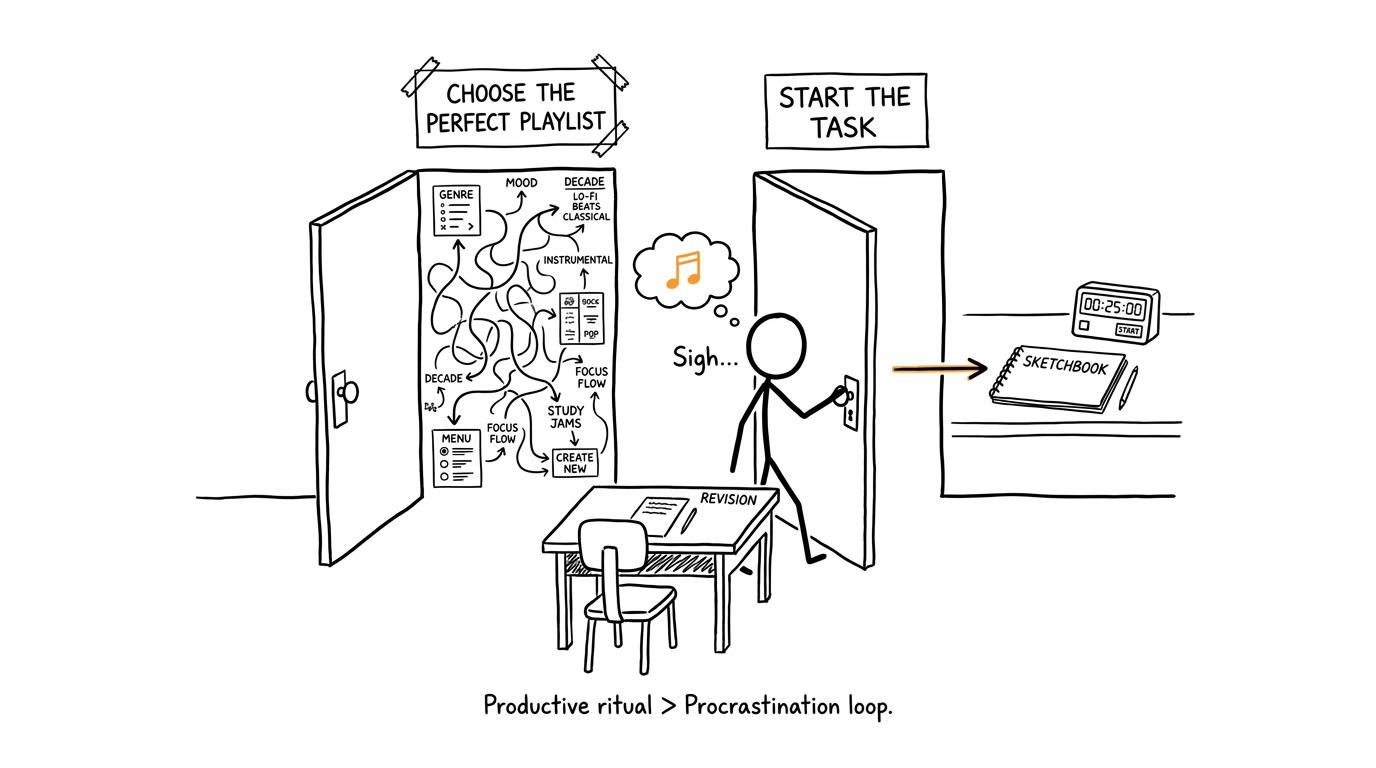 A student chooses starting work over an endless playlist maze
How to build a playlist that is less distracting
If you want to use music, design the environment rather than trusting a fashionable playlist title.
Prefer low-salience audio
Choose instrumental tracks with few dramatic changes. Music with a steady character is less likely to pull your attention away whenever the rhythm, volume or style changes. Unfamiliar instrumental music may be easier to ignore than a favourite song attached to strong memories.
Keep the volume low. The aim is background sound, not an immersive listening session.
Remove decisions before starting
Use a prepared playlist long enough to cover the session. Turn off notifications and avoid tracks that make you reach for the screen. If you must manage the music every few minutes, it is not functioning as background audio.
Maths revision benefits from the same reduction in unnecessary decisions. The GCSE maths revision timetable guide shows how to give each session a specific purpose, while the twenty-minute maths revision routine provides a simple structure for busy days.
Match the soundtrack to the task
Use instrumental audio for familiar making, silence for reading and annotation, and silence or very unobtrusive sound for difficult decisions. When switching tasks, reconsider the audio instead of letting one playlist run automatically.
For maths, the threshold should be stricter. Reading a multi-step problem, holding values in working memory and choosing a method are mentally demanding. Silence is the best baseline for learning unfamiliar content and completing timed papers, especially because that matches exam conditions.
Test your playlist instead of trusting it
You do not need a laboratory. You need a fair comparison.
Choose two similar sessions. Work in silence during one and with your proposed playlist during the other. Keep the location, session length and type of task as similar as reasonably possible. Record:
- whether you started on time;
- how often you touched your phone or changed tracks;
- how much planned work you completed;
- whether you noticed avoidable errors;
- whether the work met its original purpose.
You could summarise each session with a simple completion measure:
Completion rate=planned tasks completedplanned tasks×100%\text{Completion rate}=\frac{\text{planned tasks completed}}{\text{planned tasks}}\times 100\%Completion rate=planned tasksplanned tasks completed×100%Treat that figure as one piece of evidence rather than a verdict. Quality matters too, particularly for annotation, visual recording and refinement.
For maths, objective feedback is easier to obtain. Complete comparable sets from the Edexcel GCSE Maths mini tests, or select material for your board from the GCSE Maths revision hub. Compare accuracy, time and the number of questions you could begin without help.
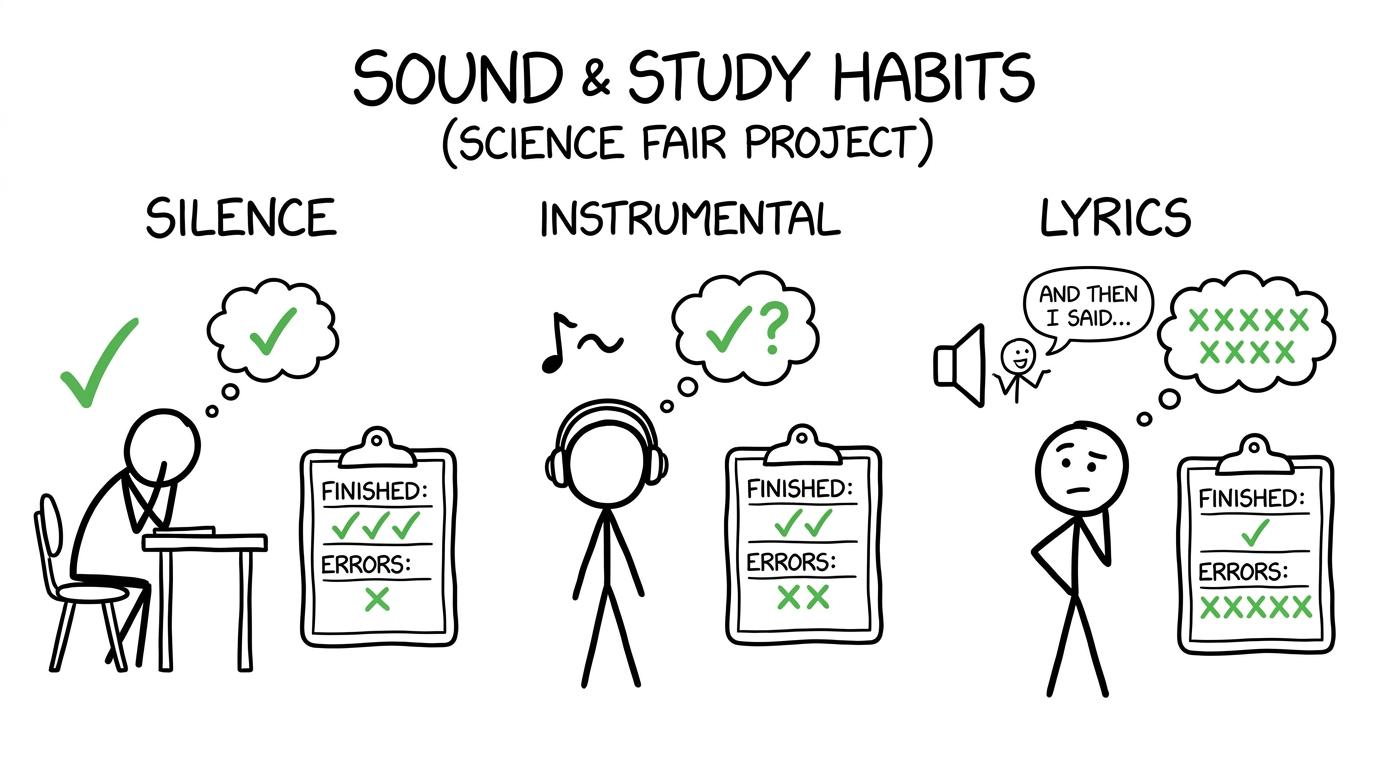 A student compares silence, instrumental music and lyrical music
Using music without weakening maths revision
Art and maths place different demands on attention. A soundtrack that feels harmless while refining a familiar drawing may become disruptive while interpreting a graph or rearranging an equation.
Build some silent practice into every week. Use revision lessons and practice questions with minimal distraction, then complete timed work under realistic conditions. The guide to using GCSE past papers properly explains the attempt, mark, fix and retest cycle.
Choose papers that match your specification and tier. MathsGenie provides Edexcel GCSE Maths past papers, AQA GCSE Maths past papers and OCR GCSE Maths past papers, with mark schemes and worked or video solutions where available.
Near the exams, GCSE predicted papers can provide fresh questions. They should complement past papers rather than replace them. Whatever audio you use for ordinary practice, complete full papers in silence so that concentration itself becomes familiar.
Common mistakes with study playlists
Choosing music by genre alone
“Classical” does not automatically mean calming, and “lo-fi” does not automatically mean effective. Volume, familiarity, lyrics, changes in intensity and personal response all matter.
Measuring mood instead of output
Enjoying a session is valuable if it helps you return tomorrow. It is not proof that your annotation became more analytical or that your maths answers became more accurate. Check the work.
Using lyrics during language-heavy tasks
Artist research, annotation and written evaluation require language processing. Singing along internally creates competition for attention, even if you remain seated for longer.
Changing tracks repeatedly
Each skip is a small interruption. A playlist designed for focus should require almost no management once the session begins.
Never practising in exam conditions
If every difficult task is paired with music, silence can feel unusually uncomfortable when the real assessment arrives. Practise the environment as well as the subject.
Make the playlist earn its place
Study playlists can help GCSE Art and Design focus when they reduce the friction of starting, support mood and sit quietly behind familiar practical work. They are less convincing as a direct route to better thinking. For reading, annotation, memory and complex problem-solving, silence is often safer, while lyrical music carries the clearest risk of interference.
Use music as a tool, not a promise. Give it one job, test whether it performs that job and remove it when the task changes.
Then bring the same evidence-based approach to maths. Start with MathsGenie’s free revision lessons, practise with focused questions and mini tests, and test your progress using past papers and predicted papers. Mark every attempt carefully, use the mark schemes and video solutions to repair weak methods, and make silent exam practice part of the routine. The best soundtrack to progress is still completed work.