Staying Consistent: GCSE English Literature Revision
Staying consistent GCSE English Literature revision advice for low-motivation weeks, with short routines, active recall and realistic planning.
Some evenings, opening the novel feels harder than analysing it. You know revision matters, but motivation has quietly left the room. The answer is not to wait until enthusiasm returns. Staying consistent with GCSE English Literature revision depends on creating a routine that still works when you are tired, busy or more worried about tomorrow's maths lesson.
Start with a small daily minimum, decide the task in advance and use active recall rather than passive rereading. On difficult days, completing ten focused minutes is more valuable than planning an ambitious hour and never beginning. Consistency is not doing everything every day. It is making the next useful action easy enough to repeat.
The low-motivation checklist
When motivation dips, use this stripped-back routine:
- Choose one text, character, theme or poem before the session begins.
- Set a minimum task that takes about 101010 minutes.
- Recall ideas and quotations before checking your notes.
- Complete one paragraph plan or short analytical paragraph.
- Record one gap to revisit later in the week.
- Stop at the planned time unless you genuinely want to continue.
- Keep English and maths in separate, clearly defined revision blocks.
The purpose is not to produce your finest work every evening. It is to keep returning to the material so that forgetting does not gain too much ground.
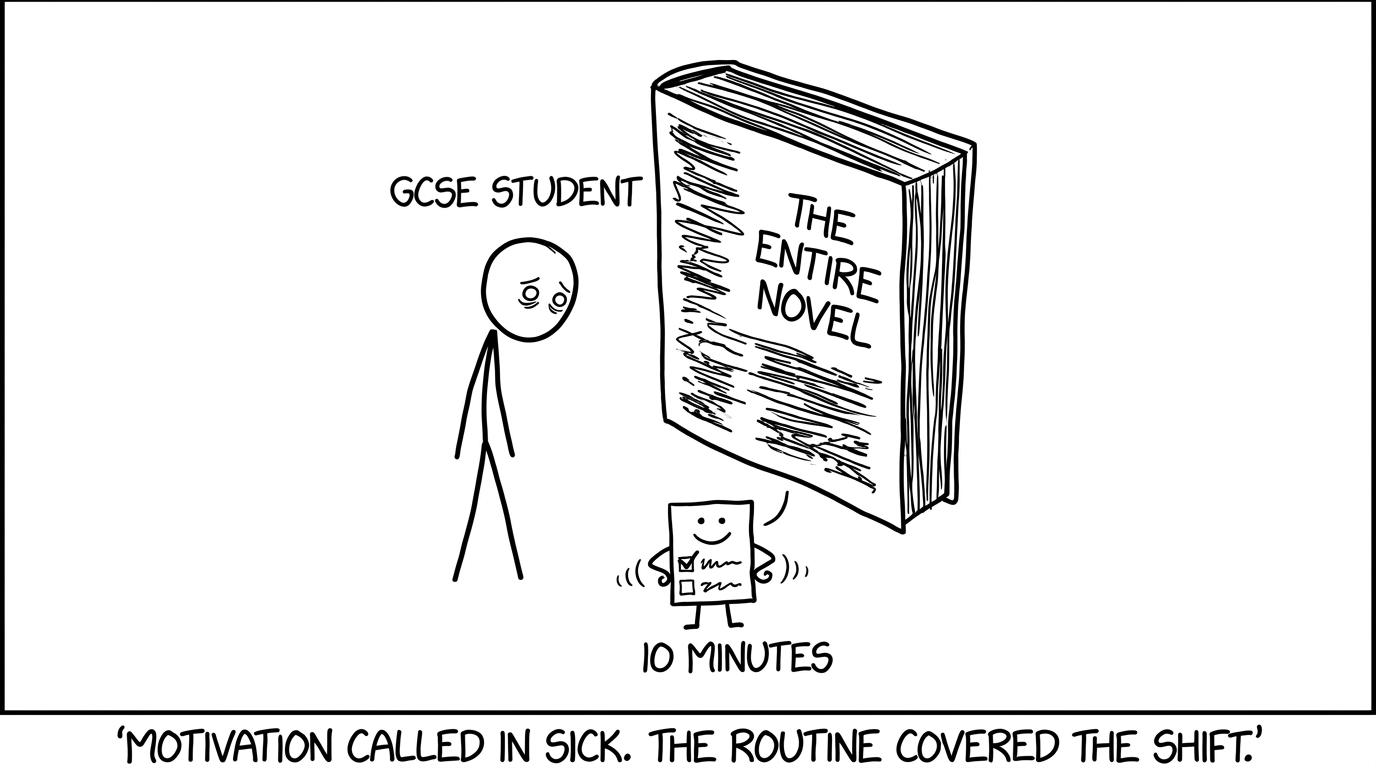 A tiny ten-minute checklist takes over when revision motivation calls in sick
Build a system that does not require motivation
Motivation is helpful, but unreliable. It rises after a good lesson, disappears after a tiring school day and often returns only when an exam feels uncomfortably close. A dependable system assumes this will happen.
Choose a repeatable cue: after dinner, after a short break from school or immediately before your maths session. Keep the location and starting action consistent. You might sit at the same desk, put your phone elsewhere and begin by writing everything you remember about one theme.
Decide tomorrow's task at the end of today's session. “Revise English Literature” creates too many choices. “Recall five quotations about responsibility and plan one paragraph” tells you exactly how to begin. Reducing decisions reduces the opportunity to postpone them.
A useful rule is to have two versions of your routine:
| Type of day | Minimum English Literature task |
|---|---|
| Normal day | Recall key knowledge, plan a response and check it against your notes |
| Difficult day | Retrieve three quotations or ideas and explain one writer's choice |
The difficult-day version is not a punishment or an excuse. It is a bridge between better days.
Make revision active enough to reveal gaps
Rereading a quotation sheet can feel reassuring because everything looks familiar. Recognition, however, is not the same as being able to retrieve and use an idea independently.
Research reviewed by the Education Endowment Foundation supports carefully planned retrieval and spaced practice. Retrieval means attempting to recall information with minimal prompting. Spacing means returning to it over separate sessions rather than concentrating all the work into one evening. The evidence also suggests that implementation matters, so these techniques should be used thoughtfully rather than treated as magic tricks.
For English Literature, active revision could include:
- writing remembered quotations before opening the text;
- linking a quotation to character, theme and context;
- explaining how language, form or structure shapes meaning;
- planning a response to an unfamiliar question;
- comparing two anthology poems from memory;
- annotating an unseen poem under a short time limit;
- checking your response against your exam board's mark scheme.
These activities expose uncertainty. That can feel less comfortable than highlighting, but it gives your next session a clear purpose.
The principle transfers directly to maths. MathsGenie's guide to stopping GCSE maths content from being forgotten uses the same broad rhythm: retrieve, practise, check and revisit.
Revise what the exam actually rewards
Consistency becomes easier when you know what you are practising. Across GCSE English Literature specifications, assessment objectives focus on understanding and responding to texts, supporting interpretations with textual references, analysing writers' methods, understanding relevant context and writing accurately where assessed.
Exact papers, set texts, timings and assessment-objective weightings vary between AQA, Edexcel, OCR and Eduqas. English Literature is untiered, unlike foundation and higher tier GCSE Maths. Check your current specification, teacher guidance and exam-board materials before building a revision plan.
Do not let quotation recall consume every session. Quotations support an interpretation; they are not the whole interpretation. Rotate between four areas:
Knowledge
Recall plot, character development, themes, relationships and the sequence of important events. For poetry, know the central argument and emotional movement of each poem.
Evidence
Build a flexible bank of short, accurate textual references. A small quotation that applies to several themes is usually more useful than a long passage you cannot confidently deploy.
Analysis
Practise explaining how a writer's choices produce meaning and why those choices matter. Relevant terminology helps when it sharpens the explanation, not when it replaces one.
Exam decisions
Plan responses, select evidence and practise working within the demands of your paper. Use official questions and mark schemes supplied for your board whenever possible.
Use a weekly rhythm instead of a perfect timetable
A timetable often fails because it imagines every day will have equal energy. A weekly rhythm is more forgiving. It gives each session a purpose while leaving room for homework, clubs, illness and other GCSE subjects.
A manageable pattern might include:
- one quotation and knowledge-retrieval session;
- one character or theme paragraph plan;
- one poetry comparison or unseen-poetry task;
- one timed response or longer plan;
- one short review of errors and forgotten material.
Space these activities across the week. If you miss Tuesday, move the task rather than declaring the plan ruined. Never turn one missed session into a missed week.
This is also why a small minimum matters. MathsGenie's 20-minute GCSE maths revision routine demonstrates how a fixed sequence can remove the daily argument about where to start. For broader organisation, the one-month GCSE maths revision plan offers a useful model for combining retrieval, focused practice and timed work.
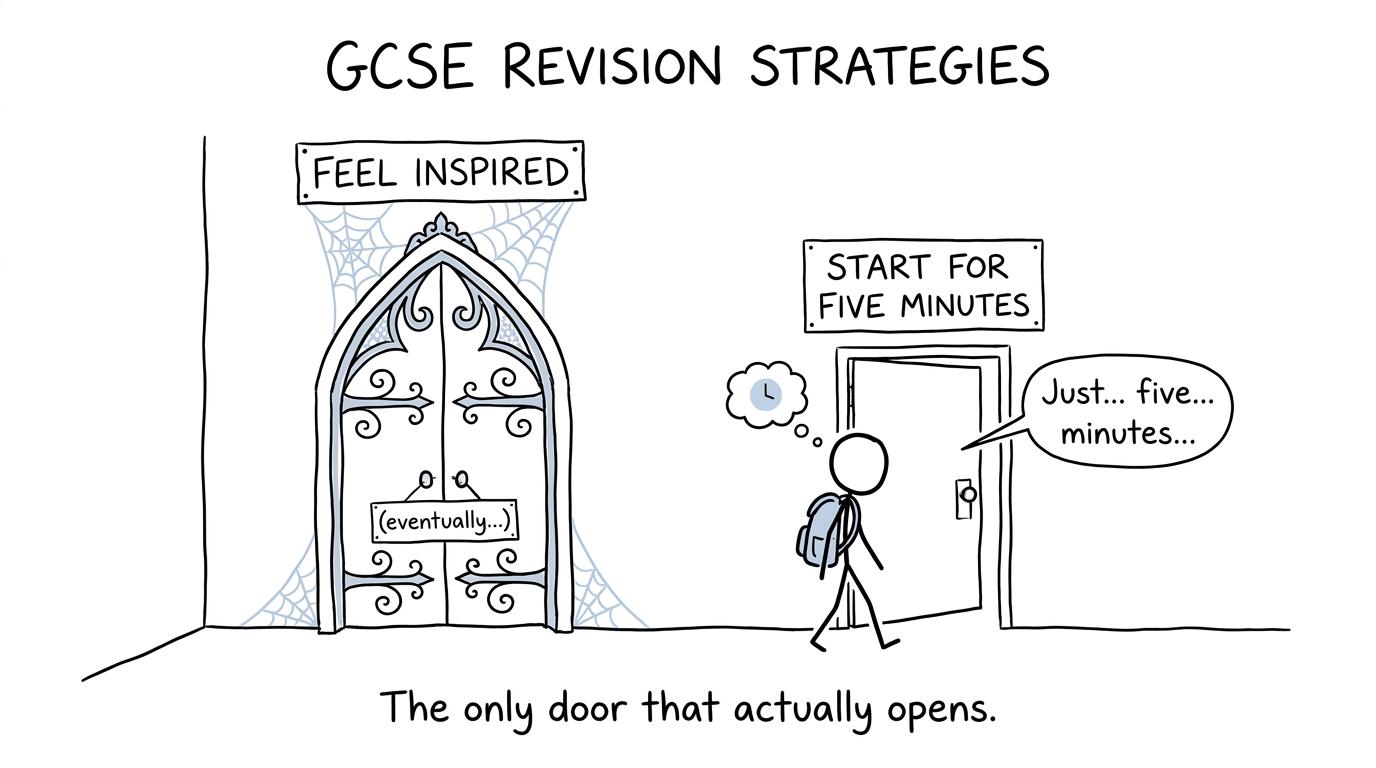 A student chooses the small start-for-five-minutes door instead of waiting to feel inspired
Measure consistency by evidence, not hours
Hours can be deceptive. An hour spent arranging stationery and copying notes may achieve less than fifteen minutes of honest retrieval.
Track outputs instead:
- quotations accurately recalled;
- paragraph plans completed;
- poems compared;
- questions attempted under time;
- weaknesses identified and revisited.
Keep a simple error log. After checking work, write the precise problem and next action. “Bad at poetry” is too vague. “I describe imagery without explaining its effect” is useful. Your next task can then be one paragraph focused on connecting imagery to interpretation.
Maths students can apply the same diagnostic thinking through MathsGenie's guide to finding weak GCSE topics. The aim in both subjects is to replace a general feeling of being behind with a specific action you can complete.
Protect English revision while preparing for maths
During exam season, the loudest subject often takes over. Maths produces visible right or wrong answers, so progress can seem easier to measure. Literature can feel open-ended, which makes it tempting to postpone.
Avoid making English and maths compete inside the same vague block. Give each a defined task. For example, complete a short English retrieval session, take a proper break and then open the GCSE Maths revision hub for one targeted topic.
If you study Edexcel Maths, the Edexcel GCSE Maths revision area keeps foundation and higher resources together. Once topic skills are secure, use Edexcel GCSE Maths past papers with their mark schemes and available solutions.
This separation helps psychologically. You are not facing “all of English and all of maths”. You are completing one defined English action and one defined maths action.
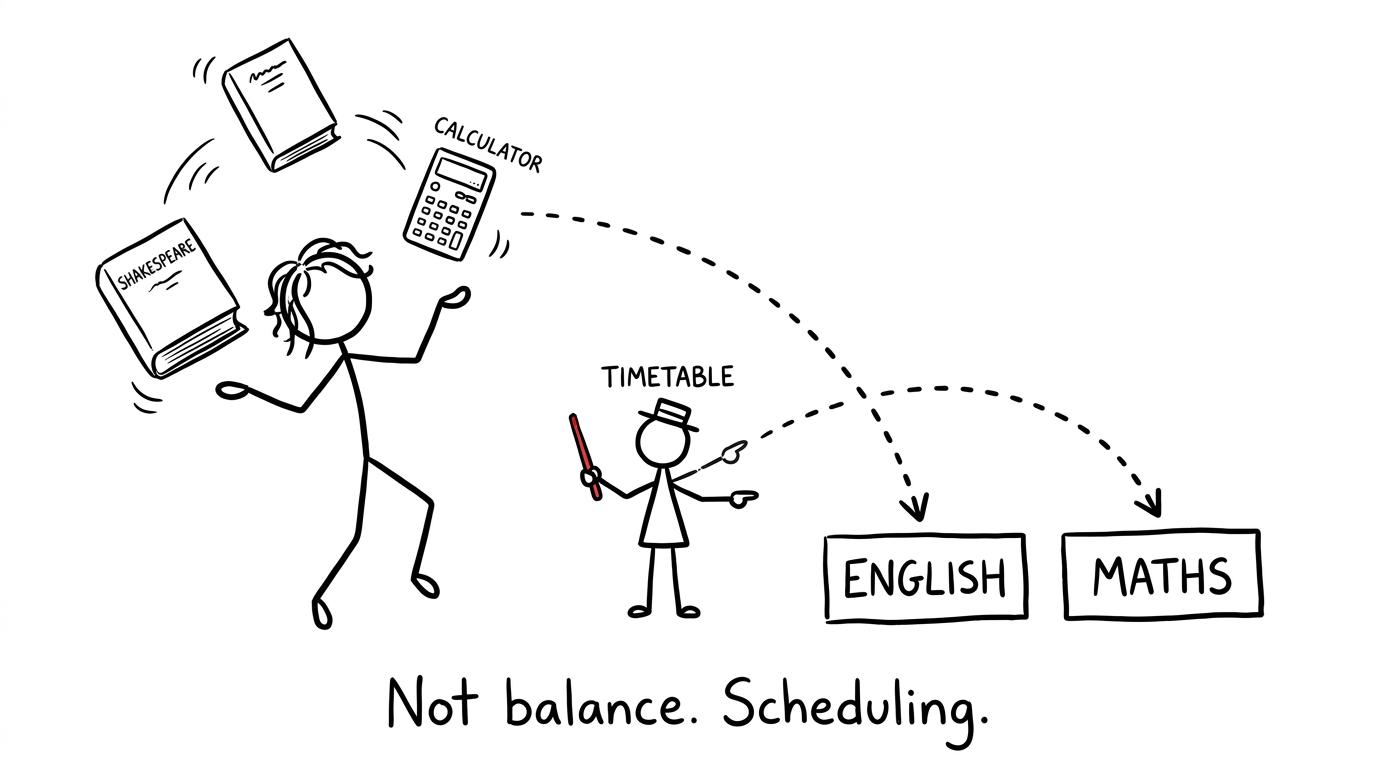 A timetable safely lands a Shakespeare book and calculator on separate revision runways
What to do after missing several days
Do not repay missed revision with an exhausting catch-up session. That makes returning feel expensive and strengthens the urge to avoid it.
Restart with three steps:
- retrieve what you can about one familiar text;
- identify one gap without judging yourself for it;
- schedule the next short review before stopping.
Then rebuild your normal rhythm. Consistency is not an unbroken streak. It is the ability to return quickly after disruption.
If your workload is genuinely unmanageable, speak to a teacher, parent, carer or another trusted adult. A revision plan should support sleep and school attendance, not steadily displace them.
Common mistakes that break revision consistency
Making the minimum too ambitious
If every session requires a complete essay, starting will feel costly. Use paragraph plans, retrieval grids and short analytical tasks between longer responses.
Confusing neat notes with effective revision
Notes are useful resources, but producing them is not automatically evidence of learning. Close the book and retrieve before checking.
Revising favourite texts repeatedly
Familiar material feels productive. Rotate your texts and use missed questions to decide what returns next.
Memorising analysis word for word
Prepared interpretations can help, but rigid scripts may not answer the question set. Learn adaptable ideas, concise evidence and the reasoning connecting them.
Ignoring the specification
Do not assume every board has identical papers or requirements. Confirm your board, set texts and current assessment structure with your school.
Treating one missed day as failure
A broken streak is a scheduling problem, not a verdict on your ability. Resume with the smallest useful task.
Keep the promise small enough to keep
The weeks when motivation disappears are not interruptions to revision. They are the weeks your revision system was designed for.
Choose tomorrow's task tonight. Retrieve before rereading. Revisit material across the week. Measure completed actions rather than impressive-looking hours. Above all, keep a difficult-day minimum that protects the habit without exhausting you.
Then give maths the same calm structure. Start with MathsGenie's free revision lessons and practice questions, use mini tests to reveal gaps, and progress to past papers, predicted papers, mark schemes and video solutions. Open the GCSE Maths revision hub, choose one board-appropriate task and begin. Motivation can arrive later. The routine can start now.