Staying Consistent GCSE Arabic Revision
Staying consistent GCSE Arabic revision gets easier with a small weekly system for vocabulary, speaking, feedback and realistic low-motivation days too.
Some weeks, revision feels easy to begin. On others, even opening a vocabulary list feels strangely difficult. For students staying consistent, GCSE Arabic revision becomes much more manageable when the plan does not depend on feeling motivated.
The practical answer is to create a small routine covering listening, speaking, reading and writing, with a reduced version for difficult days. You decide when and where revision happens, make the first task obvious, retrieve knowledge from memory and check your work. Motivation can help, but the routine must still function when motivation disappears.
This matters particularly if Arabic is competing with GCSE maths, science and other subjects. Consistency is not about revising Arabic for hours every evening. It is about returning often enough that vocabulary, grammar and sentence structures remain available when you need them.
The consistency checklist
A sustainable GCSE Arabic revision system needs only a few moving parts:
- Set a minimum session small enough to complete on a difficult day.
- Give every session one specific outcome.
- Retrieve vocabulary and structures without looking first.
- Include listening, speaking, reading and writing across the week.
- Mark or check work while the attempt is still fresh.
- Record the exact weakness that needs another visit.
- Restart immediately after a missed session rather than waiting for Monday.
- Keep Arabic revision realistic alongside your GCSE maths timetable.
The aim is not a perfect streak. It is a reliable return.
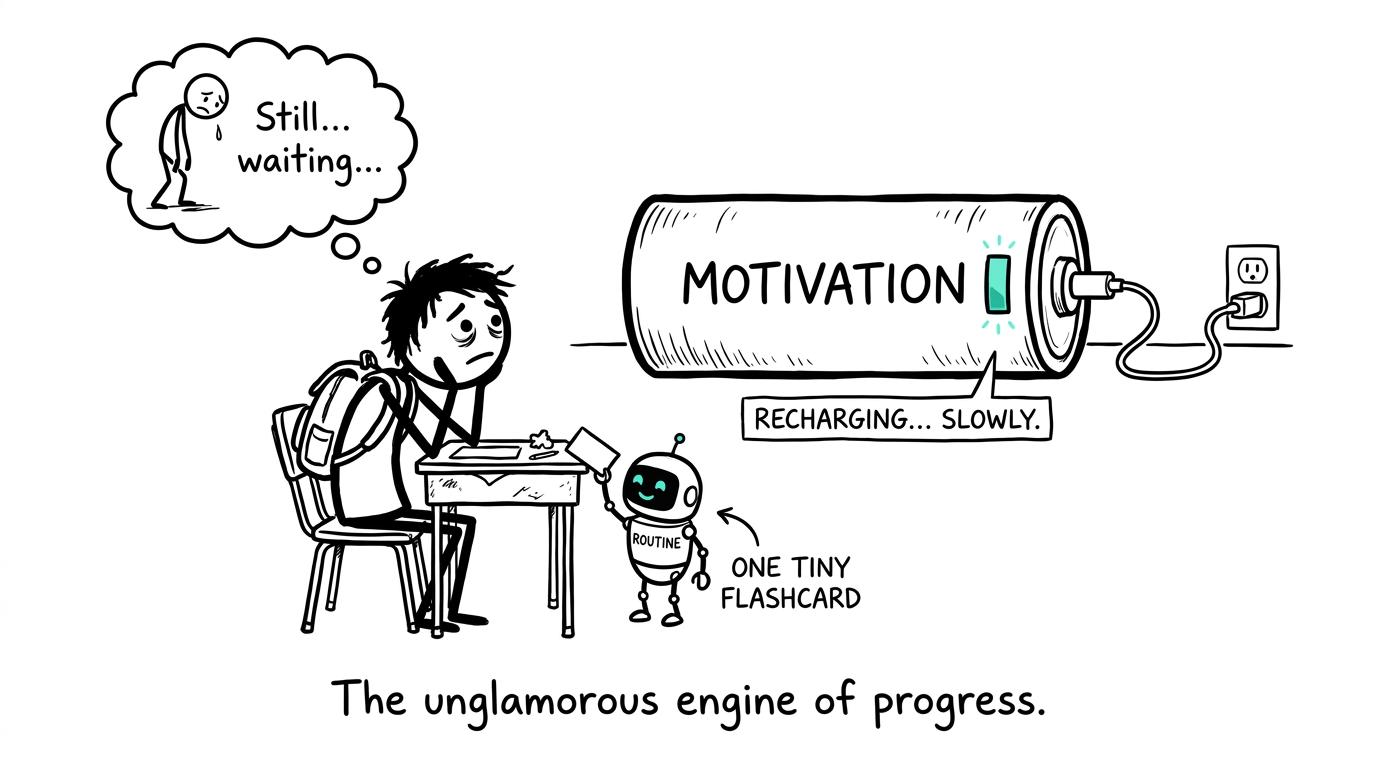 A tired student waiting for motivation while routine quietly starts the work
Why motivation is a weak revision plan
Motivation changes with tiredness, confidence, school workload and how close the exams feel. A plan based on motivation therefore works best on the days when you need it least.
A routine removes a decision. Instead of asking, “Do I feel like revising Arabic?”, you follow a pre-decided cue: after dinner, at the library, or immediately after another homework task. The session already has a starting point, such as recalling ten words or recording one spoken response.
This does not mean ignoring genuine exhaustion. It means distinguishing between a day that calls for rest and a day when the task simply feels uncomfortable. On the second kind of day, a small session protects continuity without demanding heroic concentration.
Educational guidance on self-regulated learning recommends planning, monitoring and evaluating learning. Guidance on retrieval and spaced practice also supports returning to material over time and actively bringing it to mind rather than relying only on rereading. In practical terms, your plan should tell you what to do, reveal what you cannot yet recall and schedule another attempt.
Build a minimum version of GCSE Arabic revision
Your normal session might involve a listening extract, vocabulary retrieval and a written response. Your minimum session should be much smaller.
On a low-motivation day, you could:
- recall five words without notes;
- say three prepared answers aloud;
- read one short paragraph and summarise its meaning;
- correct one previously marked sentence;
- listen to a brief extract and identify its topic and opinion.
Choose the minimum in advance. If you negotiate with yourself when already tired, the task tends to grow in your imagination. A pre-set ten-minute action feels finite.
The same principle works in maths. A full paper may be unrealistic after a difficult school day, but a focused mini test is still useful. MathsGenie’s Edexcel GCSE Maths mini tests show how short, targeted checks can keep a subject active without turning every session into an endurance test.
A minimum is not the ideal amount forever. It is the floor that prevents an imperfect week from becoming an abandoned month.
Keep all four Arabic skills moving
The current Pearson Edexcel GCSE Arabic specification assesses listening, speaking, reading and writing through four papers. Each skill contributes an equal share of the qualification, and students enter Foundation or Higher tier across all papers. Dictionaries are not permitted in the assessments. Confirm your exact specification and entry arrangements with your school, especially if you are taking a different qualification such as International GCSE.
That structure has an important consequence: revision cannot consist only of learning vocabulary lists.
Listening
Use short, repeatable listening tasks. Before checking a transcript or answer, identify the context, speakers, time frame, opinions and key details. Replay afterwards to locate the language that carried the meaning.
Do not expect to understand every word. GCSE listening often depends on recognising enough evidence to answer the question accurately, including changes of opinion, negatives and distractors.
Speaking
Speaking improves through speaking. Silently reading a model answer is preparation, but it does not test pronunciation, recall or your ability to continue after hesitation.
Record brief answers and listen back. Check whether you answered the question directly, used an appropriate tense and gave a reason or development where required. Ask your teacher for feedback on pronunciation and accuracy because self-checking cannot catch every issue.
Reading
Read with a purpose. Look for who is involved, what happened, when it happened and how the writer feels. Keep a record of recurring language rather than copying every unfamiliar word.
Translation needs particular care. A sentence that sounds natural in English must still preserve the meaning, tense, person and negative forms of the Arabic text.
Writing
Closed-book writing is more revealing than copying a polished paragraph. Attempt a short response from memory, then compare it with your notes, teacher feedback or approved model material.
Build flexible sentence patterns rather than memorising one essay for every topic. Examiners can only reward language that answers the actual task.
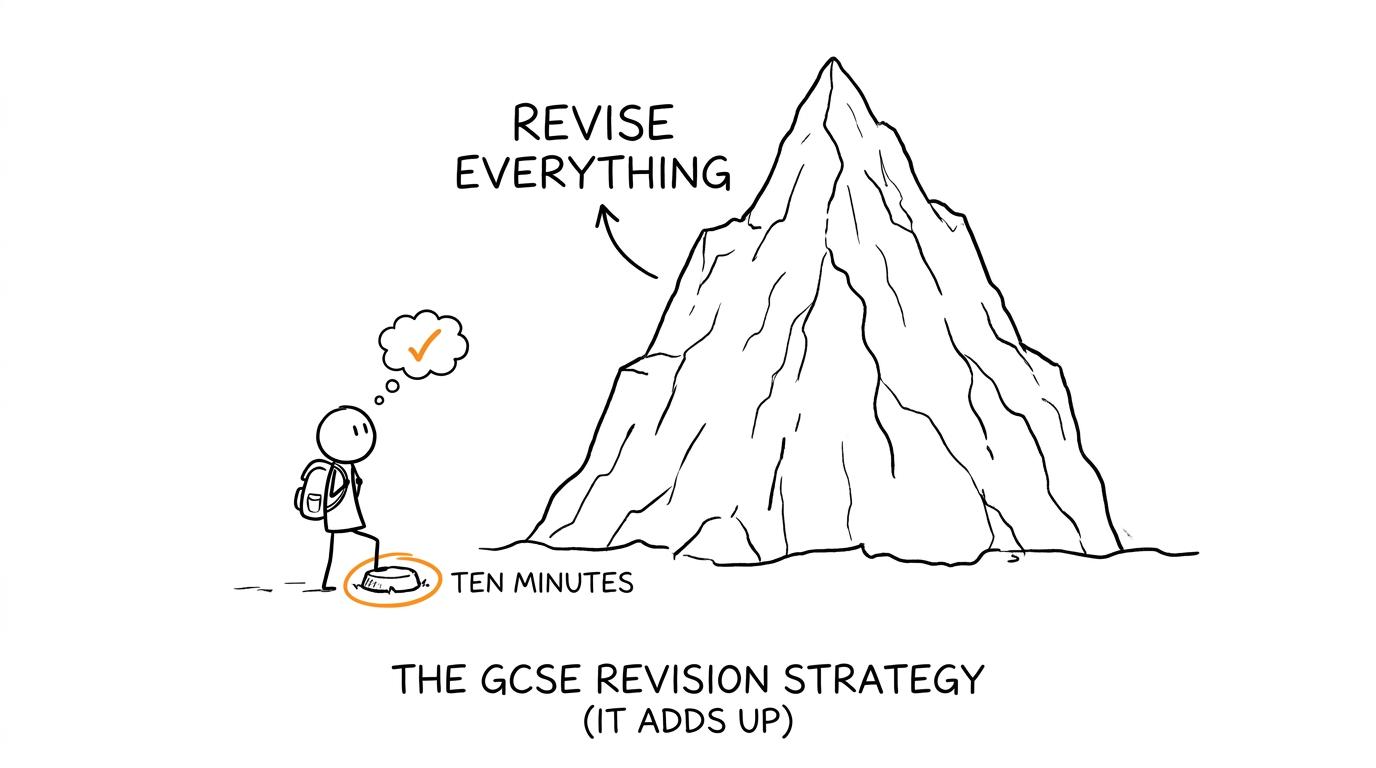 A student choosing one small revision step instead of climbing the revise-everything mountain
Use a weekly rhythm instead of a heroic timetable
A good timetable tells you what happens on an ordinary Wednesday, not merely what you hope to achieve in an unusually productive week.
One sustainable pattern is:
- one short vocabulary retrieval session;
- one listening or reading session;
- one speaking or writing session;
- one mixed review of previous errors;
- one protected catch-up slot that can remain free if it is not needed.
Pair each session with a stable cue. Keep the resources ready and remove unnecessary choices. “Revise Arabic” is vague. “After dinner, recall travel vocabulary and record two speaking answers” is actionable.
If you are balancing Arabic with maths, place the heavier tasks on different days. Use a realistic GCSE maths revision timetable to see the value of weak-topic practice, spaced review and room for catching up. A one-month GCSE revision plan can also help you organise the final weeks without attempting every subject every evening.
Your maths board may be Edexcel, AQA, OCR or Eduqas, while the current UK GCSE Arabic qualification discussed here is Pearson Edexcel. Keep the specifications separate, but let the same planning principles support both subjects.
Turn each session into a feedback loop
Consistency becomes useful when it changes what you know. Finishing a task is not enough if you never find out what went wrong.
Use this loop:
- attempt the task without help;
- check it against reliable feedback;
- label the precise problem;
- correct it;
- return to it in a later session.
An Arabic error log might contain labels such as “missed the negative”, “confused past and present”, “did not answer every bullet point” or “pronunciation needs teacher feedback”. These are better than writing “bad at listening”. Specific errors suggest specific actions.
MathsGenie applies the same philosophy to exam preparation. The guide to using GCSE past papers properly explains the rhythm of attempting, marking, repairing and retesting. You can use the MathsGenie past-paper library for board-specific maths papers, official mark schemes and available worked solutions.
For Arabic, use materials approved by your teacher and matched to your qualification. MathsGenie is a maths resource, not an Arabic course, but the feedback habit transfers cleanly between the two subjects.
What to do after missing several sessions
A missed week does not need a dramatic recovery plan. Do not try to complete every abandoned task in one evening. That makes restarting feel like punishment.
Instead:
- discard work that is no longer a priority;
- choose one short retrieval task;
- identify the next scheduled session;
- return to the normal weekly rhythm;
- review why the plan failed only after you have restarted.
The cause may be practical rather than personal. Perhaps the session was too long, the materials were difficult to find or Arabic was always scheduled after an exhausting maths paper. Adjust the system rather than treating one disrupted week as evidence that you lack discipline.
If an exam is very close, avoid turning the final evening into a rescue mission. The GCSE maths night-before plan illustrates a calmer principle that also applies to languages: use a short check, repair a few recurring mistakes, prepare what you need and stop at a sensible time.
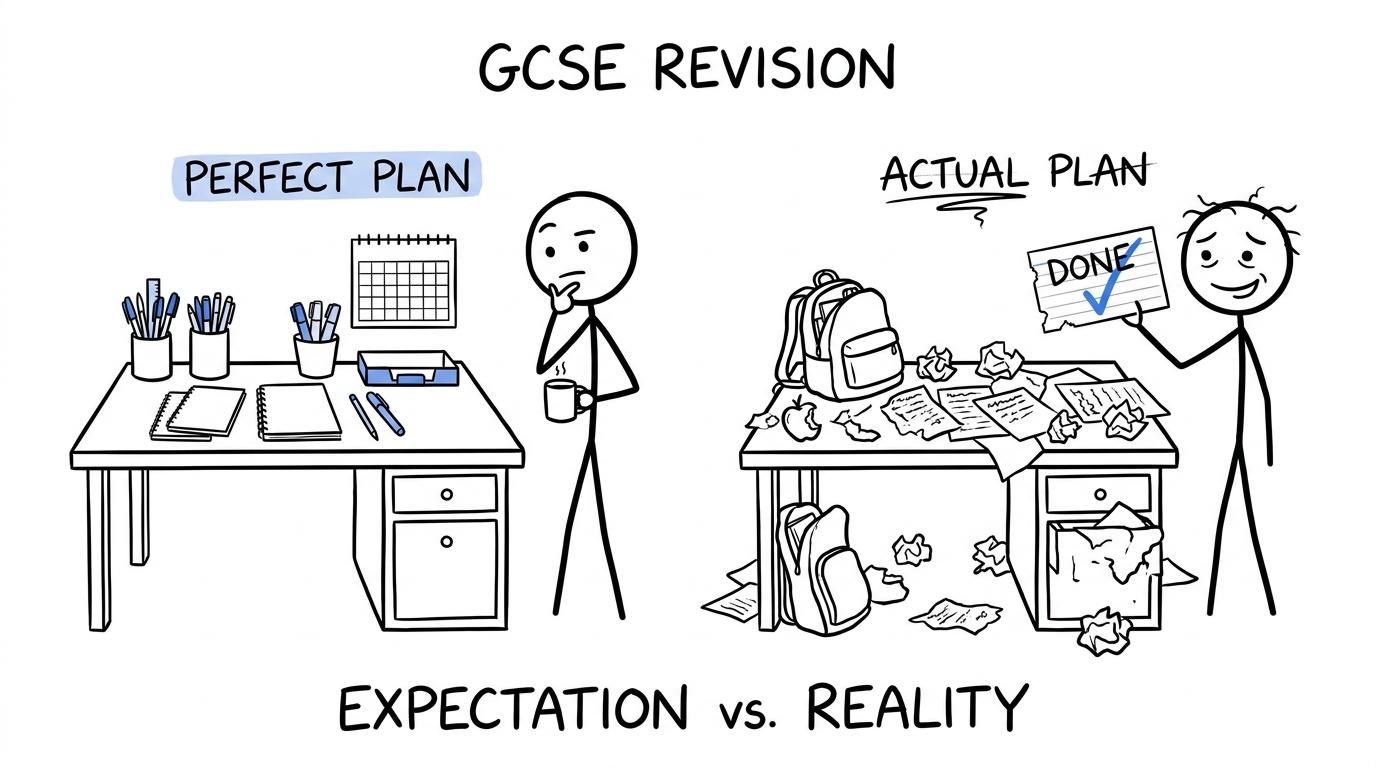 The imperfect completed revision plan defeating the beautiful plan that never started
Common mistakes that break consistency
Making the plan for your most motivated self
A timetable filled with long daily sessions may look serious, but it leaves no room for homework, tiredness or unexpected events. Plan around an ordinary week and treat extra revision as optional.
Confusing exposure with retrieval
Rereading vocabulary can feel fluent because the answers are visible. Close the book and recall the word, meaning, spelling or sentence structure before checking.
Revising only comfortable skills
Some students repeatedly read because speaking feels awkward. Others learn vocabulary because extended writing exposes grammatical gaps. Give more attention to the skill you avoid, while maintaining all four areas.
Using resources without checking the specification
Do not assume every Arabic paper found online matches your qualification, tier or assessment structure. Confirm the specification with your teacher and use the correct current materials.
Treating one missed day as failure
Consistency is not an unbroken chain. The important measure is how quickly you return. Restart with the next small action rather than designing an entirely new timetable.
Forgetting the rest of your GCSE workload
Arabic revision that damages your maths preparation is not sustainable. Use the GCSE Maths revision hub to choose the correct board and target weak topics efficiently. Short lessons, practice questions and mini tests can protect maths progress while leaving space for regular language practice.
Build a system you can return to
Staying consistent with GCSE Arabic revision is less about finding permanent motivation and more about reducing the effort needed to begin. Set a minimum, rotate through the four assessed skills, retrieve before checking and let mistakes choose what you revisit.
Then give your other subjects the same clarity. For GCSE maths, MathsGenie brings free revision lessons, practice questions, mini tests, past papers, predicted papers, mark schemes and video solutions into one structured place. Open the MathsGenie GCSE revision area, choose your exam board and tier, and schedule one precise task alongside your next Arabic session.
You do not need to win the whole revision season today. You need a next step small enough to begin and useful enough to repeat.