Spaced Repetition GCSE Engineering: A Simple Start
Spaced repetition GCSE engineering revision made simple: build a paper-card routine, recall key maths and use MathsGenie practice to prepare for exams.
Revision often fails quietly. You understand a formula on Monday, recognise it on Thursday, then cannot retrieve it when an exam question actually needs it. Spaced repetition GCSE engineering revision offers a simple answer: return to important maths at increasing intervals, trying to recall each idea before checking your notes.
You do not need a complicated app. A small set of paper cards, three labelled piles and about ten focused minutes can build the habit. The aim is not to memorise every solution. It is to make formulas, units, definitions and first steps easier to retrieve so that you can use them in unfamiliar questions.
Your simple spaced repetition checklist
Start with this routine:
- Choose one small maths topic connected to your course.
- Make prompts rather than copied notes.
- Test yourself without looking at the answer.
- Check your response immediately.
- Return to difficult prompts sooner and secure prompts later.
- Practise the skill with proper exam questions.
- Record recurring errors in a short mistake log.
That is the whole system. Everything else is refinement.
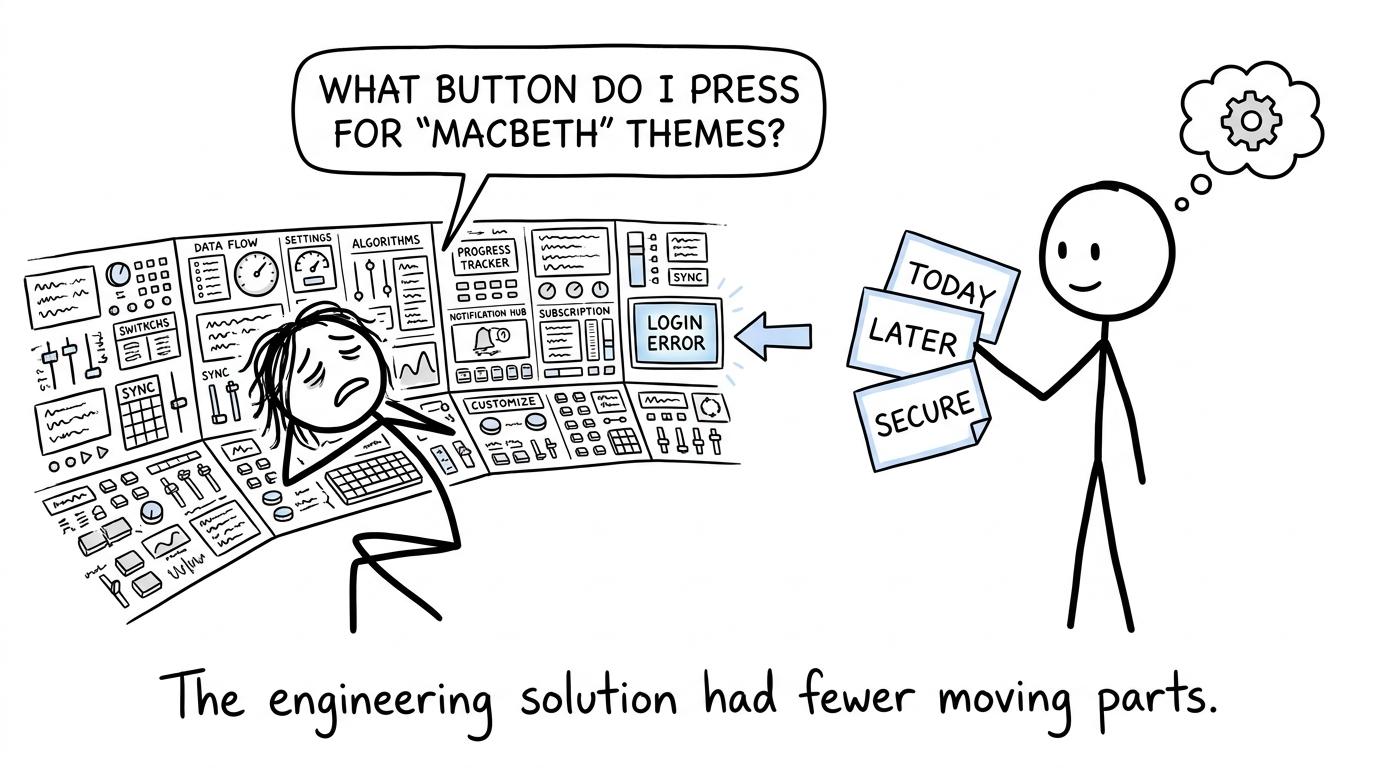 A student choosing simple revision cards instead of an overcomplicated app
What spaced repetition actually means
Spaced repetition means revisiting material across separate sessions rather than concentrating all your revision into one evening. It is closely connected to retrieval practice: attempting to bring knowledge to mind before checking the answer.
These ideas matter because recognition can be deceptive. Reading A=πr2A=\pi r^2A=πr2 for the fifth time may feel comfortable, but that does not prove you could select and use the formula independently. Closing the book and answering a prompt such as “How do I calculate the area of a circle?” gives you more useful information.
Research into learning consistently supports spacing and active retrieval over passive rereading. However, there is no single perfect timetable for every student or every topic. The interval should depend on how securely you can recall the material. Treat the schedule below as a practical starting point, not an inflexible scientific formula.
A starter schedule without an app
After learning a prompt, review it:
- later that day;
- the following day;
- about three days later;
- about one week later;
- about two weeks later.
If you cannot recall it, move it back to an earlier interval. If it feels secure and you can use it accurately, extend the gap. This creates a system that responds to your knowledge instead of forcing every card through the same timetable.
Build a three-pile revision system
Take some index cards or cut ordinary paper into smaller pieces. Label three envelopes, clips or sections of a folder:
- Learning: review in the next session;
- Developing: review in roughly three days;
- Secure: review in roughly one week.
Begin each session with the cards that are due. Attempt each prompt aloud or on paper before turning it over. A correct answer moves forward. An incomplete or incorrect answer returns to Learning.
This is deliberately unsophisticated. The best revision system is rarely the one with the greatest number of settings. It is the one you will still use when you are tired, busy or unsure where to begin.
A revision planner can help you reserve short sessions, but avoid filling every available evening. Ten minutes of honest retrieval followed by targeted practice is more valuable than an hour spent arranging cards by colour.
What to put on GCSE Engineering maths cards
Your exact course content depends on your qualification and specification, so check the documents supplied by your school or exam board. For the maths that supports engineering contexts, useful card categories may include measurement, ratio, geometry, graphs, rearranging formulae and interpreting data.
You can compare the broader GCSE maths content assessed by Edexcel, AQA, OCR and Eduqas using the GCSE maths topics by exam board and tier guide.
Formula cards
Put a cue on the front and the formula, variable meanings and required units on the back. Possible prompts include:
- the area and circumference of a circle;
- the volume of a prism or cylinder;
- Pythagoras’ theorem;
- trigonometric ratios;
- percentage change;
- speed, distance and time.
For example, the back of a circle-area card might contain:
A=πr2A=\pi r^2A=πr2The card should also remind you that rrr is the radius, not the diameter. That small distinction is often more valuable than copying the formula several times.
Unit and conversion cards
Engineering questions often combine calculation with measurement. Create prompts that ask you to recall relationships such as:
1 m=1000 mm1\text{ m}=1000\text{ mm}1 m=1000 mmand
1 m2=1 000 000 mm2.1\text{ m}^2=1\,000\,000\text{ mm}^2.1 m2=1000000 mm2.Keep length, area and volume conversions on separate cards. Their scale factors are different, and combining them too early can hide uncertainty.
Method-choice cards
Some prompts should ask for a decision rather than a formula:
- Which measurements are needed before finding a gradient?
- When would you use Pythagoras’ theorem rather than trigonometry?
- How can you check whether a calculated length is sensible?
- What must remain consistent when using a scale drawing?
These cards train the first step of a question. That matters because many students know several techniques but lose time deciding which one applies.
Error cards
Whenever practice exposes a repeated mistake, convert it into a card. The front might say, “What should I check before substituting measurements?” The back could list consistent units, the correct formula and appropriate rounding.
Error cards are personal. They stop your revision being controlled entirely by what feels easiest.
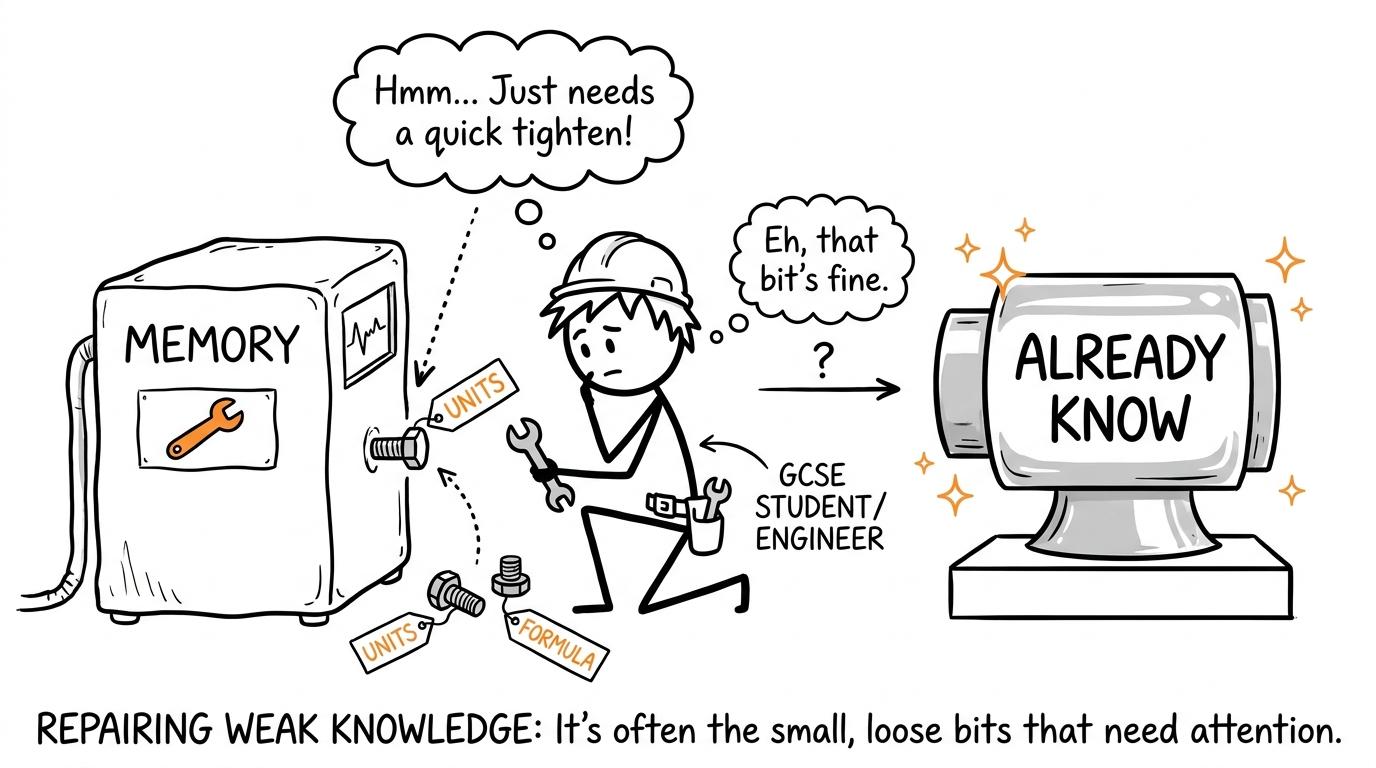 A student maintaining the weak parts of a memory machine
Connect recall to real maths questions
Spaced repetition is useful, but cards cannot replace mathematical practice. Remembering V=πr2hV=\pi r^2hV=πr2h is different from recognising the relevant dimensions in a diagram, substituting accurately and presenting the final answer with cubic units.
Use a three-stage loop:
Recall
Test the formula, definition, unit or first step without notes. Keep this stage short and demanding.
Apply
Move to exam-style practice questions. MathsGenie’s free GCSE revision resources combine revision lessons with questions and solutions, allowing you to repair a method before attempting it independently.
Review
Mark the work carefully. Decide whether each lost mark came from missing knowledge, an inaccurate calculation, weak interpretation or exam technique. Then create or update only the cards that address the actual problem.
As exams approach, use your cards as short warm-ups before longer practice. Guidance on when to begin GCSE past papers can help you move gradually from topic practice to timed papers rather than waiting until every topic feels complete.
If you follow Edexcel, the guide to using Edexcel GCSE maths past papers properly explains how marking, diagnosis and later reattempts fit together. The same general principle is useful across AQA, OCR and Eduqas: attempt, mark, repair and revisit.
Keep each session short enough to repeat
A realistic session might contain:
- five minutes testing due cards;
- ten minutes reviewing one revision lesson;
- fifteen minutes answering practice questions;
- five minutes marking and updating your mistake log.
This is not a target you must hit exactly. On a busy day, review five cards. On a longer weekend session, add a mini test or part of a paper. Consistency matters more than designing the perfect timetable and abandoning it after four days.
MathsGenie’s GCSE predicted papers and resources can provide fresh questions later in revision. Predicted papers should complement, not replace, past papers: use them to test whether knowledge remains available when the wording and context change.
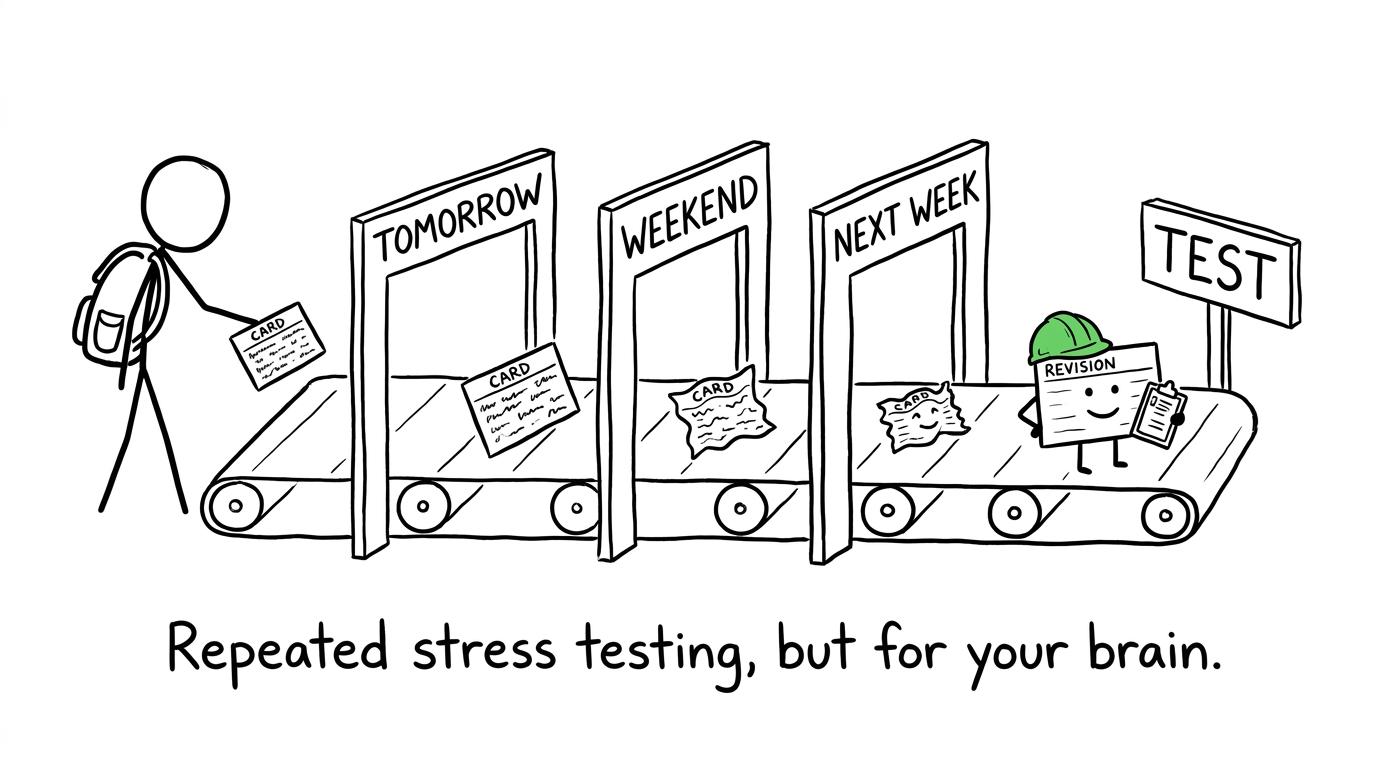 A revision card becoming more confident after repeated memory checks
Adapt the system as exams get closer
Early in revision, most sessions should focus on learning and applying individual skills. Later, full papers reveal whether you can select those skills under time pressure.
When a paper exposes a weakness, do not add twenty vague cards such as “revise geometry”. Make one or two precise prompts. Then use a MathsGenie lesson, answer focused practice questions and retest the idea after a gap.
During exam week, reduce the volume rather than trying to review your entire box. The GCSE maths night-before plan offers a calmer approach based on short exam-style practice and correcting a few important mistake patterns.
Common spaced repetition mistakes
Copying notes instead of creating prompts
A card should make you retrieve something. If the front contains the formula and the back merely repeats it, there is no meaningful test.
Turning every topic into a card
Cards are best for compact, retrievable knowledge: formulas, units, definitions, method choices and common errors. Multi-step problem solving belongs in practice questions.
Moving a card forward too easily
Recognising an answer after seeing the first line is not secure recall. Only move a card forward when you can produce the important information independently and accurately.
Ignoring units and interpretation
A correct numerical calculation can still lose marks if the unit is missing or inappropriate. Include units and variable meanings on the reverse of relevant cards.
Revising cards but avoiding exam questions
Flashcards can become comfortable because they are short and predictable. Past papers are less comfortable because they force you to choose a method. That discomfort is useful evidence about what you need to practise.
Building an elaborate system before beginning
Do not spend an evening designing categories, symbols and colour codes. Begin with ten cards and three piles. Improve the system only when a genuine problem appears.
Start small and let the system grow
Spaced repetition works best when it feels almost too simple: retrieve, check, schedule and apply. Begin with one engineering-related maths topic and ten paper prompts. Review them tomorrow, then use practice questions to discover what deserves another visit.
MathsGenie can support every stage. Use the free revision lessons and video solutions to understand methods, practice questions and mini tests to check individual skills, mark schemes to diagnose lost marks, and past papers to develop exam timing. Nearer the examination, add GCSE predicted papers for fresh exam-style practice.
You do not need to remember everything today. You need a reliable way to return to what matters, and each return can make the next one easier.