Spaced Repetition for GCSE Arabic: Start Simply
Spaced repetition GCSE Arabic revision can be simple. Build a paper-based routine for vocabulary, grammar and recall without needing a complicated app.
Revision often begins with good intentions and ends with a familiar surprise: the vocabulary you knew on Sunday has vanished by Thursday. If you are balancing Arabic with GCSE maths and several other subjects, the problem is rarely a lack of effort. It is that memory needs more than one meeting with new material.
A simple spaced repetition GCSE Arabic routine solves this by bringing vocabulary, grammar and useful phrases back at planned intervals. You do not need a complicated app. Start with paper cards, three piles and a calendar. Test yourself without notes, check the answer, and revisit difficult material sooner than material you remember securely.
That is the whole system. The details below will help you make it work.
Your simple spaced repetition checklist
- Choose a small set of Arabic vocabulary, phrases or grammar prompts.
- Put one prompt on the front of each card and the answer on the back.
- Attempt every answer from memory before turning the card over.
- Check carefully and correct errors immediately.
- Review difficult cards tomorrow, uncertain cards in a few days and secure cards next week.
- Include listening, speaking, reading and writing tasks rather than testing recognition alone.
- Keep sessions short enough to repeat consistently.
- Record recurring errors and return them to the earliest review pile.
This is a starting framework, not a scientific promise that one precise interval suits every learner. Evidence reviews from the Education Endowment Foundation describe spaced learning as distributing learning and retrieval opportunities over time rather than concentrating them in one block. They suggest that spacing across days can support learning, while also warning that classroom findings vary and implementation matters.
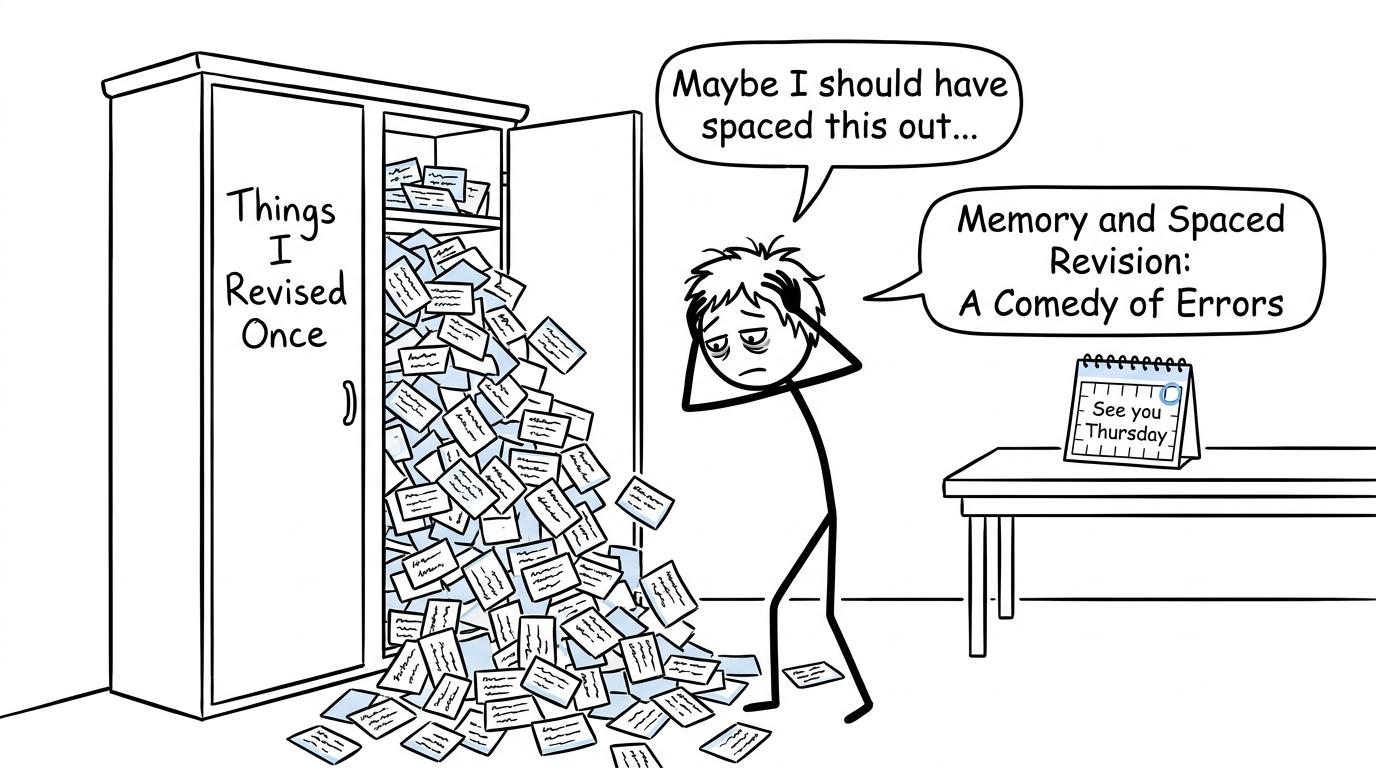 A revision cupboard overflows while a small calendar calmly schedules the next review
What spaced repetition means for GCSE Arabic
Spaced repetition combines two useful ideas.
Spacing means returning to material on different days instead of completing one long session and abandoning the topic. Retrieval practice means attempting to recall an answer before looking at it. Reading a word repeatedly may make it feel familiar, but familiarity is not the same as being able to produce it in an examination.
For Arabic, a retrieval prompt might ask you to:
- recall an Arabic word from its English meaning;
- recall the English meaning from the Arabic script;
- say a phrase aloud without seeing it;
- write a word accurately from memory;
- identify the correct verb form or agreement;
- complete a sentence stem;
- recall a connective suitable for an extended response;
- recognise a phrase when it is spoken.
The distinction matters because GCSE Arabic assesses language through listening, speaking, reading and writing. Current Pearson Edexcel GCSE Arabic materials organise assessment around those four skills and offer foundation and higher tiers. Dictionaries are not permitted in the assessments, so being able to retrieve language independently is central to exam readiness.
Always follow the specification and instructions for the qualification your school has entered. Your teacher can confirm the exact board, tier and current assessment arrangements.
How to start without an app
Complicated systems often fail for an ordinary reason: maintaining the system becomes another subject to revise. A paper method removes most of that friction.
Make three review piles
Label three envelopes, clips or sections of a card box:
- Soon: answers you missed or could not produce independently.
- Later: answers you produced slowly, incompletely or with uncertain spelling.
- Secure: answers you recalled accurately and confidently.
Begin each session with the Soon pile. Move a card towards Secure after a correct retrieval. Move it back to Soon whenever you make an error. Review the Later pile every few days and the Secure pile roughly once a week.
These intervals are intentionally flexible. The aim is to increase the gap when recall is strong and shorten it when recall fails. Difficulty should control the schedule, not pride.
Use a calendar as the reminder
Write three recurring entries in your paper planner or phone calendar:
- a short daily review of the Soon cards;
- two weekly reviews of the Later cards;
- one weekly check of the Secure cards.
A review can last ten minutes. Consistency matters more than creating an elaborate timetable that survives for only two days. If GCSE maths is also competing for attention, the twenty-minute GCSE maths revision routine shows how short, repeatable sessions can fit around busy school weeks.
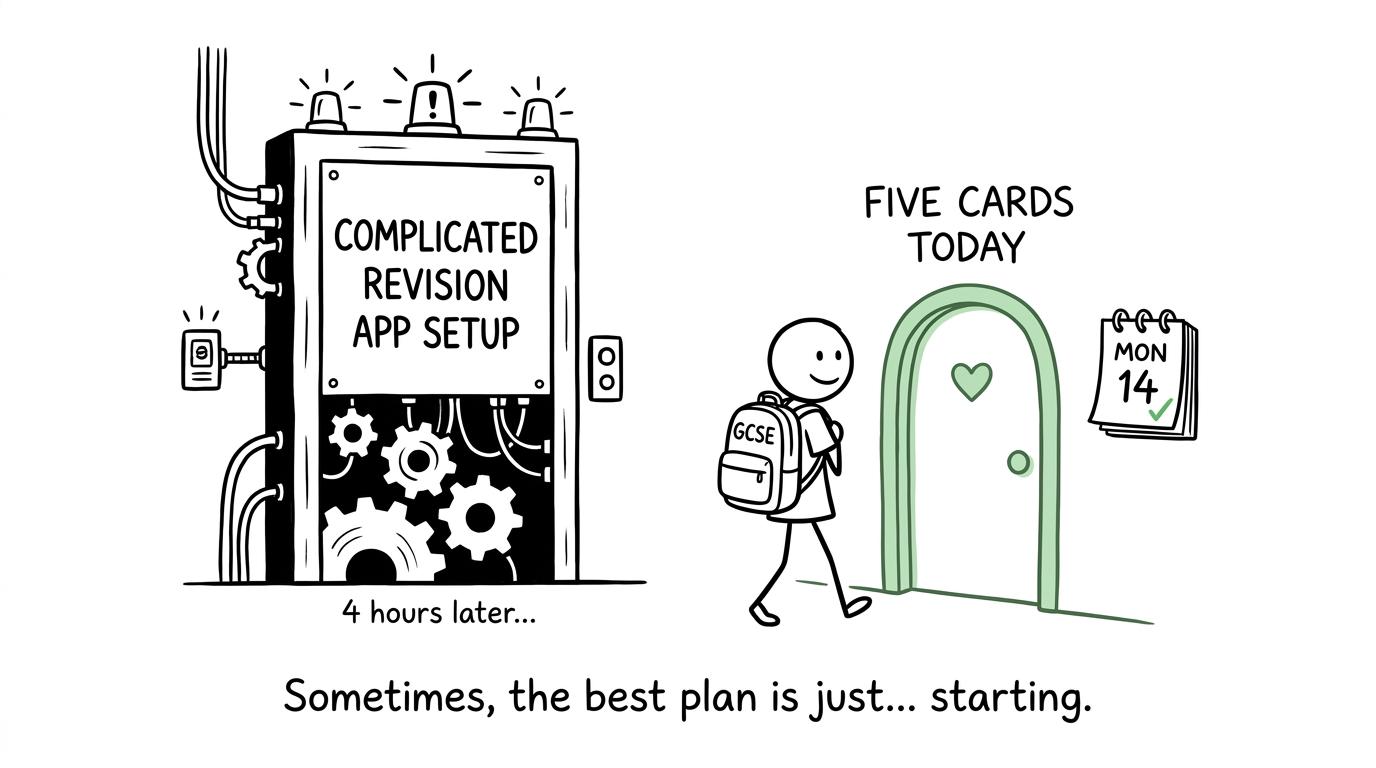 A student chooses five cards instead of entering a machine built for complicated revision
Keep the first deck deliberately small
Start with material from your current class topic or a weakness identified by your teacher. A small deck is easier to test honestly, mark properly and repeat. Adding every word from the specification at once creates administration rather than learning.
After several successful sessions, add another small batch. Keep old secure cards in circulation so that earlier topics are not quietly forgotten.
Build cards that test useful knowledge
A card should demand one clear response. If the back contains a paragraph of notes, the prompt is probably too broad.
For vocabulary, use cards in both directions. Seeing Arabic and recognising an English meaning tests a different pathway from seeing English and producing the Arabic. Both are useful, but productive recall is usually harder and deserves deliberate practice.
For grammar, avoid cards that merely ask you to “revise verbs”. Ask for one identifiable feature, rule or transformation. For speaking, use topic questions or sentence starters and answer aloud. For listening, ask a teacher or family member to read approved course vocabulary aloud, or use recordings supplied with your course materials, then retrieve the meaning without seeing the script.
Feedback is essential. Research guidance on retrieval practice stresses that incorrect retrieval can reinforce errors if it is never corrected. Check the card immediately, say or write the correct response, and then test it again later. Do not stare at the answer and count that as a successful attempt.
Connect repetition to the four language skills
Flashcards are useful, but GCSE Arabic is not a flashcard examination. The knowledge eventually needs to work inside larger tasks.
Listening and speaking
Include sound whenever possible. Arabic words that are secure on the page may feel less familiar when heard at natural speed. Practise recognising spoken language and producing responses aloud, paying attention to meaning, pronunciation and grammatical control.
Speaking prompts should gradually move beyond isolated words. Retrieve a phrase, then use it in a relevant response. You are not memorising one rigid speech for every possible question; you are building flexible pieces of language that can be selected under pressure.
Reading and writing
For reading, test precise meaning rather than vague familiarity. Ask whether you can identify a key detail, time reference, opinion or negative construction.
For writing, retrieve spelling, agreement, verb forms, connectives and sentence structures from memory. Then apply them in short writing tasks supplied by your teacher or course materials. A card can secure the component, but writing practice shows whether you can use it.
This resembles effective maths revision. Remembering a formula is useful, but you must also recognise when and how to apply it. MathsGenie's guide to stopping forgotten GCSE content uses the same broad cycle: learn, retrieve, space, check and apply.
Fit Arabic and maths into one revision system
Students rarely revise only one subject. The practical question is not whether spaced repetition works in isolation, but whether it can survive alongside homework, maths papers and the rest of the GCSE timetable.
Use one calendar for every subject. Arabic reviews can occupy short weekday slots, while longer sessions are reserved for writing or listening. Maths can follow a parallel pattern: retrieve a method, answer questions, mark them and return to weak topics later.
Start from the GCSE maths revision hub to choose resources for Edexcel, AQA, OCR, Eduqas and other available boards. Use GCSE mini tests for short recall checks rather than waiting until you have time for an entire paper.
As examinations approach, Arabic course papers should test whether vocabulary and grammar transfer into complete language tasks. For maths, MathsGenie's past-paper library provides papers with official mark schemes, with worked solutions available for selected papers. Edexcel students can go directly to the Edexcel GCSE maths past papers.
The principle across both subjects is the same: a test reveals what to revisit. It is not a verdict on your ability.
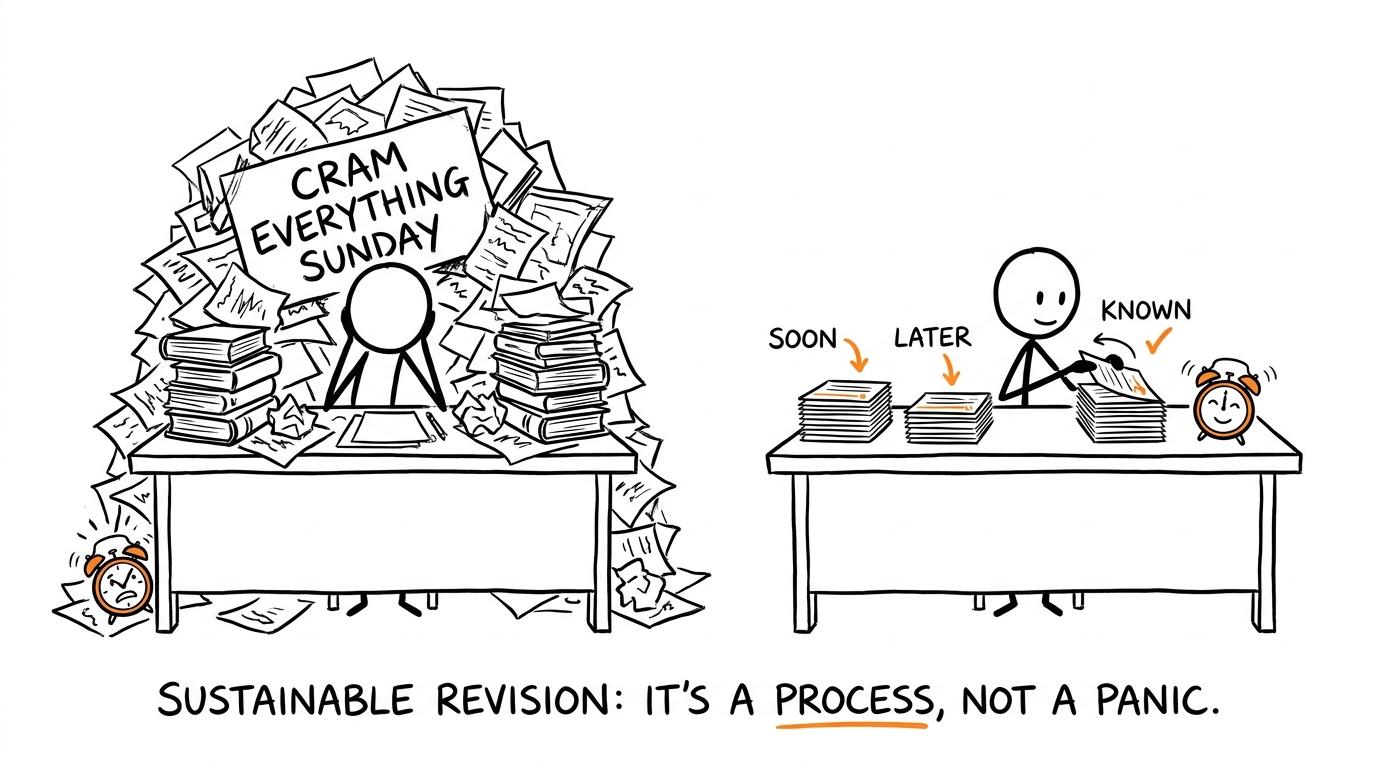 One student is buried under a cramming mountain while another calmly rotates three small card piles
Know when a card is really secure
Fast recognition can create false confidence. Before moving a card to Secure, ask:
- Did I answer before looking at the back?
- Was the meaning precise?
- Could I produce the Arabic rather than merely recognise it?
- Was the spelling or grammatical form accurate?
- Could I say it aloud or use it in a suitable context?
- Have I recalled it successfully on more than one day?
If the answer to several questions is no, keep the card in Later. Honest classification makes the routine useful.
You can apply the same diagnostic thinking to maths with the guide to finding your weakest GCSE topics. Weakness becomes less intimidating when it is converted into a specific next action.
Common spaced repetition mistakes
Reviewing with the answer visible
Cover the answer completely. Retrieval requires an attempt from memory; copying or rereading does not provide the same test.
Making enormous cards
One card should test one manageable idea. Split vocabulary, grammar and usage into separate prompts when necessary.
Testing Arabic in only one direction
Recognition can improve while production remains weak. Mix Arabic-to-English, English-to-Arabic, spoken and written prompts.
Treating every card equally
Easy cards should appear less often. Difficult and error-prone cards need shorter gaps and more feedback.
Ignoring mistakes
A wrong answer is useful information only if you correct it. Record the accurate response and return the card to Soon.
Using flashcards instead of exam tasks
Spaced cards build accessible knowledge. They do not replace speaking practice, listening tasks, extended writing or reading questions. Move regularly from cards to specification-aligned tasks.
Building a perfect system before starting
Do not spend an evening colour-coding hundreds of cards. Make a small set, test it tomorrow and improve the routine from evidence.
A calmer way to remember more
The strength of spaced repetition is not sophistication. It is the decision to return before knowledge disappears completely, then to return again after a longer gap. A few paper cards and a calendar are enough to begin GCSE Arabic revision today.
Keep the loop simple: retrieve, check, sort and revisit. Use your Arabic specification, teacher guidance and approved course materials to choose what belongs on the cards. Then give each language skill practice beyond the deck.
For maths, make MathsGenie your free revision base. Begin with the GCSE maths revision hub, use revision lessons and practice questions to repair weak methods, check recall with mini tests, and progress to past papers, predicted papers, mark schemes and video solutions. If you need a broader timetable, the one-month GCSE maths revision plan can help turn good intentions into scheduled action.
You do not need to remember everything today. You need a reliable plan for meeting it again.