Sleep Before a GCSE Bengali Exam: How Much?
Sleep before GCSE Bengali exam: find out how much teenagers need, how sleep supports memory and focus, and how to plan a calm, effective exam-night plan.

The temptation usually arrives late in the evening: learn one more vocabulary list, reread one more theme, stay awake until everything feels secure. Yet the best plan for sleep before a GCSE Bengali exam is normally much simpler. Most teenagers should aim for around 888 to 101010 hours, while allowing extra time to settle before sleep.
That is not time stolen from revision. Sleep helps stabilise what you have already learnt and supports the attention, working memory and emotional control you will need in the exam. An extra exhausted hour with your notes may feel productive, but feeling busy and learning effectively are not always the same thing.
The short answer and night-before checklist
For most GCSE students aged between 131313 and 181818, the sensible target is 888 to 101010 hours of sleep. Individual needs vary, so use the amount that usually leaves you alert rather than treating the lower end as a target to beat.
Your practical checklist is:
- Work backwards from the time you must wake up.
- Allow 888 to 101010 hours for actual sleep, plus time to settle.
- Finish demanding revision about an hour before bed.
- Review only a small amount of familiar Bengali material at the end.
- Avoid caffeine during the afternoon and evening.
- Put your phone away and make the room dark, quiet and comfortable.
- Pack what you need and check the paper time before winding down.
- If sleep does not come immediately, stay calm rather than watching the clock.
You can express the planning idea as:
B=W−S−T B = W - S - T B=W−S−THere, BBB is your target bedtime, WWW is your wake-up time, SSS is your intended sleep duration and TTT is the time you expect to need to settle. The purpose is not to calculate bedtime with artificial precision. It is to stop revision quietly consuming the night.
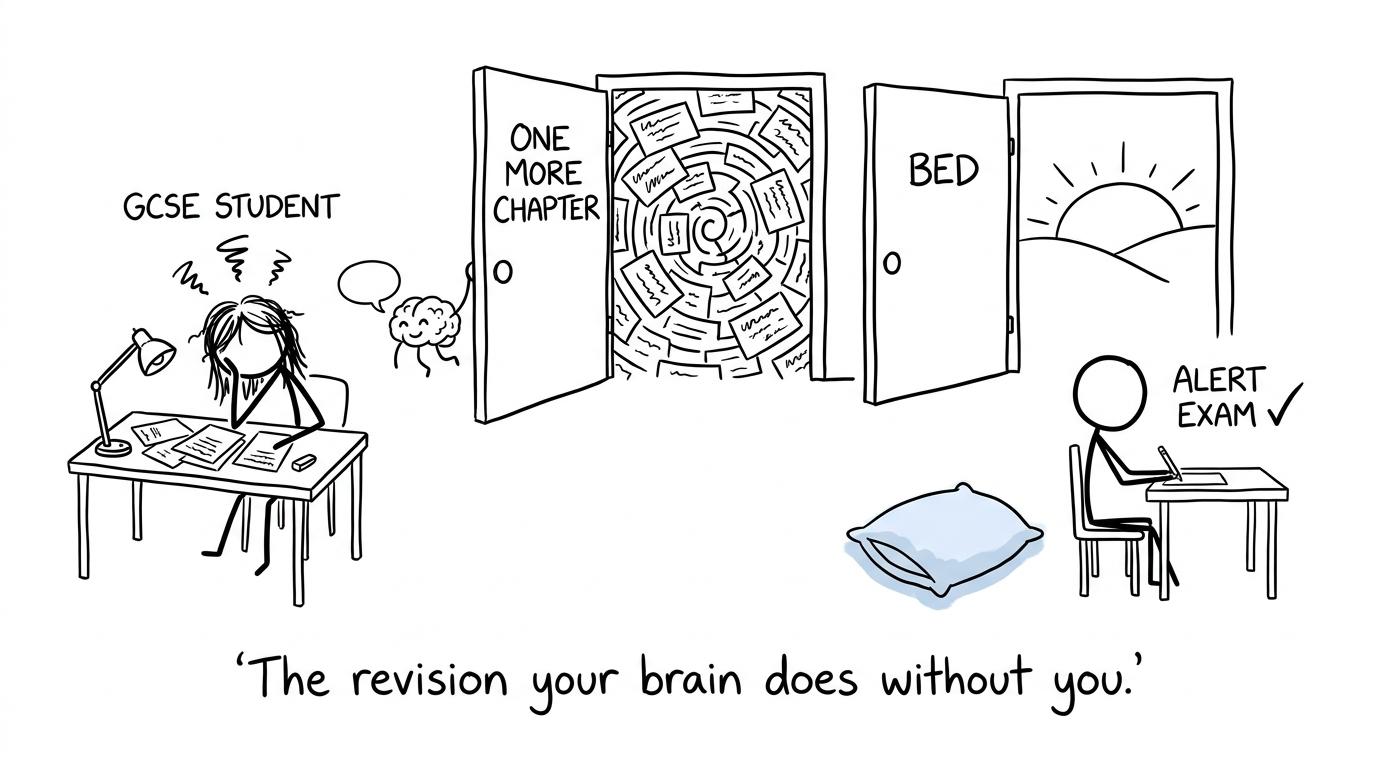 A student choosing between endless revision and restorative sleep
What sleep actually does for Bengali memory
Sleep does not place new knowledge into your mind. You still have to learn vocabulary, grammar, structures and themes while awake. What sleep can do is help the brain preserve and organise memories formed during that learning.
Research on learning consistently supports a role for sleep in memory consolidation. In simple terms, recently encountered information becomes less fragile after suitable sleep. This matters for Bengali because language exams depend on several kinds of memory at once: recognising words quickly, recalling spellings, selecting suitable structures and connecting a phrase to its meaning in context.
Sleep helps protect what you revised
Suppose you have spent the evening retrieving vocabulary from memory rather than merely rereading it. Sleeping afterwards gives that learning an opportunity to consolidate. Staying awake for several more tired hours creates more time for interference, distraction and mistakes.
This does not mean that reading a vocabulary list immediately before bed guarantees perfect recall. The learning must first be meaningful and active. A short self-test, correction of uncertain words and calm review of familiar structures are more useful than trying to absorb an entire topic at midnight.
Sleep supports recall under pressure
Knowing a Bengali word at home and retrieving it in an exam are different experiences. The exam adds timing, unfamiliar contexts and the awareness that an answer is being marked. Adequate sleep supports the mental control needed to search memory without becoming overwhelmed by the first word you cannot recall.
This is especially relevant to writing and speaking. You need to hold an idea in mind, select language, organise it and check accuracy. Fatigue can make that sequence feel much harder, even when the underlying knowledge is present.
How sleep affects focus in each exam skill
AQA GCSE Bengali assesses listening, speaking, reading and writing, with each skill contributing approximately one quarter of the qualification. Students take foundation or higher tier papers according to their entry. Always confirm your own specification, tier, timetable and arrangements with your school because the immediate demands depend on which component you are sitting.
Listening
Listening is unforgiving because the recording continues whether your attention is ready or not. You must identify key details, ignore tempting distractors and sometimes retain the beginning of a sentence while interpreting its ending.
Sleep supports sustained attention and working memory. When you are tired, a brief lapse can mean missing the word that changes the whole meaning: a time, opinion, negative or reason. Another late revision session cannot compensate easily for repeatedly losing the thread of the recording.
Reading
Reading requires more than recognising Bengali script. You must connect information across a passage, infer meaning from context and match your response to the question being asked. Fatigue encourages hurried scanning and makes it easier to overlook qualifiers or confuse similar details.
A rested student is not guaranteed the correct answer, but is better placed to slow down, return to the relevant line and distinguish evidence from assumption.
Writing and speaking
Productive language places a heavier load on retrieval. You must generate rather than recognise vocabulary, while monitoring grammar, relevance and clarity. Sleep supports the focus needed to plan before responding and to check what you have produced.
It also helps emotional regulation. Exam nerves are normal, but tiredness can make ordinary uncertainty feel like a crisis. A calmer brain is more likely to pause, use language it knows securely and continue after a small mistake.
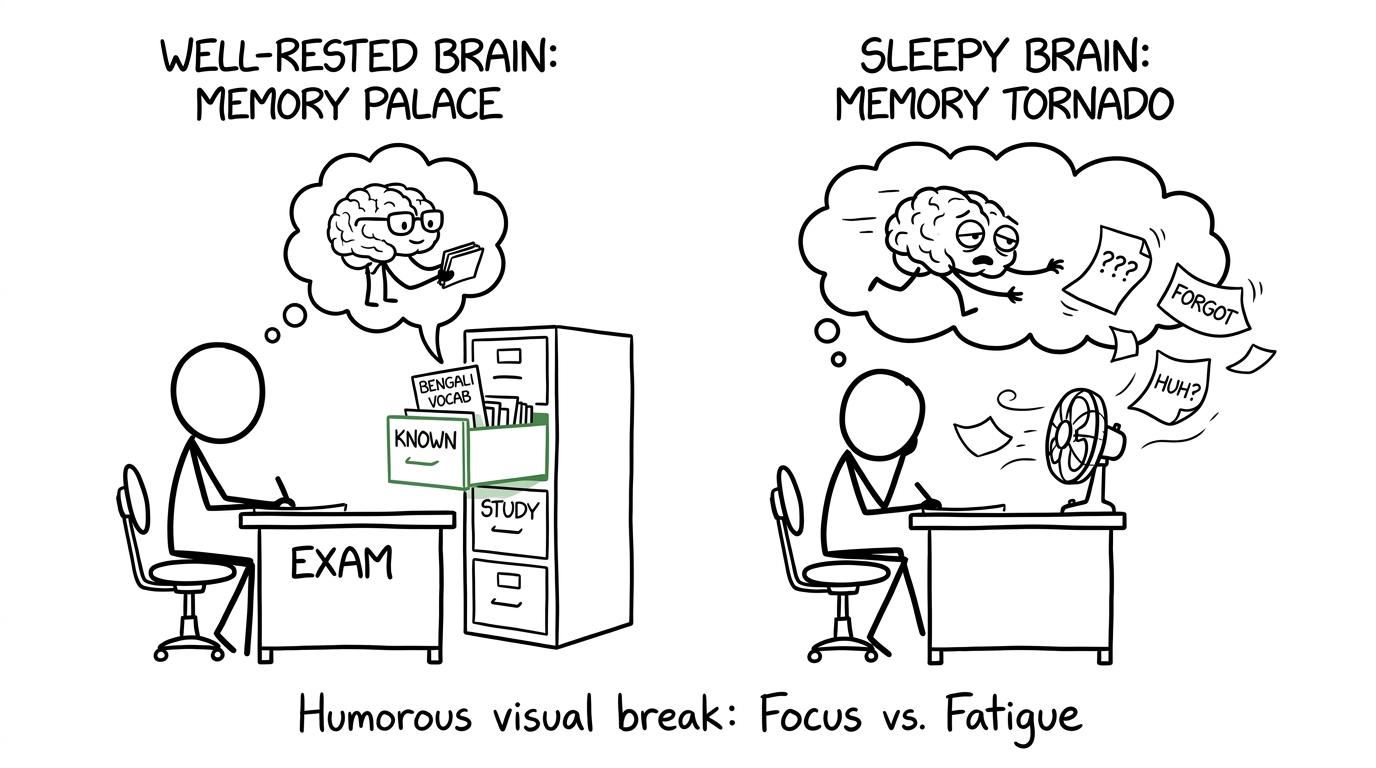 An organised brain and a sleepy brain handling vocabulary in an exam
A calm revision cut-off that protects sleep
The night before an exam is for stabilising, not rebuilding. If large parts of the course remain uncertain, sacrificing sleep will not turn several months of content into durable knowledge overnight. Choose the material with the highest immediate value.
A useful final session might include:
- retrieving a small set of frequently used vocabulary;
- checking a few structures you already understand;
- reviewing personal error notes;
- confirming the format of tomorrow's component;
- stopping when your planned revision period ends.
Avoid beginning a full paper late at night. It may expose gaps when there is no sensible time to repair them, increasing anxiety without producing much learning. The same principle applies to maths. MathsGenie's GCSE maths night-before plan recommends short, purposeful practice rather than a last-minute marathon.
During the wider exam season, use the GCSE maths revision hub to complete revision lessons and practice questions earlier in the day. Then your evening can become quieter instead of carrying every unfinished maths topic into bed.
Building an exam-week sleep routine
One good night helps, but sleep works best as a pattern rather than an emergency technique. A sudden very early bedtime may fail if your routine has drifted late for several weeks. Begin protecting your sleep before the final night where possible.
Keep wake-up times reasonably consistent
A stable routine helps your body anticipate sleep and waking. Large weekend lie-ins or late naps can make an early school-night bedtime harder. Morning daylight and activity during the day can also support the sleep-wake cycle.
The aim is not perfection. Exam timetables, family life and nerves can disrupt plans. Consistency simply makes sleep more likely instead of leaving it to chance.
Use caffeine carefully
Coffee, strong tea, cola and energy drinks can make falling asleep harder. Caffeine can remain active for hours, so waiting until bedtime to stop may be too late. NHS sleep guidance for teenagers commonly advises avoiding caffeinated drinks during the afternoon and evening.
Energy drinks are not a substitute for sleep. They may make you feel more awake temporarily without restoring the memory consolidation and sustained attention that sleep provides.
Give your brain a clear ending
A repeated wind-down routine can act like a boundary between revision and sleep. Pack your bag, set an alarm, write down anything you are worried about, dim the lights and choose a quiet offline activity.
Maths students can reduce unfinished-work anxiety by planning revision in advance. MathsGenie's GCSE maths revision timetable helps distribute topic work, mark-scheme review and timed practice across the week rather than forcing everything into the final evening.
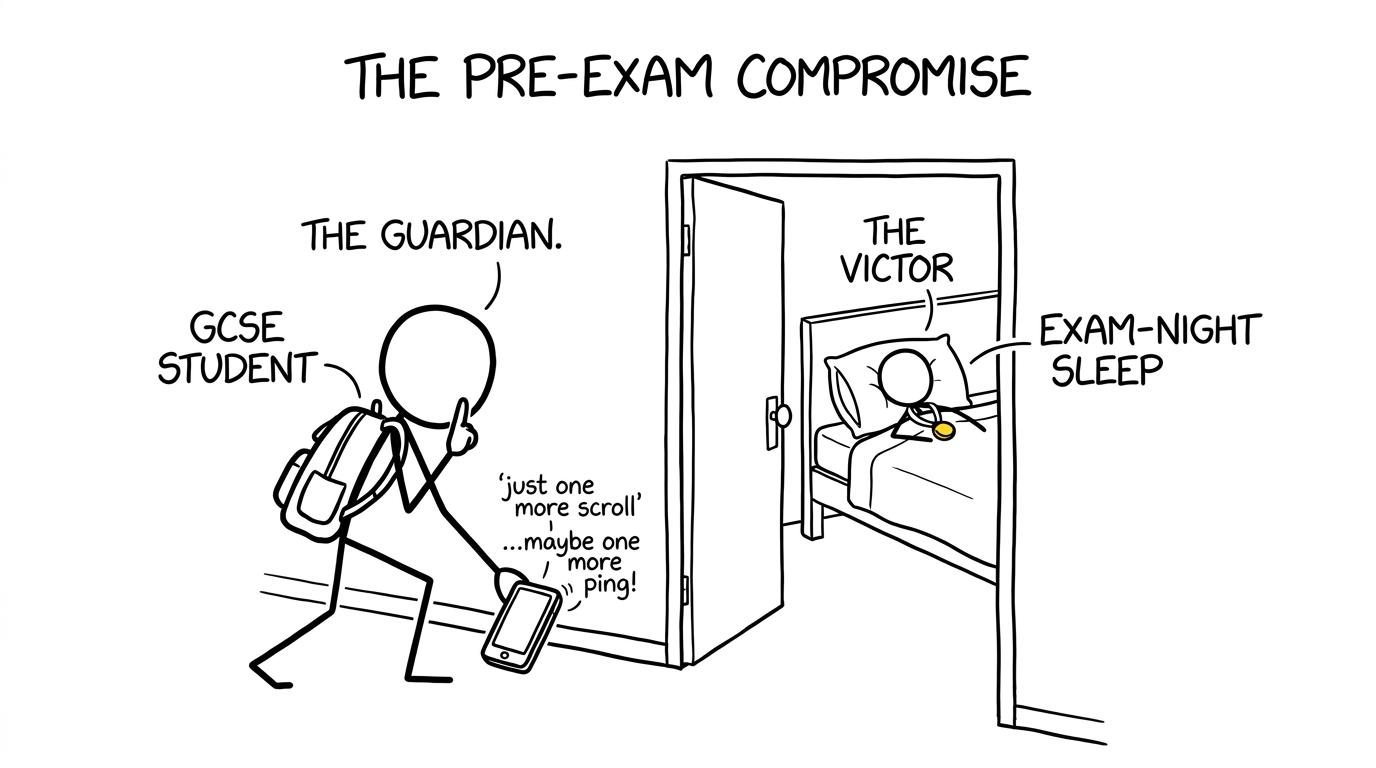 A phone protesting as it is removed from the bedroom
What to do if you cannot fall asleep
Trying to force sleep often makes it feel more distant. If you are awake, avoid repeatedly calculating how few hours remain. Clock-watching converts a delay into a countdown.
Keep the lights low and do something quiet. If you have been lying awake for a while, getting up briefly to read something calm can be better than associating your bed with frustration. Return when you feel sleepier. Avoid reopening intense revision, social media or a stimulating video.
One imperfect night does not decide your result. Follow your morning routine, eat and drink as you normally would, arrive with enough time, and focus on the paper in front of you. If sleep difficulties are frequent, severe or affecting daily life, speak to a parent, carer, school support professional, pharmacist or GP rather than treating them solely as an exam problem.
Common mistakes before a GCSE Bengali exam
Treating sleep as optional revision time
Students often compare one visible hour of revision with one invisible hour of sleep. But the comparison is misleading: late-night work may be low quality, while sleep supports the knowledge already acquired and the concentration needed to use it.
Memorising brand-new lists at midnight
New material needs attention and retrieval practice. Learning a large unfamiliar list when exhausted can create a false sense of familiarity. Prioritise secure, high-value recall and note what must be addressed earlier next time.
Using a phone as a wind-down tool
A phone may feel relaxing while continuing to provide light, novelty and emotional stimulation. Place it out of reach, disable notifications or charge it outside the bedroom if practical.
Completing full papers too late
Timed papers are valuable when there is time to mark, diagnose and repair mistakes. MathsGenie's guide to using GCSE past papers properly emphasises the full cycle: attempt, mark, fix and retest. Starting that cycle just before bed leaves it unfinished.
Changing everything on exam morning
An unfamiliar breakfast, excessive caffeine or frantic final cramming adds uncertainty. Keep the morning predictable and use only a brief review of material you already know.
Sleep is part of revision, not the absence of it
The final evening can feel important because it is the last moment you can control. Yet control does not mean continuing until exhaustion. It means choosing a stopping point that lets your preparation survive the night and remain accessible in the exam room.
Aim for 888 to 101010 hours, protect a calm wind-down and trust the revision already completed. Then carry the same approach into your maths papers. Use MathsGenie's GCSE exam-week checklist to organise each paper, practise earlier with free GCSE predicted papers, and use revision lessons, practice questions, mark schemes, video solutions and mini tests to fix gaps before the final night.
The goal is not to reach bedtime knowing everything. It is to arrive at the exam rested enough to use what you know.