

Should You Drop GCSE Arabic Mid-Year?
Drop GCSE Arabic or keep going? Learn how to judge your workload, what withdrawal affects, and whether the extra time could improve GCSE maths.
A difficult subject can make the rest of your timetable feel smaller. One poor Arabic assessment turns into a late evening of catch-up, which steals time from maths, which then creates another problem. Soon, the question is no longer how to improve. It is whether you should drop GCSE Arabic altogether.
The short answer is: consider dropping it only after checking your actual performance, your school’s rules and your post-16 entry requirements. Struggling temporarily is not the same as being irretrievably behind. Equally, keeping a qualification at any cost is not always wise if it is seriously damaging your health or your core GCSE preparation.
This guide will help you separate a hard month from a genuinely unmanageable course and understand what withdrawing does and does not change.
Your decision checklist
Before deciding, find clear answers to these questions:
- What grades are you currently achieving in listening, speaking, reading and writing?
- Are your difficulties limited to one skill, or present across the whole course?
- How much taught content have you missed?
- What grade does your teacher realistically predict with continued support?
- Has your school already submitted your examination entry?
- Would withdrawing affect your school’s curriculum requirements?
- Does Arabic count towards a sixth-form, college or future course requirement you need?
- What exactly would replace the freed lesson and revision time?
Do not make the decision immediately after a disappointing mock. A mock is evidence, but it is not a verdict.
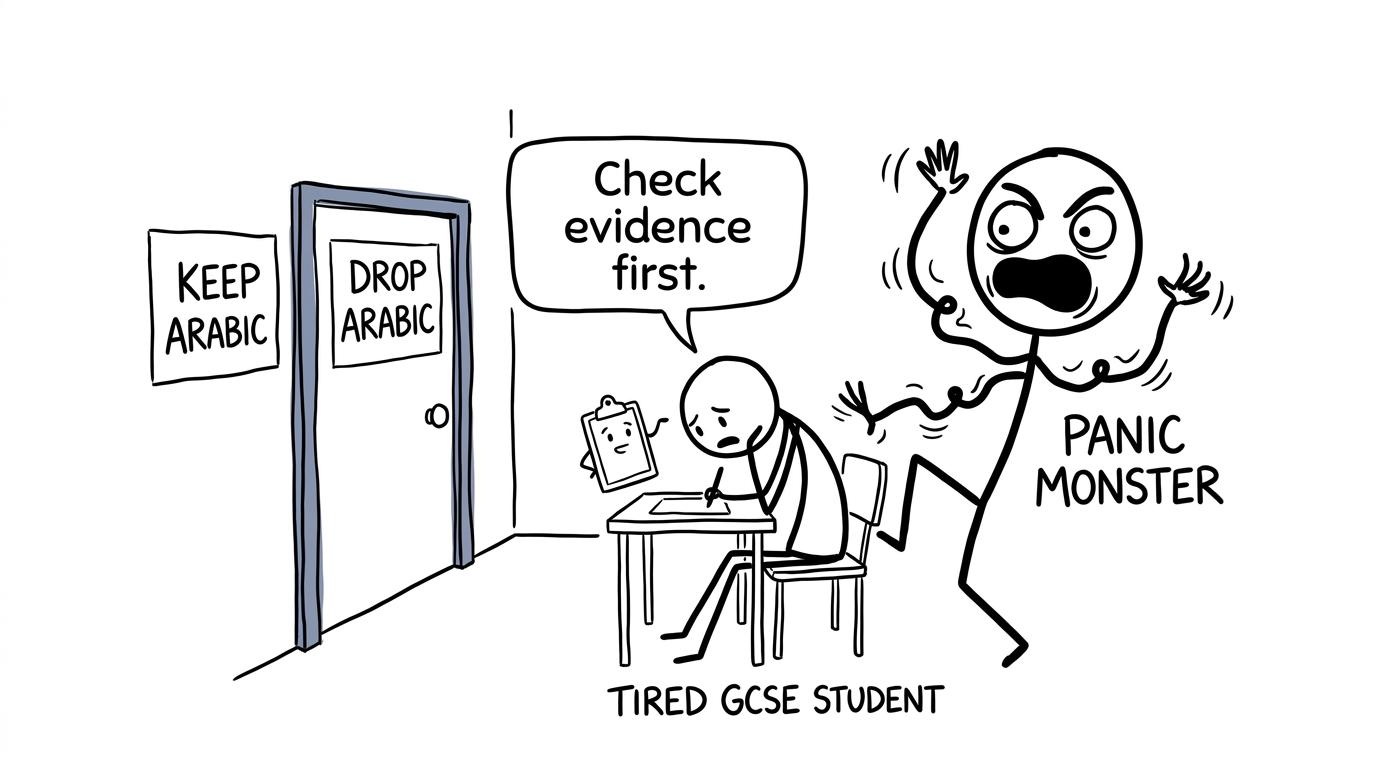 A student choosing between keeping and dropping Arabic while a panic monster offers unhelpful advice
How to tell if you are actually in over your head
GCSE Arabic is not assessed through one general language paper. Under the Pearson Edexcel specification, students complete listening, speaking, reading and writing assessments. Each skill contributes 25%25\%25% of the qualification, and students enter either foundation or higher tier across all four papers.
That matters because feeling weak at speaking does not automatically mean the entire qualification is beyond you. You need a skill-by-skill diagnosis.
Signs that the course may still be recoverable
You may be struggling rather than overwhelmed if:
- you understand lessons but lose marks through limited vocabulary or examination technique;
- one assessment area is much weaker than the others;
- your performance improves when you revise consistently;
- you can complete foundation-tier tasks but find higher-tier work discouraging;
- absence, timetable disruption or inconsistent revision explains the recent decline;
- your teacher can identify a realistic route to your target grade.
A tier discussion may sometimes be more appropriate than withdrawal. GCSE Arabic requires one tier across all papers, so this is a decision for your teacher and examinations officer rather than something you can change independently.
Signs that withdrawal deserves serious consideration
The position is more concerning if several of these apply over a sustained period:
- you cannot understand the foundations needed for current work;
- major gaps remain across all four skills despite regular help;
- your teacher believes the required progress is unrealistic in the time left;
- Arabic is consuming disproportionate revision time without measurable improvement;
- the workload is materially damaging attendance, sleep or preparation for core subjects;
- there is no suitable teaching, intervention or tier adjustment available;
- continuing serves no entry requirement or clearly defined personal goal.
Use at least two or three weeks of evidence where time permits. Record assessment results, completed revision, teacher feedback and the hours spent. Memory tends to magnify the most recent bad day; a written record shows the trend.
What dropping GCSE Arabic actually affects
Withdrawing from a GCSE is an administrative and academic decision. It should involve you, your parent or carer, the subject teacher, a senior member of staff and, where appropriate, the school’s examinations officer.
Your Arabic qualification
If your school formally withdraws your entry before you complete the assessments, you will not receive a GCSE Arabic grade from that examination series. Work already completed in class does not become a separate qualification.
Do not simply stop attending lessons or miss an examination. That is not the same as an agreed withdrawal and may create attendance, entry or results complications. Ask the examinations officer to confirm your status in writing.
Awarding organisations have their own entry, amendment and withdrawal deadlines. These dates vary, and later changes can affect the fees paid by your centre. The practical message is simple: speak to school promptly rather than relying on a date found online for a different board or examination series.
The English Baccalaureate
In England, Arabic is an eligible modern language for the English Baccalaureate, commonly called the EBacc. If Arabic is your only qualifying language and you withdraw, you would no longer complete the language element through that subject.
The EBacc is a group of subjects and a school performance measure, not a separate certificate or GCSE grade. Dropping Arabic does not cancel the GCSEs you achieve in English, maths, science, history or geography. Ask your school how its curriculum policy applies to you, particularly because national accountability arrangements and local policies can change.
Sixth-form and college applications
There is no single entry rule used by every sixth form or college. Some providers ask for a certain number of GCSEs at specified grades. Others calculate an average from a student’s best results, while A Level subjects often have their own requirements.
For A Level Maths, the decisive requirement is normally the grade achieved in GCSE Maths, although the precise threshold varies by provider. Further Maths usually has a higher mathematics requirement. Arabic could still matter if:
- it would be included in a best-results calculation;
- withdrawing leaves you below a minimum number of full GCSEs;
- you intend to study Arabic or another language after Year 11;
- a particular course or institution requests a language qualification.
Check the current published criteria for every sixth form or college you are seriously considering. Do not rely on what an older student needed in a previous year.
Your GCSE Maths grade
Dropping Arabic does not directly alter your maths tier, examination entry, grade boundaries or marks. The two qualifications are assessed separately.
It could help indirectly if the released time becomes focused maths revision. It will not help if that time dissolves into unplanned evenings. Start by identifying your board and tier through the GCSE Maths revision hub, then use the GCSE Maths topics by board and tier guide to locate the skills that repeatedly cost you marks.
Measure the real trade-off
Students often imagine dropping a subject creates a large pool of new time. In practice, some lessons may become supervised study, while homework and independent revision are the main hours released.
Write down what would change during a normal week:
- Arabic lessons that your school allows you to repurpose;
- Arabic homework and vocabulary practice;
- travel or external tuition connected with the subject;
- the support sessions you would no longer attend.
Then assign each available block a purpose. A credible maths plan might include one topic lesson, one set of practice questions and one timed test each week. MathsGenie’s twenty-minute maths revision routine works well when school days are crowded, while the one-month GCSE maths revision plan can form the basis of a fuller revision planner.
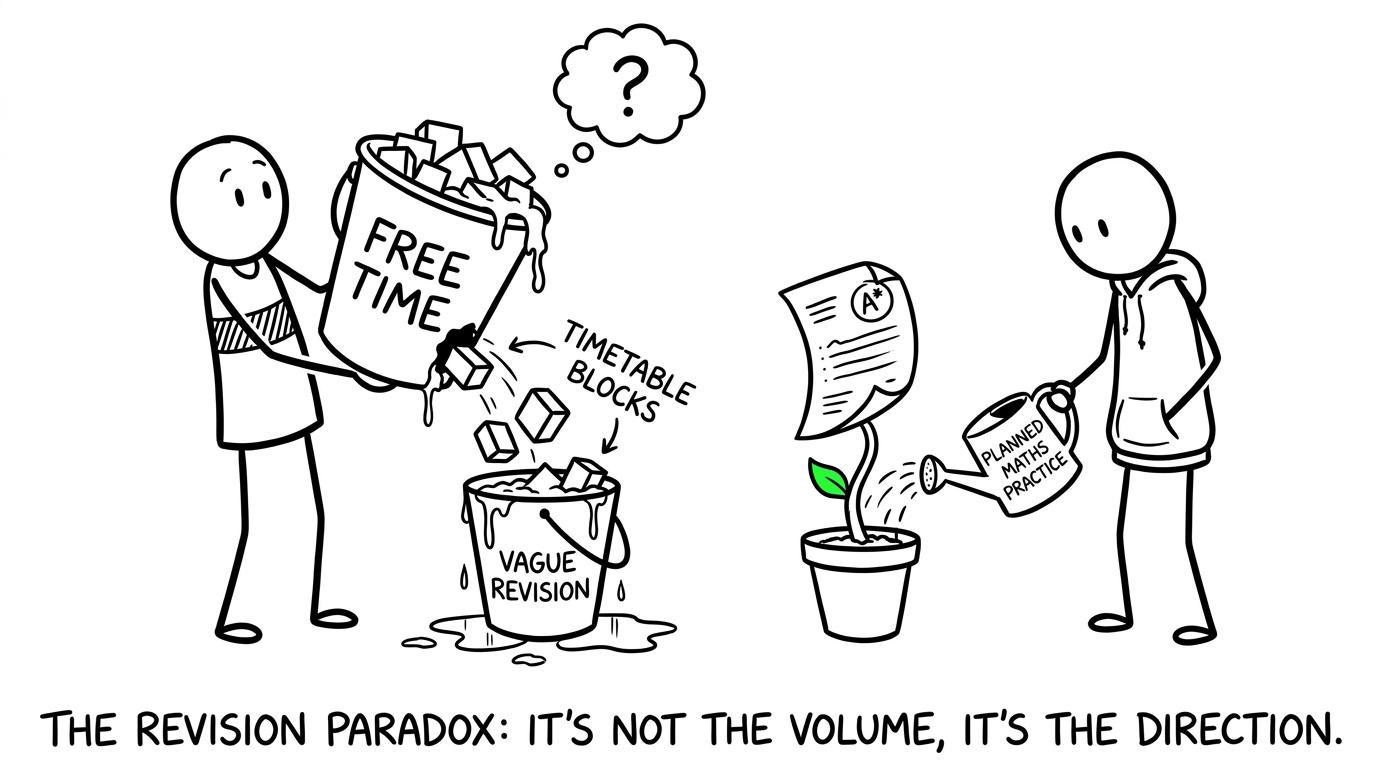 A student discovers that freed revision time needs a plan rather than a leaky bucket
Try a rescue period before withdrawing
Unless deadlines or wellbeing concerns make delay inappropriate, agree a short rescue period with your school. This is not about pretending everything is fine. It is a controlled test of whether improvement is possible.
For Arabic, ask your teacher to identify:
- your weakest assessment skill;
- the vocabulary and grammar with the greatest immediate value;
- whether your present tier remains suitable;
- one measurable target for the next assessment;
- the support available before and after school.
At the same time, test whether your maths workload is genuinely unmanageable. Complete a short timed paper or mini test and mark it carefully. Edexcel students can use GCSE Maths mini tests. For fuller paper practice, use the relevant collection of Edexcel GCSE Maths past papers, AQA GCSE Maths past papers or OCR GCSE Maths past papers.
At the end of the rescue period, review the evidence with your teacher. If your Arabic performance has moved, the course may be salvageable. If it has not, despite attendance, deliberate practice and support, withdrawal becomes a more evidence-based option.
What to ask your school
A calm meeting is more useful than announcing that you have already decided. Take this list:
- What is my current working grade in each Arabic skill?
- What is my realistic predicted grade?
- Am I entered for foundation or higher tier?
- Has my examination entry been submitted?
- Is formal withdrawal still possible, and who approves it?
- What happens during the lessons if I withdraw?
- Would this affect any internal programme, certificate or sixth-form application?
- Is a reduced workload, extra support or tier change available instead?
- Can the final decision and examination status be confirmed in writing?
If wellbeing, additional needs or difficult personal circumstances are involved, speak to the relevant pastoral or SEND staff as well. The right decision should account for more than a single predicted grade.
Common mistakes when deciding whether to drop Arabic
Deciding from one mock result
One poor paper can expose a gap without proving that the whole subject is impossible. Compare several assessments and separate the four language skills.
Assuming more time automatically means better maths
Time only becomes useful when assigned. Decide which maths topics, questions and papers will fill the released hours before you withdraw.
Ignoring admissions criteria
Removing one GCSE may affect a minimum subject count or best-grade average. Check your intended providers rather than assuming Arabic is either essential or irrelevant.
Treating non-attendance as withdrawal
Only your school can confirm and process the examination entry. Continue following your timetable until an authorised member of staff tells you otherwise.
Keeping the subject because of sunk time
The hours already spent cannot be recovered. The useful question is what choice gives you the strongest realistic outcome from today onwards.
Dropping it purely to chase perfection elsewhere
A secure Arabic result may be more valuable than a speculative attempt to move every other subject up a grade. Base the choice on realistic forecasts, not the hope that every freed hour will convert neatly into marks.
Make the decision, then commit to it
Whether you keep Arabic or withdraw, uncertainty should not occupy the rest of the year. If you continue, agree a focused recovery plan and judge progress by completed tasks and assessment evidence. If you withdraw, confirm the administrative details and give every released study block a job.
For maths, begin with MathsGenie’s free revision lessons and practice questions. Use mini tests to expose weak skills, past papers to develop timing, and predicted papers to rehearse unfamiliar questions. Mark every attempt with the mark scheme, and use video solutions when your method needs rebuilding.
Dropping a subject is not automatically failure, just as keeping one is not automatically resilience. The sensible choice is the one made with evidence, accurate information and a plan for what happens next. Open the MathsGenie GCSE revision area, build your revision planner and turn the time you have into deliberate, measurable practice.










