Should I Take GCSE Arabic? Honest Questions
Should I take GCSE Arabic? Ask honest questions about fluency, exam skills, workload and timetable fit before choosing this language option at school.
Choosing a GCSE can feel strangely permanent. A subject that occupies one small box on an options form will eventually claim lessons, homework, revision time and a place in your exam timetable.
So, should I take GCSE Arabic? The honest answer is yes if you are interested in the language, have access to suitable teaching and are prepared to develop listening, speaking, reading and writing. But speaking Arabic at home, wanting an extra GCSE or being told that the subject will be easy are not, by themselves, strong enough reasons.
The decision matters particularly when you are also preparing for compulsory subjects such as GCSE maths. Every option has an opportunity cost. The aim is not to choose the most impressive timetable. It is to choose one you can sustain.
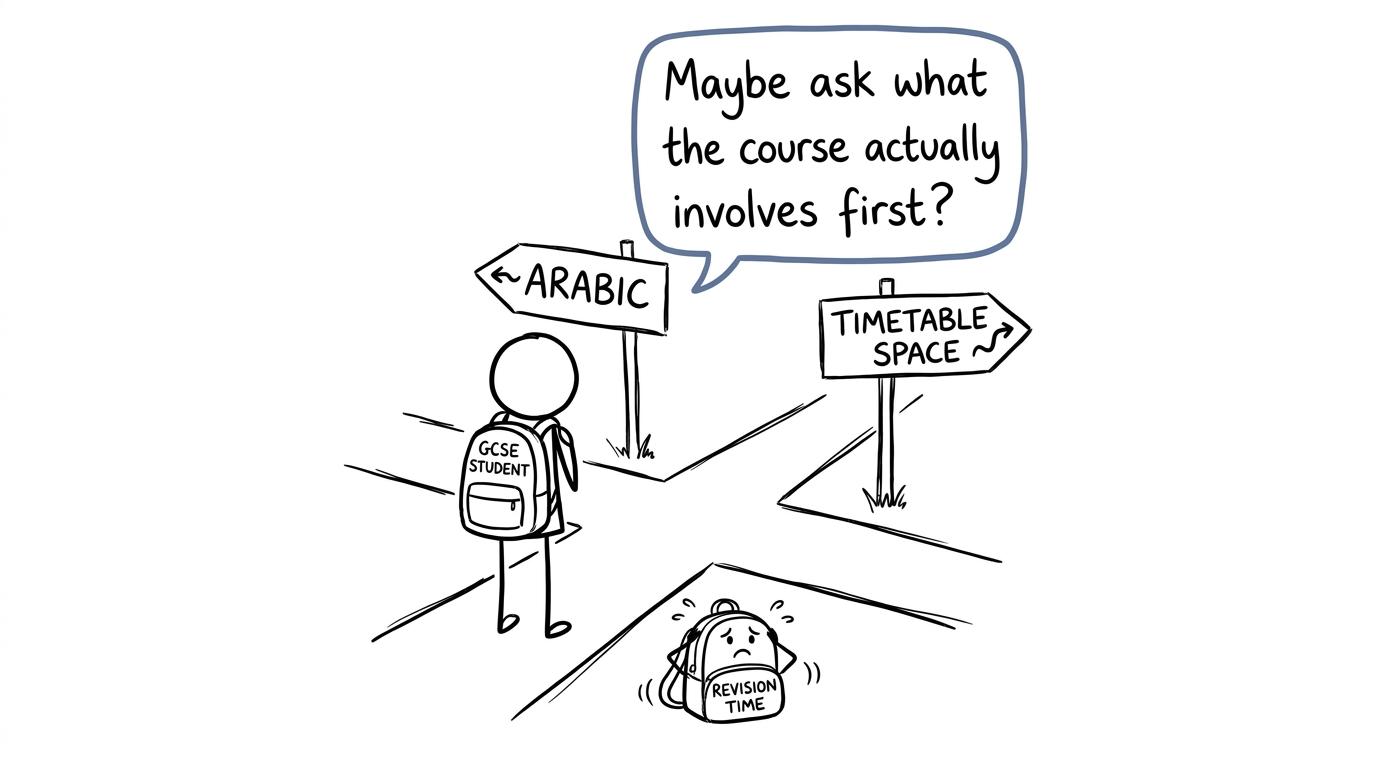 A student considering Arabic, timetable space and revision time at an options crossroads
A quick GCSE Arabic decision checklist
Before choosing the subject, ask yourself:
- Do I enjoy learning Arabic, rather than merely like the idea of having the qualification?
- Can I read and write accurately enough to build towards an examination?
- Am I willing to practise formal Arabic as well as any dialect I use at home?
- Who will teach me, assess my speaking and provide feedback?
- What qualification and exam board will my school enter me for?
- Can the subject fit beside maths, English, science and my other options?
- Have I looked at an actual specification and sample paper?
- Would I still choose Arabic if I expected it to require steady work?
If several answers are uncertain, that does not automatically mean no. It means you need better information before committing.
What does GCSE Arabic actually assess?
For the current Pearson Edexcel GCSE Arabic qualification, students are assessed through four papers: listening, speaking, reading and writing. Each skill contributes 25%25\%25% of the qualification. Students enter either foundation or higher tier and take the same tier across all four papers.
The speaking assessment includes a role play, discussion of a picture stimulus and a conversation. Reading includes comprehension and translation into English, while writing includes responses in Arabic and translation into Arabic. Dictionaries are not permitted in the assessments.
These details matter because GCSE Arabic is not simply a test of whether you can understand relatives or hold an everyday conversation. It assesses communication across different contexts, alongside vocabulary, grammar, reading accuracy and written expression.
Start by confirming the exact qualification offered by your school. Some centres may offer a different or international qualification with a different structure. The words “Arabic GCSE” are not enough: ask for the full qualification title, specification and exam board. You can then explore the free GCSE Arabic revision hub for relevant papers, questions and revision materials.
Can you use Arabic, or can you take an Arabic exam?
This is the most important distinction for many students.
A heritage speaker may have strong listening and speaking skills but less experience of formal reading, spelling or extended writing. Another student may read Arabic confidently through religious or community education but have a smaller everyday vocabulary. Someone learning Arabic mainly at school may know grammar rules well but need more speaking fluency.
None of these starting points is automatically better. They are simply different profiles.
The examination assesses standard Arabic. If you mainly use a regional dialect at home, that experience can provide a valuable foundation, but you should not assume that every familiar expression or grammatical pattern will be appropriate in an exam response. Look at each skill separately:
- Listening: Can you follow unfamiliar speakers discussing school, travel, relationships and wider issues?
- Speaking: Can you answer unprepared questions and refer to past, present and future events?
- Reading: Can you understand formal written passages without relying on vowel marks?
- Writing: Can you communicate accurately, organise ideas and translate into Arabic?
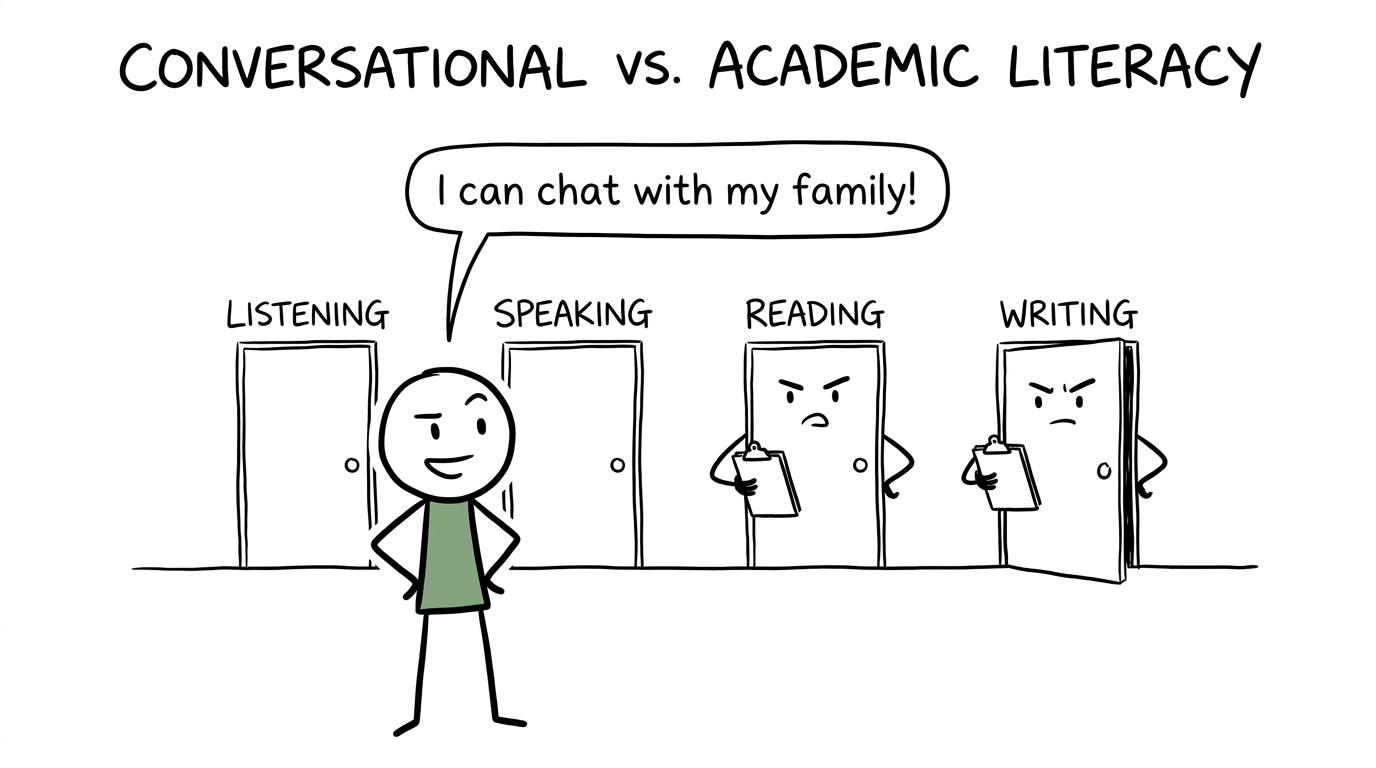 A conversational Arabic speaker meets the four rather formal exam skills
A useful test is to attempt part of a sample assessment under quiet conditions. Do not use it to predict your final grade. Use it to discover whether your confidence is balanced across all four skills.
Do you have proper teaching and feedback?
Motivation helps, but access matters too.
Ask who will teach the course and how regularly lessons will happen. Find out who will conduct speaking practice, mark writing and explain the difference between dialect and the language expected in the assessment. If Arabic sits outside the normal timetable, ask whether sessions could clash with intervention lessons, clubs or revision support.
Independent entry can be possible through some centres, but arrangements, deadlines and fees vary. The speaking component also requires an approved centre to conduct and record the assessment correctly. Speak to your school or prospective exam centre before assuming that entry can be arranged later.
Good feedback is especially important in language learning. An answer can communicate the general idea while still containing errors that limit marks. You need someone who can identify those errors and show you what to improve.
Will GCSE Arabic fit your real timetable?
Students often plan around their best week: no illness, no coursework pressure and no difficult maths homework. The safer approach is to plan around an ordinary week.
Write down your compulsory subjects, other options, travel, activities and regular responsibilities. Then ask where Arabic practice would genuinely fit. Languages usually respond better to short, frequent contact than to one large session completed reluctantly at the weekend.
Protect maths time as well. A simple routine might combine brief Arabic vocabulary or reading practice with a separate focused maths session. The 20-minute GCSE maths revision routine is useful when school days are crowded, while the GCSE maths revision timetable guide can help you see whether your overall plan is realistic.
Your option is sustainable if you can name when the work will happen. “I will somehow fit it in” is not a timetable.
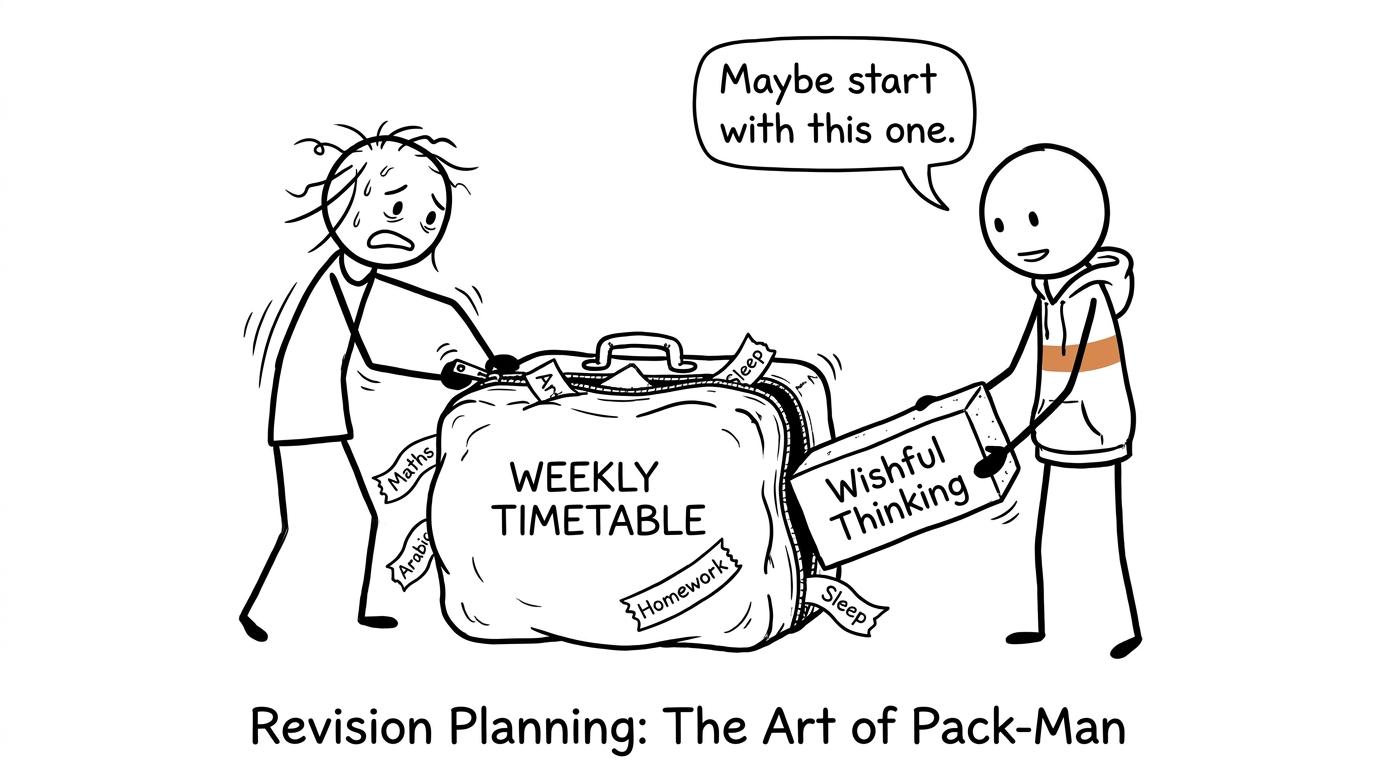 A student tries to close an overfilled weekly timetable suitcase
Are you choosing it for the right reason?
There is no single correct motivation. You might want to strengthen a language connected to your family, explore cultures across the Arabic-speaking world, prepare for further language learning or simply study something you enjoy.
The weaker reasons are those built on assumptions:
- “I speak it, so I will not need to revise.”
- “An extra GCSE always looks better.”
- “Someone else chose it, so I should too.”
- “It will guarantee a high grade.”
- “I can learn the writing near the end.”
No GCSE guarantees a particular result. Ofqual explains that grade boundaries are set after papers have been taken and can change from year to year to reflect paper difficulty. Treat any promise of an automatic grade with caution.
It is also sensible to discuss future plans with your school or college. Entry requirements differ between courses and institutions, so check the requirements that actually apply to you rather than relying on general rumours about which subjects “count”.
What will Arabic do to your maths revision?
This question is not about choosing Arabic instead of maths. GCSE maths remains central to your timetable, and many post-161616 routes set their own minimum maths requirements.
The issue is whether another subject will reduce the quality of your preparation. If maths is currently demanding significant attention, use evidence rather than anxiety. Try the GCSE maths revision hub, complete a short assessment and identify where marks are being lost. The guide to finding your weakest maths topics gives you a practical process.
A manageable plan could include topic practice during the week and an Edexcel GCSE maths mini test at the weekend. Later, move towards full past papers and Edexcel predicted papers if that is your board.
This gives you useful evidence. If Arabic can fit without repeatedly displacing essential maths work, that is encouraging. If every plan depends on sacrificing sleep or ignoring weak subjects, reconsider the load.
Common mistakes when choosing GCSE Arabic
Assuming home fluency covers every paper
Conversational confidence is valuable, but it does not automatically provide formal vocabulary, accurate spelling, translation skills or extended writing. Audit all four skills separately.
Not checking the exact qualification
A school may offer Pearson Edexcel GCSE Arabic, an international qualification or no taught course at all. Assessment structures are not interchangeable. Ask for the specification code and current entry arrangements.
Ignoring foundation and higher tier
In Pearson Edexcel GCSE Arabic, students take one tier across all four papers. Discuss likely tier entry with your teacher rather than judging it from speaking confidence alone.
Treating an extra GCSE as automatically worthwhile
One more qualification is not cost-free. It uses teaching, practice and examination time. The better question is whether Arabic adds something meaningful without weakening the subjects and commitments already on your timetable.
Waiting too long to inspect a paper
A course description can sound appealing while hiding the skill that will demand the most work. Look at sample and past assessment materials before making the choice, not after months of lessons.
Make the decision with evidence, not timetable regret
GCSE Arabic can be a rewarding choice. It can develop a language you value, formalise knowledge you already possess and give you a reason to become more accurate across speaking, listening, reading and writing.
But the honest test is straightforward: do you understand the assessment, have suitable support and possess enough time to prepare consistently? If the answer is yes, Arabic may deserve its place. If the plan relies on assumed fluency, uncertain exam arrangements or revision time that does not exist, pause before signing the form.
Whatever you decide, keep your compulsory subjects organised. Use MathsGenie’s free revision lessons and practice questions to strengthen individual maths topics, then test your progress with mini tests, past papers, mark schemes, video solutions and predicted papers. A good timetable is not the one containing the most subjects. It is the one that lets you prepare properly for every subject you choose.