Short Breaks vs Long Break GCSE Statistics
Short breaks vs long break GCSE statistics: explore the evidence, choose sensible timings and build a focused, testable maths revision routine.
The first ten minutes of statistics revision can feel productive. You remember what a histogram is, organise your notes and begin answering questions. Later, concentration becomes harder to judge. You are still sitting at the desk, but are you still learning?
For students comparing short breaks vs long break GCSE statistics revision, the practical answer is this: several planned short breaks are usually the better starting point during a long session. They can interrupt fatigue before it becomes severe and make it easier to return to a specific task. However, the evidence does not prove one perfect timetable for every student, and demanding work may occasionally require a longer recovery.
The important question is not simply how long you sit. It is how much accurate, retrievable maths you produce while you are there.
The quick revision-break checklist
A sensible starting routine is:
- Work on one clearly defined statistics task for about 202020 to 303030 minutes.
- Take a planned break of roughly 555 minutes.
- Move away from the question rather than opening another demanding task.
- Return with a written next action, such as completing three histogram questions.
- After several focused blocks, take a longer break of around 151515 to 303030 minutes.
- Adjust the pattern using completed questions, accuracy and concentration, not mood alone.
These timings are a practical trial, not a biological law. If you remain focused for longer, there is no need to stop halfway through a useful line of reasoning. If concentration has already collapsed, waiting for a timer will not restore it.
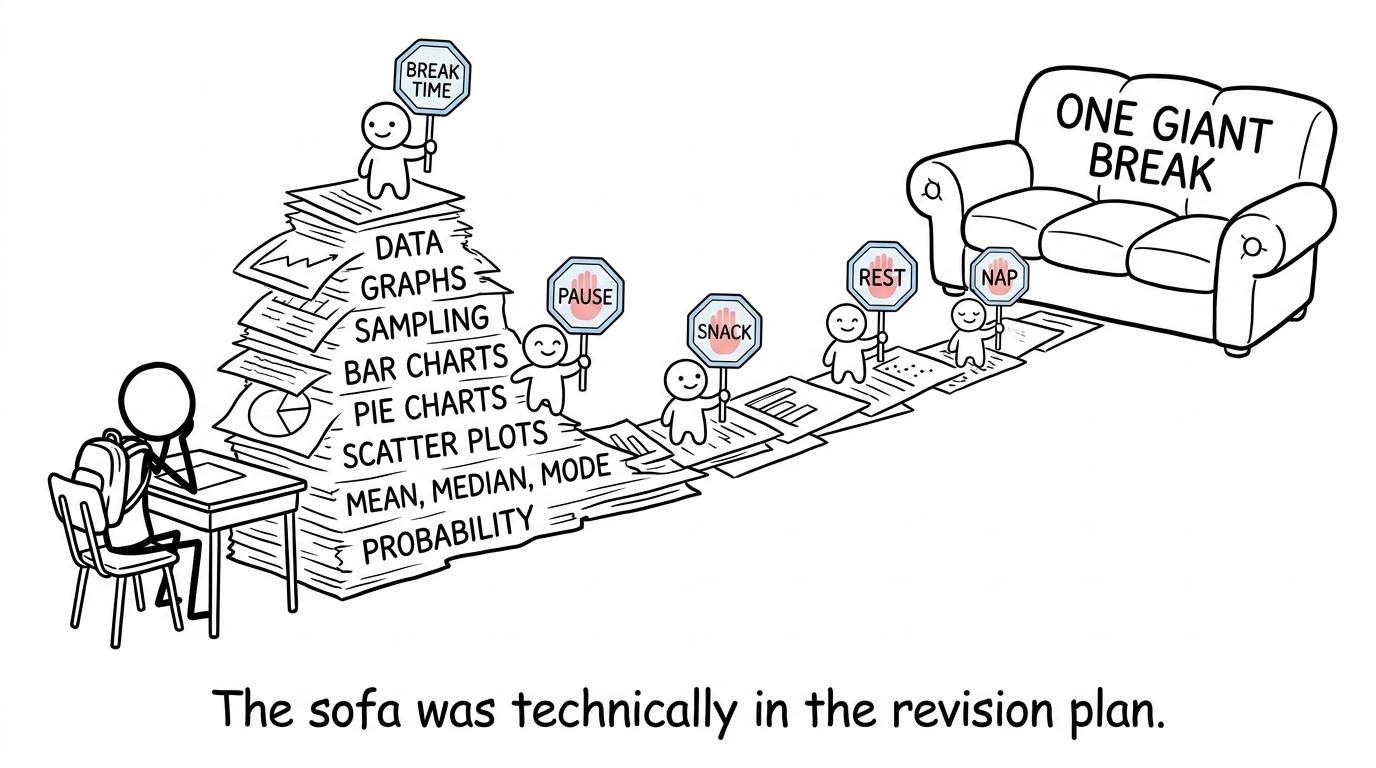 A student discovers that the enormous sofa at the end was technically part of the revision plan
What the evidence says about revision breaks
Research gives us a useful direction, but not a universal winning timetable. Direct studies of GCSE students revising statistics at home are limited. Much of the available evidence comes from university students, workplace tasks, classroom activity breaks or controlled memory experiments. That matters because learning frequency density is not identical to typing a sequence or attending a seminar.
Still, several findings are relevant.
A 202220222022 systematic review and meta-analysis found that micro-breaks of up to 101010 minutes produced small improvements in energy and reductions in fatigue. The overall improvement in task performance was not statistically clear. Longer breaks tended to help performance more, especially after depleting tasks, suggesting that very short pauses may not always provide enough recovery.
A 202320232023 real-world study compared self-regulated breaks with predetermined patterns. The planned groups used either 242424 minutes of work followed by 666 minutes of rest, or 121212 minutes followed by 333 minutes. Students choosing their own breaks tended to study and pause for longer, while reporting more fatigue, distraction and lower concentration. Task completion did not differ significantly, but systematic breaks appeared more efficient and supported a better study experience.
More recent classroom research with university students has also reported better sustained quiz performance with frequent micro-breaks than with one traditional break. This is promising, but it involved taught seminars rather than independent GCSE revision, so it should inform your routine rather than dictate it.
Research into quiet wakeful rest provides another clue. Brief periods of low-stimulation rest after learning can support memory consolidation in many controlled studies. Yet findings in realistic educational settings are mixed, particularly for complex material. A break can create useful mental space, but it cannot replace retrieval practice, feedback or sleep.
The honest conclusion is modest: planned short breaks usually help manage fatigue, while a longer break remains useful after sustained or especially difficult work.
Why GCSE statistics can feel unusually dense
Statistics switches repeatedly between calculation, graphical representation and written interpretation. You may need to distinguish a sample from a population, calculate an estimated mean, interpret correlation and then explain why a conclusion could be unreliable.
At higher tier, topics such as cumulative frequency, box plots and histograms add further decisions. For a histogram, remembering that bar area represents frequency is only the beginning. You must identify class width and apply
frequency density=frequencyclass width.\text{frequency density}=\frac{\text{frequency}}{\text{class width}}.frequency density=class widthfrequency.That combination of recall, calculation and interpretation places demands on attention. A tired student may know the formula but read the scale incorrectly. Another may calculate quartiles correctly but forget that
IQR=Q3−Q1.\text{IQR}=Q_3-Q_1.IQR=Q3−Q1.Breaks do not teach these ideas. Their job is to protect the quality of the practice that does.
Begin with the MathsGenie GCSE Statistics revision hub if you take Edexcel GCSE Statistics. If statistics is part of your GCSE Mathematics course with Edexcel, AQA, OCR or Eduqas, choose your board through the wider GCSE Maths revision hub.
Several short breaks or one long break?
When several short breaks are likely to win
Frequent short breaks are particularly useful when:
- You are learning or relearning an unfamiliar method.
- You are making repeated errors that you would normally spot.
- The session contains several different statistics skills.
- You are revising after a full school day.
- You tend to postpone breaks until concentration has disappeared.
They also create natural boundaries. One block might cover a revision lesson, the next practice questions and the third marking. This is more purposeful than treating revision as one uninterrupted stretch of desk time.
For a difficult topic, study the histograms revision guide, pause briefly, then answer questions without copying the method. On another block, use the averages from frequency tables guide before moving into independent practice.
When one longer break may be better
A longer break can be valuable after a full timed paper, an extended higher-tier problem set or several completed short blocks. Recovery from demanding work may need more than a brief stretch.
Longer breaks also make practical activities possible: eating, taking a walk or genuinely leaving the revision environment. The danger is not the length itself. It is losing the return point. A break without a planned end can quietly become the end of the session.
The strongest routine therefore combines both approaches: short breaks within concentrated revision, followed by a longer break after a meaningful group of tasks.
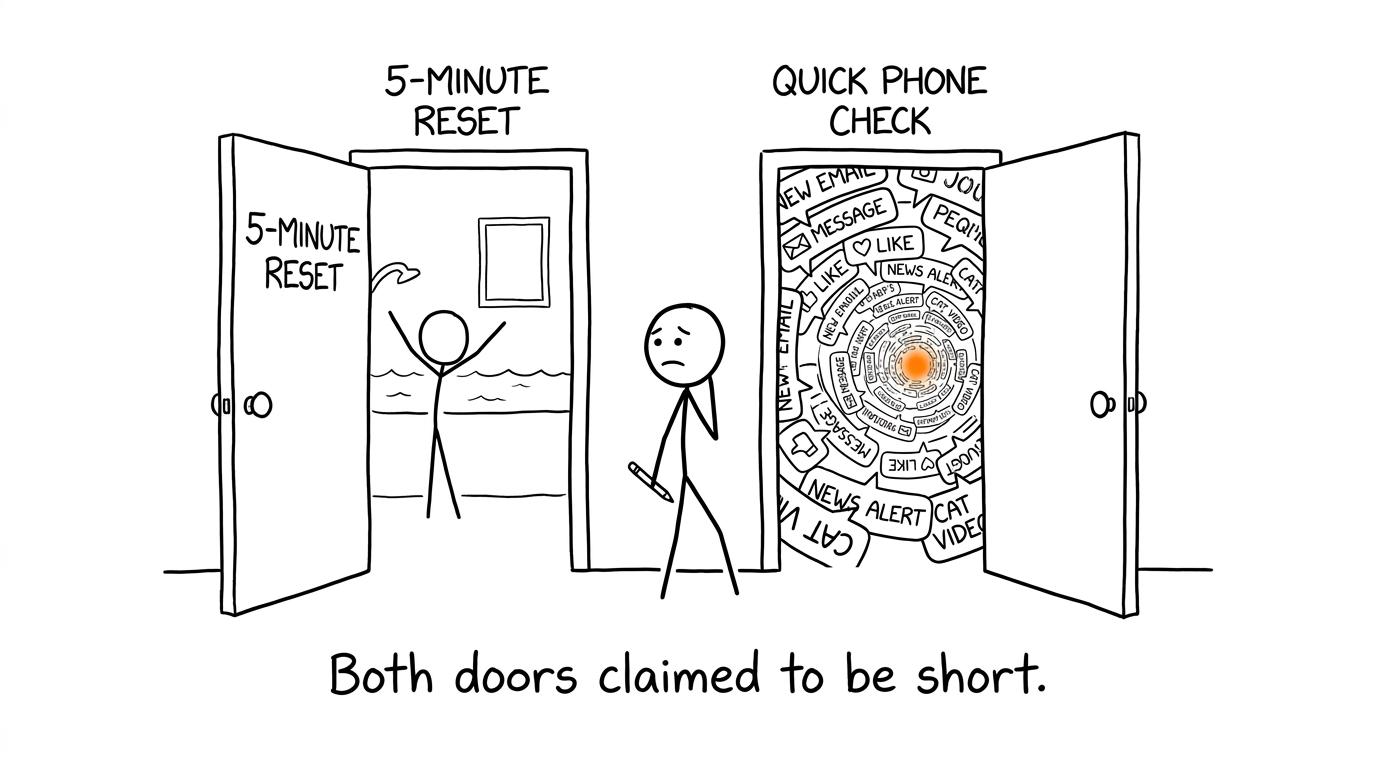 A five-minute reset competes with the endless tunnel behind a quick phone check
What should happen inside each statistics block?
A break schedule cannot rescue passive revision. Reading a page repeatedly may feel smooth because the material becomes familiar, but familiarity is not the same as being able to produce a method in an exam.
Give each block one observable outcome:
- Recall a formula or method without notes.
- Complete a small set of exam-style questions.
- Draw and interpret one statistical diagram.
- Mark answers and classify each lost mark.
- Correct errors without looking at the original solution.
- Retest the same skill on another day.
For graphical topics, the cumulative frequency and box plots worksheet provides a focused task that can fit into a revision block. When you are ready to combine skills, use Edexcel GCSE Statistics past papers with the official mark schemes and available solutions.
Do not pause during a timed paper unless access arrangements permit it in the real examination. Timed practice serves a different purpose: it develops stamina, pacing and decision-making under authentic conditions. Use breaks while learning and correcting topics, then gradually practise performing without them.
Make the break genuinely restorative
A useful break changes the demand placed on your attention. Stand up, drink water, look outside or walk around briefly. Quiet rest may also be helpful immediately after learning something new.
A phone break often replaces one stream of information with another. Messages, short videos and notifications can make a planned 555-minute pause difficult to end. This does not mean every screen is harmful. It means your break should reduce distraction rather than invite an unlimited supply of it.
Before leaving the desk, write your first action for the return. “Start question 444” creates less friction than “continue statistics”. Set a timer and keep the required worksheet open.
Test the routine like a statistician
Your ideal break pattern should be judged using evidence. Test two routines across comparable sessions rather than deciding from one unusually good or bad evening.
Keep the total revision time, topic difficulty and time of day as similar as reasonably possible. Record:
- questions attempted;
- questions answered correctly;
- marks gained;
- avoidable errors;
- whether you returned on time;
- concentration at the end of each block.
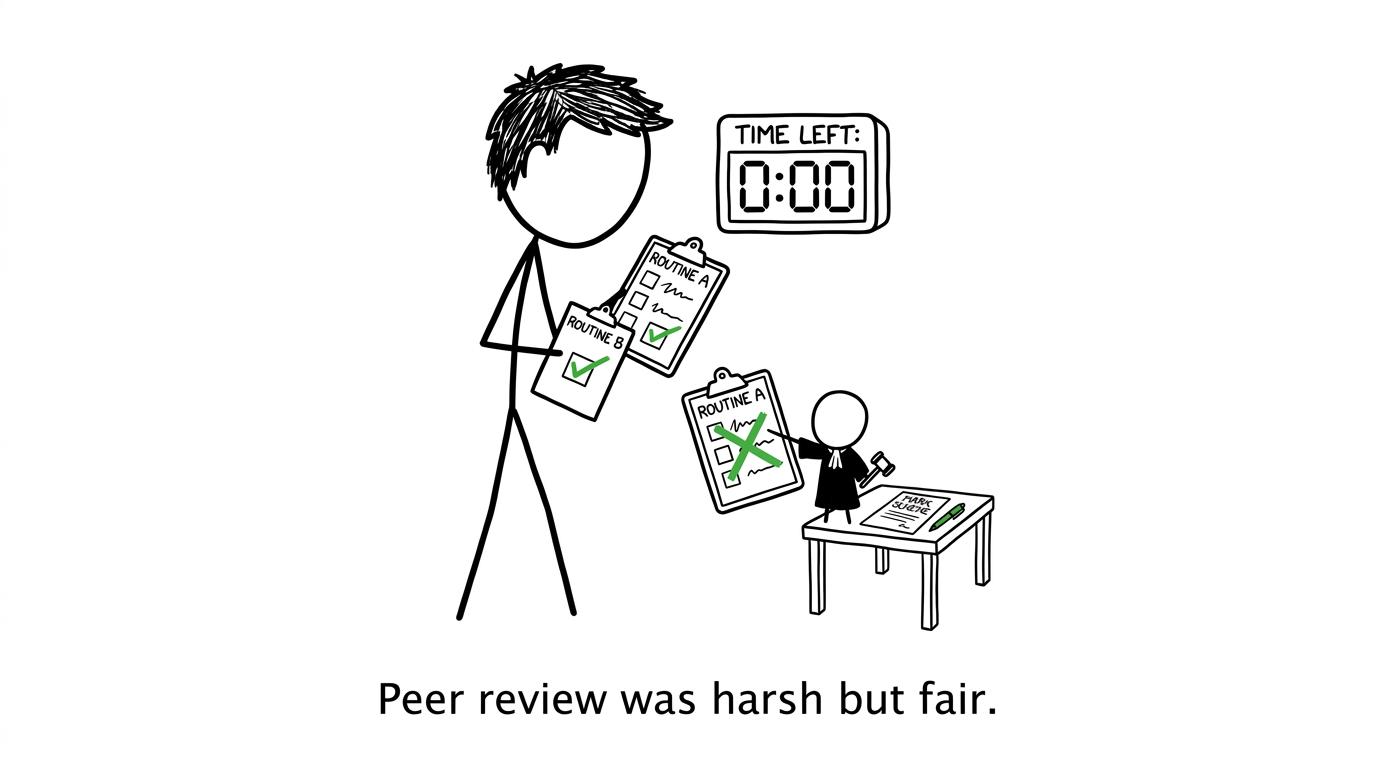 A student runs a stern but fair experiment on two revision routines
Accuracy can be summarised as
accuracy rate=marks gainedmarks available×100%.\text{accuracy rate}=\frac{\text{marks gained}}{\text{marks available}}\times 100\%.accuracy rate=marks availablemarks gained×100%.Do not overinterpret a tiny sample. A single session can be affected by sleep, topic familiarity or interruptions. Look for a repeated pattern over several days, then review the routine. This is metacognition in practical form: plan, monitor and evaluate how you learn.
If you need a broader structure around these sessions, follow the GCSE one-month revision plan. On particularly busy days, the 20-minute GCSE maths routine provides a smaller alternative.
Common mistakes when planning revision breaks
Treating break timing as more important than revision quality
A perfectly timed session spent copying notes remains weak revision. Questions, retrieval and marking should occupy most of the working blocks.
Waiting until exhaustion before stopping
Self-regulated breaks can drift because students often stop only when work feels unbearable. Decide your likely stopping points before beginning, while allowing enough flexibility to finish a question sensibly.
Turning every break into screen time
A break filled with new information may not feel restorative, and an open-ended feed makes returning harder. Choose an activity with a clear end.
Changing too many variables at once
If you alter the topic, time of day, break length and resource together, you cannot tell what helped. Compare routines under reasonably similar conditions.
Using breaks during every timed paper
Topic revision and examination rehearsal are different. Build understanding with breaks, but complete some papers under the uninterrupted conditions required by your exam board and tier.
Never revisiting the topic
Breaks within a session are not the same as spacing revision across days. Return to the skill later. A method that works tonight but disappears next week is not secure.
Build a routine you can trust
Several short breaks are usually a stronger default than struggling through one long stretch and hoping a large break will repair your concentration afterwards. But the best plan is rarely extreme. Use brief, predetermined pauses during focused topic work, then take a longer break after several blocks or a demanding paper.
Most importantly, measure what the routine produces. Correct questions, clearer explanations and fewer repeated mistakes matter more than how disciplined the timer looks.
Start with MathsGenie's free revision lessons and practice questions, then check your work using mark schemes and video solutions. Build stamina with mini tests before progressing to past papers and predicted papers. Put each session into your revision planner, protect the breaks you have chosen and return with one specific task waiting. A good routine does not make statistics effortless. It makes your effort count.