

Short Breaks vs Long Break GCSE English Language
Short breaks vs long break GCSE English Language: explore the evidence, choose sensible timings, prevent phone drift and build a repeatable revision plan.
Revision often fails quietly. You begin analysing an unseen extract, feel your concentration thinning, and promise yourself a break after one more paragraph. Twenty minutes later, you are still sitting there but no longer thinking clearly.
So, in the debate over short breaks vs long break GCSE English Language revision, which approach wins? The most defensible answer is that planned short breaks usually provide the better default during a revision session, while a longer break becomes useful after several demanding blocks. Research suggests that brief breaks can reduce fatigue and restore energy, but it does not prove that one perfect timetable improves everybody's exam performance.
For dense English Language work, try focused blocks of roughly 202020 to 303030 minutes separated by breaks of around 555 minutes. After 222 or 333 blocks, take a longer break of 151515 to 303030 minutes. Adjust the pattern according to the task and your genuine concentration to not according to when your phone becomes interesting.
The short answer and revision checklist
A sensible starting plan is:
- Choose one precise task before starting.
- Work with full attention for 202020 to 303030 minutes.
- Take a planned break of about 555 minutes.
- Repeat for 222 or 333 focused blocks.
- Take a longer recovery break of 151515 to 303030 minutes.
- Mark or review what you produced before changing topic.
- Stop if accuracy has clearly deteriorated and recovery is no longer helping.
This is a framework rather than a law. A student planning a persuasive response may prefer a different rhythm from one completing a timed reading section. The useful principle is that breaks should protect the quality of your work, not merely divide the clock.
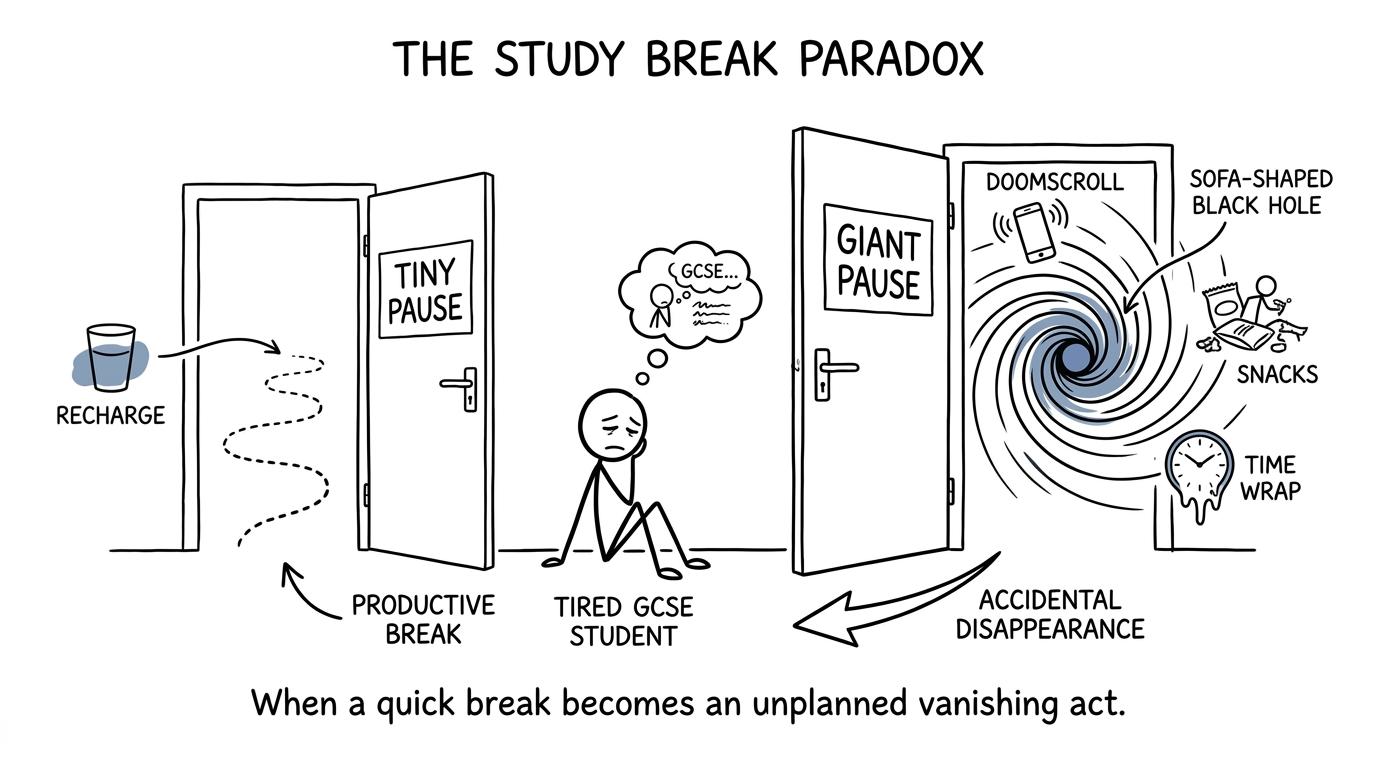 A revision break offering a small pause or a sofa-shaped black hole
What the evidence actually suggests about breaks
It is tempting to search for a single winning ratio: perhaps 252525 minutes of revision followed by 555 minutes away. Research is less tidy.
A 2022 systematic review and meta-analysis brought together 222222 experimental study samples involving 2,3352{,}3352,335 participants. It defined micro-breaks as pauses lasting no more than 101010 minutes. Across the studies, these breaks produced small improvements in feelings of energy and reductions in fatigue. However, the overall improvement in task performance was not statistically significant. Longer micro-breaks appeared more helpful for some performance measures, particularly in less cognitively demanding or more creative tasks.
That distinction matters. A break can make you feel fresher without automatically improving the quality of an analytical paragraph. Well-being and performance are connected, but they are not identical.
A 2023 study of university students compared self-chosen breaks with two systematic patterns: 242424 minutes of work followed by 666 minutes of rest, and 121212 minutes of work followed by 333 minutes of rest. The planned-break groups reported less fatigue and distraction than the self-regulated group, while task completion and mental effort did not differ significantly. The strongest lesson was not that one ratio defeated another. It was that deciding the breaks in advance may prevent revision from expanding into a longer, more distracted session.
These studies do not provide a final answer specifically for GCSE pupils revising English Language. Participants, tasks and settings vary, and much of the evidence comes from adults or university students. The honest conclusion is therefore modest: short breaks are reasonably supported as a way to manage fatigue, but claims that they directly guarantee higher marks would go beyond the evidence.
Why GCSE English Language feels mentally dense
GCSE English Language is not simply a collection of facts to memorise. Across Edexcel, AQA, OCR and Eduqas, students must read critically, identify explicit and implicit ideas, analyse language and structure, compare perspectives, evaluate texts and write for particular purposes and audiences. Exact paper structures vary by specification, so revision should match your board.
These tasks demand sustained decisions. You may need to select evidence, infer meaning, identify a writer's method, explain its effect and connect that effect to the wider text. Writing adds planning, organisation, vocabulary, sentence control, spelling and punctuation.
A short break can interrupt accumulating fatigue before your responses become vague. It also creates a boundary between unlike tasks. For example, you might analyse an extract in one block, pause, then plan a transactional response in the next. The break is useful because the next block has a defined purpose.
It is less useful when every pause destroys momentum. If you are halfway through a paragraph and your timer sounds, finish the sentence or note the next idea before stopping. A timetable should support thought, not behave like a fire alarm.
When several short breaks are likely to work better
Short, frequent breaks are particularly useful when you are:
- annotating an unfamiliar text;
- practising focused language or structure analysis;
- reviewing a marked response and identifying weaknesses;
- planning several possible writing questions;
- revising after a full school day;
- alternating English with demanding GCSE maths practice.
The shorter pattern works because each block has a visible finish line. A difficult task feels less shapeless when you know what must be completed before the timer ends.
Use an output target as well as a time target. “Revise English” is too broad. “Select three quotations and explain the effect of each” gives the block a destination. For maths, the equivalent might be completing one focused set from the GCSE Maths revision hub and marking it before the break.
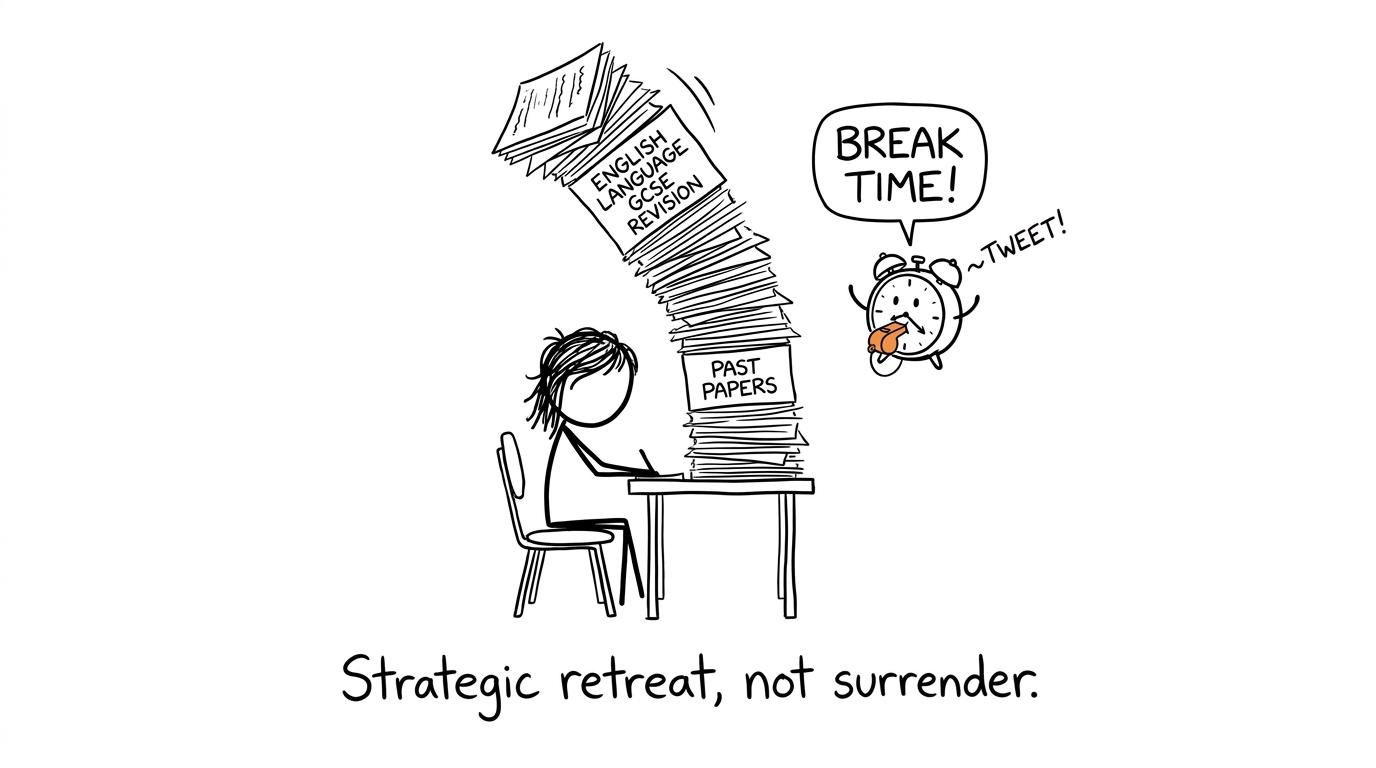 An alarm clock prevents a tower of revision papers from toppling
When one longer break may be better
A longer break has a different job. It is not there to rescue every moment of boredom. It is there to provide deeper recovery after sustained effort.
Consider a longer break when you have:
- completed several focused blocks;
- written a substantial timed response;
- marked work and corrected the main weaknesses;
- reached the point where rereading no longer improves understanding;
- finished one subject and need to reset before another.
A break of 151515 to 303030 minutes gives you time to eat, walk, stretch or move to another room. Those activities are more restorative than sitting at the same desk while consuming fast-moving content on a phone.
Longer breaks carry a practical risk: they can become endings. If returning is difficult, decide the next action before leaving. Keep the book open at the correct page, write a one-line instruction and set an alarm. Reduce the number of decisions waiting for you.
Students balancing English with maths could return to a small, closed task such as an Edexcel GCSE Maths mini test. A defined test is easier to begin than the vague instruction to “do some maths”.
A practical hybrid routine for English and maths
For most students, the best answer is not exclusively short or long breaks. It is a hybrid structure.
Begin with two English blocks
Use the first block for reading or analysis and the second for planning or writing. Place a short break between them. Keep your phone away from the desk and use a basic timer if possible.
Take a genuine longer reset
After two demanding blocks, leave the revision space. Drink water, have food if needed, or walk briefly. Avoid opening something designed to hold your attention indefinitely.
Return with one maths task
Switching subjects can refresh attention, but only if the next task is specific. Choose a revision lesson, a small group of practice questions or a mini test from your correct exam-board pathway. The Edexcel GCSE Maths revision area brings lessons, questions and revision tools together, while the broader GCSE Maths revision collection covers boards including AQA, Edexcel, OCR and Eduqas.
Mark the work before finishing. MathsGenie's free mark schemes and video solutions help turn an incorrect answer into a precise next step. For a more detailed short-session structure, use the 20-minute GCSE maths revision routine.
Breaks are not the same as spaced practice
A five-minute pause within one evening is a break. Returning to the same skill several days later is spaced practice. The two ideas are related, but they solve different problems.
Breaks manage immediate fatigue. Spacing creates repeated opportunities to retrieve and apply learning over time. Evidence reviewed by the Education Endowment Foundation suggests that spacing material across days or lessons can have a small positive impact on learning, although results vary and evidence for spacing within individual lessons is more limited.
For English Language, revisit analysis, comparison and writing skills across different days using fresh texts. For maths, return to weak methods after a delay rather than completing one large worksheet and never seeing the topic again. The guide to stopping GCSE maths content from being forgotten explains how retrieval, spaced practice and exam questions can work together.
A break helps you return to the desk. Spacing helps you return to the knowledge.
Make each break genuinely restorative
The quality of the pause may matter as much as its duration. A useful short break changes your physical or attentional state without creating a difficult new stopping problem.
Good options include:
- standing and stretching;
- walking to another room;
- looking away from the screen;
- drinking water;
- opening a window;
- preparing the materials for the next block.
Be careful with social media, short-form video and games. The problem is not moral weakness. These activities are designed around continuation, so a five-minute break can lose its boundary.
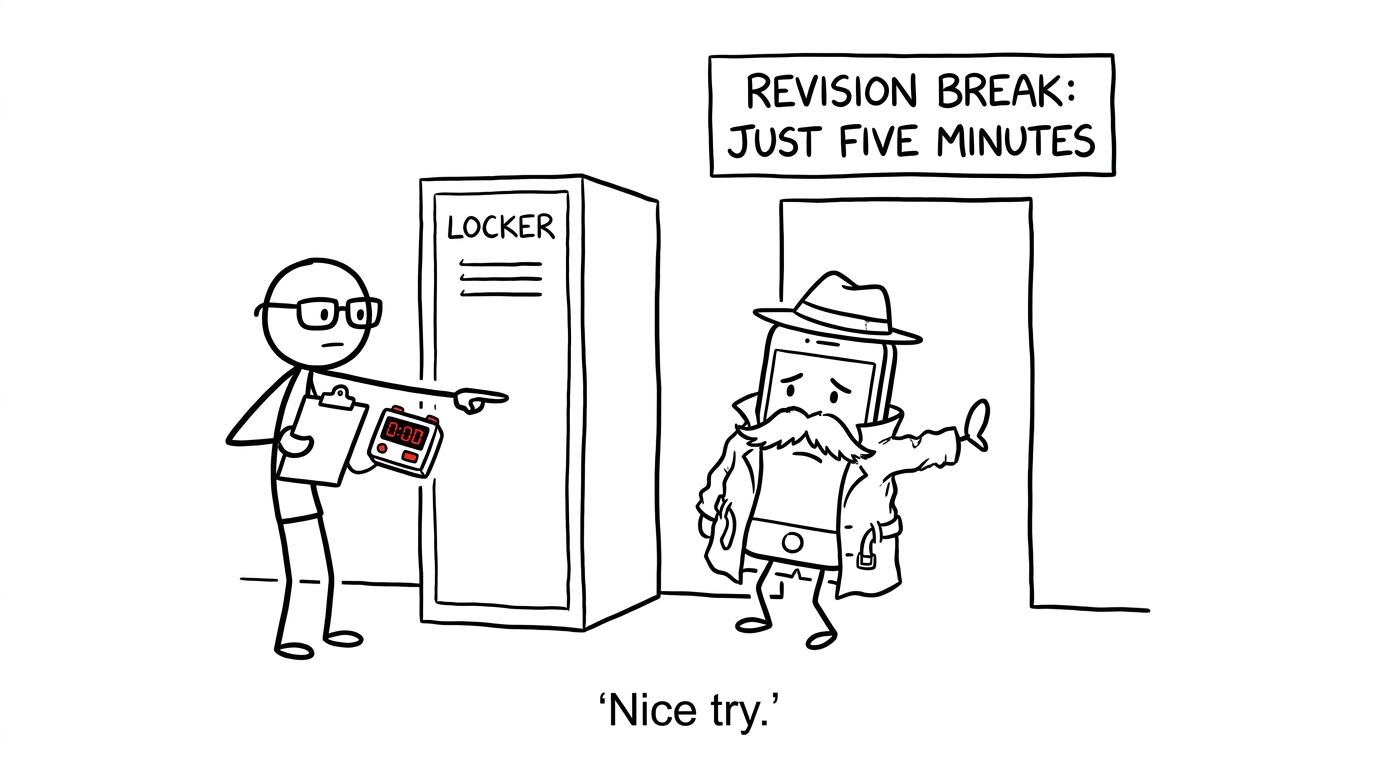 A disguised phone fails to enter a five-minute revision break
Common mistakes with revision breaks
Waiting until concentration has completely collapsed
If you only stop once you are exhausted, a brief pause may not be enough. Plan the first break before beginning and adjust future blocks using evidence from your accuracy and focus.
Treating every uncomfortable moment as a signal to stop
Good revision often feels effortful. Pause because the block has ended or your performance is deteriorating, not simply because the question is difficult.
Returning without a defined task
Write down exactly what happens next. “Complete the second comparison paragraph” is easier to restart than “continue English”. In maths, use the process in finding your weakest GCSE topics to choose a specific skill rather than revising randomly.
Using breaks but doing passive revision
A perfect timer cannot rescue weak methods. Reading model responses repeatedly may feel smooth, but you also need to retrieve ideas, plan answers, write under time and use feedback. In maths, move quickly from revision lessons to practice questions and mark schemes.
Forcing one schedule onto every task
A short analysis exercise and a timed paper section place different demands on attention. Protect realistic exam practice by completing the planned section without artificial interruptions. Guidance on using GCSE past papers properly can help you separate learning sessions from full exam-condition practice.
Build a routine that you can repeat
Several planned short breaks generally beat one unplanned long disappearance during ordinary GCSE English Language revision. Yet the strongest routine uses both: short pauses to limit fatigue within a session, followed by a longer recovery period after sustained, demanding work.
Start small. Choose one English skill, complete two focused blocks and judge the result by the work produced rather than the hours claimed. Then use the same rhythm for maths: learn, practise, mark, fix and retest.
MathsGenie gives you a free place to run that cycle with revision lessons, practice questions, mini tests, past papers, predicted papers, mark schemes and video solutions. Open the GCSE Maths revision hub, choose your board and tier, and give your next focused block one clear purpose. A good break protects the work. A good system makes you return.










