

Sharing in a Ratio GCSE Maths: A Clear Method
Sharing in a ratio GCSE maths explained with a simple method, clear worked examples, common mistakes and exam-style questions for confident revision now.
Sharing in a ratio can feel strangely unreliable. You understand it in class, answer one question correctly, then meet a slightly different version in a paper and divide by the wrong number.
For sharing in a ratio GCSE maths, the dependable method is simple: add the ratio parts, divide the total by that sum, then multiply to find each share. The difficulty is usually not the arithmetic. It is recognising what each number represents.
Imagine a student called Sam. Sam keeps dividing the total by the number of people. That works when the shares are equal, but a ratio describes unequal shares. Once Sam starts thinking in parts rather than people, the topic clicks.
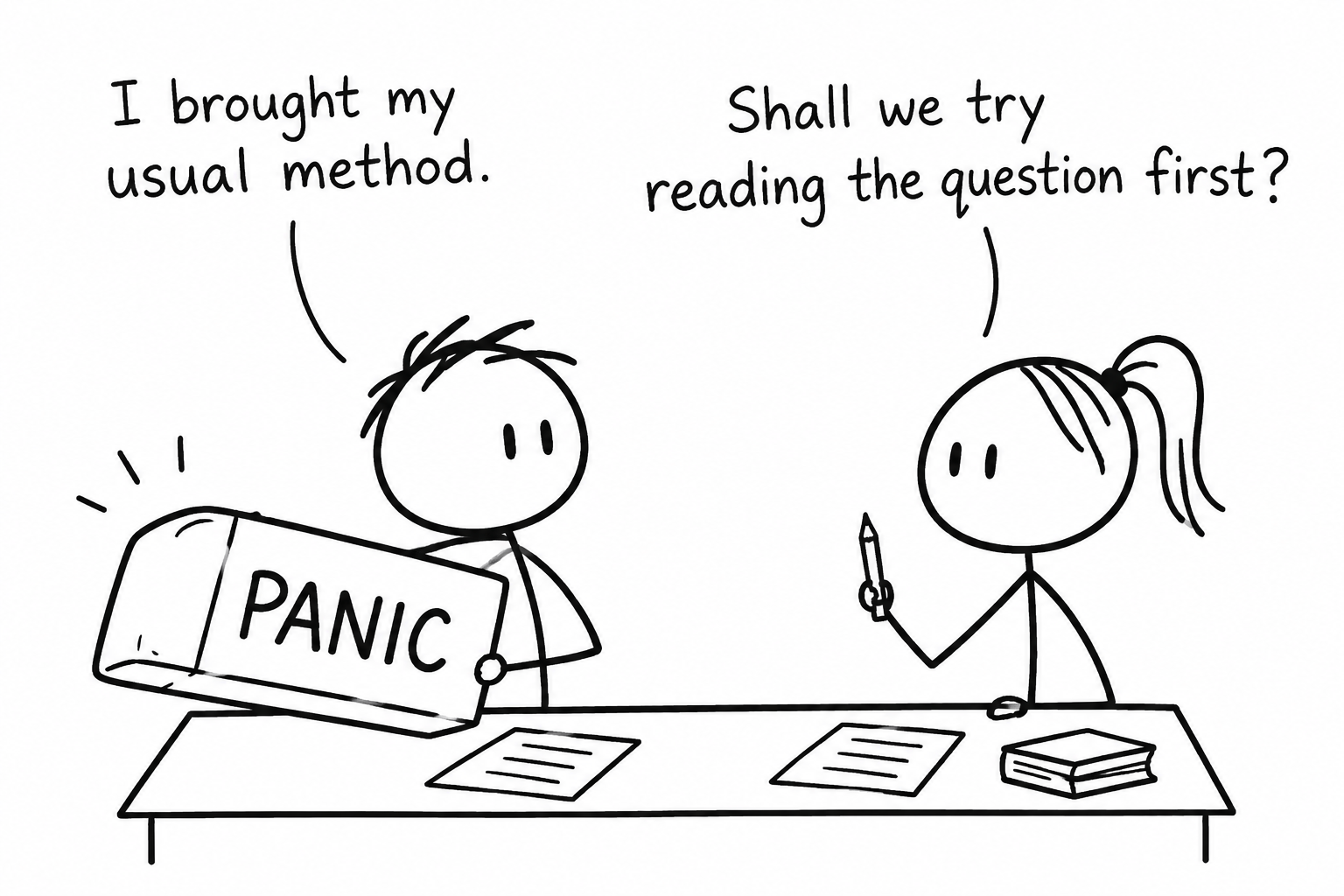 Two students reconsidering their usual panic-based revision method
The sharing in a ratio checklist
Use this process whenever the total amount is given:
- Add all the numbers in the ratio.
- Divide the total amount by the number of parts.
- Multiply the value of one part by each ratio number.
- Check that your shares add back to the original total.
- Include units, such as pounds, centimetres or sweets.
In compact form:
one part=total amounttotal number of ratio parts\text{one part}=\frac{\text{total amount}}{\text{total number of ratio parts}}one part=total number of ratio partstotal amountYou can explore the same process through the Maths Genie Ratio lesson and revision resources, which include lessons, exam-style questions and worked solutions.
Why the method works
Suppose two people share an amount in the ratio 3:43:43:4. The first person receives 333 equal parts and the second receives 444 equal parts. There are therefore:
3+4=7 parts3+4=7\text{ parts}3+4=7 partsThe total must be divided into 777 equal pieces before those pieces can be allocated. This is where Sam used to go wrong. There are two people, but there are 777 ratio parts. Dividing by 222 would create equal shares and ignore the ratio completely.
A ratio is not the amount itself. It tells you how many equal parts belong to each person or category.
If setting up the method and finding suitable practice feels like another revision task, use the AQA Ratio lesson and the Ratio Question Bank to move directly from learning the steps to applying them.
Sharing in a ratio worked examples
Sharing between two people
Share £84£84£84 between Aisha and Ben in the ratio 3:43:43:4.
First, add the ratio parts:
3+4=73+4=73+4=7Divide the total by 777 to find one part:
£84÷7=£12£84\div 7=£12£84÷7=£12Aisha receives 333 parts:
3×£12=£363\times £12=£363×£12=£36Ben receives 444 parts:
4×£12=£484\times £12=£484×£12=£48Check the total:
£36+£48=£84£36+£48=£84£36+£48=£84Therefore, Aisha receives £36£36£36 and Ben receives £48£48£48.
The check matters. It is a quick way to catch multiplication errors before moving on.
Sharing between three people
Share 969696 counters between Kai, Leo and Mia in the ratio 2:3:72:3:72:3:7.
Add all three parts:
2+3+7=122+3+7=122+3+7=12Find the value of one part:
96÷12=896\div 12=896÷12=8Now calculate each share:
Kai=2×8=16Leo=3×8=24Mia=7×8=56\begin{aligned} \text{Kai} &=2\times 8=16\\ \text{Leo} &=3\times 8=24\\ \text{Mia} &=7\times 8=56 \end{aligned}KaiLeoMia=2×8=16=3×8=24=7×8=56Check:
16+24+56=9616+24+56=9616+24+56=96So the shares are 161616, 242424 and 565656 counters.
Sam's old instinct might have been to divide 969696 by the three people. The better question is always: How many ratio parts are there altogether?
When one share is given
Not every question gives the total. A question might say that A and B share money in the ratio 5:25:25:2, and A receives £45£45£45. Find B's share.
A's 555 parts are worth £45£45£45, so one part is:
£45÷5=£9£45\div 5=£9£45÷5=£9B receives 222 parts:
2×£9=£182\times £9=£182×£9=£18Therefore, B receives £18£18£18.
The important change is that you do not add the ratio first. The known amount corresponds to one particular side of the ratio, so divide it by that side's number of parts.
For more on deciding which ratio operation a question requires, read How to Simplify and Divide Ratios in GCSE Maths.
When the difference is given
Two amounts are in the ratio 7:47:47:4. The difference between them is £18£18£18. Find both amounts.
The difference in ratio parts is:
7−4=37-4=37−4=3Those 333 parts represent £18£18£18, so one part is:
£18÷3=£6£18\div 3=£6£18÷3=£6The two amounts are:
7×£6=£427\times £6=£427×£6=£42and
4×£6=£244\times £6=£244×£6=£24The answer is £42£42£42 and £24£24£24. Checking the difference confirms it:
£42−£24=£18£42-£24=£18£42−£24=£18This version looks different, but the central idea has not changed. Identify how many equal parts correspond to the known amount, then find one part.
How to recognise what the question gives you
Before calculating, underline the quantity you know and ask what it represents.
- If you know the whole amount, divide by the sum of the ratio parts.
- If you know one person's share, divide by that person's ratio number.
- If you know the difference, divide by the difference between the ratio numbers.
This short pause is often more valuable than rushing into arithmetic. More varied examples are available in GCSE Ratio Questions Explained.
Common mistakes with sharing in a ratio
Dividing by the number of people
For a ratio of 2:52:52:5, there are 777 parts, not 222. Add the ratio numbers before dividing when the whole amount is known.
Forgetting one part of a three-part ratio
For 2:3:72:3:72:3:7, the total is:
2+3+7=122+3+7=122+3+7=12It is easy to add only the first two numbers when working quickly. Write the complete addition explicitly.
Reversing the order
If Zara and Yusuf share money in the ratio 3:53:53:5, Zara gets the 333-part share and Yusuf gets the 555-part share. Ratio order matches the order of the names or categories.
Dividing by the sum when only one share is known
If 444 parts are worth £28£28£28, calculate £28÷4£28\div 4£28÷4. Do not divide by the sum of the complete ratio because £28£28£28 is not the whole amount.
Leaving out units or checks
Money answers need the pound sign, while measurements need the correct unit. A final addition or subtraction check can also reveal an otherwise hidden error.
If you are reviewing errors after practice, compare each line with the worked method rather than checking only the final answer. The Maths Genie guide to using GCSE mark schemes explains how careful checking can turn mistakes into useful revision.
Sharing in a ratio questions
Try these without looking back at the examples.
Question one
Share 727272 in the ratio 5:35:35:3.
Question two
Share 150150150 in the ratio 2:3:52:3:52:3:5.
Question three
Two amounts are in the ratio 4:74:74:7. The larger amount is 636363. Find the smaller amount and the total.
Question four
Two amounts are in the ratio 5:25:25:2. Their difference is 242424. Find both amounts.
Answers
For question one, there are 888 parts and each part is worth 999. The shares are:
45 and 2745\text{ and }2745 and 27For question two, there are 101010 parts and each part is worth 151515. The shares are:
30, 45 and 7530,\ 45\text{ and }7530, 45 and 75For question three, 777 parts are worth 636363, so one part is 999. The smaller amount is 363636 and the total is:
36+63=9936+63=9936+63=99For question four, the difference is 333 parts, so one part is:
24÷3=824\div 3=824÷3=8The amounts are:
5×8=405\times 8=405×8=40and
2×8=162\times 8=162×8=16Turn the method into reliable marks
Sam's turning point is not a new trick. It is learning to identify what the given amount represents before dividing. Knowing that method is useful, but following it across unfamiliar questions is what makes it dependable in an exam.
Your turn: Start the matching Ratio Lesson and continue into the Question Bank.















