Send GCSE Further Maths Result to Sixth Form
Send GCSE Further Maths result to sixth form or college: learn what evidence to provide, when to upload it and what to do if the result is delayed.
The envelope opens, your eyes move down the page, and there it is: your Further Maths grade. Relief arrives quickly. Then another thought replaces it. Does your new sixth form already have the result, or are you supposed to send it?
If you need to send GCSE Further Maths result to sixth form, the safest approach is to follow the provider's enrolment instructions and supply a clear copy of your official Candidate Statement of Provisional Results. Do not assume an external sixth form or college has received the grade automatically. Your exam board sends the result to the school or examination centre where you sat the qualification; your destination provider may then ask you to upload, email or bring evidence.
The process is usually simple. The risk lies in assuming somebody else has completed it.
Your results-day checklist
Before results day, prepare the following:
- Your sixth-form or college offer and its exact entry requirements
- Your admissions portal login details
- The provider's enrolment deadline and contact details
- Your school or examination centre's results collection instructions
- A device capable of taking a clear photograph or scan
- Any identification or additional documents requested for enrolment
- A folder for your original results statement
On results day:
- Check whether Further Maths appears on your statement
- Confirm that your name and candidate details are correct
- Photograph or scan the entire statement clearly
- Upload or send it using the method specified by the provider
- Complete the remaining enrolment steps
- Save the confirmation email or take a screenshot of the completed portal
MathsGenie's GCSE results and sixth-form offers guide explains how this fits into the wider process of confirming a post-161616 place.
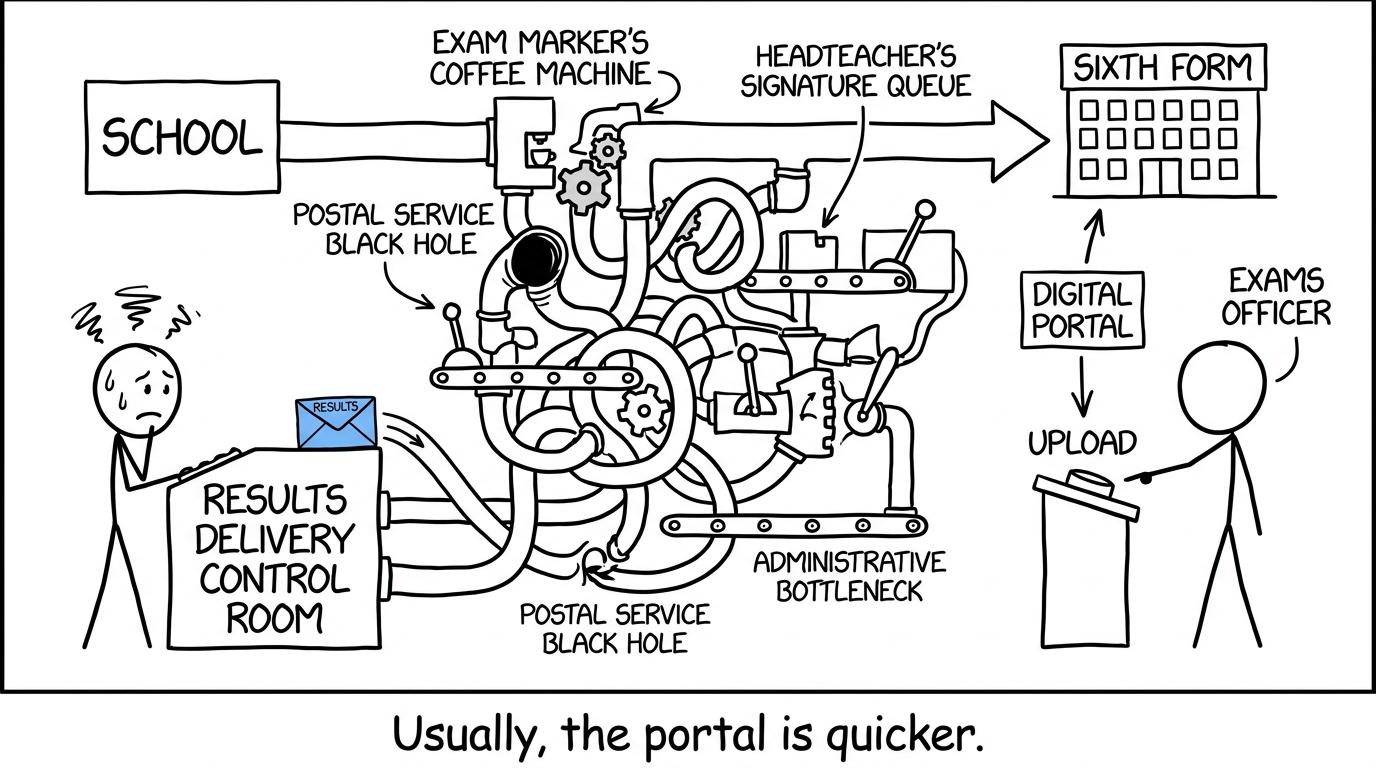 A student watches an over-engineered results delivery system while a simple upload button waits nearby
How GCSE Further Maths results reach you
Results do not normally travel straight from the exam board to every sixth form or college you have applied to.
The awarding organisation sends results electronically to the registered examination centre. This is usually your secondary school, although private candidates may have used another approved centre. The centre then prepares the results information released to you.
For many students, GCSE Further Maths means the AQA Level 222 Certificate in Further Mathematics. It is an untiered Level 222 qualification graded from 999 to 111. However, schools also use other qualifications with similar names, so check the exact title and awarding organisation on your results statement. For example, OCR Additional Mathematics is an FSMQ rather than a GCSE or Level 222 Further Mathematics certificate, and its results arrangements may follow a different qualification timetable.
This detail matters because an admissions team must record the qualification accurately. Avoid shortening every qualification to “Further Maths” when completing a form. Copy the official title, board and grade from the statement wherever the portal allows you to do so.
How the result reaches a sixth form or college
There is no single enrolment system used by every provider. An external sixth form or further education college may ask you to:
- enter your grades in an admissions portal;
- upload a scan, photograph or PDF of your results statement;
- email evidence to its admissions team;
- bring the original statement to an enrolment appointment; or
- complete an online form before attending in person.
Some providers may verify results directly with your former school, particularly if something is unclear. However, you should not rely on that happening before an enrolment deadline.
If you are staying at the sixth form attached to your current school, staff may already have access to your results through the school's management system. Even then, complete any confirmation or subject-choice form you have been sent. Having the grades is not necessarily the same as confirming that you intend to take up the place.
External applicants usually need to take a more active role. Read your offer email again, including any attachments. Search for terms such as “results evidence”, “enrolment”, “upload grades” and “conditional offer”. If the instructions remain unclear, contact admissions before results day rather than guessing.
What counts as acceptable evidence?
On results day, you normally receive a Candidate Statement of Provisional Results rather than the final certificate. The word “provisional” does not make the statement useless. It is the standard evidence used for results-day decisions while post-results services remain possible.
JCQ recommends that statements supplied to sixth forms or further education colleges are printed on school letterheaded paper or endorsed with the school's name or logo. The statement should also include your Unique Candidate Identifier, which helps a new centre manage future examination entries.
Your provider may accept a photograph, scan, PDF or portal screenshot, but its own instructions decide what is acceptable. Make sure the evidence shows:
- your full name;
- the school or examination centre;
- the qualification title;
- the awarding organisation, where displayed;
- the achieved grade; and
- the examination series or date.
Do not crop the image so tightly that the provider cannot see whose result it is. Avoid filters, annotations or edited images. If an online statement lacks your school details, ask your examinations officer whether an endorsed printout is available.
Certificates are the final record of achievement and usually arrive later through the centre where you sat the exams. AQA states that it sends certificates to centres around eight weeks after results day. Keep the certificate safely once collected, but do not wait for it if your sixth form requires provisional evidence during August enrolment.
For a broader view of what happens next, use the GCSE results day timeline.
What to do if Further Maths is missing or delayed
A missing grade creates uncertainty, but it does not mean the qualification has disappeared. First, check whether it has been listed separately from your GCSE subjects. Some results statements group qualifications by type, so a Level 222 certificate or FSMQ may appear in another section.
If it is genuinely absent, take these steps promptly.
Contact your examinations officer
Speak to the school or examination centre where you sat the papers. The examinations officer can check the secure results system and identify whether the result is pending, omitted from a printout or affected by another issue.
Do not start by contacting the exam board yourself. Awarding organisations generally direct individual candidates back to their centre because the centre holds the entry details and handles official enquiries.
Tell the destination provider immediately
Send the available results before the deadline and explain that the Further Maths result is being checked. Include:
- your full name and application reference;
- the exact qualification title;
- the school or centre where you sat it;
- the steps you have taken to investigate; and
- when you expect to provide an update, if known.
Ask whether the provider can continue processing your enrolment while evidence is outstanding. Do not claim a predicted grade as an achieved result. Predictions and mock grades are not substitutes for official results evidence.
Keep written records
Save emails, portal messages and screenshots. If an upload fails, capture the error and contact admissions before the deadline. A record showing that you tried to comply on time is more useful than explaining the problem several days later.
MathsGenie's guide to college applications after GCSE results has further advice for students dealing with enrolment decisions or searching for another course.
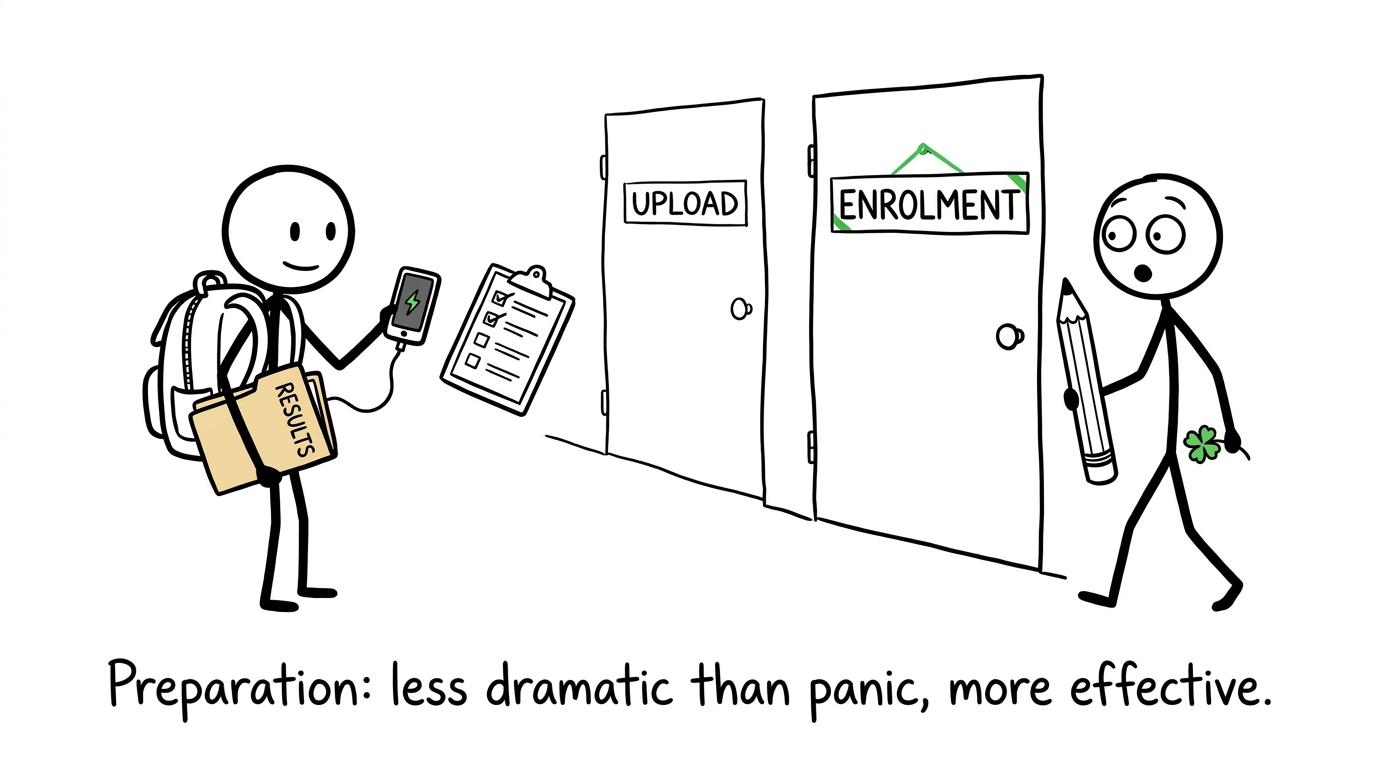 A prepared student carries results and a checklist while another arrives with only a lucky pencil
What if the grade is lower than expected?
A disappointing grade and a delayed result are different problems. If a grade has been issued, send it accurately and contact the sixth form if it affects an entry condition. Missing one condition does not automatically tell you what the provider will decide. Admissions teams may consider the full grade profile, course availability and their published policies.
If you believe something may be wrong with the marking, speak to your examinations officer about the available post-results services. These can include access to a script, a clerical re-check or a review of marking. A review checks whether the mark scheme was applied correctly; it is not simply a request for extra marks.
Written candidate consent is required for relevant services because marks and grades can stay the same, rise or fall. For the June 202620262026 series, JCQ's deadline for awarding bodies to receive most review-of-results requests is 242424 September 202620262026. Your school will usually set an earlier internal deadline so staff have time to discuss and submit the request.
Tell the sixth form if an official review is underway, but do not promise that the grade will change. Ask what evidence or update the admissions team wants and whether it can hold a decision until the outcome arrives.
Common mistakes when sending a Further Maths result
Assuming the result transfers automatically
Your destination provider may not receive an external applicant's complete results without action from the student. Follow its instructions even if you have met every condition.
Uploading only the grade
A typed list or tightly cropped image may not prove whose result it is. Upload the complete document unless the portal says otherwise.
Using the wrong qualification name
“GCSE Further Maths”, “Level 222 Further Mathematics” and “Additional Mathematics” are not always interchangeable. Copy the official wording from your statement.
Waiting for the final certificate
August enrolment usually relies on provisional results evidence. The certificate comes later and should be retained as the final record.
Missing an enrolment deadline while investigating
Send the results you do have and inform admissions about the missing item. Silence can look like a failure to respond, while a clear message gives the provider something it can act on.
Sending a predicted grade as if it were final
Predicted grades supported your application, but enrolment decisions normally require achieved results. Label every piece of information honestly.
Forgetting to keep proof
Save confirmation emails and screenshots. If a technical or administrative delay occurs, you will have a reliable timeline of what you submitted and when.
Keep the administration in perspective
There is a strange feature of results day: months of demanding mathematics can end with a task as ordinary as uploading a photograph. Yet that small task matters because it connects the work you have completed with the course you want to begin.
Prepare the portal details beforehand. Send clear evidence promptly. Ask your examinations officer about missing information and keep the sixth form informed rather than waiting in silence.
Until results day, keep strengthening the grade itself. The AQA GCSE Further Maths revision hub brings together free revision lessons and questions, while AQA Further Maths past papers provide paper practice with mark schemes. For your main GCSE Maths qualification, use the GCSE Maths revision hub to choose your board and access lessons, practice questions, mini tests and predicted papers.
The most reliable routine remains simple: attempt a question, mark it honestly, repair the weakness and return to it. MathsGenie's guide to using GCSE past papers properly shows how to turn each paper into a practical revision plan. Start now, keep your results-day documents ready, and let preparation handle both sides of the journey: earning the result and making sure it reaches the right place.