

Send GCSE Arabic Result to Sixth Form: Guide
Send GCSE Arabic result to sixth form or college correctly. Learn who receives the grade, what evidence to provide and what to do if it is delayed.

Results day can feel strangely administrative. You have spent months preparing for exams, but your next step may depend on whether the right document reaches the right admissions team.
If you need to send GCSE Arabic result to sixth form, the safest approach is to obtain your Candidate Statement of Provisional Results from the school or exam centre that entered you, then follow your sixth form or college's instructions for uploading, emailing or presenting it at enrolment. Do not assume that an exam board will automatically send an individual GCSE result to your new institution.
The process is usually simple. The important part is knowing who holds the result, what counts as acceptable evidence and who to contact if Arabic is missing or delayed.
Your quick results checklist
Before results day, make sure you know:
- which school or exam centre entered you for GCSE Arabic
- whether the qualification is GCSE Arabic or International GCSE Arabic
- the awarding organisation shown on your entry documents
- how and when your centre will release results
- whether your sixth form or college wants an upload, email or paper copy
- your applicant number and the course for which you have applied
- the admissions team's results-day contact details
- what identification you must bring to enrolment
For the June 2026 exam series, GCSE results are released to candidates on Thursday 20 August 2026. Your own school or exam centre decides its collection time and method, so check its instructions rather than assuming that every centre opens at the same time.
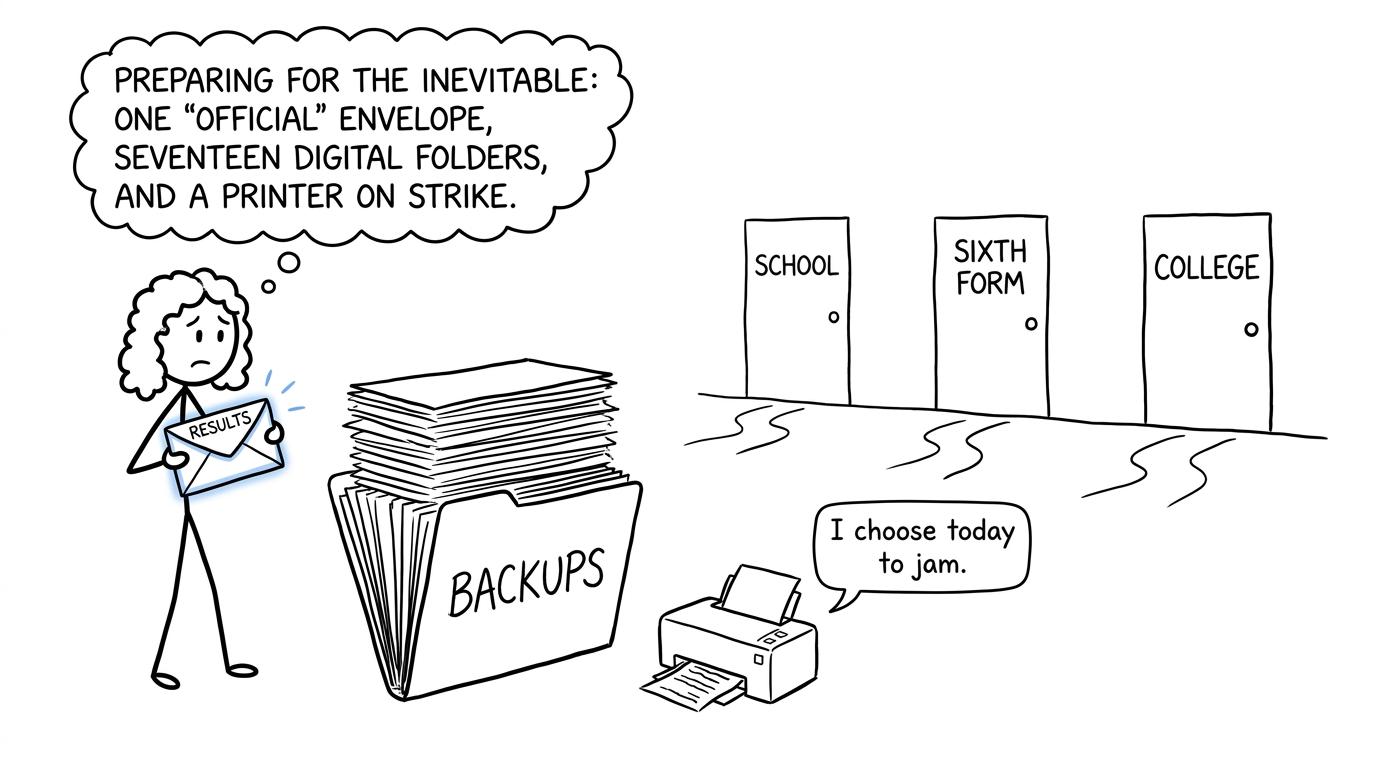 A prepared student faces a printer with unfortunate timing on results day
How GCSE Arabic results actually travel
An exam result does not normally move directly from the awarding organisation to every sixth form named on an application.
The awarding organisation sends the result to your exam centre
The awarding organisation releases results securely to the centre that entered you. This might be your secondary school, another school, a college, an independent exam centre or a British Council centre if you sat the qualification overseas.
The centre's exams staff receive the electronic results data under embargo before candidates can see it. They then prepare your results slip or make the result available through an approved portal or another arrangement.
GCSE Arabic follows this general results process. It does not gain a separate automatic admissions route simply because it is a language qualification.
Your exam centre gives the result to you
On results day, you normally receive a Candidate Statement of Provisional Results. It may contain all the qualifications processed by your centre, including Arabic and maths, even if different awarding organisations issued them.
The Joint Council for Qualifications recommends that statements being used for sixth-form or further-education enrolment are printed on school letterheaded paper or endorsed with the centre's name or logo. The statement should also include your Unique Candidate Identifier, commonly called your UCI, because this helps a new centre identify your examination record.
You provide the evidence requested by admissions
Your sixth form or college may ask you to:
- upload a clear scan or photograph to an applicant portal
- email the statement to admissions
- bring the original statement to an enrolment appointment
- share an eligible digital education record
- ask your previous school to confirm the result directly
Follow the provider's own instructions. An emailed photograph may be accepted by one college while another asks to see an endorsed paper statement in person.
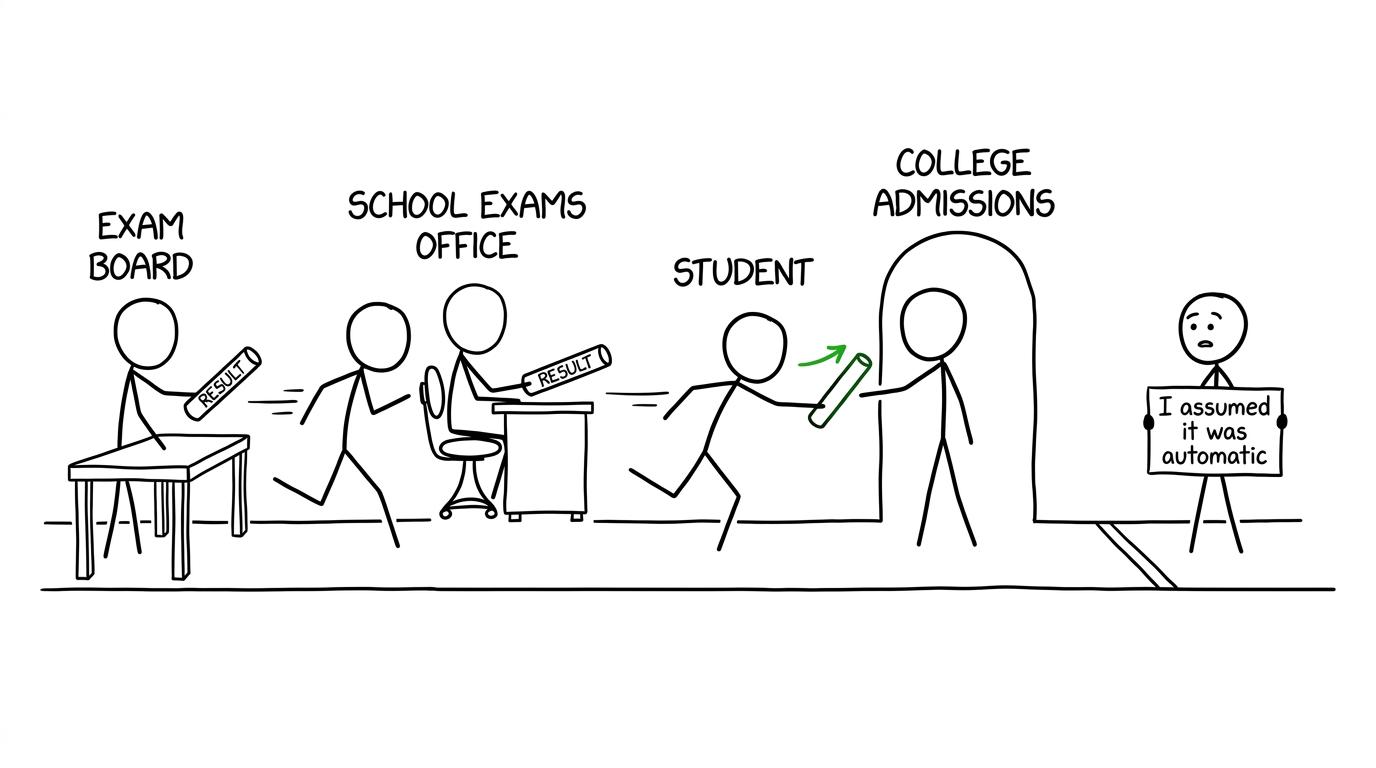 A results baton travels through the correct relay while one applicant waits in the automatic lane
Is the result sent automatically?
For ordinary sixth-form and FE college admissions, you should not rely on your GCSE Arabic grade being sent automatically. This differs from the familiar university process in which many UK Level 3 results are passed to course providers through UCAS.
Some connected school systems may already share information internally. From summer 2026, the Department for Education is also rolling out the Education Record app in England. Where you have been issued a record and a provider supports the process, the app may help you share your education record with a sixth form, college or training provider.
However, the app is an additional route rather than a reason to ignore your centre's results-day arrangements. Students are still expected to obtain their school results slip, and a provider remains responsible for deciding what evidence it accepts.
The calm rule is this: unless your new institution has explicitly confirmed that it already receives your result, send or present the evidence yourself.
How to send your GCSE Arabic result safely
Check the admissions instructions first
Look at your offer email, applicant portal and enrolment letter. Search for phrases such as “results upload”, “evidence of qualifications” or “enrolment documents”.
If the instructions are unclear, contact admissions and ask:
- which document they accept
- where it should be sent
- whether they need all GCSE results or only Arabic
- whether they need to see the original at enrolment
- what deadline applies
Use the official address or portal given by the institution. Avoid sending personal examination documents to an unverified address or through a public social-media account.
Make the result easy to match
When emailing or uploading the document, include your full name, date of birth, applicant number, intended course and a short description of the attachment. The scan or photograph should show the complete page, including your name, qualification title, grade, centre details and UCI where displayed.
Keep the original safe. A digital copy is useful for immediate admissions checks, but your provider may later ask to see the paper statement or final certificate.
Confirm that it has arrived
An automated upload receipt or admissions reply gives you a record that the document was submitted. Save it alongside the file you sent.
If there is no acknowledgement and an enrolment deadline is close, telephone admissions. Sending the same attachment repeatedly to several addresses can create confusion rather than speed.
If you sat Arabic at a different exam centre
This is one of the most important situations to plan for. You might revise at your usual school but sit GCSE Arabic as a private candidate at another centre. In that case, the centre that entered you for Arabic normally receives that result.
Your main school may receive your maths, English and science grades without receiving the separate Arabic result. Contact the Arabic exam centre before results day and establish:
- how it will release your result
- whether collection requires identification
- whether an authorised person can collect it
- whether it can provide an endorsed electronic statement
- when the final certificate will be available
If two results slips are issued by two centres, send both when the sixth form asks for your complete GCSE profile. Explain briefly that Arabic was taken through a separate centre.
What to do if the Arabic result is delayed or missing
A missing grade deserves prompt action, but it does not always mean that your examination has been lost.
Contact the entering centre first
Speak to the exams officer at the centre that entered you for Arabic. Awarding organisations generally do not disclose or discuss individual results directly with students. The exams officer can check the secure result, your entry details and any status code shown.
If the result is marked as pending or no result is issued, ask the centre what the code means and what action it is taking. Do not guess the grade or edit the results statement.
Tell the sixth form or college immediately
Send the available results and explain that the Arabic grade is being investigated by your exam centre. Include the name of that centre and ask whether your enrolment can be considered using the remaining evidence while confirmation is sought.
Admissions decisions belong to the sixth form or college. A delayed result does not automatically confirm or cancel a place, so obtain a clear answer from the provider rather than relying on assumptions.
Keep a simple record
Write down the date, the person contacted and the agreed next action. Keep copies of messages and attachments. If your centre later issues a corrected statement or confirms a grade change following a post-results service, forward the updated evidence promptly.
Provisional results and final certificates
The results-day statement is provisional, but it is the document commonly used for immediate enrolment. The final certificate is the formal record of the qualification and is issued later through the centre where you sat the exam.
Collect and store that certificate carefully. You may need it for future education or employment. If admissions staff doubt a provisional result, they can contact the entering centre for confirmation or ask to see the certificate once it has been issued.
If you believe the Arabic mark may be wrong, speak to your exams officer about the available post-results services, deadlines, fees and consent requirements. A review can leave a mark unchanged or cause it to rise or fall. Tell admissions that a review is in progress, but continue using the currently issued result unless your centre replaces it.
Common mistakes when sending the result
Assuming the exam board contacts the college
The normal route is awarding organisation to entering centre, then student to admissions. Confirm any different arrangement directly with the college.
Sending a cropped screenshot
A grade without your name, qualification details or centre information may not be enough. Send the whole statement unless admissions specifically asks for something else.
Contacting the wrong school
If Arabic was taken privately, contact the centre that made the Arabic entry rather than assuming your usual school controls the result.
Confusing GCSE with International GCSE
Copy the qualification title exactly as it appears. A provider may record GCSE Arabic and International GCSE Arabic differently even when both are accepted.
Waiting for the certificate before enrolling
Certificates arrive after results day. Use the provisional statement for immediate enrolment and supply the certificate later if requested.
Ignoring a missing result until enrolment closes
Contact both the entering centre and admissions promptly. Early communication gives everyone more time to verify the position.
Keep the admin separate from your maths revision
Results administration matters, but it should not consume the weeks in which you can still improve your exam performance. Give the paperwork a short checklist, save the contact details, then return to the work that earns marks.
Start with the GCSE Maths Revision hub, where resources are organised by exam board and tier. If Edexcel is your board, use the Edexcel GCSE Maths predicted papers for fresh exam-style practice. Students following other specifications can work through AQA GCSE Maths past papers or OCR GCSE Maths past papers.
A plan is often more useful than another hour of unfocused revision. The GCSE maths revision timetable guide helps turn weak topics into scheduled practice, while the one-month GCSE revision plan builds towards timed papers. Closer to the exams, use the GCSE maths night-before plan to keep preparation controlled rather than frantic.
Make the next step easy for yourself
To send your GCSE Arabic result successfully, remember the chain: the awarding organisation releases it to your entering centre, the centre provides your provisional statement, and you give the sixth form or college the evidence it requests. If the grade is delayed, contact the entering centre first and keep admissions informed.
Prepare that process once. Then put your attention back where it can still change the outcome.
Use MathsGenie's free revision lessons to understand each method, practice questions and mini tests to strengthen weak areas, mark schemes and video solutions to correct mistakes, and past papers or predicted papers to rehearse the real exam. Good results-day organisation protects your next step. Good revision creates the grades that take you there.










