Self-Studying A-Level Maths: A Practical Plan
Self-studying A-Level Maths is possible with the right sequence. Build a weekly plan for learning topics, practising questions and testing progress.
A parent watching a student revise alone often sees the visible things first: the calculator, the textbook and the increasingly complicated timetable. What is harder to see is the central question beneath them: Am I learning this in the right order?
Self-studying A-Level Maths is possible, but it requires more than watching explanations and hoping they settle. You need a complete specification, a weekly routine, regular problem-solving and an honest way to identify gaps. Most importantly, every topic must move through three stages: learn it, practise it and test it without support.
This guide gives students and parents a practical structure. It also consolidates the questions about timetables and hours into one principle: consistency and feedback matter more than producing a perfect-looking schedule.
Your self-study checklist
Before beginning, make sure you can answer these questions:
- Which exam board and specification are you following?
- Where and when will you sit the examinations?
- Which GCSE algebra skills need strengthening first?
- When will you learn Pure Mathematics, Statistics and Mechanics?
- What resources will teach each topic?
- How will you mark work and record mistakes?
- When will you begin timed past papers?
If you are entering independently, confirm the current entry arrangements with your chosen examination centre. Do this early. Learning the course and arranging an examination entry are separate jobs, and a revision timetable cannot solve an administrative problem.
Start with the specification, not the textbook
Imagine a student opening an A-Level textbook at page one and working forwards. It feels sensible. Yet textbooks are teaching resources, not contracts. The specification is the contract: it defines the assessed content for your exam board.
Download the current specification from Edexcel, AQA, OCR or Eduqas and convert it into a topic checklist. Group the content under:
- Pure Mathematics
- Statistics
- Mechanics
Then mark every item as not started, learning, practising or secure. This turns a large qualification into a visible sequence of smaller decisions.
Do not neglect prerequisite knowledge. A-Level work quickly exposes uncertainty with fractions, indices, surds, rearranging formulae, graphs and quadratics. If these foundations feel fragile, use the MathsGenie GCSE revision programme and organise the repair work through a realistic GCSE maths revision timetable. Returning to GCSE revision is not moving backwards. It is strengthening the floor before adding another storey.
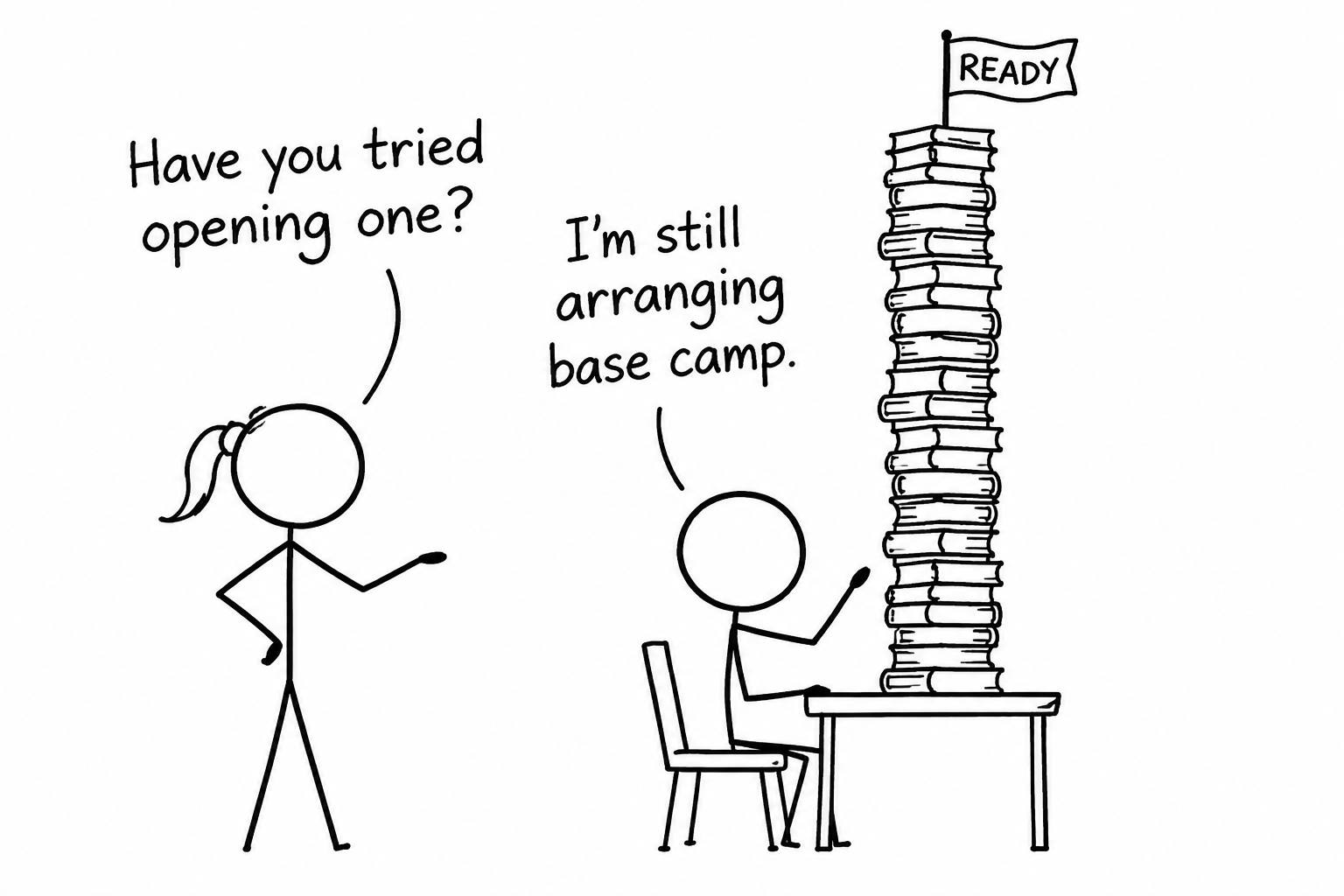 A student builds an enormous tower of maths books while a parent suggests opening one
Build a weekly plan that survives ordinary life
A useful timetable is repeatable. It should survive homework, family commitments and an unexpectedly difficult chapter. That is why planning every minute months in advance rarely helps.
Instead, use four types of session:
| Session | Purpose |
|---|---|
| Learn | Understand definitions, methods and connections |
| Practise | Answer questions without copying a model solution |
| Retrieve | Recall earlier material after a gap |
| Test | Complete mixed or timed questions and mark them |
A student with five weekly sessions might use this pattern:
- two sessions learning and practising new content
- one session revisiting older topics
- one session for mixed questions
- one session for a mini test, corrections and planning
The exact number of hours depends on your starting point, other subjects, target grade and time before the examinations. Avoid treating a universal hourly target as a guarantee. A focused session spent solving and correcting questions is more valuable than a longer session spent passively rereading notes.
Leave spare capacity too. If every available hour is allocated, one missed session can make the whole plan feel broken. A buffer lets you move unfinished work without abandoning the schedule.
Once you have this weekly structure, you can build a schedule in the MathsGenie Revision Planner rather than repeatedly redrawing it by hand.
Use a study technique that produces evidence
The central difficulty in self-study is not access to explanations. It is knowing whether an explanation has become usable knowledge.
For each topic, follow this cycle:
Learn the idea
Use a structured lesson or video solution. Pause to explain why each step is valid. Definitions and conditions matter. A method remembered without its conditions can produce convincing but incorrect work.
Close the explanation
Recreate the method from memory. This is retrieval practice: you are asking your mind to produce the idea rather than recognise it on a page.
Practise in increasing difficulty
Begin with focused questions, then move to mixed problems where the required method is not announced. MathsGenie provides free A-Level Maths revision resources that can help connect explanations with practice questions and solutions.
Mark and diagnose
Do not record only the mark. Classify each error:
- knowledge gap
- algebraic slip
- misunderstood wording
- calculator error
- incomplete reasoning
- poor time management
Then redo the question later without viewing the solution. A correction copied immediately can create familiarity, but familiarity is not independence.
Revisit after a gap
Return to the topic after several days and again after several weeks. The interval makes recall harder, which is precisely why it is informative. Mix it with older material so that you must choose the method yourself.
Treat Pure, Statistics and Mechanics differently
The three areas belong to one qualification, but they create different self-study problems.
Pure Mathematics depends heavily on connected algebraic ideas. Falling behind on functions, trigonometry or differentiation can affect several later topics. Preserve the chain: learn prerequisites before techniques that rely upon them.
Statistics requires more than inserting numbers into formulae. Pay attention to interpretation, assumptions, modelling and the large data set required by your specification. Use the correct exam-board materials rather than an unrelated data set.
Mechanics turns words into mathematical models. Draw a clear diagram, define directions and state assumptions before manipulating equations. If a model goes wrong, more algebra usually makes the wrong model longer rather than better.
A balanced plan should keep all three areas active. Waiting until the end of the course to begin Statistics or Mechanics creates an avoidable bottleneck.
Move from topic questions to exam papers
Topic practice helps you learn a method. Examination papers test whether you can select and combine methods under pressure. You need both.
Begin with short, untimed sets while learning. Progress to mixed mini tests, then individual timed sections and finally complete papers. Use MathsGenie A-Level past papers where available for your course, together with mark schemes and video solutions.
After every paper, create a repair list. Revisit the weakest topics, complete fresh practice and then retest them. Predicted papers can provide additional practice near an examination series, but they should complement official past papers rather than replace broad specification coverage.
Parents can help without becoming the teacher. Ask what the student learned from the mark scheme, which error recurred and what will change next week. Those questions support reflection without taking over the mathematics.
Common mistakes when learning independently
Collecting resources instead of using them. One dependable teaching route, one source of practice and a specification checklist are enough to begin.
Watching complete solutions too soon. Attempt the question first. Even an unsuccessful attempt reveals what you understand.
Confusing notes with practice. Neat notes can support learning, but marks come from retrieving ideas and applying them to unfamiliar questions.
Studying only comfortable topics. Confidence grows quickly when you repeat strengths, while the actual gaps remain untouched. Let test results determine the next priority.
Starting full papers before learning enough content. Early papers can become exercises in leaving blanks. Use topic questions and mini tests first, then increase the breadth and timing demands.
Ignoring the mark scheme. Mathematical communication matters. Study how valid reasoning is expressed, but do not memorise isolated wording without understanding it.
Turn the plan into a routine
A student may understand this structure perfectly and still lose weeks deciding what to revise each evening. Knowing the plan and following it are different achievements, particularly when you are managing the course alone.
Your turn. Enter the topics you need to cover and organise the fixed weeks before your examinations, so each learning session, review and test has a place. Build your self-study schedule in the MathsGenie Revision Planner.