AQA GCSE Maths Grade 8 Boundary: What Mark Do You Need?
AQA GCSE maths grade 8 boundary explained with dated past marks, Higher tier requirements and practical revision advice for Year 11 students and parents.
A Year 11 student finishes an AQA Higher practice paper, adds up the marks and asks the question that suddenly makes revision feel more concrete: “Is that enough for an eight?”
The AQA GCSE maths grade 8 boundary was 191191191 out of 240240240 in June 2024, compared with 186186186 out of 240240240 in June 2023. Those are historical examples, not a guaranteed target for your exam. A grade 8 is available on Higher tier, and your grade depends on your combined marks across all three papers.
That gives you a useful starting point. The next step is understanding what the boundary means and turning it into a revision plan.
The grade 8 checklist
Before comparing a practice result with AQA grade boundaries, check that you are using:
- The right qualification: AQA GCSE Mathematics, specification 8300.
- The right tier: Higher tier, because Foundation does not offer grade 8.
- The right series: the boundaries published for the papers you completed.
- The full total: marks from all three papers, out of 240240240.
- A realistic comparison: timed attempts marked carefully using the matching mark schemes.
The MathsGenie AQA GCSE Maths grade calculator helps you compare paper marks with historical boundaries. Treat the result as evidence about your current performance, rather than a promise about results day.
What was the AQA GCSE maths grade 8 boundary?
These examples show the minimum total required for grade 8 in two completed summer exam series.
| AQA GCSE Maths exam series | Tier | Maximum total | Grade 8 boundary | Approximate percentage |
|---|---|---|---|---|
| June 2024 | Higher | 240240240 | 191191191 | 79.6%79.6\%79.6% |
| June 2023 | Higher | 240240240 | 186186186 | 77.5%77.5\%77.5% |
The dates matter. A screenshot labelled only “AQA grade boundaries” can easily lose the context that makes it useful.
If our Year 11 student has completed the June 2024 papers, the June 2024 boundary is the relevant comparison. Applying the June 2023 boundary to that result would make the performance look stronger without changing a single answer.
For a future series, use past boundaries to understand the general standard. Leave room above them in your revision target because the next boundary can move.
Which tier do you need for grade 8 maths?
You need to be entered for Higher tier. Foundation tier awards grades up to grade 5, so even full marks on Foundation cannot produce a grade 8.
AQA Higher GCSE Maths consists of three papers, each worth 808080 marks. Paper 1 is non-calculator; Papers 2 and 3 allow a calculator. Together, they contribute 240240240 marks.
You do not need to reach a separate grade 8 threshold on every paper. Your overall subject grade comes from the combined total. A stronger calculator paper can therefore compensate for marks dropped on the non-calculator paper.
For parents, this is a useful distinction when discussing mocks. Ask whether the reported grade comes from a complete set of papers or a school assessment covering selected topics. The two provide different kinds of evidence.
Why do AQA grade boundaries change?
Exam papers cannot be made precisely equal in difficulty every year. Different questions, contexts and combinations of topics can make one set more demanding than another.
Grade boundaries help account for those differences while maintaining grading standards. Awarding involves evidence about performance and the quality of students’ work. The boundary is set after the exams have been marked, rather than being a fixed percentage announced before students sit them.
This explains why “grade 8 means eighty per cent” is an unreliable rule. It may be a convenient rough reference for some past papers, but it is not the definition of the grade.
A harder practice paper may produce a lower raw score without showing that your understanding has deteriorated. Compare each completed set with its own boundaries before deciding what the result means.
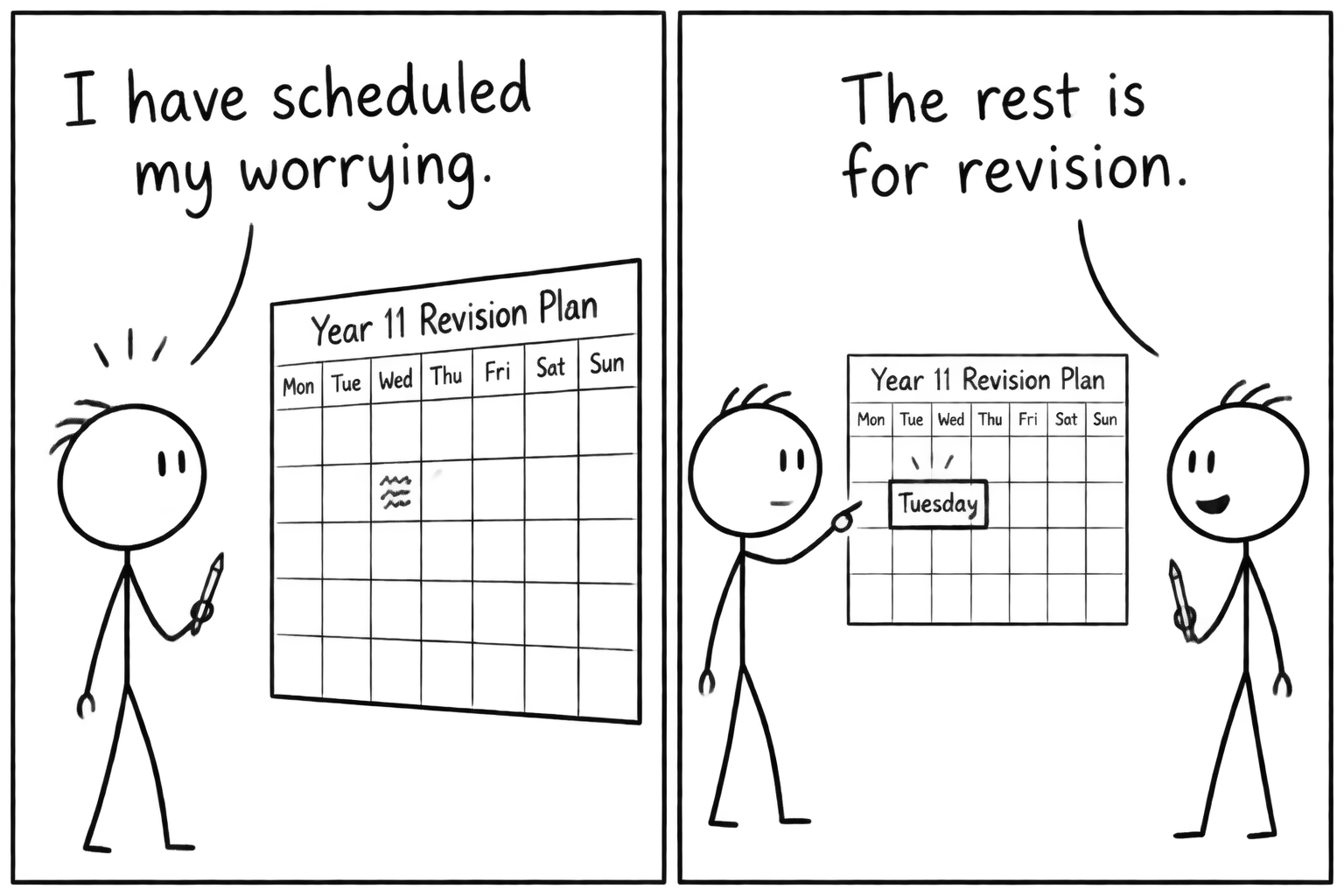 A stick-figure student schedules their worrying so the rest of the calendar is free for revision.
Turn a boundary into useful revision decisions
Our hypothetical student now knows the historical target. The temptation is to keep checking how far away it feels. A better use of the next revision session is to examine where the marks went.
Find the cause of each lost mark
After marking a complete paper, sort errors into three practical groups:
- Knowledge gaps: you did not know the method or recognise the topic.
- Execution errors: you knew the method but made an arithmetic, algebra or calculator mistake.
- Exam decisions: you misread the question, omitted working or spent too long elsewhere.
Each group needs a different response. Watching a lesson helps with an unfamiliar method. Repeatedly watching that lesson will do less for a habit of dropping negative signs. That needs careful written practice and checking.
Choose topics using your own evidence
There is no universal list of topics guaranteed to deliver the most marks in the next paper. Topic coverage and question combinations vary.
Start with weaknesses that affect several areas. Algebraic manipulation supports equations, graphs and geometry. Fractions, ratio and percentages appear in many contexts. Secure calculation skills help you carry a correct method through to a correct answer.
Then address Higher content exposed by your marked papers, such as quadratics, trigonometry or similarity. Use the relevant MathsGenie revision lessons to revisit the method, attempt practice questions independently and check your work afterwards.
The topics that move your marks most are the ones where a specific weakness meets a realistic opportunity to improve.
Check whether the improvement lasts
Return to the topic after a gap, then try questions in a mixed paper. Recognising a method immediately after watching a video is easier than choosing it independently during an exam.
Keep a short record of recurring errors. This gives your next revision session a purpose and makes progress easier to see than repeatedly estimating a grade.
Common mistakes when using grade boundaries
Treating one paper as a complete GCSE result. One paper can reveal strengths and gaps, but the published subject boundary applies to the full total.
Mixing exam boards or tiers. AQA Higher boundaries cannot be transferred directly to Edexcel, OCR or Foundation papers.
Treating predicted papers as forecasts. Use them as additional practice. Their scores and topic choices cannot guarantee your exam result.
Aiming exactly at an old boundary. Build a margin through more consistent performance, particularly on questions you already understand.
Only practising the hardest questions. Challenging problems matter, but avoidable losses earlier in a paper also count towards your total.
Make the next revision session count
The boundary answers “What was needed?” Your marked work answers the more useful question: “What should I improve next?”
Choose one recurring weakness, open the matching Maths Genie lesson, and follow it with independent practice. Then test that skill again in a mixed paper. Small, well-chosen improvements make the distance to grade 8 more manageable, one recovered mark at a time.