Can You Self Study GCSE ICT? A Realistic Plan
Self study GCSE ICT with a realistic twelve-week plan. Check qualification availability, choose resources and prepare effectively as a private candidate.
The hardest part of revising alone is not usually understanding the content. It is knowing whether you are learning the right content in the first place.
If you want to self study GCSE ICT, the short answer is yes; but you must confirm exactly which qualification you can enter before buying resources or building a timetable. GCSE ICT is no longer a standard current GCSE in England, where GCSE Computer Science and other digital qualifications have largely taken its place. Availability differs across England, Wales and Northern Ireland, and some qualifications include practical or centre-assessed work that cannot simply be completed at home.
Your first task, therefore, is administrative rather than academic: identify the qualification, download its current specification and find an approved centre willing to enter you. Once those pieces are secure, independent revision is realistic for an organised student.
Your self-study checklist
Before beginning, make sure you can answer these questions:
- What is the exact qualification title and awarding body?
- Is the specification still available in your intended exam series?
- Will a local school, college or private examination centre accept your entry?
- Does the qualification include coursework, controlled assessment or practical tasks?
- Which textbooks and past papers match your specification?
- How many weeks can you study before the assessment?
- How will you get feedback on extended answers and practical work?
Do not treat these as minor details. A beautifully organised revision plan cannot rescue an entry for the wrong specification.
Is GCSE ICT still available?
The name matters more than many students expect. In England, the reformed GCSE Computer Science qualification is available from boards including AQA, OCR and Pearson Edexcel, but it is not simply a renamed ICT course. Computer Science generally places greater emphasis on algorithms, programming, data representation, computer systems and networks.
Qualifications involving digital technology or information technology may still be available elsewhere in the UK or through alternative vocational routes. Wales and Northern Ireland have their own qualification arrangements, while Eduqas and WJEC naming can cause confusion for students searching online.
Because qualifications and final assessment dates can change, check the current specification on the awarding body's official website and obtain written confirmation from your proposed centre. Ask for the qualification title, specification code, assessment components and entry deadline.
A centre saying that it offers “computer exams” is not enough. You need confirmation that it can enter your exact qualification and administer every required component.
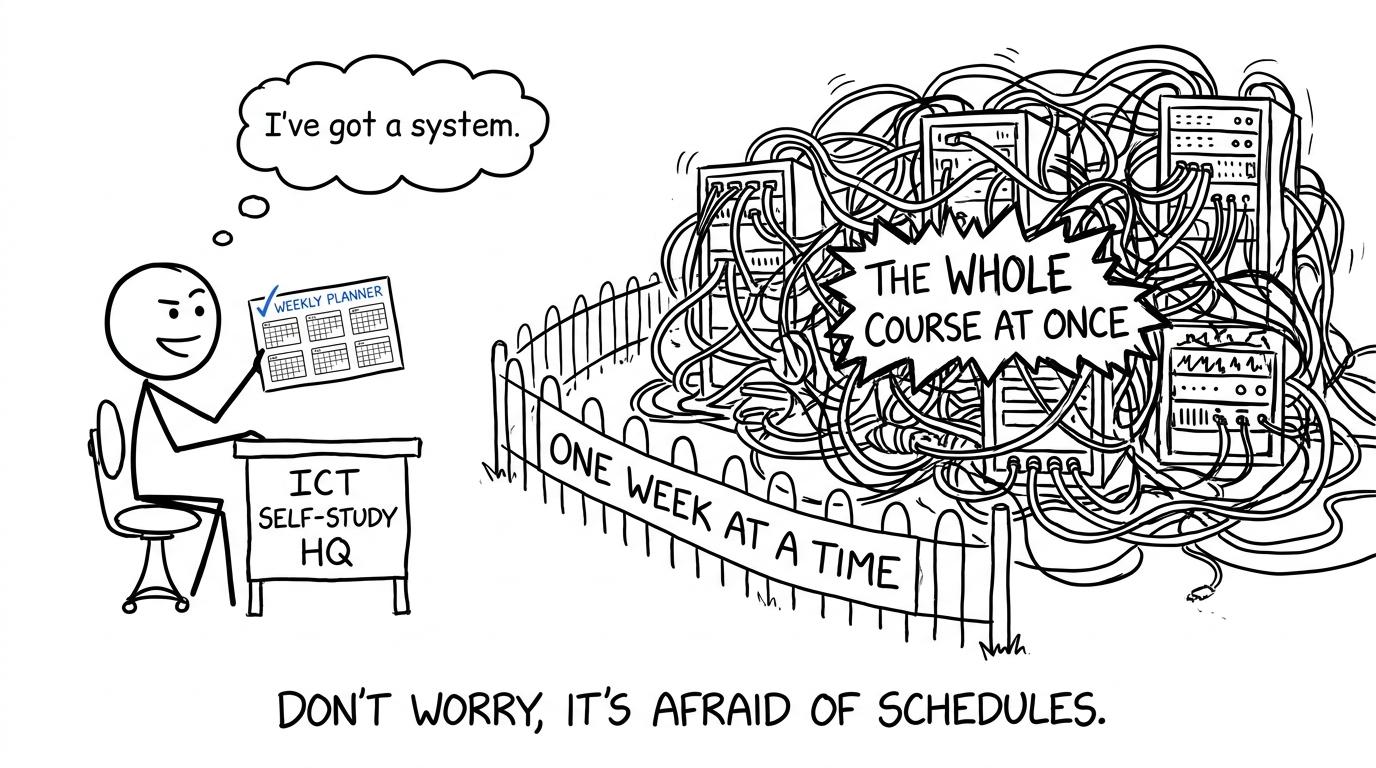 A student protects a weekly ICT plan from the whole course at once
What makes independent ICT revision possible?
ICT and digital qualifications combine factual knowledge with application. You may need to understand hardware, software, networks, cyber security, data handling, legal and ethical issues, communication methods and the effects of technology on organisations and society. Depending on the specification, you may also need practical competence with databases, spreadsheets, presentations or other software.
That makes self-study possible, but passive reading will not be enough. A workable system has four parts:
- Specification coverage: every session is tied to a named syllabus statement.
- Retrieval: you regularly answer questions without notes.
- Application: you practise applying ideas to unfamiliar scenarios.
- Feedback: you compare answers with mark schemes and improve them.
This is the same disciplined cycle that works in mathematics. MathsGenie's GCSE maths revision lessons organise content by topic and grade, showing how a large course becomes manageable when it is divided into clear skills.
A realistic twelve-week GCSE ICT plan
This plan assumes you have already confirmed your entry and can give the subject around four focused sessions each week. A typical session might last approximately 454545 to 606060 minutes, but consistency matters more than stretching a tired session.
Adapt the order to your specification. If your qualification has practical or centre-assessed components, arrange those with your centre before relying on this plan.
| Week | Main focus | Evidence to produce |
|---|---|---|
| One | Read the specification and assessment guidance | A topic checklist and list of assessment components |
| Two | Hardware, software and computer systems | Retrieval questions and corrected definitions |
| Three | Networks, internet technologies and communication | A comparison sheet and exam responses |
| Four | Data, databases and data quality | Practical files or structured questions, where relevant |
| Five | Spreadsheets, modelling and presenting information | Saved tasks demonstrating required software skills |
| Six | Cyber security, privacy and safe working | Scenario-based answers using precise terminology |
| Seven | Legal, ethical, environmental and social issues | Timed extended responses checked against mark schemes |
| Eight | Organisations, users and digital systems | Case-study questions and a list of weak areas |
| Nine | Mixed-topic retrieval and practical consolidation | A closed-book knowledge test and corrected practical work |
| Ten | First complete past paper or formal assessment set | A timed script, mark and error log |
| Eleven | Targeted repair of weak topics | Reattempted questions completed without notes |
| Twelve | Final timed paper and light consolidation | A final script and short last-week checklist |
The weekly rhythm
Within each week, use four distinct sessions rather than repeating the same activity:
- Learn: study one small specification section and reduce it to concise notes.
- Retrieve: close the notes and write or say what you remember.
- Apply: complete practical work or examination questions.
- Review: mark your work, log errors and revisit weak knowledge.
A useful principle is to spend less time creating attractive notes and more time producing evidence of learning. Evidence might be a completed database query, a timed six-mark response, a corrected test or an explanation recalled without prompts.
For students balancing ICT with maths, MathsGenie's revision guide and planner can help turn both subjects into scheduled tasks rather than vague intentions.
How to choose resources without wasting time
Start with the specification, not a textbook. Make a spreadsheet containing each topic statement, its status and the date you last tested it. Suggested status labels are “not started”, “learning”, “needs practice” and “secure”.
Then gather only resources that match the exact course:
- the current specification and assessment guidance;
- an endorsed or clearly matched textbook;
- official past papers, sample materials and mark schemes;
- suitable software for any practical requirements;
- a folder containing every completed task and correction.
Older online videos may still explain useful ideas, but terminology and assessment structures can change. Check each resource against your specification before investing time in it.
Maths students can use the same resource hierarchy. Begin with the specification-level topic, use a lesson to understand it, complete practice questions, and then test performance under exam conditions. The MathsGenie GCSE past papers provide that final stage for maths, while predicted GCSE maths papers offer additional exam-style practice near the examination period.
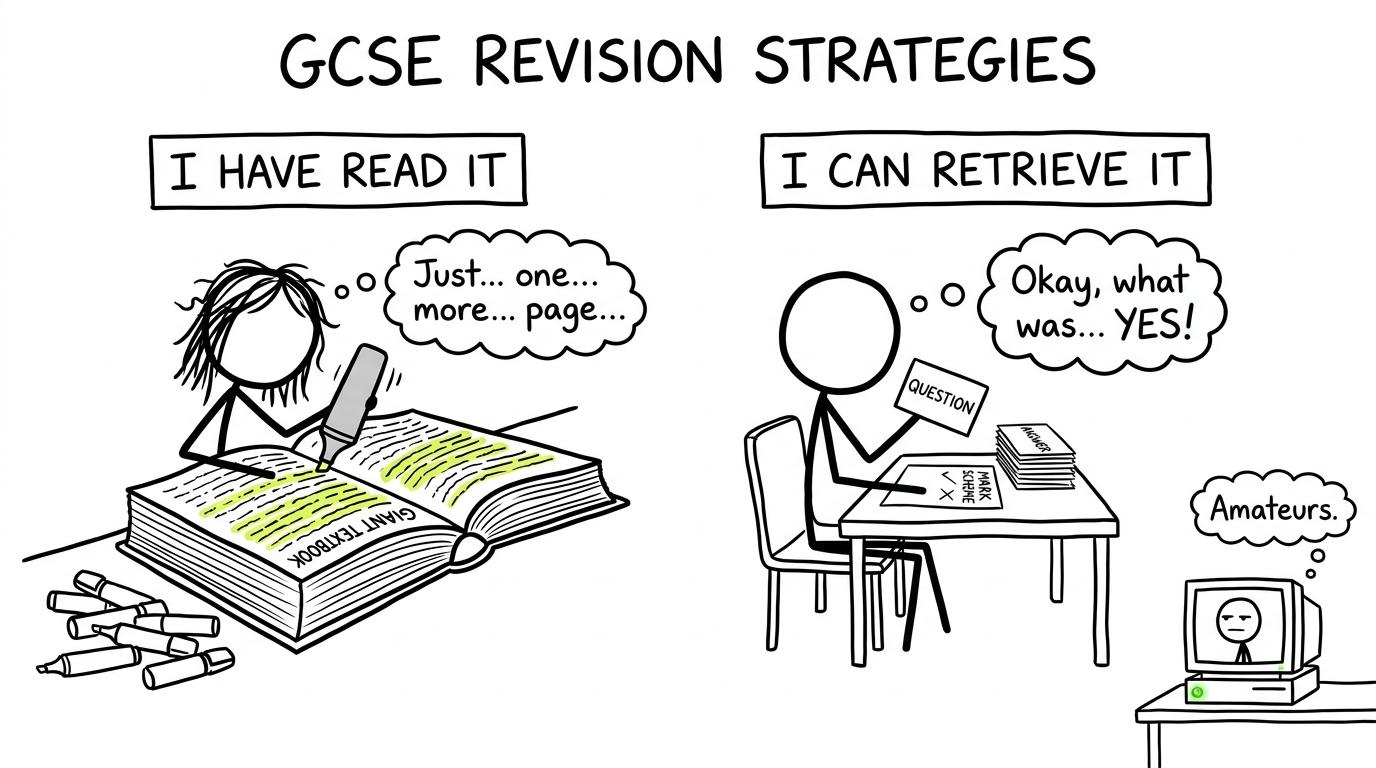 One student highlights everything while another retrieves and checks
How to learn theory and practical skills alone
Build precise theory knowledge
ICT answers are often weakened by language that sounds plausible but lacks technical precision. “It is safer” rarely explains enough. A strong response identifies the security measure, the threat it addresses and the consequence for the user or organisation.
Create short question-and-answer prompts rather than copying paragraphs. Test definitions in both directions: given a term, explain it; given an explanation or scenario, identify the term.
For longer questions, pay attention to command words such as identify, describe, explain, compare and evaluate. Compare your structure and technical content with the mark scheme, but do not memorise isolated mark-scheme phrases without understanding them.
Make practical work deliberate
Watching somebody use a spreadsheet or database is not the same as being able to create one. If practical skills appear in your course, complete tasks from a blank file. Save versions clearly, check outputs and record mistakes.
Your specification should determine which skills you practise. Do not assume that being comfortable with everyday apps covers formal requirements such as validation, queries, formulae, modelling, testing or selecting an appropriate data structure.
If a component must be supervised, authenticated or completed using particular conditions, home practice is preparation rather than the official assessment. Confirm the rules with your centre.
Use maths revision to strengthen the plan
Students preparing for maths exams cannot give every evening to ICT. A balanced timetable protects both subjects.
Place demanding sessions when your concentration is strongest. Mix subjects across the week instead of abandoning maths for several weeks and then trying to recover it. The GCSE maths topic resources allow you to choose a specific foundation or higher-tier skill rather than writing an unhelpfully broad task such as “revise maths”.
Data handling also creates some natural overlap. Percentages, averages, graphs, probability and interpreting information can support digital subjects, even though the assessment techniques remain different. Use the MathsGenie GCSE exam papers to keep your mathematical fluency active alongside ICT.
If you are planning beyond GCSE, the MathsGenie A Level maths revision resources show how independent habits become even more important when courses grow deeper and more connected.
How to know whether the plan is working
Progress should be visible in performance, not measured only by hours.
At the end of each week, record:
- the specification statements you tested;
- your score on closed-book questions;
- practical tasks completed independently;
- repeated errors or missing terminology;
- the next action for each weak area.
When you reach full papers, reproduce examination conditions as closely as reasonably possible: use the stated time, remove notes and put your phone away. Mark honestly. Then classify every lost mark as missing knowledge, weak application, misunderstood command word, poor timing or careless reading.
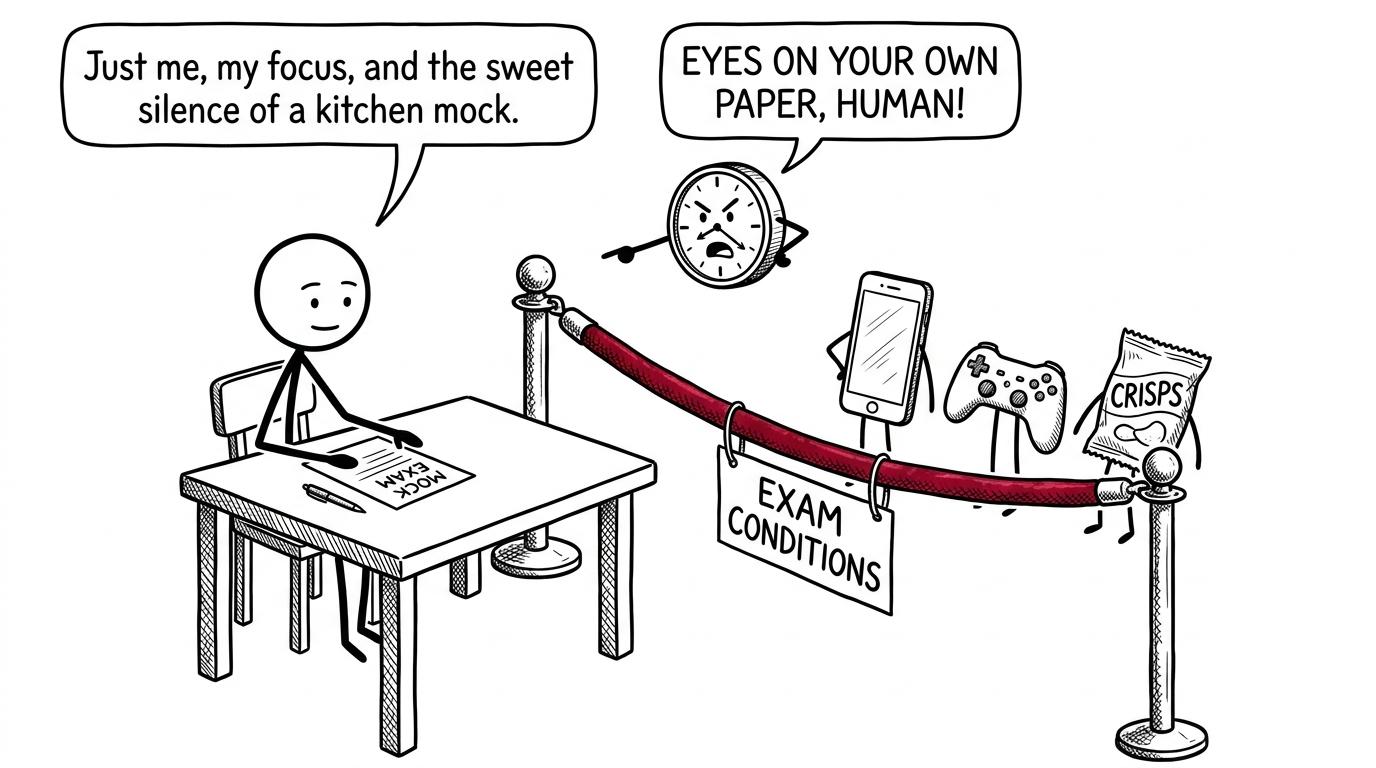 A phone and games controller wait outside a mock exam
Common mistakes when self-studying GCSE ICT
Starting before confirming the qualification
This is the most expensive mistake. Students can spend months following a legacy GCSE ICT course that is no longer available to them. Secure the specification and centre first.
Assuming ICT and Computer Science are interchangeable
They overlap in places, but their content and assessment are not identical. Use the exact qualification title whenever you search for resources or contact a centre.
Ignoring non-examined or practical requirements
A private candidate may be able to prepare independently yet still need a centre to supervise, authenticate or assess particular work. Resolve this before paying an entry fee.
Reading instead of retrieving
Familiar pages create a comforting illusion. Close the book, answer questions and check what you can actually produce.
Leaving past papers until the final week
Past papers diagnose timing, interpretation and application problems. Complete the first full paper early enough to act on what it reveals.
Marking generously
Self-study requires unusually honest feedback. Use official mark schemes, keep an error log and ask a teacher or tutor to review some extended answers if you cannot judge them confidently.
Build a plan you can actually repeat
You can self-study a suitable ICT or digital qualification outside school, but the realistic route begins with verification. Confirm that the qualification exists in your region and exam series, find a centre, understand every assessment component, and only then begin the twelve-week learning cycle.
The students who revise well are not those who attempt everything in one heroic weekend. They create a small system and return to it: learn, retrieve, apply, review.
Use that same system across your subjects. Start with MathsGenie's free GCSE revision lessons, work through the linked practice questions and video solutions, then use past papers and mark schemes to test your progress. As the exams approach, add the MathsGenie predicted papers to your timetable. A clear plan does not make revision effortless; it makes the next useful action obvious.