Revising GCSE Food and Nutrition With Music
Revising GCSE Food and Nutrition with music may aid motivation, but lyrics can disrupt recall. Learn when to press play, pause or choose silence.
A playlist can make opening a revision book feel easier. The harder question is whether it makes the information easier to remember. If you are revising GCSE Food and Nutrition with music, the short answer is this: quiet instrumental music may be fine for familiar or repetitive tasks, but silence is usually the safer choice for reading, memorising and writing demanding answers. Music with lyrics is the most likely to interfere.
That distinction matters because GCSE Food Preparation and Nutrition is not one type of work. You might be learning nutrient functions, explaining food science, interpreting information, planning an investigation or completing calculations. The best background sound depends on what your brain is being asked to do.
The quick music and revision checklist
Use this as your starting rule:
- Choose silence for learning new content, practising recall and writing extended answers.
- Try quiet instrumental music for organising notes or completing familiar, low-demand tasks.
- Avoid songs with lyrics while reading or remembering verbal information.
- Keep the volume low enough that the music stays in the background.
- Do realistic exam practice in silence.
- Test your choice using recall scores, not simply how productive you felt.
- Put your phone out of reach so choosing music does not become choosing distractions.
The goal is not to prove that music is good or bad. It is to discover when it helps you begin without allowing it to weaken the work that follows.
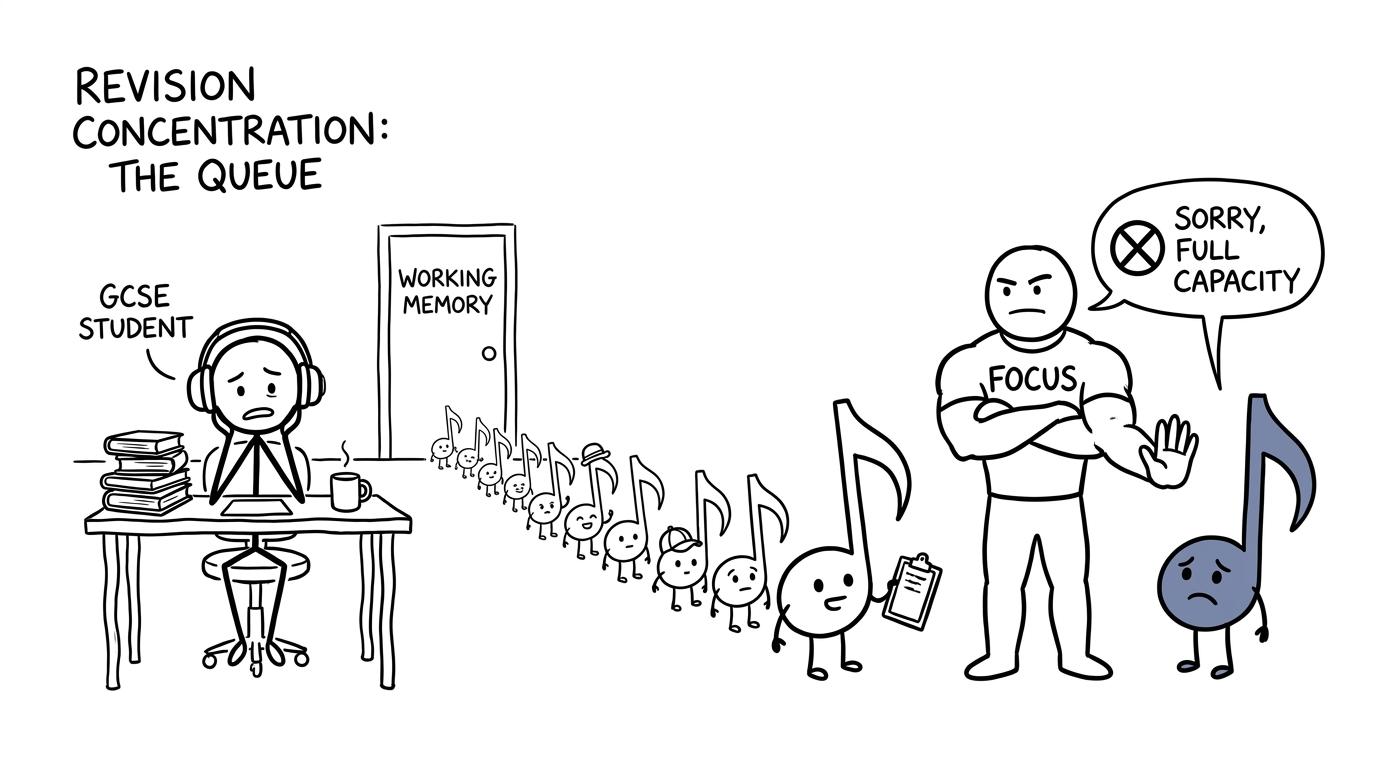 A musical note waiting at the door of working memory while a focus bouncer decides whether it may enter
Does background music actually improve focus?
Research does not support a universal answer. Reviews of background music and cognitive performance have found mixed results: music sometimes has no measurable effect, sometimes creates a small benefit and sometimes harms performance. The task, the listener and the type of music all matter.
One systematic review found that negative effects appeared particularly in memory and language-related tasks, with lyrical music tending to be more disruptive than instrumental music. A controlled study published in 2023 similarly found that music with lyrics hindered verbal memory, visual memory and reading comprehension among its participants. Instrumental lo-fi music did not produce a credible improvement or impairment in that study.
There is an important limitation. Much of this research uses adults or university students rather than pupils revising a particular GCSE specification. It cannot tell every student exactly what will happen. It does, however, support a sensible precaution: if a task depends heavily on language or memory, lyrics introduce another stream of verbal information for your attention to process.
Music can still improve the experience of revision. It may make a session feel less dull or help mask unpredictable background noise. Feeling better can make it easier to start. But enjoyment and learning are not identical. A playlist may keep you at the desk while also making each paragraph slightly harder to retain.
Why the type of Food and Nutrition task matters
GCSE Food Preparation and Nutrition specifications differ between AQA, OCR and Eduqas, so always follow your own exam board. Across these courses, students meet a mixture of nutrition, food science, food safety, food choice or provenance, practical preparation and non-exam assessment.
That variety is why a single music rule is too crude.
Learning nutrients, functions and key terminology
This is a memory-heavy task. You need to connect terms with precise functions, sources, deficiencies or dietary needs. Lyrics can compete with the words you are trying to encode and retrieve, particularly when the song is familiar enough to invite silent singing.
Use silence for initial learning and closed-book recall. If you want music during a short break, press play after testing yourself rather than during the test.
Reading about food science and safety
Processes such as protein denaturation, gelatinisation, enzymic browning and microbial growth require careful reading. Missing a qualifying word can change the meaning of an explanation. Silence is the lowest-risk option here.
If your home is noisy, low-volume instrumental audio may be less disruptive than irregular conversations. The comparison is not always music versus perfect silence; sometimes it is steady sound versus unpredictable noise.
Planning notes and organising folders
Music is less risky when you are sorting flashcards, labelling sections, creating a revision list or filing feedback. These jobs matter, but they place fewer demands on recall than learning new theory.
Be honest about the boundary. Recopying attractive notes while listening to favourite songs can feel fluent without requiring retrieval. Organisation prepares revision; it does not replace it.
Recipe quantities, percentages and units
Food and Nutrition also uses mathematical thinking. You may need to scale quantities, compare nutritional values, interpret percentages or convert units. Familiar calculations may tolerate instrumental music better than verbal learning, although difficult multi-step questions still deserve quiet concentration.
MathsGenie can strengthen those connected skills through free lessons and questions on recipe proportion, percentages, ratio and conversions and units. Choose resources matching your maths exam board and tier through the main GCSE maths revision hub.
Lyrics, volume and familiarity all change the effect
Not all playlists place the same demand on attention.
Lyrics are the clearest warning sign
Reading and writing already use language processing. Adding sung language can create competition, even when the song is in the background. Familiar lyrics may be especially tempting because your brain predicts what comes next.
Songs in an unfamiliar language are not guaranteed to solve the problem. Voices, changes in intensity and memorable melodies can still attract attention. For verbal revision, instrumental tracks remain the more cautious choice.
Volume should remain genuinely low
If you notice the bass, wait for a chorus or adjust the volume repeatedly, the music is no longer behaving like background sound. Avoid dramatic tracks, sudden adverts and shuffled playlists with large changes in loudness.
Set one playlist before the session starts. Do not keep unlocking your phone to find the perfect song. The search for ideal concentration music can consume the concentration you hoped to create.
Familiar music can comfort and distract
Familiar tracks may reduce the effort needed to tolerate a revision session, but they can also trigger memories or invite you to sing along. Unfamiliar instrumental music may be less personally distracting, although no genre guarantees better learning.
The useful question is not, “Is classical music intelligent?” It is, “Can I retrieve the material accurately afterwards?”
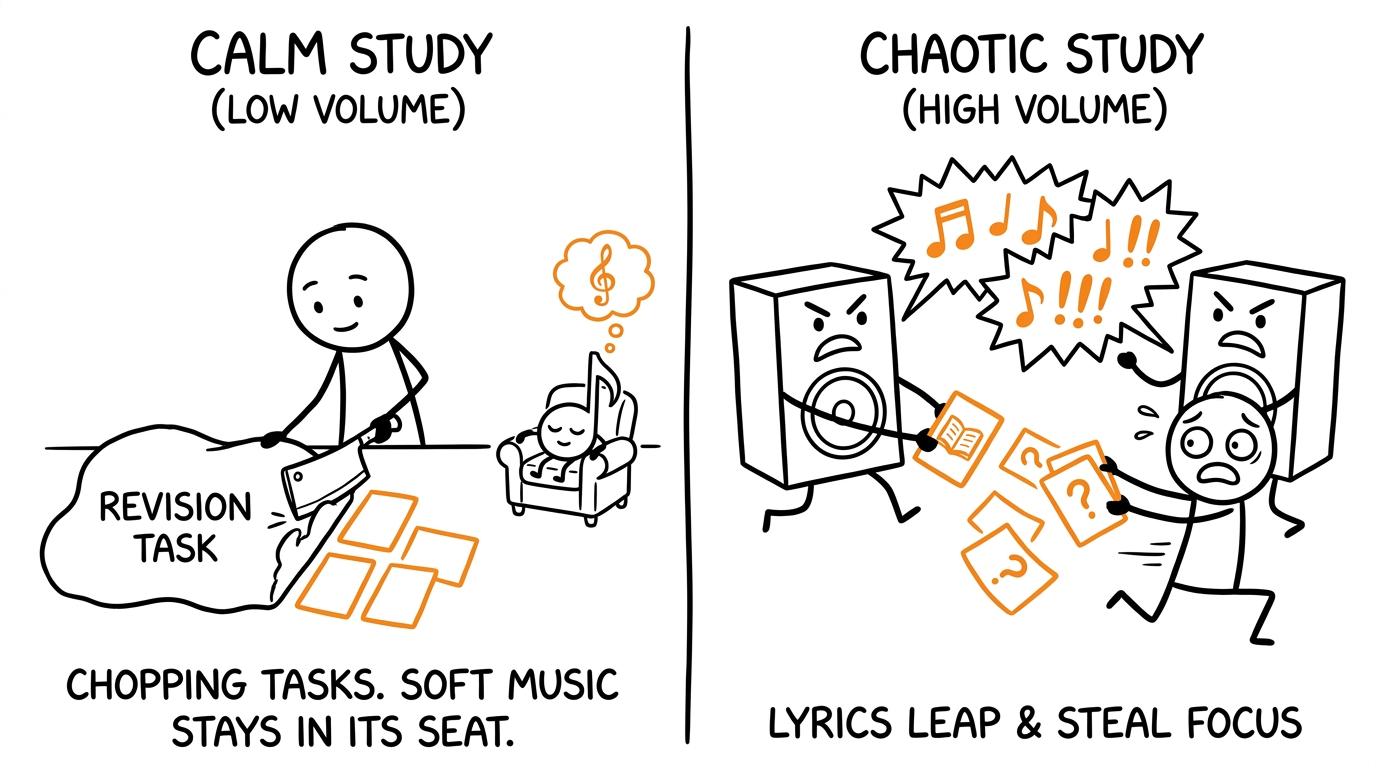 Quiet instrumental music sits politely while loud lyrics escape with the revision flashcards
How to test whether music works for you
Run a small, fair comparison instead of relying on mood.
Choose two Food and Nutrition topics of similar difficulty. Revise one in silence and the other with your proposed background music. Keep the revision time, method and number of questions as similar as possible. After a delay, complete a closed-book recall test for each topic.
A simple recall percentage is:
Recall percentage=correct items recalledtotal items tested×100\text{Recall percentage}=\frac{\text{correct items recalled}}{\text{total items tested}}\times 100Recall percentage=total items testedcorrect items recalled×100Record more than accuracy. Note how often you changed tracks, checked your phone, reread a paragraph or lost your place. Repeat the comparison on another day and swap the sound conditions. One unusually easy topic or tired evening should not decide your entire routine.
Your conclusion may be task-specific: instrumental music might be harmless while organising material but unhelpful during recall. That is a more useful discovery than declaring yourself a person who can or cannot revise with music.
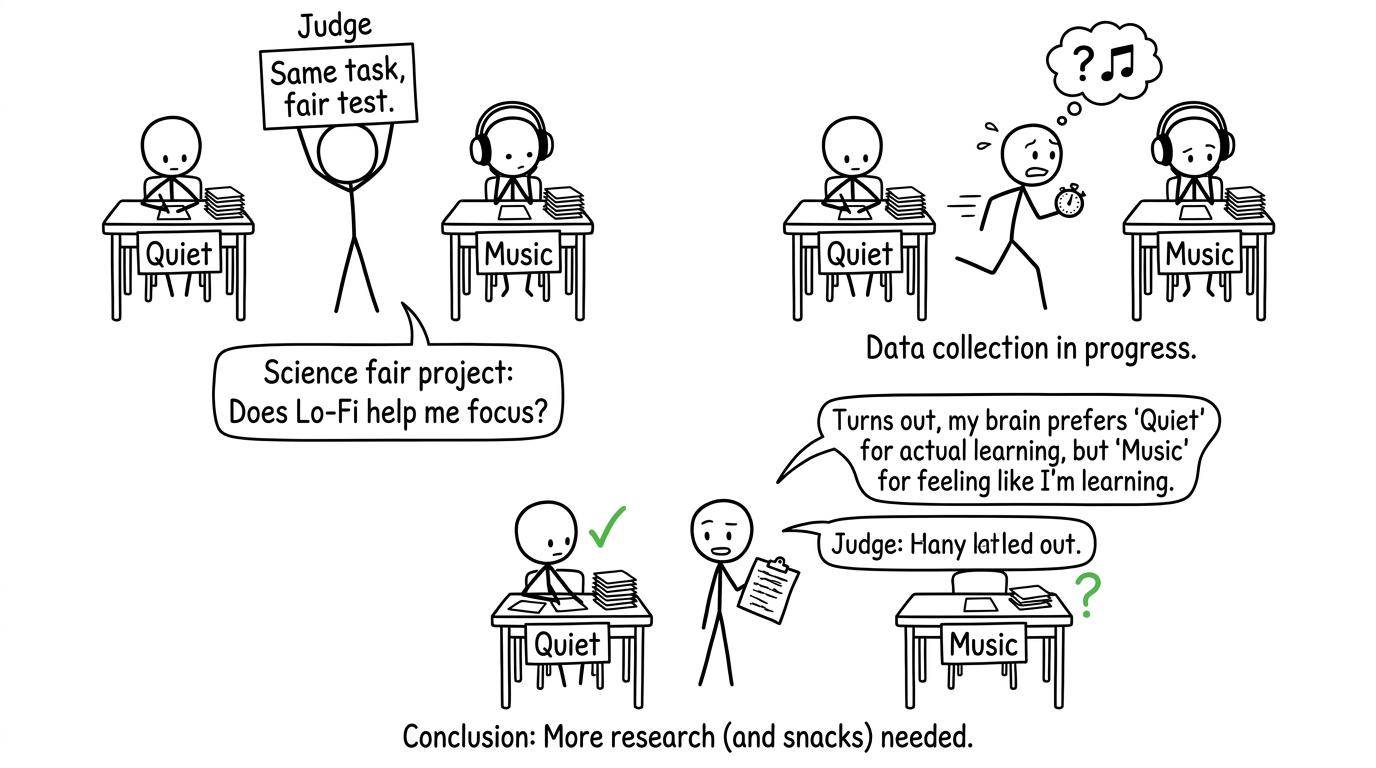 A student conducts a fair test between quiet and music using equal piles of revision cards
A practical Food and Nutrition revision routine
Begin with a clear outcome rather than a vague promise to “do nutrition”. For example, aim to recall key functions, answer a set of questions or explain one food-science process without notes.
A focused session could follow this pattern:
- Set up: choose the topic, place your phone away and decide the sound condition.
- Learn: read or watch the relevant material, preferably in silence when it is new.
- Retrieve: close the source and write what you remember.
- Check: compare your response with reliable notes or a mark scheme.
- Repair: correct missing terminology and unclear explanations.
- Return later: test the same material again without prompts.
Keep exam-condition practice silent unless an access arrangement formally permits otherwise. Your AQA, OCR or Eduqas written paper will not come with a revision playlist, so some of your preparation should reproduce that environment.
The same principle applies to maths. Use the MathsGenie revision planner to give sessions a purpose, then use revision lessons, practice questions and video solutions to check whether the method has stuck. A realistic GCSE maths revision timetable can help you balance Food and Nutrition with foundation or higher tier preparation.
When silence is the better decision
Choose silence when:
- you are encountering a topic for the first time;
- you need to memorise definitions or technical vocabulary;
- you are reading a dense explanation;
- you are planning or writing an extended response;
- you are completing a timed paper;
- the music keeps pulling your attention towards your phone;
- you cannot explain what you have just revised without looking back.
Silence may initially feel less comfortable because it reveals effort. That is not necessarily a problem. Effective retrieval often feels harder than rereading because your brain must produce the information rather than recognise it.
Common mistakes when revising with music
Judging the session by time rather than recall
Sitting at a desk for an hour does not prove that the material was learned. Finish with closed-book questions so the result is visible.
Choosing favourite lyrical songs
A familiar chorus can compete directly with definitions and written explanations. Save those tracks for breaks, exercise or simple organisational tasks.
Changing songs throughout the session
Every search, notification and playlist decision interrupts the task. Prepare the audio beforehand and keep the device beyond easy reach.
Using music during every kind of revision
Flashcard recall, extended writing, recipe calculations and folder organisation do not impose identical demands. Match the sound to the task.
Never practising under exam conditions
Comfortable revision is not the final goal. You need to retrieve information in the environment where marks will be awarded. Build regular silent, timed sessions into your plan, just as you would when learning how to use GCSE past papers properly.
Ignoring safety during practical work
Do not use headphones during school practical assessments unless your teacher explicitly permits them. You must be able to hear instructions and remain aware of equipment, heat and other people in the kitchen.
The best answer is a deliberate one
Revising GCSE Food and Nutrition with music is not automatically a bad idea. Quiet instrumental music may help you settle into routine tasks, especially when the alternative is distracting background noise. But music with lyrics is a poor default for reading, verbal memory and extended writing, while silence remains the best preparation for realistic exam practice.
Treat music as a tool, not a reward you must defend. Test it. Measure recall. Change your approach when the task changes.
Then bring the same discipline to your maths preparation. Start at MathsGenie’s free GCSE maths revision hub, choose your exam board and tier, and move from revision lessons to practice questions, mini tests, past papers and predicted papers. Mark your work carefully, use the mark schemes and video solutions, and let the evidence tell you what to revise next, whether the room is silent or softly playing.