Revising GCSE Bengali With Music: Is It a Good Idea?
Revising GCSE Bengali with music may help you begin, but lyrics can disrupt language work. Learn when to choose silence, instrumentals and exam conditions.
You sit down to revise. The Bengali vocabulary list is open, your maths questions are waiting in another tab, and silence feels strangely loud. A playlist promises to make the session easier. But will it help you learn, or simply make revision feel more pleasant?
The short answer is that revising GCSE Bengali with music is usually safest with silence for demanding language tasks. Songs with lyrics can interfere with reading, writing and verbal memory. Quiet instrumental music may be acceptable for familiar, low-demand work, but research does not show that it reliably improves learning. Timed papers and listening practice should be completed without background music.
That distinction matters. Enjoying a revision session and remembering its content are not always the same thing.
The quick music and revision checklist
Use this as your starting point:
- Choose silence for vocabulary recall, translation, reading comprehension and extended writing.
- Never play background music during a Bengali listening exercise.
- If silence stops you beginning, try quiet, familiar instrumental music.
- Avoid lyrics in Bengali, English or another language you understand.
- Turn music off for timed practice so your conditions resemble the exam.
- Compare your results rather than trusting how productive a playlist feels.
- Apply the same principle to demanding GCSE maths questions: reduce distractions when your working memory is busy.
The aim is not to prove that music is universally good or bad. It is to match the sound environment to the task in front of you.
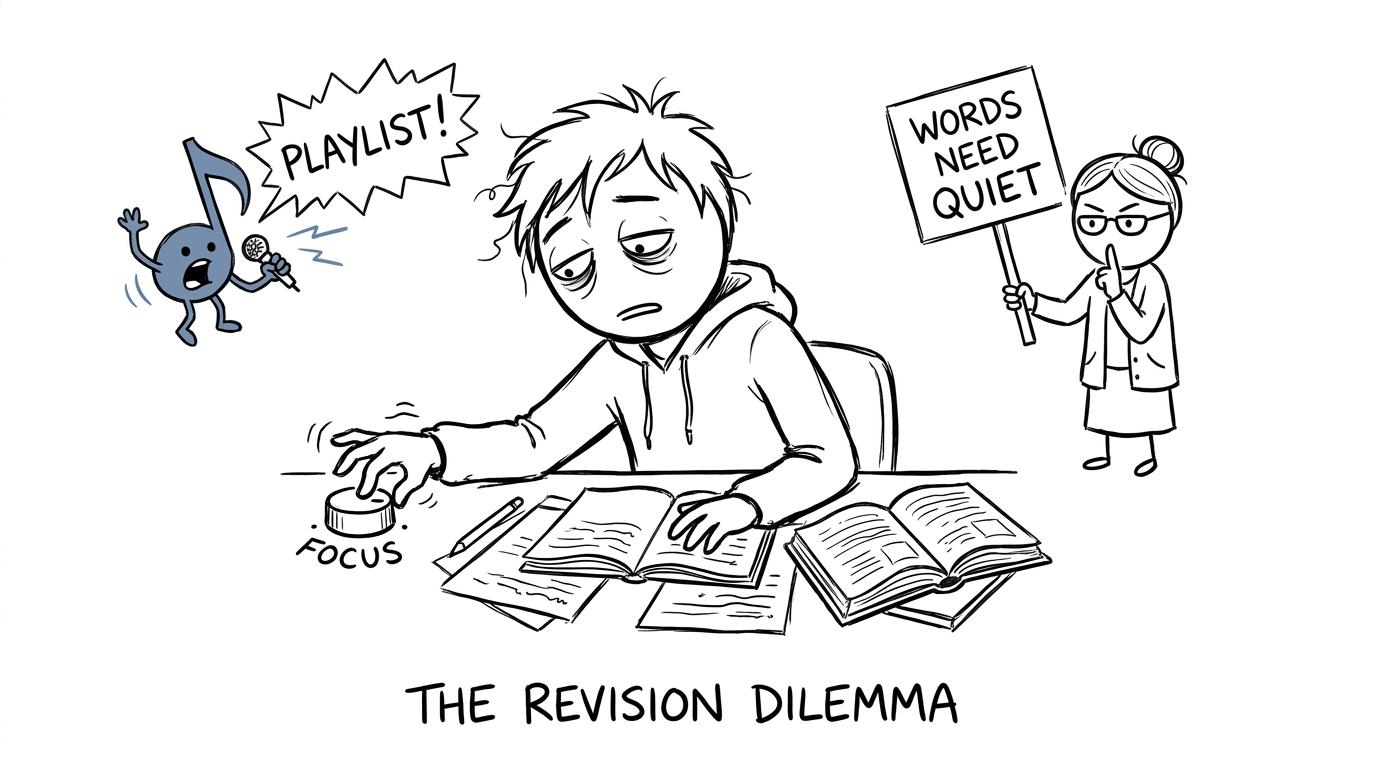 A student choosing between a loud playlist and quiet language revision
What research says about background music and focus
Research into background music is more cautious than many playlist titles suggest. A systematic review covering memory, language, reasoning, attention and other cognitive tasks found that results varied according to the task, the music and the individual. Across the evidence, background music tended to be harmful for memory and language-related work, while many other comparisons found no clear effect.
Lyrics appear to be especially important. A controlled study published in the Journal of Cognition in 202320232023 found that music with lyrics impaired verbal memory, visual memory and reading comprehension compared with silence. Instrumental lo-fi music did not reliably improve or damage performance in that study.
A 202420242024 reading-comprehension study also found lower performance with lyrical pop music than without music. Disruption was particularly noticeable when the language of the lyrics matched the language being read. That does not prove exactly what will happen to every GCSE Bengali student, but it supports a sensible rule: if your brain is processing words, do not give it another stream of words to process unnecessarily.
There are limits to the evidence. Much of this research involves adults or university students rather than GCSE candidates, and studies use different music, tasks and testing conditions. There is no strong basis for promising that a particular genre will raise your Bengali or maths grade. The responsible conclusion is narrower: lyrics are a meaningful distraction risk during verbal work, while instrumental music is generally less disruptive but not a guaranteed learning aid.
Why GCSE Bengali makes lyrics particularly distracting
The current AQA GCSE Bengali specification assesses four areas: listening, speaking, reading and writing. Each contributes 25%25\%25% of the qualification. These are all language-intensive activities, so the interference created by background words is especially relevant.
Vocabulary and translation compete with song lyrics
Learning vocabulary requires you to connect meaning, spelling and recall. Translation adds another layer because you must move accurately between Bengali and English while preserving the intended meaning.
A song with understandable lyrics introduces competing vocabulary at precisely the moment you are trying to retrieve other words. You may still finish the page, but slower recall or unnoticed errors can reduce the value of the session.
For flashcards and translation practice, begin in silence. Look at the prompt, retrieve the answer without notes, check it, and return to missed items later. Music should not become a cue that supplies energy while quietly weakening the retrieval itself.
Reading needs attention to detail
GCSE reading questions can depend on a contrast, tense, opinion or small qualifying phrase. Background lyrics may pull attention away for only a moment, yet that moment can contain the word that changes the meaning of the passage.
Silence is therefore the strongest default for reading comprehension. If you use music while organising notes or highlighting known vocabulary, switch it off when you begin answering questions from memory.
Writing requires planning and monitoring
Writing in Bengali involves generating ideas while checking vocabulary, grammar, spelling and whether every part of the task has been covered. Familiar songs can create the illusion of harmless background sound, but the words may still compete for attention.
Use silence for translations and extended responses. Afterwards, mark the work against your teacher's guidance or the relevant mark scheme. The correction stage deserves quiet too, because noticing why an answer lost marks is where much of the learning happens.
Listening practice must contain only the required audio
This is the clearest decision of all. Background music should be off during a listening task. You need to hear pronunciation, detail, changes of speaker and the language used in the recording. Adding another audio source makes the activity less valid and unlike the real assessment.
When music might still have a useful role
Music can help with the behaviour surrounding revision even when it does not improve the learning process itself. A short instrumental track might become a cue to open your materials, put your phone away and start. For a student who keeps postponing revision, that transition can be useful.
It may also be reasonable during low-demand tasks such as:
- arranging folders and resources;
- copying dates into a revision plan;
- preparing blank flashcards;
- checking which topics need attention;
- completing familiar questions that require little verbal processing.
Keep the volume low and choose predictable music without lyrics. Avoid dramatic tracks, changing playlists and songs that tempt you to sing along. The moment the work becomes difficult, turn the music off.
This is relevant beyond Bengali. When choosing topics for maths, the GCSE Maths Revision hub can help you organise lessons and practice. Music may be harmless while you build that plan. Once you begin a demanding multi-step question, quiet gives your attention fewer places to wander.
Test whether music works for you
Personal preference matters, but preference should be tested against performance. You can run a small revision experiment without pretending it is a scientific study.
Choose two comparable Bengali tasks. Complete one in silence and the other with your usual music. Keep the time and difficulty as similar as possible. Record:
- how many answers were correct;
- how long the task took;
- how many times you reread the question;
- what you could recall the next day;
- whether you changed tracks or touched your phone.
Repeat the comparison on several days. One unusually easy passage tells you little. A repeated pattern is more useful.
Do not measure success only by whether the session felt enjoyable. Music can improve mood while leaving accuracy unchanged or worse. Your evidence should come from recall, completed questions and marked work.
The same method works for maths revision. Use an Edexcel GCSE Maths mini test or another short set at your level, then compare accuracy and concentration under quiet and instrumental conditions. This is not a worked mathematical example; it is a way to make your revision environment accountable.
A practical sound plan for Bengali and maths revision
A good session changes its sound environment as the work changes.
Start with a short setup cue
If music helps you begin, play one instrumental track while setting out your book, water and resources. Decide the exact task before the track finishes. Avoid browsing for the perfect playlist, because choosing music can become procrastination wearing headphones.
For a manageable structure, adapt the 20-minute maths revision routine: retrieve first, practise actively, then mark. The same rhythm can support Bengali vocabulary or reading work.
Work in focused quiet blocks
Use a quiet block of roughly 202020 to 303030 minutes for reading, writing, vocabulary recall or difficult maths. Keep your phone out of reach. Take a short break afterwards, when you can listen to a song properly rather than dividing your attention between two activities.
A realistic weekly structure is more valuable than one heroic evening. The GCSE maths revision timetable guide explains how to balance targeted topic work with timed practice and review.
Recreate exam conditions regularly
Revision should sometimes be comfortable. Practice papers should not be.
Complete timed tasks in silence, with the equipment and conditions you will have in the real assessment. For maths, select the correct exam board and tier. Maths Genie provides Edexcel GCSE Maths past papers and AQA GCSE Maths past papers, including mark schemes and worked solutions where available.
Predicted papers are useful for fresh practice, but they are not promises about the real exam. The Edexcel GCSE Maths predicted papers are most valuable when completed under timed, quiet conditions and followed by careful correction.
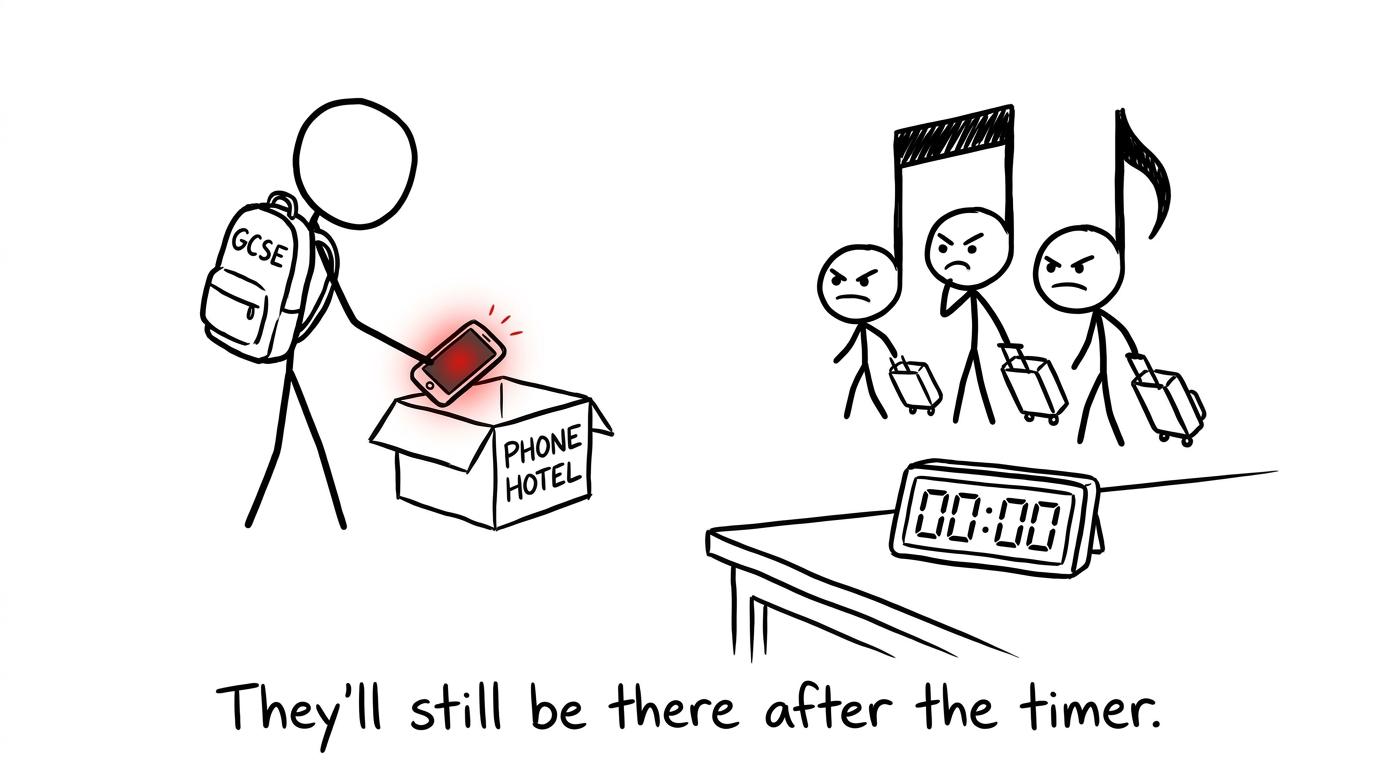 Musical notes checking into a phone hotel before timed practice
Common mistakes when revising with music
Assuming instrumental music automatically improves concentration
Instrumental music is generally less risky than lyrical music, but less distracting does not mean beneficial. If your accuracy falls or you work more slowly, choose silence.
Playing songs in a language you do not understand
Unfamiliar lyrics may create less semantic interference, but changes in rhythm, vocals and volume can still capture attention. Test the effect rather than assuming the words are harmless.
Using music during every task
Organising notes, recalling vocabulary and sitting a timed paper place different demands on attention. One rule for the entire session is too crude. Match the sound to the task.
Changing tracks repeatedly
Skipping songs combines music with phone use and decision-making. A playlist that requires constant management is not background music; it is a second activity.
Practising in conditions that cannot exist in the exam
If every hard question is completed with headphones, silent exam conditions may feel unfamiliar. Follow the full paper process in MathsGenie's guide to using GCSE past papers: sit the paper, mark it, identify errors, repair weak topics and retest.
Confusing time spent with learning achieved
A two-hour playlist does not prove that two hours of useful revision occurred. Count completed retrieval attempts, corrected mistakes and marked questions instead.
Choose the environment that protects your attention
Revising GCSE Bengali with music is not automatically a bad idea, but the safest answer depends on the task. For reading, writing, translation, vocabulary recall and listening practice, silence is usually the better choice. For simple preparation or familiar routine work, quiet instrumental music may help you settle down without causing obvious harm.
Then carry the same judgement into maths. Use music to begin if necessary, but use quiet to think, retrieve and test yourself. Maths Genie gives you the structure: free revision lessons to rebuild a method, practice questions and mini tests to strengthen it, and past papers, predicted papers, mark schemes and video solutions to test it honestly.
Open the Maths Genie GCSE revision hub, choose one weak topic, put the phone away and complete a focused block. Your playlist can wait. The marks you are learning to earn cannot.