

Revising Before Bed GCSE English Language: Help?
Revising before bed GCSE English Language can aid memory if it stays brief and protects sleep. Learn what to review, when to stop and what to avoid.
The clock says you should stop. Your notes suggest otherwise. There is always another language technique to recall, another writing plan to improve and another page that suddenly feels essential.
So, does revising before bed GCSE English Language help? It can, provided the revision is brief, calm and followed by enough sleep. Reviewing material before sleeping may support memory consolidation, but staying up late, attempting demanding new work or becoming anxious can remove that advantage. Sleep is not time stolen from revision. It is part of the learning process.
This matters especially when English Language sits beside GCSE maths, science and other exams in a crowded timetable. The goal is not to squeeze work into every available minute. It is to decide which minutes are genuinely useful.
The short answer: protect sleep first
Use this checklist when deciding whether evening revision will help:
- Keep the final session short and focused.
- Retrieve information instead of passively rereading it.
- Review familiar material rather than learning a difficult new skill.
- Avoid completing a full paper immediately before bed.
- Leave time to wind down without revision or scrolling.
- Stop at a fixed time, even if the session feels unfinished.
- Move demanding analysis and timed writing to earlier in the day.
Research reviews consistently support an active role for sleep in memory consolidation. Evidence involving children and adolescents suggests that sleep can help working memory and the retention of learned information, although the effect varies with the task and the individual. It does not follow that the minute immediately before sleep is a uniquely powerful learning window. The clearer conclusion is simpler: learning followed by sufficient sleep is generally preferable to learning followed by sleep restriction.
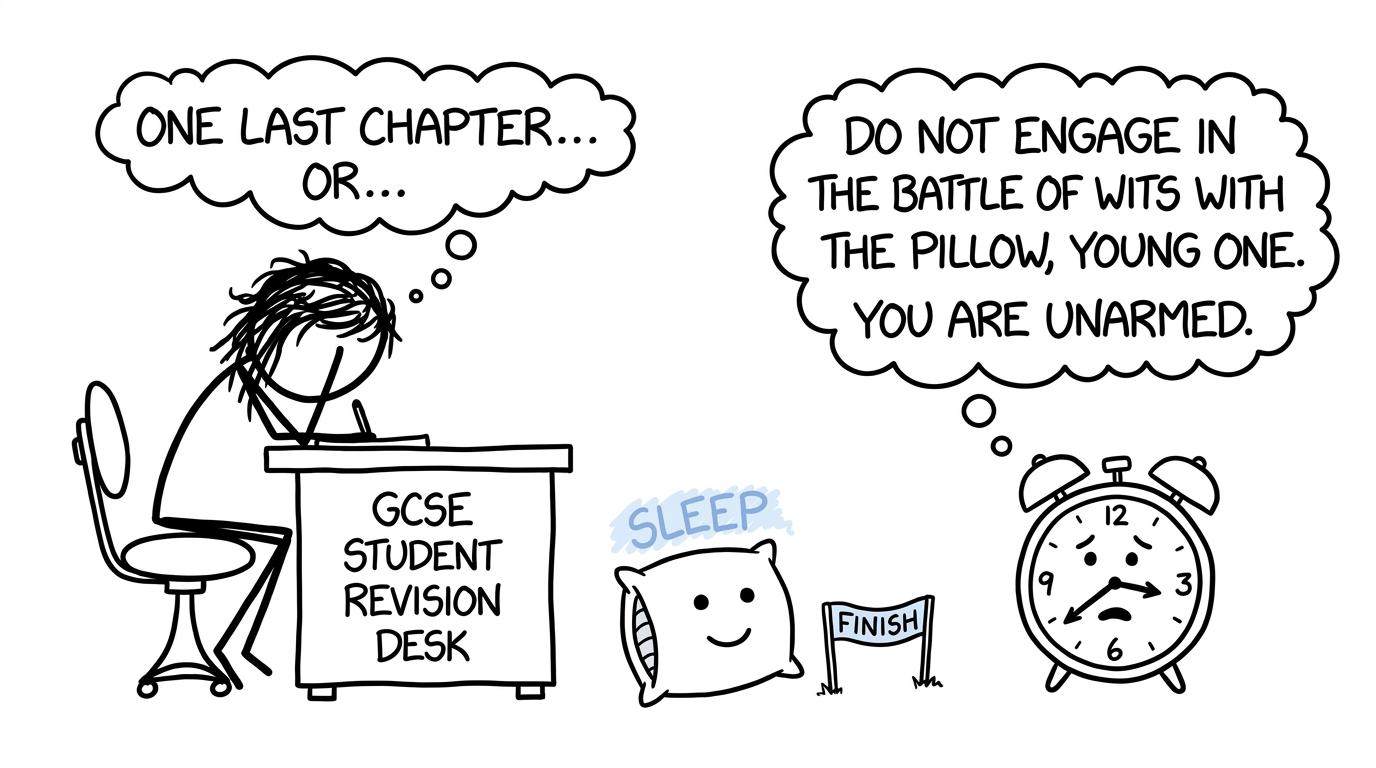 A worried alarm clock watches revision compete with a friendly pillow
How sleep supports memory consolidation
Learning does not finish when you close a book. New information must be stabilised and connected with knowledge already stored in memory. Sleep supports this consolidation process and also helps prepare the brain for learning the following day.
For GCSE English Language, the information you might consolidate includes:
- the purpose of an assessment objective;
- language and structural terminology;
- ways to organise a comparison;
- features associated with a particular form, audience or purpose;
- reminders about punctuation and sentence control;
- a sequence for approaching each question on your exam board’s paper.
Across AQA, Edexcel, OCR and Eduqas, GCSE English Language assesses reading and writing through shared national assessment objectives, although paper structures and question wording differ. Students must interpret information, analyse language and structure, compare or evaluate where required, and communicate effectively with technical accuracy.
Those broad ideas can be reviewed before bed. However, English Language is not mainly a memory test. Knowing the word “metaphor” does not automatically produce perceptive analysis, just as knowing a maths formula does not guarantee that you can recognise when to use it. Performance requires application under exam conditions.
That is why bedtime review works best as the final, lighter layer of a wider plan, not as a replacement for timed reading and writing practice.
What to revise before bed for GCSE English Language
The most suitable material is familiar, contained and easy to stop. You should finish feeling that you have closed a small loop, not opened five new ones.
Recall your paper routine
Without looking at your notes, say or write the order in which you will approach the paper. Recall the question types, the relevant assessment objectives and the approximate pacing recommended by your teacher or exam board materials. Then check your answer.
Use resources that match your exact specification. AQA, Edexcel, OCR and Eduqas do not arrange every paper in the same way, so a routine copied from a student on another board may be wrong for you.
Review a small set of techniques
Choose a few language or structural methods and recall what each one can achieve. Focus on effects and interpretation, not definitions alone. In the examination, identifying a technique is usually only the beginning; the valuable thinking explains how the writer’s choice shapes meaning or influences the reader.
Plan without writing a full response
Briefly plan a descriptive, narrative or viewpoint-writing task. Decide on the audience, purpose, tone and broad structure. Stop before producing the complete answer.
This keeps the task manageable while rehearsing decisions that matter for writing assessment. Full responses deserve an earlier session when you are alert enough to draft, check and improve them properly.
Recall one correction from earlier practice
A mistake you have already understood makes excellent bedtime material. You might recall that your comparison became two separate analyses, that your evidence was too long or that you forgot to proofread sentence boundaries.
This approach is also useful in maths. A short review of one corrected error can be more valuable than starting an unfamiliar topic while exhausted. Maths students can use the GCSE Maths revision hub to organise daytime lessons and practice, then reserve the final evening review for a few methods or corrections already encountered.
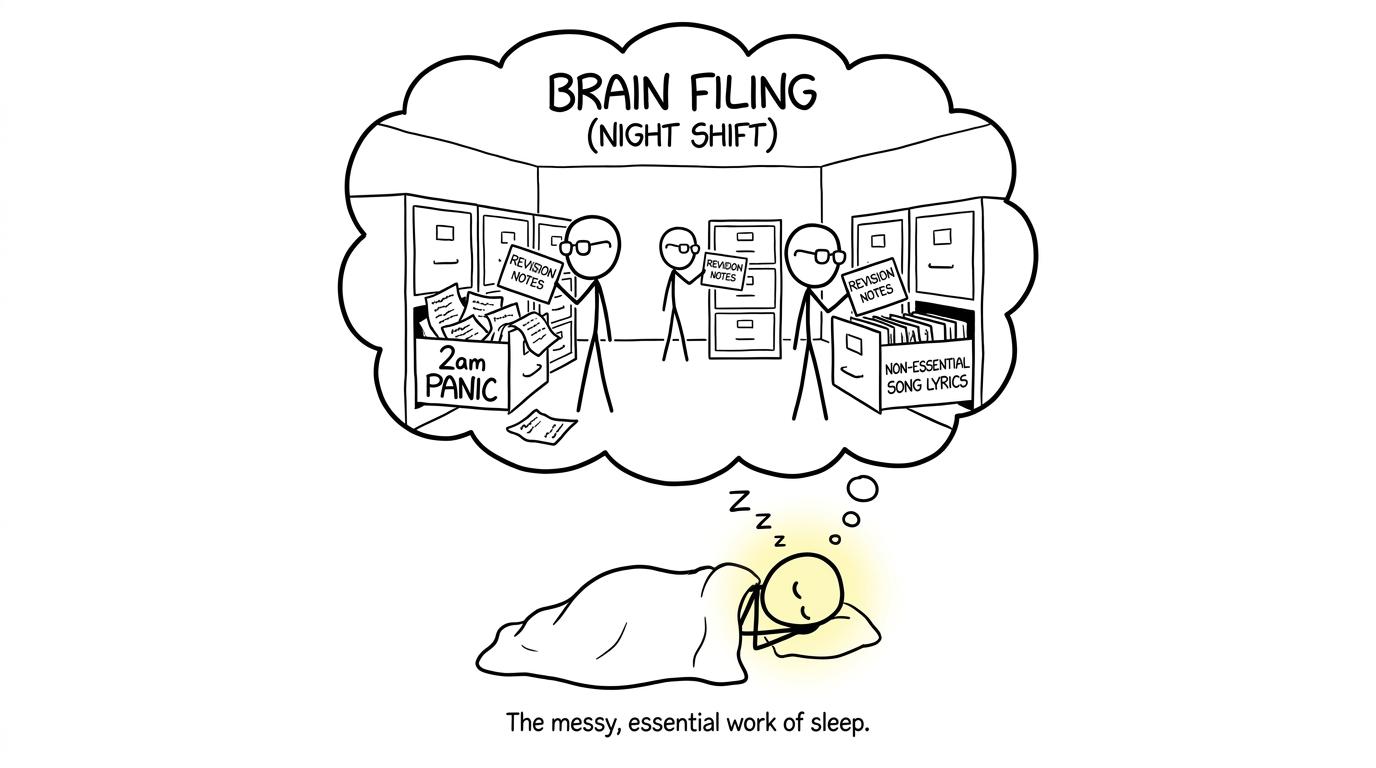 Tiny brain librarians file revision notes while the student sleeps
When bedtime revision begins to hurt
The boundary is not “revision versus no revision”. It is useful revision versus the sleep and recovery it displaces.
You continue beyond your planned bedtime
Teenagers commonly need around eight to ten hours of sleep, although individual needs vary. NHS sleep guidance for young people emphasises regular routines, a calm wind-down period and reduced use of electronic devices before bed.
If revision repeatedly shortens your sleep, the cost can appear the next day as reduced alertness, weaker concentration and poorer learning readiness. An extra hour with a textbook is not automatically an extra hour of progress.
You attempt intense timed work
A full English Language paper, a long creative response or a difficult evaluation question can leave your mind active when you are trying to settle. Save these tasks for an earlier block. The same applies to a challenging higher-tier maths paper.
For maths, MathsGenie’s guidance on when to start GCSE past papers explains how full papers can be introduced gradually rather than left to late-night cramming. When you do sit one, use the correct board and tier, then review it while you still have the attention to learn from the mark scheme.
Your phone turns ten minutes into an hour
A phone may begin as a timer or flashcard tool and end as a source of messages, videos and exam anxiety. NHS sleep guidance commonly recommends reducing screen use as bedtime approaches. Paper notes, printed cards or a short handwritten checklist remove both the distraction and the temptation to keep searching for “one more” resource.
Revision increases anxiety
If reviewing a list of topics makes you feel less prepared rather than more focused, stop. Write down the next action for tomorrow and close the materials. A plan gives an unfinished thought somewhere to go.
The free MathsGenie revision planner can help you move maths tasks out of your head and into a visible schedule, leaving room for English Language and your other GCSE subjects.
A calm bedtime revision routine
A useful routine should be deliberately modest. Try this structure:
- Earlier in the evening: complete demanding practice, such as a timed reading response, extended writing task or maths question set.
- After marking: record one or two corrections rather than rewriting everything.
- Before the wind-down period: spend a brief session retrieving familiar material from memory.
- At the finish time: write tomorrow’s first task, put resources away and stop.
- During the wind-down: choose a quiet, non-revision activity and prepare for sleep.
The important feature is the finish time. Without one, revision expands to fill the night.
If you are balancing English with maths, the twenty-minute GCSE maths revision routine offers a repeatable structure for busy days. For the evening immediately before a maths paper, follow the GCSE maths night-before plan, which prioritises a controlled session and a clear stopping point.
Active recall beats bedtime rereading
Rereading feels smooth because the page supplies the information. Retrieval is less comfortable because your memory must produce it. That difficulty is useful: it reveals what you can recall without support.
For English Language, close your notes and answer a few focused prompts:
- What does this question ask me to demonstrate?
- Which evidence would be precise enough to analyse?
- What should a comparison do beyond identifying similarities?
- How will I adapt tone for the stated audience and purpose?
- Which technical error do I need to check in my own writing?
Then open your notes and correct only what was missing. This is a check, not a marathon.
Maths revision follows the same attempt-and-feedback principle. Use Edexcel GCSE Maths past papers under proper conditions earlier in the day, mark them, and revisit a small number of errors later. Nearer the examination, GCSE predicted papers can provide additional practice, but they should complement specification-wide revision rather than encourage guessing about what will appear.
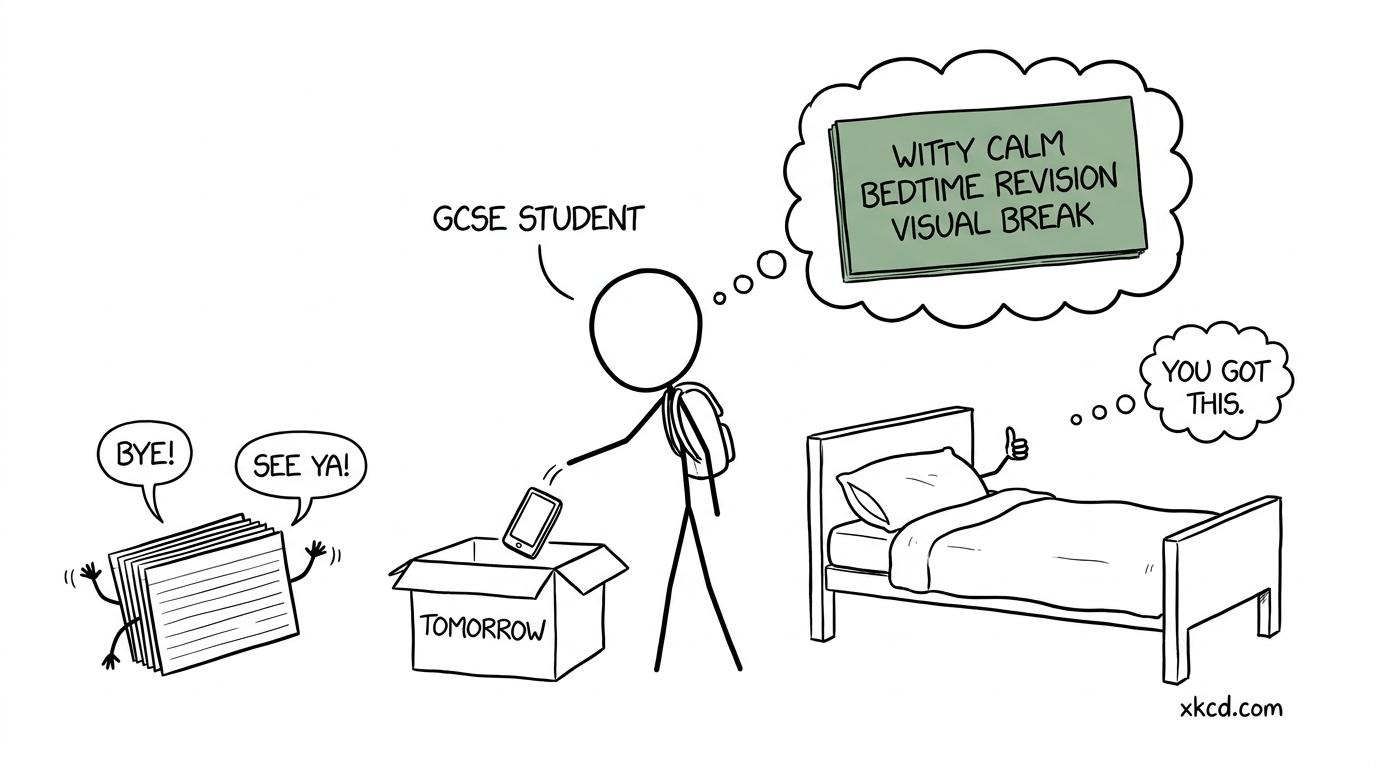 A student puts the phone away as flashcards wave goodnight
Common mistakes with late-night revision
Treating sleep as optional
Memory consolidation depends on actually sleeping. Revision before bed is not helpful if it becomes revision instead of bed.
Learning a new exam method at the last moment
New methods need explanation, application and feedback. Put them into tomorrow’s plan rather than forcing uncertain learning into a tired session.
Revising terminology without analysis
A list of techniques can create false confidence. GCSE English Language rewards what you do with textual evidence: interpretation, analysis, comparison and evaluation according to the question.
Ignoring the exam board
The assessment objectives are shared, but paper structures are not identical. Check the current specification and guidance for your exact board rather than relying on generic timings or question numbers.
Finishing with an unmarked task
An unmarked answer may leave uncertainty circling in your mind. Complete substantial tasks earlier, when there is time to review them. Bedtime is better suited to familiar recall and already-corrected mistakes.
Using one bad night as evidence that the plan failed
Sleep varies. Do not respond to one unsettled night by adding more revision the next evening. Return to a consistent routine and seek support from a parent, carer, teacher or health professional if sleep difficulties persist.
Make the final session smaller, not later
Revising before bed can support GCSE English Language when it consists of calm, active recall followed by sufficient sleep. It becomes harmful when it delays bedtime, increases anxiety or tries to replace the deeper practice that should happen earlier.
Think of the final session as closing the day. Recall a paper routine. Review one correction. Set tomorrow’s first task. Then stop.
For the maths side of your GCSE timetable, make MathsGenie’s free GCSE revision resources your starting point. Use revision lessons and practice questions to repair individual topics, mini tests to check recall, and past papers with mark schemes and video solutions to develop exam technique. Add predicted papers near the examination, organise the work with the revision planner, and protect the sleep that allows tomorrow’s revision to count.










