

Revise Weakest Topic First GCSE Astronomy?
Revise weakest topic first GCSE Astronomy with a balanced session plan that tackles hard content early, protects confidence and strengthens exam recall.

The hardest topic on your revision list has a strange power. Leave it until the end and it follows you through the whole session. Start with it immediately and you may spend ten minutes staring at a page while your concentration slowly disappears.
So, should you revise weakest topic first GCSE Astronomy? Usually, yes, but not completely cold. Begin with a short warm-up, tackle your weakest area while your attention is still relatively fresh, then finish with mixed retrieval or a more secure topic. This gives difficult material your best effort without allowing it to consume the whole session.
The order matters, but the method matters more. A weak topic only improves when you retrieve knowledge, answer questions, check your work and return to it later.
The short answer: weak topic early, not necessarily first
A productive GCSE Astronomy session usually follows this pattern:
- Warm up: retrieve a few facts or complete one familiar question.
- Weak-topic block: focus on one precisely defined gap.
- Check and correct: use notes, solutions or a mark scheme.
- Mixed practice: switch between the weak area and older content.
- Finish clearly: record what to revisit and when.
For a session lasting roughly 505050 minutes, that might mean a 555-minute warm-up, 252525 minutes on the weak topic, 151515 minutes of questions and feedback, and 555 minutes planning the next review. These are flexible proportions rather than a compulsory timetable.
The important distinction is between first and early. Starting with a brief success settles you into the work. Spending the best part of the session on your weakest area ensures it does not repeatedly get postponed.
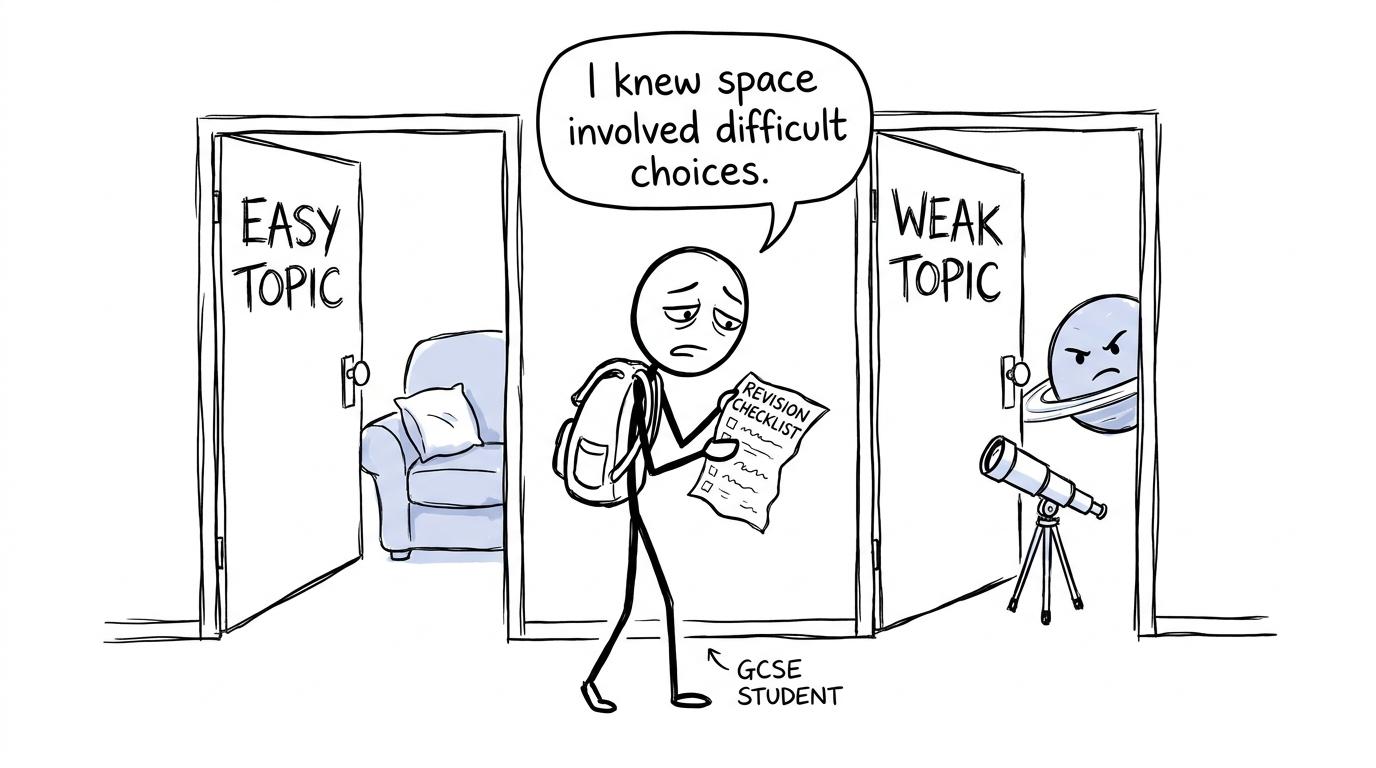 A student choosing between an easy topic and a weak astronomy topic
Why tackling the weakest area early usually helps
The comfortable topic offers quick reassurance. You recognise the vocabulary, complete the questions and feel productive. But familiarity is not always the same as learning.
Your weakest topic creates more useful information. It shows which facts you cannot retrieve, which mathematical steps break down and which question wording causes hesitation. That feedback can direct the rest of your revision.
Research on learning supports active retrieval and spaced practice rather than repeated rereading. Retrieval means attempting to recall an idea before looking at the answer. Spacing means returning to it after a delay instead of trying to perfect it in one sitting. Interleaving adds a further step by mixing related question types so that you must decide which knowledge or method applies.
This suggests a sensible principle: give a weak topic focused attention early, but do not trap it inside one enormous revision block. Revisit it across several days.
MathsGenie's GCSE one-month revision plan uses the same broad rhythm: diagnose gaps, practise actively, check mistakes and return to them later.
Why GCSE Astronomy weaknesses deserve careful diagnosis
A topic can feel weak for several different reasons. You may not remember the astronomical idea. You may understand the science but lose control of the calculation. Alternatively, you may know both and still misinterpret the command word or data.
Before deciding what to revise first, classify the problem:
- Knowledge gap: you cannot explain the relevant object, process or model.
- Application gap: you know the fact but cannot use it in an unfamiliar context.
- Mathematical gap: standard form, units, graphs or rearranging formulae cause the error.
- Observational gap: you struggle to plan, analyse or evaluate an observation.
- Exam-technique gap: you misread the question, omit working or give insufficient detail.
This matters because GCSE Astronomy is not simply a memory test. The official assessment objectives give substantial weight to both knowledge and application, while analysis and evaluation also matter. Official requirements also state that mathematical skills must account for at least 20%20\%20% of the qualification's marks.
Those skills include standard form, ratios, inverse-square relationships, logarithms, means, specialist distance units, algebra, graphs, gradients and angular measures. If an astronomy calculation goes wrong, the true weakness may therefore be a transferable GCSE Maths skill.
Use the GCSE Maths revision hub to strengthen the underlying method. Students preparing for foundation or higher tier Maths can choose resources appropriate to their own course, even though GCSE Astronomy itself has a different assessment structure.
A better way to define your weakest topic
“Cosmology” is too broad to revise effectively. So is “graphs”. A useful weakness is small enough to test in one session.
Replace broad labels with specific statements such as:
- interpreting the gradient of an astronomical graph;
- converting between astronomical distance units;
- distinguishing apparent and absolute magnitude;
- explaining why an observation may be unreliable;
- using standard form accurately in a multi-stage calculation;
- selecting information from a supplied formula and data sheet.
Precision reduces avoidance. “Revise the Universe” feels endless. “Answer questions on interpreting redshift data” gives the session a visible finish line.
A past paper is one of the best diagnostic tools because it tests whether you can recognise the required idea without being told the topic. Use the Edexcel GCSE Astronomy past papers, mark your attempt carefully and record the exact reason for each lost mark.
Do not rank weaknesses only by how unpleasant they feel. Give priority to gaps that appear repeatedly, block several other skills or cost marks across different question types.
When the weakest topic should come last
Starting with the weakest area is a strong default, not an unbreakable rule.
Put it later when the beginning of the session must rebuild momentum. After a tiring school day, a short familiar task may be the difference between beginning and abandoning revision altogether. The key is to set a firm limit so that the warm-up does not become the whole session.
A weak topic can also come last when the final block is a short retrieval check. For example, you might study the topic earlier, switch to something else, then finish by recalling its key ideas without notes. That final check is not postponement; it is a second encounter.
Leave demanding new learning until another session if you are so tired that you are repeatedly guessing. Difficult practice should be effortful, but it still needs attention. Doing low-quality questions late at night can create a page of errors without revealing much about what you actually know.
The decision should therefore be based on the purpose of the session:
- Learning or repairing a major gap: place it early.
- Brief retrieval of something already studied: place it near the end.
- Diagnosing strengths and weaknesses: begin with mixed questions.
- The night before an exam: prioritise short, controlled repairs rather than attempting to relearn an enormous topic.
For a calm final-evening structure, adapt the principles in MathsGenie's GCSE Maths night-before plan.
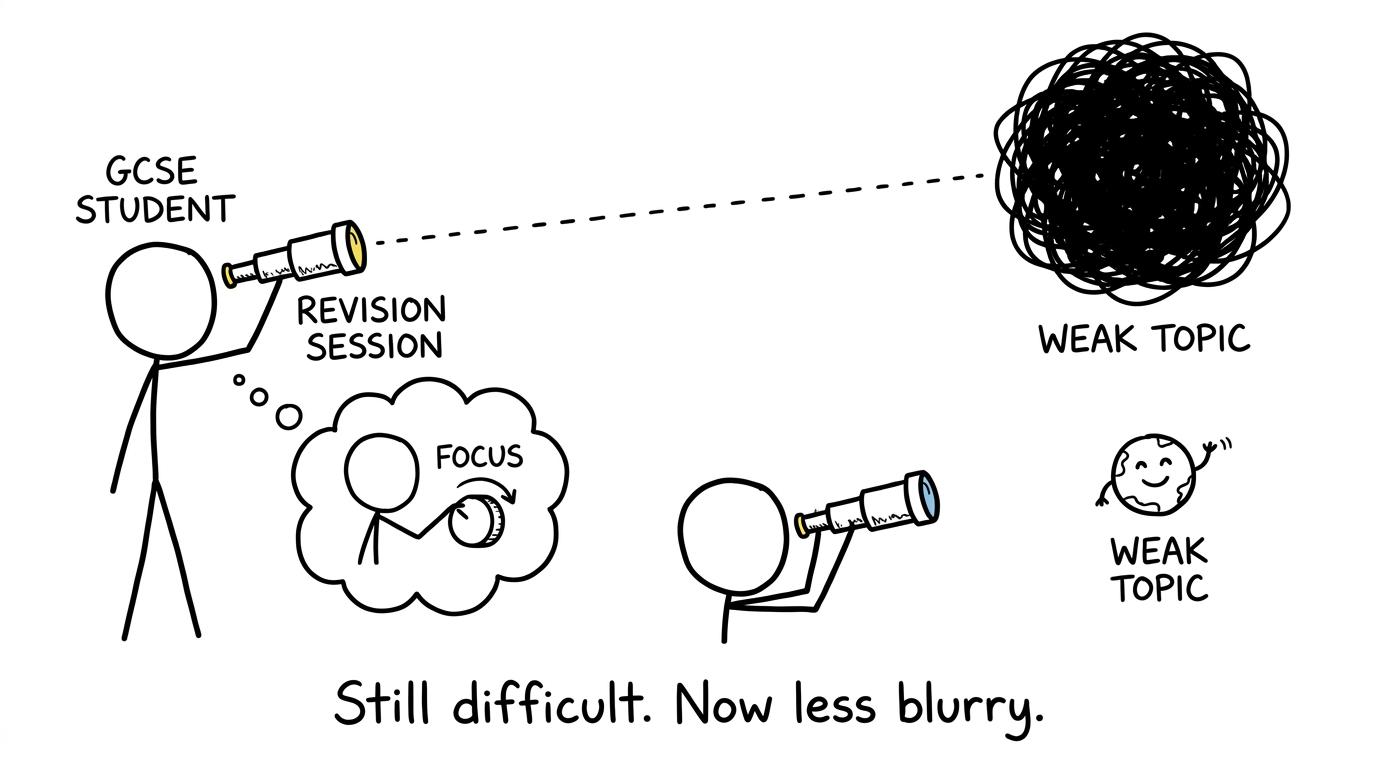 A telescope bringing a weak revision topic into focus
How to revise the weak topic once you reach it
Ordering your topics cannot compensate for passive revision. Reading a page several times may make the wording feel familiar, but the exam asks you to produce and apply knowledge without that page in front of you.
Start with retrieval
Close the notes and write what you can remember. Sketch a labelled structure where appropriate, list stages in a process or explain the idea aloud. Then compare your recall with the specification or revision material.
The blank spaces are useful. They show where learning should begin.
Separate astronomy from the maths
If the concept is secure but the calculation is not, isolate the mathematical skill. Astronomical quantities often involve very large distances and powers of ten, so MathsGenie's standard form revision guide can help repair that part of the problem.
Unit errors deserve their own practice too. The SI units, prefixes and standard form guide reinforces a reliable routine: identify the required unit, convert carefully and round only when appropriate.
Practise questions and inspect the feedback
Complete a small set without notes. Mark it soon afterwards, but do more than count correct answers. Ask:
- Did I choose the right idea?
- Was my mathematical setup valid?
- Did I include units and sensible precision?
- Did my explanation answer the command word?
- What single change would earn the missing mark next time?
A mark scheme is a map of the required response, not a verdict on your ability. Where available, video solutions can also reveal whether your reasoning failed at the first step or only near the end.
Schedule the return
Write the topic into your next few sessions. A single successful attempt can create confidence, but spaced retrieval tests whether the learning remains accessible.
Use MathsGenie's guidance on building a realistic GCSE revision timetable to balance weak areas, mixed practice and timed papers without trying to repair everything at once.
Common mistakes when ordering revision topics
Spending the entire session on one weakness
Long blocks can turn careful thought into guessing. Set a stopping point, record the unresolved issue and return after a gap.
Choosing weaknesses from memory alone
Students often revise what feels difficult rather than what actually loses marks. Use questions, past papers and mark schemes to gather evidence.
Starting hard and staying stuck
Struggle is useful only when followed by feedback. If you cannot begin, reduce the task: review one definition, identify the relevant section of the data sheet or repair the underlying maths skill.
Finishing only with easy work
A comfortable ending may feel encouraging, but include at least one retrieval check from the weak topic. Otherwise, you do not know whether the session changed what you can recall.
Ignoring transferable maths errors
Astronomy can expose gaps in algebra, graphs, significant figures and standard form. Treating every lost mark as an astronomy fact problem wastes revision time. Short MathsGenie Edexcel GCSE Maths mini tests can help check whether the underlying skill survives under time pressure.
Start early, finish with evidence
The best answer is not simply “first” or “last”. Revise your weakest GCSE Astronomy topic early enough to give it genuine attention, after a brief warm-up and before fatigue takes over. Then finish by testing whether anything has changed.
That final test is the part students often miss. Progress is not the number of pages highlighted. It is being able to retrieve an idea, select a method and earn marks without support.
Start with one precisely defined weakness today. Use a MathsGenie revision lesson or guide to rebuild the underlying skill, complete practice questions, check the mark scheme and schedule another attempt. Then move towards Edexcel GCSE Astronomy past papers and timed practice.
MathsGenie gives you the wider system around that decision: free revision lessons, practice questions, mini tests, past papers, predicted papers, mark schemes and video solutions. Your weakest topic does not need one heroic evening. It needs an honest first attempt, useful feedback and a planned return.










