Revise GCSE History Alone or With Others?
Revise GCSE History alone or with others? Compare both approaches, choose the right method for each topic, and build a focused revision routine.
The difficult part of revision is not always learning the content. Sometimes it is deciding how to learn it. Should you shut the door, test yourself quietly and work at your own pace? Or will discussing causes, sources and interpretations with friends make everything clearer?
If you are deciding whether to revise GCSE History alone or with others, the most useful answer is: use both, but give each method a different job. Solo revision is usually better for recalling precise knowledge, writing timed answers and identifying personal gaps. Group revision is valuable for explaining ideas, debating interpretations and receiving feedback. The right choice depends on the topic, the task and the people involved.
This matters if you are balancing History with GCSE Maths too. Every unfocused hour spent chatting over History notes is an hour unavailable for algebra, geometry or a timed paper. A good method protects both your marks and your time.
The quick decision checklist
Before each session, ask:
- Do I need to remember facts or understand an argument?
- Does this task require uninterrupted writing?
- Would explaining the topic expose gaps in my knowledge?
- Are the other students prepared to work?
- Can we define a clear outcome and finishing time?
- How will I check whether the session improved my performance?
Choose solo revision for retrieval, memorisation, planning and timed practice. Choose revision with others for questioning, explanation, comparison and feedback. If neither method produces something you can check, such as a completed quiz, essay plan or marked answer, the session probably needs more structure.
What GCSE History actually asks you to do
GCSE History is not simply a memory contest. For GCSE History qualifications regulated in England, Ofqual sets four assessment objectives. Knowledge and understanding account for 35%35\%35% of the subject marks, while explanation and analysis using concepts such as cause, consequence, change and significance account for another 35%35\%35%. Source evaluation and interpretations each account for 15%15\%15%.
That balance explains why one revision style is rarely enough. You need private recall to build accurate knowledge, but you must also learn to use that knowledge in explanations, judgements and evaluations.
Exact topics, paper structures and command words vary between Edexcel, AQA, OCR and Eduqas. Always use the specification and mark schemes for your own exam board rather than assuming that a friend's question structure applies to you.
| Revision need | Usually best method | Reason |
|---|---|---|
| Dates, people and key events | Alone | You can retrieve facts without hints |
| Chronology | Alone, then checked together | Private recall reveals gaps before discussion |
| Causes and consequences | With others, then alone | Discussion develops links; solo writing tests control |
| Sources | With others | Different readings can reveal overlooked details |
| Interpretations | With others | Debate helps you compare claims and evidence |
| Timed exam answers | Alone | This reproduces the individual demands of the exam |
| Reviewing a completed answer | Alone and with others | Self-marking builds independence; peers may spot unclear reasoning |
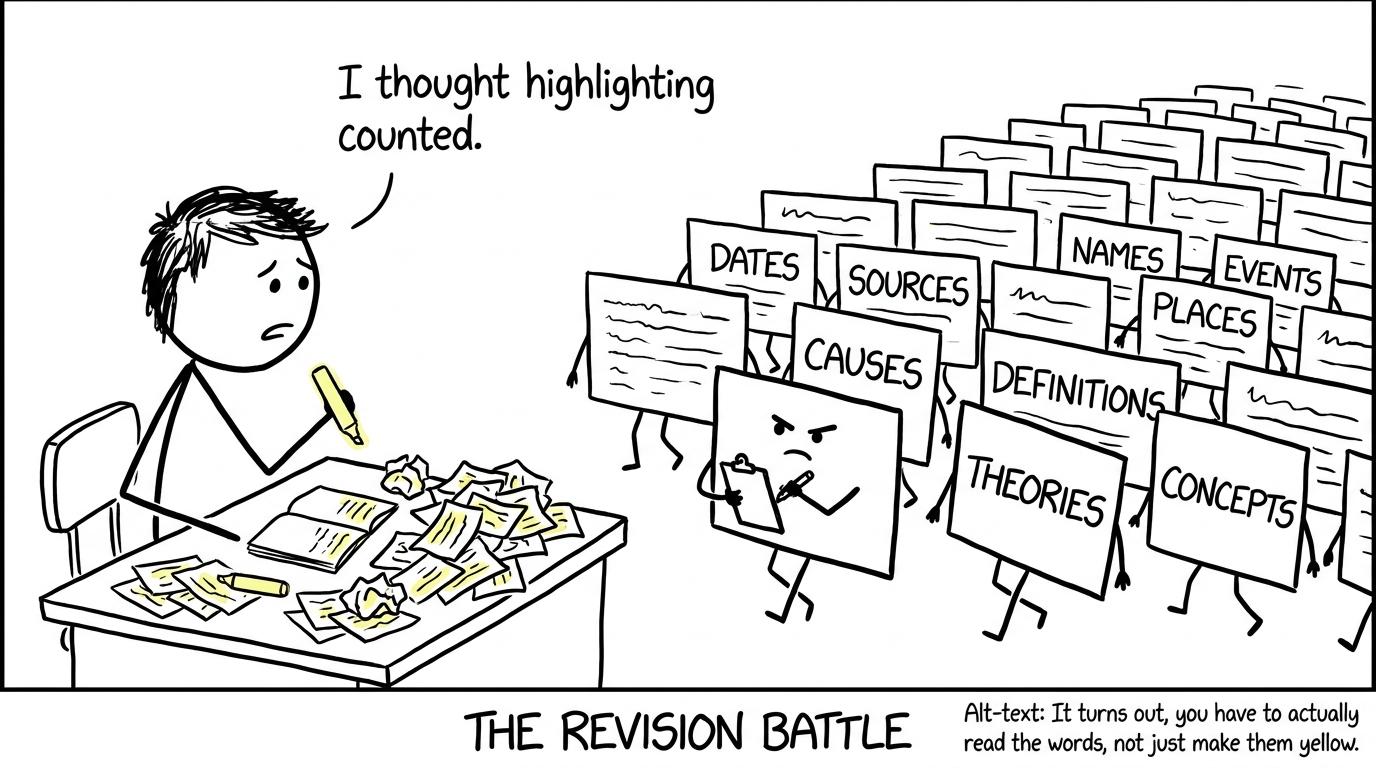 A lone reviser discovers that highlighting is not the same as remembering
When revising GCSE History alone works best
Solo revision gives you control. You choose the pace, remove social distractions and spend longer on the material that you genuinely find difficult. More importantly, there is nobody nearby to complete a half-remembered answer for you.
That last point matters. Recognition can feel like knowledge. When a friend gives the first half of a date, name or explanation, the rest may suddenly seem obvious. In the exam, however, the prompt will not arrive with a helpful hint. Private retrieval shows what you can produce independently.
Learning precise knowledge and chronology
Revise alone when you need to secure:
- key dates and chronological sequences;
- names, policies and turning points;
- accurate topic vocabulary;
- factual evidence for essays;
- features of a historical period or environment.
Close the book before answering questions. Flashcards can help, but only if you attempt the answer before turning the card over. Reading, copying and highlighting may make notes look organised without proving that you can retrieve the content.
Writing under exam conditions
The final History examination is an individual performance. Timed answers should therefore form part of your solo revision.
Use questions from your exam board, observe the stated time limit and finish without consulting notes. Afterwards, compare the response with the relevant mark scheme and any guidance supplied by your teacher. Look beyond the total mark: identify whether you lacked knowledge, explanation, evidence, judgement or time.
Maths requires the same honest feedback loop. The MathsGenie guide to using mark schemes explains how to turn lost marks into specific actions rather than simply recording a score.
Protecting attention when subjects compete
Solo sessions are easier to place inside a busy revision timetable. A focused History block can sit beside a short maths session without requiring several people to be free at once.
If long evenings tend to drift, borrow the structure of the twenty-minute GCSE Maths revision routine: choose one small goal, retrieve what you know, complete an exam-style task and review the result. The resources differ between subjects, but the principle remains useful.
When revising GCSE History with others works best
History contains arguments, competing explanations and evidence that can be read in more than one way. A purposeful partner or small group can make those features visible.
The key word is purposeful. Simply being in the same room does not make revision collaborative. Everyone should arrive with a topic, questions and an agreed outcome.
Explaining causes, consequences and significance
A strong group session makes each student speak in complete explanations. One person might explain why an event happened; the others can challenge missing links, request evidence or ask which cause was most important.
This is especially useful for:
- causation and consequence;
- change and continuity;
- similarity and difference;
- the significance of events or individuals;
- connections across a thematic study.
Explaining a topic aloud can reveal the exact point where understanding becomes vague. If you can name three causes but cannot connect them to the outcome, you have found a useful revision target.
Analysing sources and interpretations
Sources and interpretations suit careful discussion because students may notice different details. One person may focus on content, another on origin or purpose, and another on relevant contextual knowledge.
The aim is not to collect random opinions. Every claim should return to the question and the historical context. Ask:
- What does the source or interpretation claim?
- Which detail supports that reading?
- What contextual knowledge helps us evaluate it?
- What limitation matters for this particular enquiry?
- What judgement can be justified?
Your exam board may use different wording or question formats, so keep its mark scheme beside you. Group discussion is useful preparation, but each student should finish by writing an independent paragraph or plan.
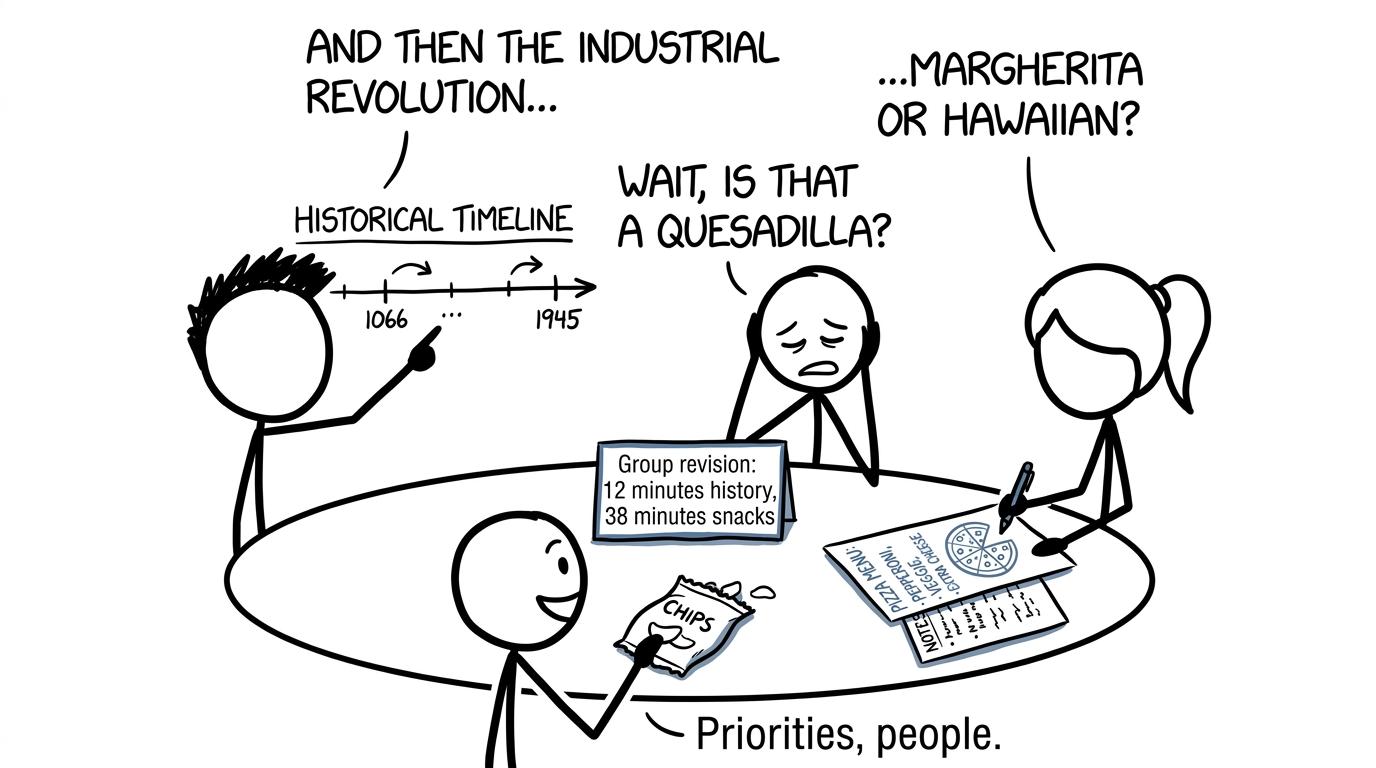 A revision group discovers that snacks can expand to fill the timetable
Testing one another without giving clues
A partner can ask questions in an unpredictable order, which prevents you from relying on the layout of your notes. Agree that the questioner will wait before offering prompts. If an answer is incomplete, record the gap instead of quietly turning it into a group answer.
Keep the group small enough for everyone to contribute. If one person lectures while everyone else listens, the speaker may benefit more than the audience. Rotate the roles of questioner, answerer, challenger and checker.
Which approach suits each kind of History topic?
Depth studies often demand detailed knowledge of a relatively concentrated period. Begin alone by securing chronology, individuals and supporting evidence. Then use a partner to test explanations and challenge judgements.
Thematic studies cover developments across a longer span of time. Group work can help build comparisons between periods and trace patterns of change and continuity. Afterwards, recreate the timeline or thematic map alone to check that the group's ideas have become your own knowledge.
Period studies also benefit from a mixed approach. Learn the central sequence independently, then discuss turning points, causes and consequences. For historic environments, solo knowledge of the site and context can be followed by group questioning about how physical features connect to the wider period.
Source and interpretation work is particularly suitable for paired discussion, while full timed responses should usually be completed alone. The principle is simple: collaborate while developing ideas, then separate when proving that you can use them.
A practical hybrid revision routine
A strong session can move through three stages:
Prepare alone
Retrieve the essential knowledge without notes. Write down uncertainties rather than disguising them. This prevents the group from spending its time discovering that nobody prepared the topic.
Discuss with a purpose
Set one task, such as comparing two interpretations or ranking the causes of an event. Require evidence for each claim and keep one person responsible for checking the specification or mark scheme.
Finish alone
Complete an exam question, paragraph plan or closed-book summary. This final stage converts a shared conversation into individual exam readiness.
Use the same sequence across your broader timetable. MathsGenie's GCSE Maths revision hub brings together board-specific revision lessons, exam questions, flashcards and papers. You can diagnose a topic independently, ask a friend to challenge your method, then return to solo questions.
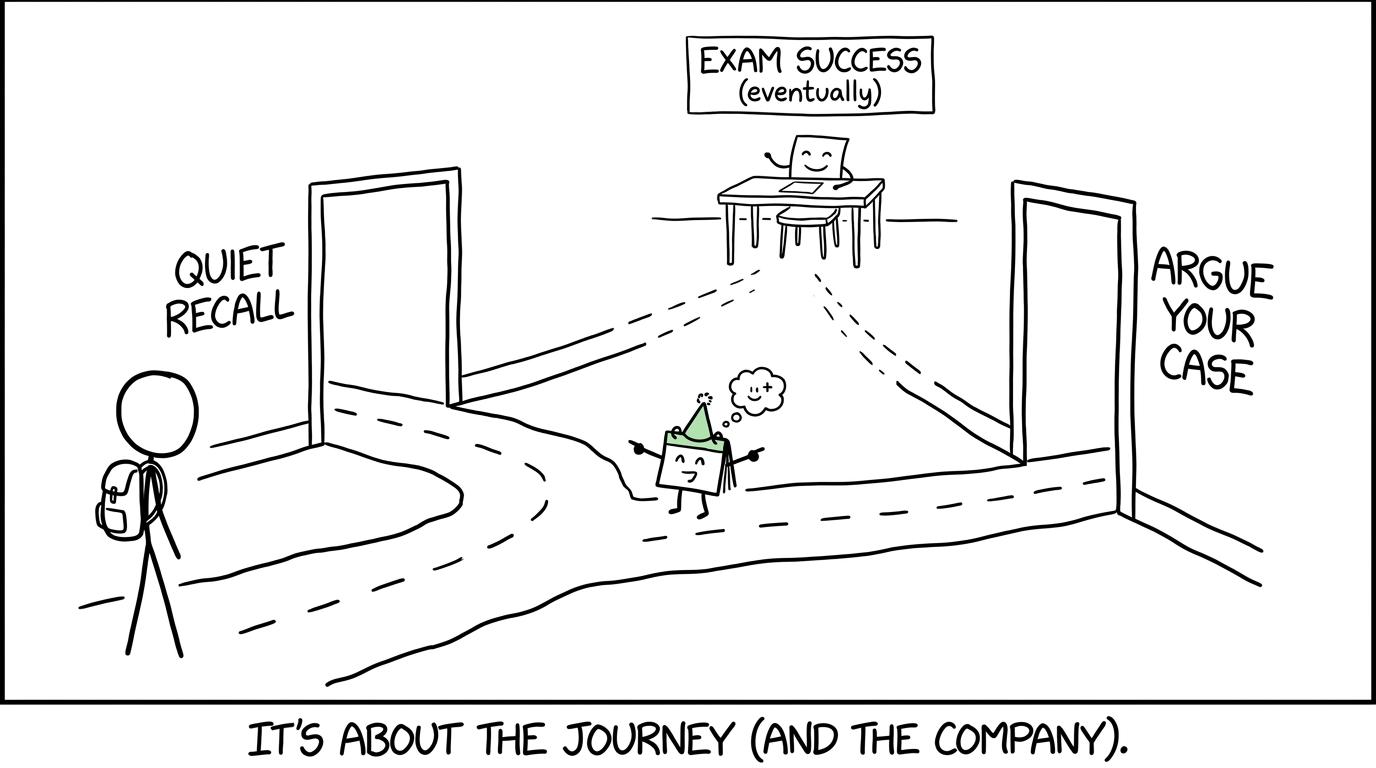 Two revision routes lead towards the same exam desk
Common mistakes when revising alone or together
Choosing the comfortable method every time
Some students always work alone because discussion feels exposing. Others always choose a group because silence makes weak recall obvious. Comfort is not reliable evidence of progress. Select the method that fits the task.
Turning group revision into shared reading
Reading notes aloud is not the same as retrieving, explaining or evaluating. Give every participant a role and produce something that can be checked at the end.
Letting confident students dominate
Confidence and accuracy are not identical. Check claims against your course materials, specification and mark schemes. Every student should answer questions rather than becoming a permanent audience member.
Revising content without exam questions
Knowing a topic does not automatically mean you can answer the question set. Include command words, time limits and mark schemes in both solo and collaborative revision.
Ignoring evidence from mistakes
Do not choose next week's topics by mood. Use marked work to locate the weakest areas. MathsGenie's guide to finding your weakest GCSE topics offers a practical diagnostic process that can inform your whole revision timetable.
Allowing History to crowd out Maths
Essay subjects can consume an evening because there is always another page to read. Set an endpoint, then move to your other priorities. In maths, use Edexcel GCSE Maths past papers or the appropriate board area to test performance under realistic conditions. The guidance on when to begin GCSE past papers can help you balance topic learning with exam practice.
Build a method that survives the exam
The question is not whether solo or group revision is universally better. It is whether your chosen method prepares you for the next demand of the paper.
Work alone to build precise knowledge, expose gaps and practise timed writing. Work with others to explain relationships, challenge arguments and compare evidence. Then return to independent work, because understanding only becomes exam-ready when you can reproduce it yourself.
As you balance History with Maths, make MathsGenie your free maths revision base. Start with revision lessons and practice questions, build confidence through mini tests, and move into past papers with mark schemes and video solutions. Near the exams, use GCSE predicted papers to sharpen your preparation without treating predictions as a substitute for the full specification.
Choose one task, choose the right company and leave every session with evidence that you improved.