Revise GCSE Economics With a Sibling: Does It Help?
Revise GCSE Economics with a sibling effectively: keep useful exam insight, reject outdated details, and strengthen the maths skills your papers require.
There is something reassuring about revising with someone who has already walked into the exam hall, opened the paper and survived the experience. But if you plan to revise GCSE Economics with a sibling, the short answer is: yes, it can help, provided their experience supports your current course rather than replacing it.
An older sibling can test your recall, challenge vague explanations and make difficult ideas feel less intimidating. What they cannot reliably provide is the latest specification, paper structure, grade boundaries or mark-scheme wording. Their experience is useful. Their memory is not the official source.
The best arrangement combines their human support with current materials from your teacher and exam board. For the numerical side of Economics, MathsGenie's free GCSE maths revision can help you strengthen the calculations, graphs and data interpretation that economic questions often require.
A quick checklist before you revise together
A sibling revision session is most useful when you can answer yes to these questions:
- Are you working from your current Economics specification?
- Does your sibling understand that the course may have changed?
- Will you attempt questions before receiving help?
- Can they ask questions rather than simply deliver a lecture?
- Will you check answers against a current mark scheme?
- Can you separate Economics knowledge from the maths skills underneath it?
- Have you agreed what you want to achieve during the session?
That last question matters. “Help me with Economics” is too broad. “Test whether I can explain how higher interest rates may affect households and firms” gives both of you a clear job.
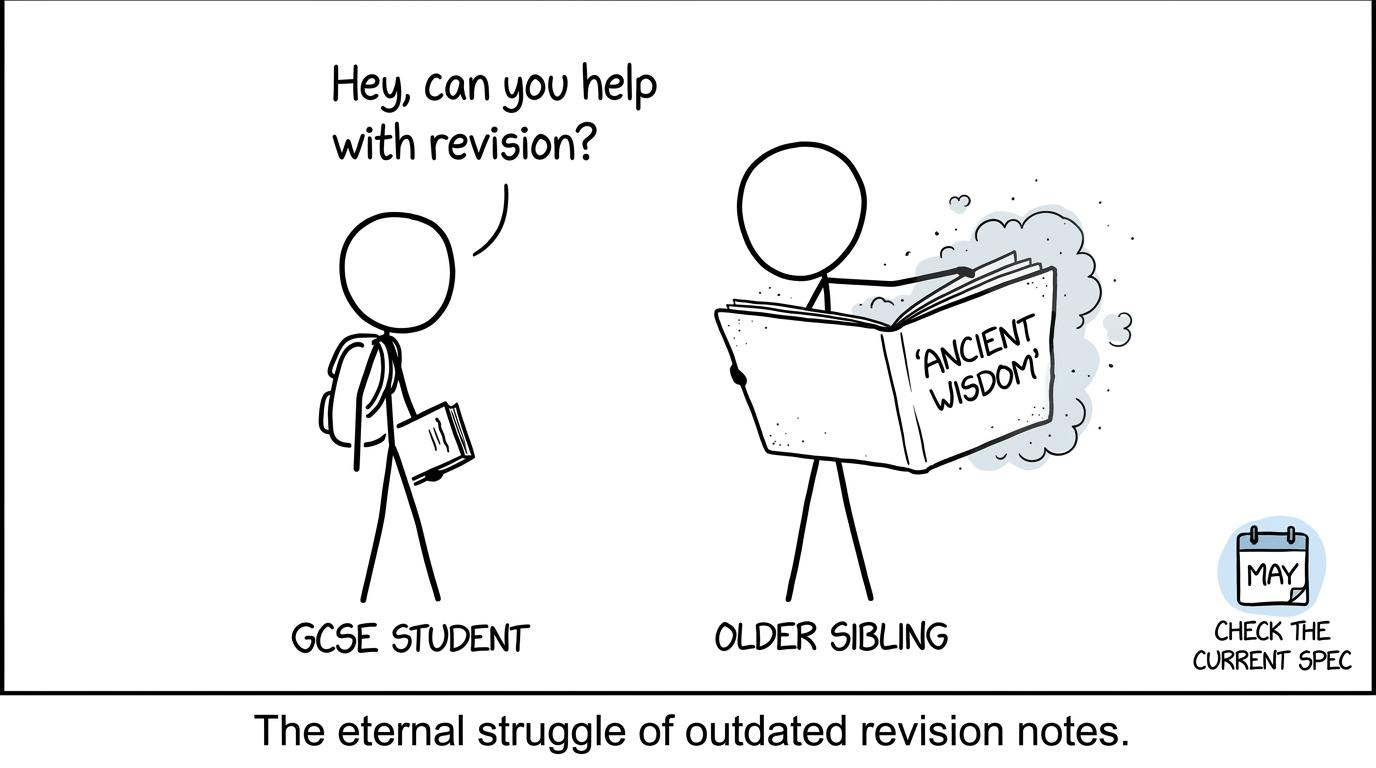 An older sibling offers ancient exam wisdom while a student checks the current specification
What an older sibling can genuinely help with
Turning notes into active recall
Reading a page can create the comforting impression that you know it. Being asked to explain the page without looking reveals whether you actually do.
A sibling can turn headings into questions, remove key terms from definitions or ask you to connect a policy with its possible consequences. This makes the session active. You must retrieve, organise and communicate the knowledge rather than recognise familiar words.
Ask your sibling to wait after posing a question. Silence can feel awkward, particularly between family members, but immediate hints prevent you from discovering what you can recall independently.
Spotting explanations that are incomplete
Economics answers often depend on chains of reasoning. Naming an effect is not always the same as explaining it. Your sibling can keep asking:
- Why might that happen?
- Who would be affected?
- What assumption are you making?
- Is there an alternative consequence?
- Does your conclusion answer the question?
They do not need to be an expert to notice when an answer jumps from one idea to another. However, the final judgement should still come from a current mark scheme, teacher guidance or specification.
Reducing the fear around exam technique
Someone who has already sat public examinations can make the process feel more ordinary. They can help you practise planning under time pressure, leaving space for a conclusion and moving on when a question is consuming too much time.
Their broad advice may remain useful across subjects. Yet claims such as “this command word always means three paragraphs” should be checked. The number of marks, assessment objective and wording of the current question matter more than a remembered classroom rule.
Supporting the quantitative side of Economics
GCSE Economics is not a maths qualification, but current courses include quantitative skills such as percentages, ratios, averages, graphs and interpreting economic data. Your sibling may be able to explain the economic meaning of a result, while MathsGenie helps you practise the underlying method.
For example, percentage change uses:
percentage change=new value−original valueoriginal value×100%\text{percentage change}=\frac{\text{new value}-\text{original value}}{\text{original value}}\times 100\%percentage change=original valuenew value−original value×100%The calculation is only part of the task. You may also need to interpret what the change suggests about prices, output, employment or consumer behaviour. Build the calculation skills through MathsGenie's graded GCSE revision resources, then bring the economic context back into your answer.
This has an additional benefit if you are also preparing for foundation or higher tier maths. Time spent becoming more accurate with percentages, graphs and proportional reasoning can support both subjects.
Which sibling advice might be outdated?
The age gap matters less than the version of the course they completed. A sibling who sat the same specification recently may remember useful details. Someone who studied a previous specification may still explain supply and demand well, but their recollection of the assessment could be wrong.
| Often still useful | Must be checked against current information |
|---|---|
| Explanations of enduring economic concepts | The present specification content |
| Questions that test your understanding | Paper structure and question styles |
| Advice about staying calm and managing time | Current mark allocations |
| Feedback on whether an answer is clear | Grade boundaries from a different year |
| Help reading tables, charts and percentages | Any remembered formula or resource sheet |
| Encouragement and accountability | Old case studies, policy figures and economic data |
Government policies and economic conditions also change. Historic examples can still illustrate an idea, but current tax rates, inflation figures, benefits, interest rates and labour-market details should never be recalled casually and presented as current facts.
Likewise, do not assume that an old paper predicts your paper. Past papers reveal useful patterns in assessment, not future questions. This is equally true in maths, where GCSE maths past papers are best used to identify weaknesses and practise complete papers rather than guess exact topics.
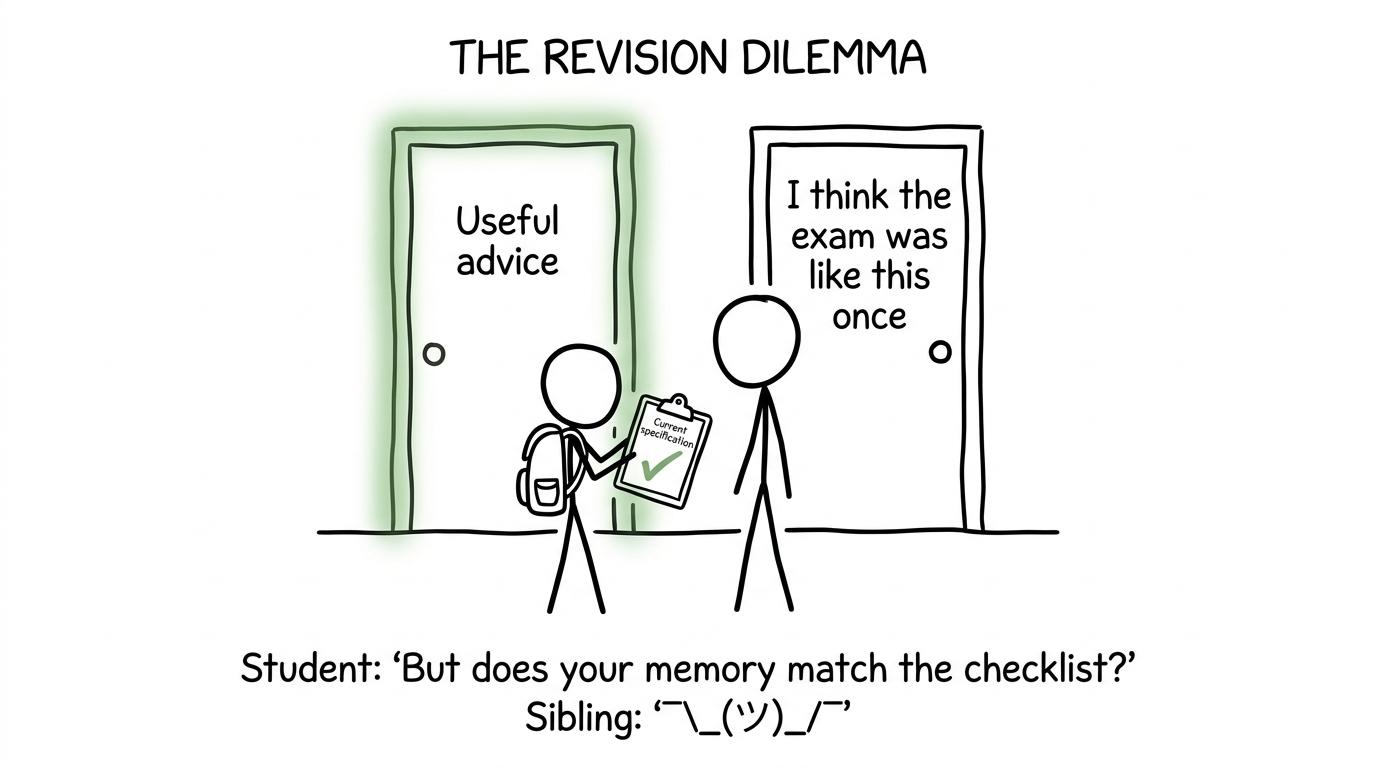 Two siblings choose between useful advice and a hazy memory of an old exam
How to structure a productive sibling revision session
Begin with a specific outcome
Choose one manageable goal from the current specification. It might be recalling key terms, interpreting a data source or improving the evaluation in an extended answer.
Show your sibling the relevant specification point or teacher checklist. This prevents the session drifting into content that is interesting but not examinable.
Attempt the task independently
Your sibling should not explain everything first. Begin by answering questions from memory or completing an exam-style task alone. That gives both of you evidence about what needs attention.
A useful sibling behaves more like a calm coach than an alternative teacher. They prompt only when necessary, ask you to justify decisions and avoid taking the pen.
Check with current materials
Compare your response with an up-to-date mark scheme and any guidance supplied by your school or exam board. Highlight missing knowledge separately from weak communication or inaccurate calculations.
This distinction improves revision. If the economics is correct but a percentage is wrong, practise the numerical skill. If the calculation is accurate but the interpretation is vague, work on economic reasoning.
Maths students can use GCSE maths past papers and mark schemes to develop the same habit: attempt, mark, diagnose and revisit.
Finish with retrieval, not rereading
At the end, close the notes and explain the main ideas again. Your sibling can retest any question you missed earlier. Record remaining weaknesses in a short revision list so that the next session begins with evidence rather than guesswork.
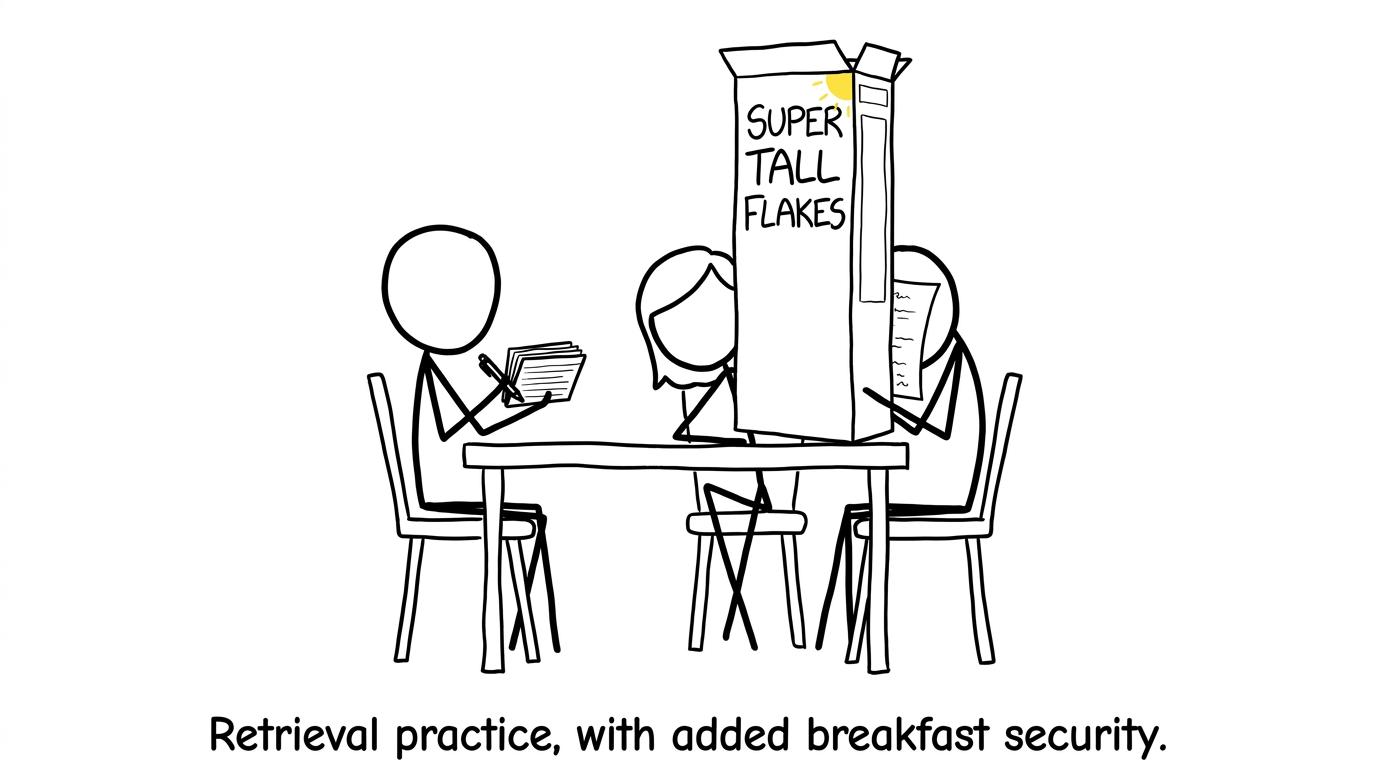 A cereal box protects the answers during sibling retrieval practice
When sibling revision does not work
Revision together is not automatically productive because you share a home or surname. It may be better to work independently if your sibling constantly interrupts, gives answers too quickly or turns every disagreement into an argument.
It is also unhelpful when the sibling becomes overconfident about remembered rules. “That was how my teacher did it” is evidence of an experience, not proof of a current requirement.
Set boundaries before starting. Agree that the current specification and mark scheme settle factual disagreements. Keep sessions focused, and stop when concentration falls. You can still ask your sibling to test you occasionally without making them responsible for your entire revision plan.
For maths preparation, use a structured mix of topic practice and full papers. MathsGenie's GCSE revision hub organises topics by grade, while predicted GCSE maths papers provide further exam-style practice. Predicted papers are practice resources, not forecasts of exact exam questions.
Common mistakes when revising with an older sibling
Treating memory as a mark scheme
A sibling may remember receiving a good mark without remembering exactly why. Always check current assessment materials rather than accepting “the examiner wants this” as fact.
Letting them do the difficult thinking
Watching someone produce a polished answer can feel useful, but the person doing the explaining is often doing most of the learning. You should speak, write, calculate and decide first.
Copying an old revision timetable
Your sibling's strengths, subjects and available time were different. Build a plan around your own gaps. MathsGenie's revision resources let you select work by topic and difficulty rather than following somebody else's route.
Ignoring calculator and graph skills
Students sometimes revise definitions while postponing the numerical material. Practise extracting values from tables, checking scales, comparing data and deciding whether an answer is reasonable. These skills also matter throughout A Level maths revision if you continue with maths after GCSE.
Using old grade boundaries as a target
Grade boundaries can vary between examination series. An old boundary cannot tell you precisely what will be required in your year. Aim to improve the quality and consistency of your answers rather than revising towards a remembered number.
Make your sibling part of the system, not the system
The real advantage of revising with a sibling is not secret knowledge about the exam. It is access to another person who can question you, notice gaps and keep you accountable. Those benefits remain valuable even when their course details have expired.
Use current Economics materials as the authority. Use your sibling for retrieval, explanation and encouragement. Then use MathsGenie to strengthen the mathematical foundations that support data handling, graphs, percentages and confident exam performance.
Start with free GCSE maths revision lessons and practice questions, measure your progress through past papers with mark schemes, and add predicted paper practice when you are ready to combine topics. A good revision partnership helps, but a reliable process is what carries you into the exam.