

Revise GCSE Economics: Can't Sit Still?
Revise GCSE economics, can't sit still? Use short sprints, walking recall, exam questions and purposeful movement breaks to build a routine that lasts.
Revision advice often begins with a chair, a silent desk and an ambitious timetable. That works for some students. For others, the chair becomes the problem.
If you searched revise gcse economics cant sit still, the useful answer is simple: stop making stillness a condition of learning. Use short revision sprints, retrieve facts while moving, speak answers aloud and complete exam questions in manageable blocks. You still need focused written practice, but it does not have to occupy an entire evening.
The goal is not to force yourself into someone else's revision routine. It is to build one that produces repeated contact with economic ideas, accurate calculations and better exam answers.
Your active economics revision checklist
A practical routine should include:
- short, clearly defined revision sprints;
- active recall rather than repeated reading;
- movement with a specific learning purpose;
- regular economics exam questions;
- written practice under timed conditions;
- a record of mistakes and weak topics;
- spaced returns to material across several days;
- quiet exam practice before the real assessment.
You do not need to use every method at once. Choose a small system you can repeat.
Make the task smaller than your resistance
A vague instruction such as “revise economics” feels endless. Your brain cannot see where the task finishes, so almost anything else becomes more attractive.
Replace it with a precise action:
- recall four causes of inflation;
- label one demand and supply diagram;
- plan one evaluation paragraph;
- answer one calculation question;
- check one response against its mark scheme.
Set a timer for approximately 101010 to 202020 minutes. During that time, work on only the selected task. When the timer ends, stand up, move and decide whether to begin another sprint.
This is not a promise that concentration will suddenly become easy. It simply lowers the cost of starting. A short session completed today is more valuable than an ideal two-hour session continually postponed.
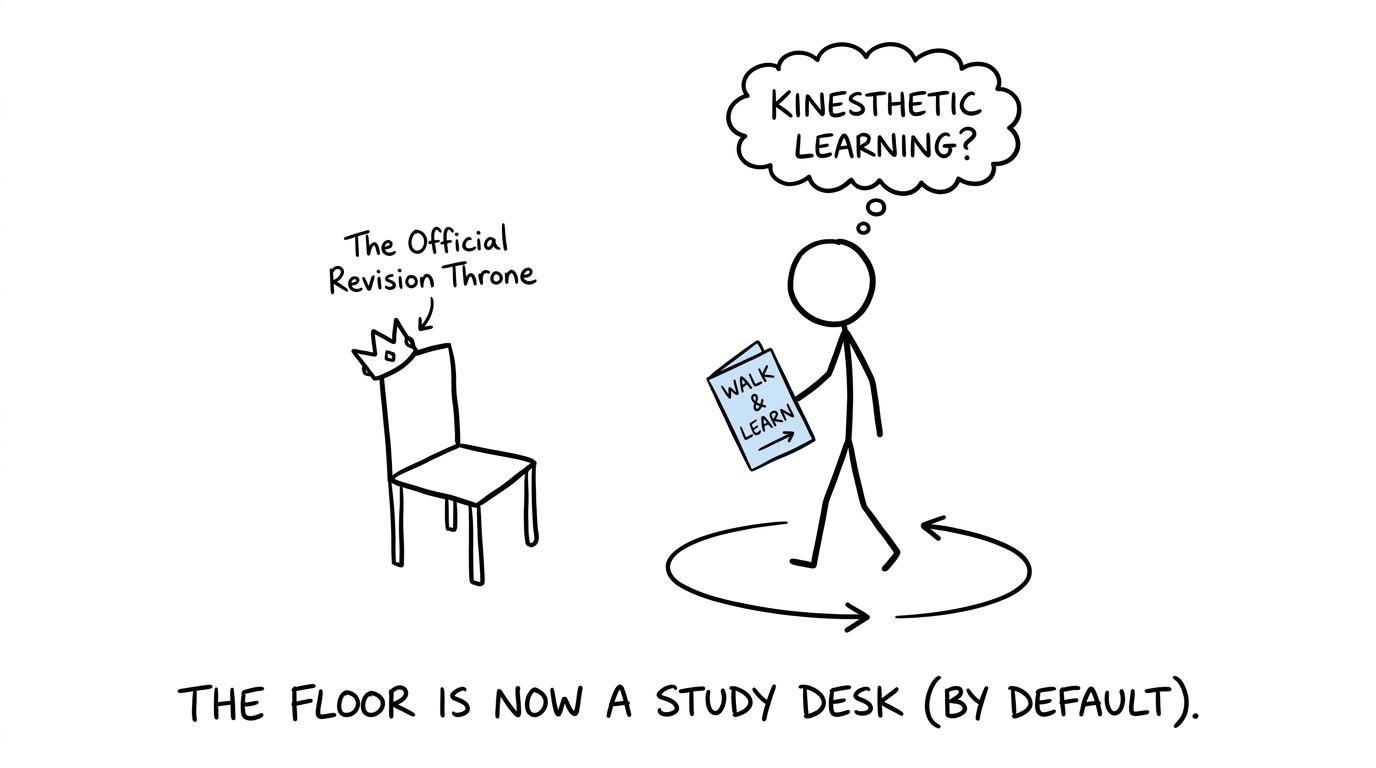 A restless student revises while the abandoned chair becomes the official revision throne
Turn movement into retrieval practice
Movement helps only when it supports the learning task. Wandering around while scrolling through notes may feel busy, but it asks very little of your memory.
Retrieval practice is different. You close the book and try to produce the knowledge yourself. That effort exposes what you know and, more importantly, what you cannot yet recall.
Walk with question cards
Put a question on the front of each card and a concise answer on the back. Walk around the room, garden or another safe space while answering each question aloud before checking it.
Useful prompts include:
- What causes a movement along a demand curve?
- What can shift supply?
- How might inflation affect households?
- Why might a government intervene in a market?
- What is one limitation of this policy?
Sort the cards into confident, uncertain and incorrect piles. Return to the uncertain and incorrect cards later. Familiarity is not the same as recall, so always answer before turning the card over.
Record audio questions
Record yourself reading short questions, leaving a pause after each one. Listen while walking and answer aloud during the gap. Keep the questions narrow enough that you can judge whether your answer was complete.
Audio recall works especially well for definitions, chains of reasoning and evaluative prompts. It is less suitable for diagrams and calculations, which still need written practice.
Teach an imaginary class
Choose one concept and explain it without notes. Include the definition, the causal chain and any relevant limitation. If your explanation becomes vague, mark that point for review.
Teaching aloud makes gaps difficult to hide. Saying “this increases demand because it just does” reveals a missing link that silent rereading can disguise.
Build movement breaks into the plan
A break should refresh the next period of attention rather than quietly replace it. Decide in advance what the break contains: get water, stretch, walk downstairs or step outside briefly. Avoid opening an app designed to keep serving new content.
A flexible sequence might be:
- 151515 minutes of active recall;
- 555 minutes of movement;
- 151515 minutes of diagram or calculation practice;
- a longer break;
- 202020 minutes answering and marking an exam question.
These timings are not rules. Adjust them until the focused blocks are demanding but realistic. The essential feature is the cycle: focus, move, return.
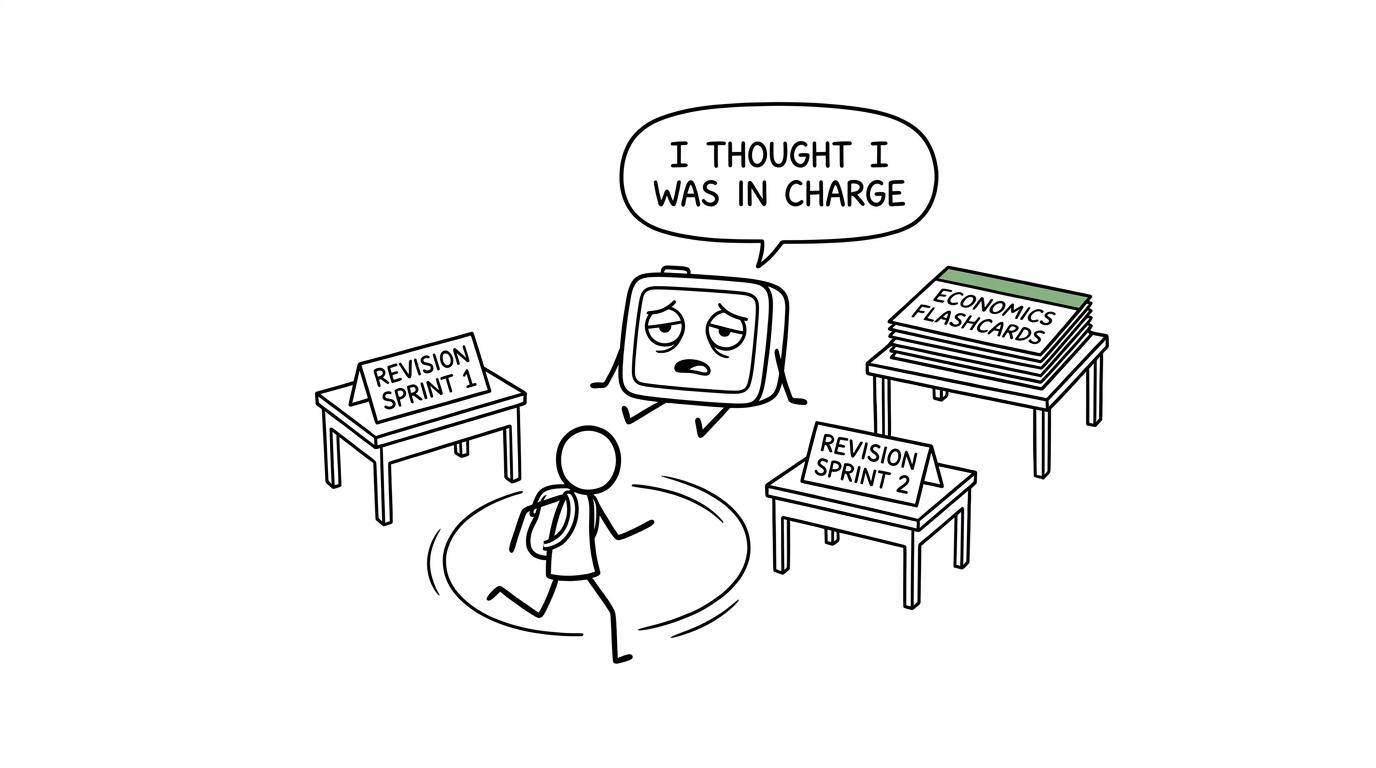 A student takes a victory lap while the revision timer wonders who is in charge
Revise the different demands of GCSE Economics
GCSE Economics is not a single memory test. Current specifications differ between exam boards, so check whether you are following AQA, OCR or another qualification offered by your school. Use your specification and teacher's guidance to confirm the exact content and assessment arrangements.
Most effective revision plans need to cover four broad demands.
Knowledge and definitions
Create precise prompts for terms such as opportunity cost, productivity, unemployment, external costs and fiscal policy. Practise producing the complete definition rather than recognising it on a page.
Application
Application means using the information in the question or source. During a walking recall session, take a short scenario and ask: which detail could support my argument? Then return to your desk and incorporate that detail into a written response.
Analysis and evaluation
Build causal chains aloud. Start with a change, explain its immediate effect and continue until you reach the likely consequence. Then challenge the chain by considering timescale, magnitude, stakeholder effects or assumptions.
Evaluation is not simply adding “however”. It means explaining why a conclusion may change under different conditions.
Quantitative skills
Economics may require percentages, percentage change, averages, ratios and interpretation of graphs or data. Percentage change can be represented as:
percentage change=new value−original valueoriginal value×100\text{percentage change}=\frac{\text{new value}-\text{original value}}{\text{original value}}\times 100percentage change=original valuenew value−original value×100Price elasticity of demand is represented by:
PED=percentage change in quantity demandedpercentage change in price\text{PED}=\frac{\text{percentage change in quantity demanded}}{\text{percentage change in price}}PED=percentage change in pricepercentage change in quantity demandedDo not attempt every calculation mentally while pacing. Movement can help you recall the formula, but sit or stand at a stable surface to substitute values, show your working and check units.
If calculations are slowing down your economics answers, use the free GCSE maths revision resources to strengthen the underlying skills. MathsGenie's grade 2 revision topics can reinforce basic numerical fluency, while the grade 3 revision materials and grade 4 revision resources support increasingly demanding percentage, ratio and graph work.
Use a stand-up revision circuit
A revision circuit gives movement a structure. Place four stations around a room:
- definitions;
- diagrams;
- calculations;
- extended-response planning.
Spend one short sprint at each station. Carry only the materials needed for that task. At the end of the circuit, record which station caused the most errors. That becomes the starting point next time.
You can also use a whiteboard or large sheet of paper fixed at standing height. Draw diagrams from memory, annotate them and then compare them with your notes. Erase errors and redraw the whole diagram rather than tracing over the correction.
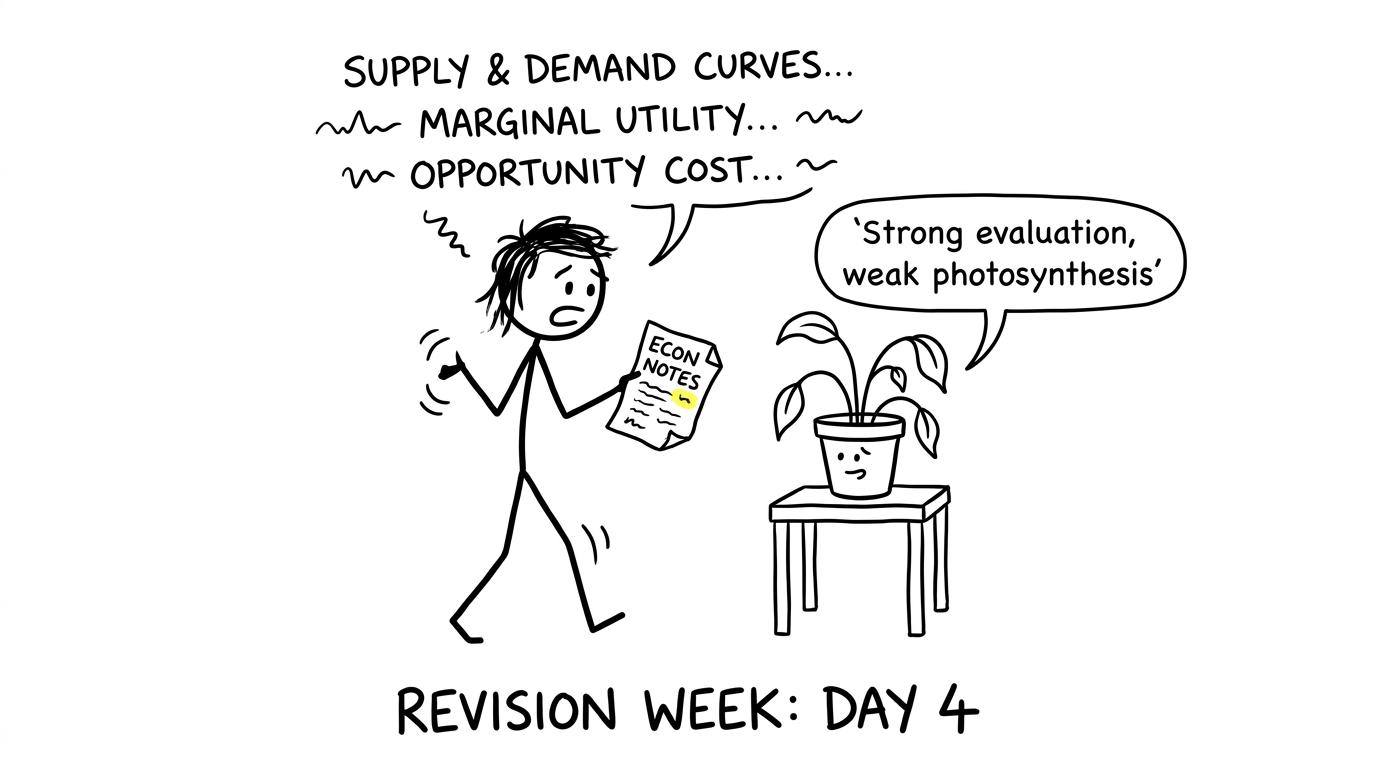 A student explains economics to a houseplant with unexpectedly high academic standards
Practise sitting before the examination
Active revision can include plenty of movement, but the examination itself will require you to remain at your desk for a sustained period. Avoiding seated practice completely would leave that part of the assessment unfamiliar.
Build tolerance gradually. Begin with one timed question. Later, complete a group of questions without leaving your seat. Eventually, attempt a full paper under the timing and permitted conditions specified by your school and exam board.
The same principle matters for maths examinations. Use GCSE maths past papers to rehearse sustained written work, then check your methods carefully with the available mark schemes and video solutions. When appropriate for the current exam series, MathsGenie predicted papers can provide additional practice rather than a prediction of the exact questions that will appear.
Students aiming to strengthen more advanced numerical reasoning can also explore the grade 5 maths revision topics. The objective is not to revise unrelated content. It is to remove weaknesses in percentages, graphs and proportional reasoning that can cost marks across subjects.
Mark your work while your thinking is fresh
Completing a question is only half the revision process. Check it soon afterwards, while you can still remember why you made each decision.
Use the mark scheme to identify:
- missing economic knowledge;
- weak use of the source or context;
- gaps in the analytical chain;
- unsupported conclusions;
- calculation or graph errors;
- poor timing.
Keep an error log with three brief fields: the topic, the mistake and the action needed. For example, the action might be to relearn a definition, redraw a diagram or answer another question using contextual evidence.
Return to the same weakness after a gap. Spacing practice across different days is usually more useful than exhausting one topic in a single sitting, because later recall shows whether the knowledge remained available.
Common mistakes when revising without sitting still
Confusing movement with progress
Steps around a room do not measure learning. Test yourself before and after the activity. If you cannot retrieve more accurately, change the method.
Making every sprint too short
Short sessions should reduce the barrier to starting, not prevent deeper thought. Extended responses require enough uninterrupted time to plan, develop and evaluate an argument.
Reading cards instead of answering them
Always attempt the answer first. Turning a card over immediately creates recognition, not reliable recall.
Avoiding written calculations and diagrams
Knowing a formula aloud does not prove that you can apply it accurately. Written working also helps examiners award method marks where the mark scheme permits them.
Ignoring examination conditions
Movement-based revision and timed seated practice solve different problems. Include both.
Treating persistent restlessness as a character flaw
Difficulty sitting still is not evidence that you are lazy. If restlessness is persistent, causes distress or affects school and daily life, speak to a parent, carer, teacher, school support lead or healthcare professional. Revision advice cannot diagnose an underlying difficulty.
Build a routine you can return to
The best revision routine is not the one that looks most impressive. It is the one that brings you back to the material, shows you what you have forgotten and includes enough exam practice to turn knowledge into marks.
Start with one economics question, one short timer and one purposeful movement break. Recall while walking. Write when the task requires writing. Mark the result. Return to the weakness another day.
For the quantitative skills supporting economics and your maths exams, begin with MathsGenie's free GCSE revision lessons. Use the practice questions and video solutions to repair individual gaps, then move to full GCSE past-paper practice and predicted papers when suitable. You do not have to become better at sitting still before you can become better at revising. You need a system that helps you start, move with purpose and come back.










