

Revise GCSE Bengali Can't Sit Still? Active Plan
Revise GCSE Bengali can't sit still? Use an active plan for listening, speaking, reading and writing without forcing long, silent revision sessions at home.
Some revision advice seems to assume that every student can sit silently at a desk for hours. If your search is “revise gcse bengali cant sit still”, the useful answer is simple: stop making stillness a condition of learning. Use short, active sessions built around listening, speaking, reading and writing, with movement between tasks.
You still need to practise under exam conditions eventually. But your everyday revision does not have to resemble the exam from the beginning. Walking while recalling vocabulary, recording spoken answers and moving between task stations can all turn restless energy into purposeful practice.
This matters when Bengali is only one part of a crowded GCSE timetable. Your system must leave enough attention for maths and your other subjects too, not consume an entire evening because you were trying to force one long session.
Your active GCSE Bengali revision checklist
Build your routine around these principles:
- Confirm your exam board, specification and tier with your teacher.
- Divide revision between listening, speaking, reading and writing.
- Choose one precise outcome for each session.
- Work in short bursts and move deliberately between them.
- Retrieve language from memory instead of repeatedly rereading it.
- Mark written work and record recurring errors.
- Return to difficult vocabulary and structures after a gap.
- Gradually introduce timed, seated exam practice.
For AQA GCSE Bengali, the four assessment objectives cover listening, speaking, reading and writing, with each contributing approximately rac{1}{4} of the qualification. Foundation students can access grades 111-555, while higher tier covers grades 444-999. All four papers must be taken at the same tier and in the same exam series. Always check the current specification and your school’s instructions rather than assuming another language qualification follows the same format.
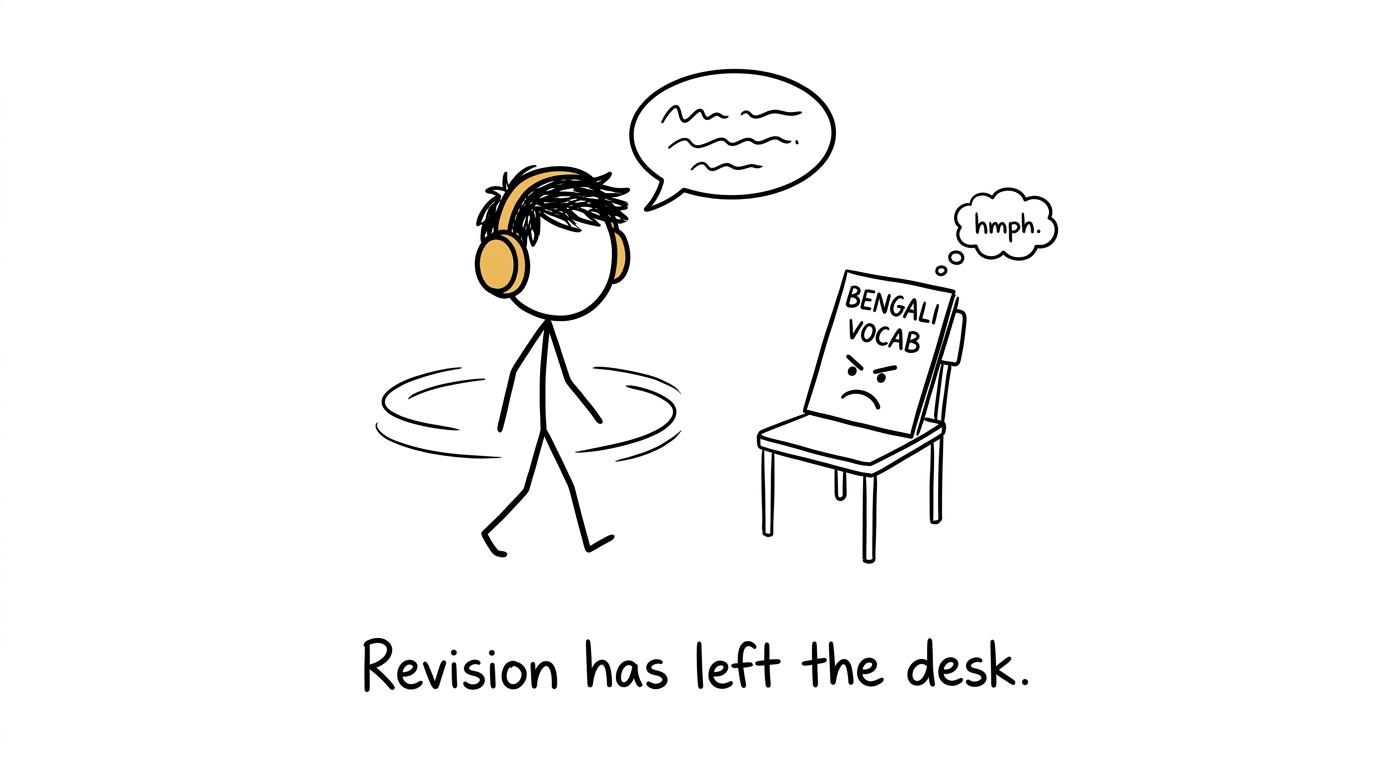 A student walking while revising as an abandoned flashcard watches
Replace long sessions with active revision loops
A short session is not automatically an easy session. Ten focused minutes of retrieval can demand more thought than forty minutes of highlighting.
Use a repeatable loop:
- Choose: name one skill, such as recognising opinions in listening.
- Attempt: answer without notes or prompts.
- Check: compare with the transcript, teacher feedback or mark scheme.
- Correct: write or say the improved response.
- Move: change position, walk briefly or switch station.
- Return: test the same material later without looking.
The target should describe an action. “Revise Bengali” is too broad. “Recall vocabulary about education aloud” or “plan responses to two speaking prompts” tells you exactly when the task is complete.
This resembles the feedback loop used in effective maths revision. MathsGenie’s guide to finding your weakest GCSE topics explains why evidence from mistakes is more useful than choosing whatever feels comfortable. Apply the same logic to Bengali: identify the skill losing marks, repair it and retest it.
Revise listening while moving
Listening is the easiest skill to take away from a desk. Walk around a safe indoor space, do a simple household task or stand while listening to material supplied by your teacher or exam board.
Movement must not become the main event, however. Give each listen a purpose:
- First listen: identify the topic and speakers.
- Second listen: notice opinions, reasons, time references or contrasts.
- Final listen: pause and repeat useful phrases aloud.
After listening, stop the audio and summarise what you understood from memory. Then check. Passive exposure may make Bengali sound familiar, but the examination requires you to extract and communicate meaning.
Keep safety and concentration in mind. Do not revise from a screen while crossing roads, cycling or navigating busy places. A calm indoor route or stationary standing task is enough.
Practise speaking without being pinned to a chair
Speaking improves through speaking, not through silently reading model answers. Put prompts in different parts of a room and walk to each one before responding. You could use separate stations for a role-play, photo-card ideas and general conversation themes if those match your specification.
Record some responses on your phone, then listen back for:
- whether you answered the actual question;
- whether your meaning was clear;
- whether you developed an idea with a reason or detail;
- whether verb forms and time frames were controlled;
- whether hesitation made the response difficult to follow.
Do not memorise one long paragraph so rigidly that an unfamiliar question causes it to collapse. Build flexible banks of opinions, reasons, comparisons and time phrases instead. Your teacher can help you distinguish natural Bengali from structures that are technically possible but unsuitable for the context.
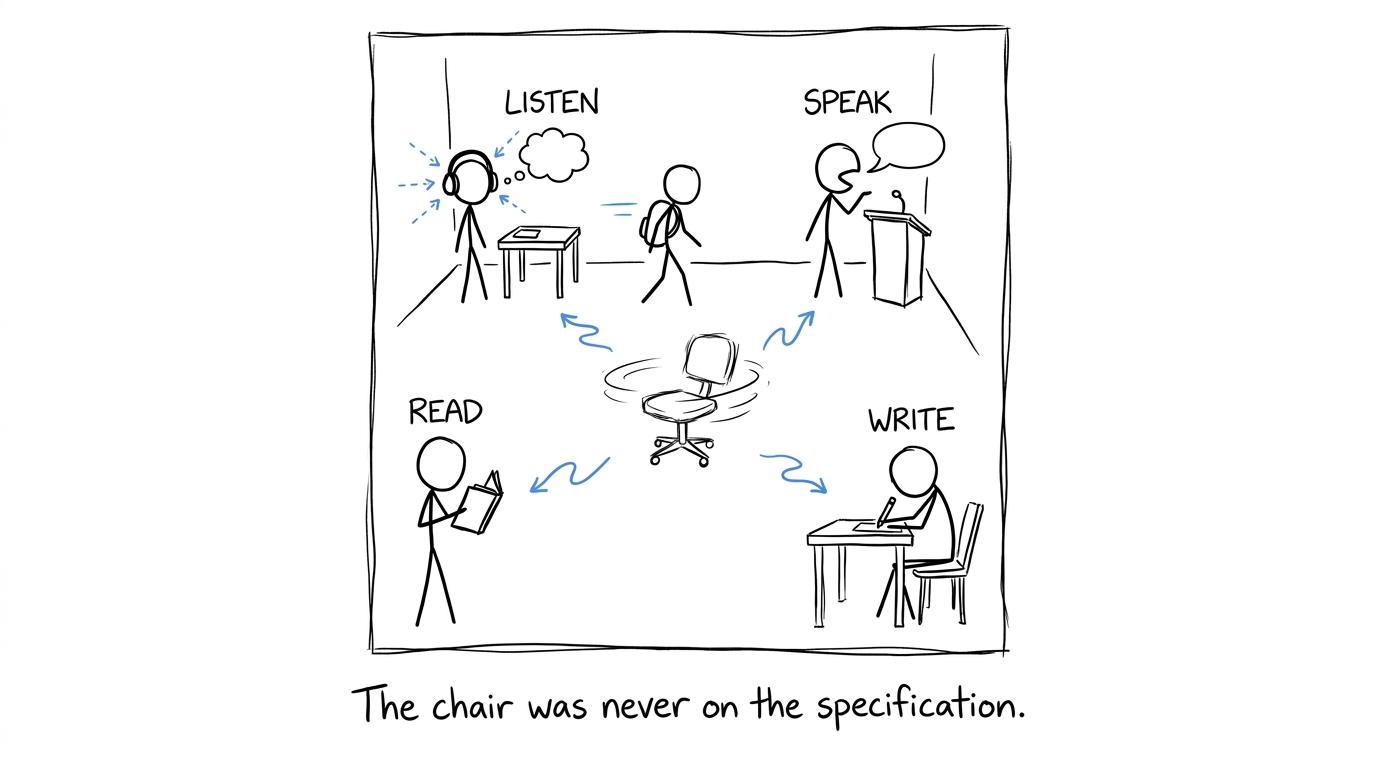 Four active revision stations surround an unused chair
Make reading physical and purposeful
Reading does require visual attention, but it does not require one unbroken sitting. Place short texts or question cards at stations around the room. At each station, complete one job before moving:
- identify the main message;
- underline evidence for an answer;
- find a negative or contrast;
- work out an unfamiliar word from context;
- summarise a paragraph in English or Bengali as required.
Avoid translating every word before answering. Reading questions often test whether you can locate precise meaning, not whether you can produce a complete line-by-line translation. Look at the question first, identify what evidence is needed and then read selectively.
Translation still deserves separate practice where it appears in your paper. Treat it as careful communication: preserve meaning, check tense and pronouns, and reread the completed sentence rather than translating isolated words mechanically.
Break writing into stages you can move between
Writing is usually the hardest skill to combine with movement because the final response must appear on the page. The solution is to move between stages rather than trying to move while writing.
Start standing and say possible ideas aloud. Move to a wall or whiteboard to organise the required content. Sit briefly to write one section. Stand again to check whether every bullet point has been covered. Finally, return to the page for an accuracy check.
Use a compact editing checklist:
- Did I answer every required part?
- Are my opinions supported with reasons or details?
- Are time references clear?
- Have I checked common spelling and grammatical errors?
- Is the response appropriate for the task and audience?
Marking is part of revision, not an administrative task after it. That principle also sits at the heart of MathsGenie’s guide to using GCSE past papers properly. An attempted answer reveals the problem; careful checking tells you what to practise next.
Build a weekly plan that includes maths
GCSE Bengali cannot occupy every available revision slot. A sustainable week alternates skills and protects time for other subjects.
You might rotate listening, speaking, reading and writing across short sessions, then finish the week with one mixed check. Keep a tiny error log with three details: the skill, what went wrong and the next action. That prevents vague repetition.
For maths, use the same short-cycle approach. Begin at the GCSE Maths revision hub, where you can choose your board and work through revision lessons and practice questions. If a complete paper feels too demanding after language revision, GCSE mini tests provide a more manageable burst of retrieval.
Board-specific practice matters. MathsGenie provides collections of AQA GCSE Maths past papers and OCR GCSE Maths past papers, including mark schemes and worked solutions where available. Edexcel students can use GCSE Maths predicted papers after topic practice to test whether methods remain secure in an unfamiliar paper.
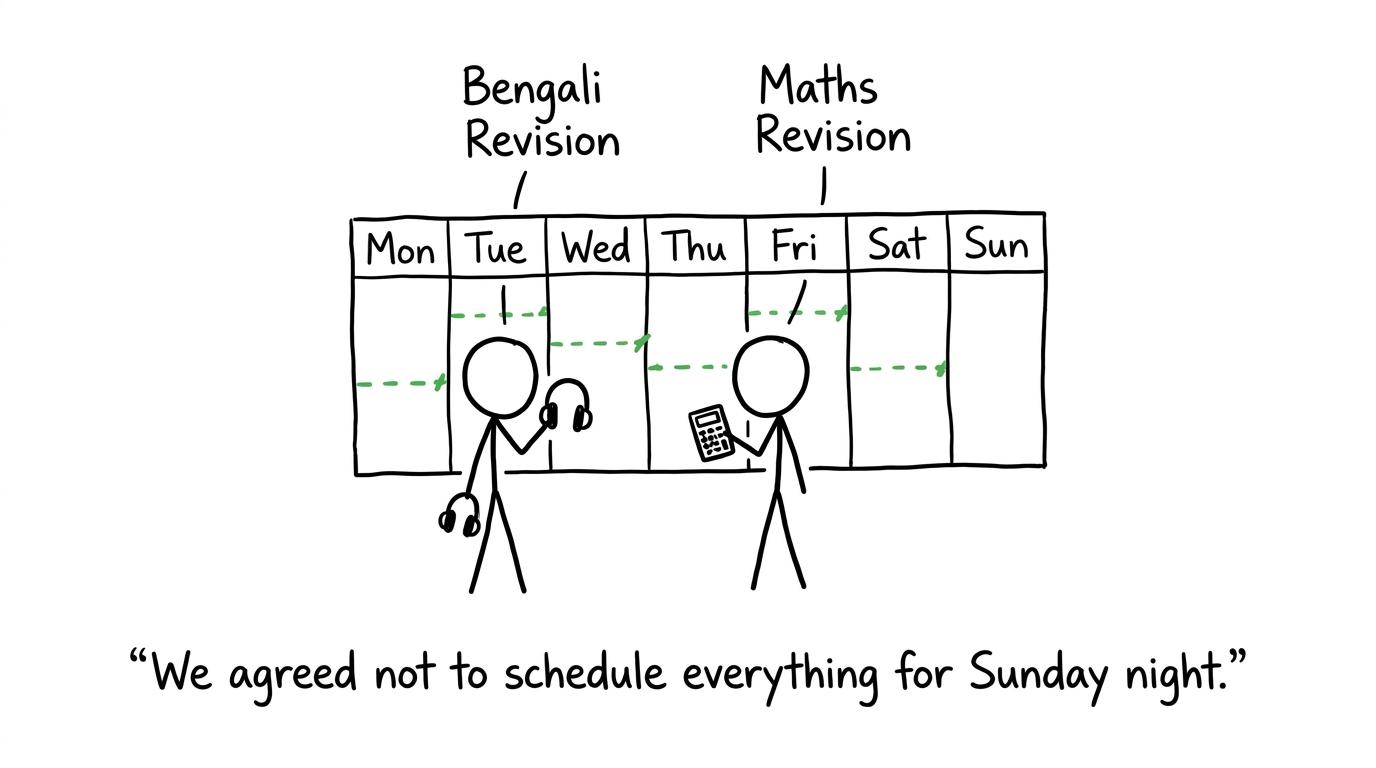 Bengali and maths revision share a timetable
Train for the seated exam gradually
Active revision is a route into learning, not a reason to avoid exam practice forever. The actual listening, reading and writing papers require you to remain in the examination room and work under controlled conditions. Speaking also follows a defined assessment format.
Build tolerance progressively. Begin with one short timed question while seated. Later, join several questions together. Eventually, attempt full sections and complete papers using the correct time, permitted materials and conditions for your specification.
Think of this as training two separate abilities:
- learning Bengali effectively;
- performing under examination conditions.
Movement may help with the first. Gradual timed practice develops the second. You need both, but they do not have to be trained in exactly the same way every day.
The same progression works in maths: topic practice first, mini tests next and full papers when you are ready. MathsGenie’s one-month GCSE maths revision plan shows how short retrieval, focused practice and timed work can fit together without turning every evening into a marathon.
Common mistakes when you cannot sit still
Confusing movement with progress
Walking while audio plays is not enough. Finish with retrieval: explain what you heard, answer questions or repeat key language without prompts.
Changing tasks too quickly
Movement should separate focused tasks, not interrupt them every few seconds. Complete one small outcome before switching station.
Only practising favourite skills
Speaking may feel more natural than writing, or reading may feel safer than listening. Track all four skills so the weakest one does not quietly disappear from your timetable.
Making elaborate resources instead of using Bengali
Colour-coded cards and attractive planners can feel productive. Test them immediately. If they do not make you retrieve, understand or produce language, simplify them.
Avoiding all seated practice
The aim is not to become perfectly still during ordinary revision. It is to become capable of completing the real assessment. Introduce timed seated work gradually rather than leaving it until the final week.
Treating every restless session as failure
A difficult session still gives you information. Shorten the next task, remove distractions or change the activity. If restlessness regularly affects lessons, revision or everyday life, speak to a parent, carer, teacher, pastoral lead or relevant health professional. Revision advice cannot diagnose the cause, and asking for support is sensible.
Turn movement into a revision system
You do not earn extra marks for looking calm at a desk. You earn them by understanding spoken and written Bengali, communicating accurately, responding to the task and managing the examination.
Start today with one active loop: choose one Bengali skill, attempt a small task from memory, check it carefully and schedule a retest. Then use the same structure for maths. Open MathsGenie’s free revision lessons, complete practice questions, mark your work and build towards mini tests, past papers and predicted papers with mark schemes and video solutions.
The goal is not to force yourself into somebody else’s idea of revision. It is to build a method active enough to begin, structured enough to repeat and realistic enough to carry you to the exam.










