Revise GCSE Astronomy: Can't Sit Still?
Revise GCSE astronomy when you can't sit still with short, active routines for recall, observations, maths skills, past papers and better exam focus.
Revision advice often begins with a desk, a chair and an instruction to concentrate for several hours. That is not useful if sitting still is the very thing making concentration harder. If you searched “revise GCSE astronomy cant sit still”, the practical answer is this: revise in short, active cycles, give each cycle one precise goal and use movement as part of the method rather than treating it as a distraction.
You can walk while recalling facts, stand while labelling diagrams, move between question stations and complete past papers in manageable sections. The aim is not to force yourself into somebody else's idea of a good student. It is to build a routine that produces accurate recall, stronger mathematical skills and better exam answers.
The current Pearson Edexcel GCSE Astronomy qualification is untiered, unlike foundation and higher tier GCSE Maths. It has two written papers covering naked-eye and telescopic astronomy. You must also develop observational skills through at least one unaided and one aided observation. That breadth makes an organised, movement-friendly plan especially valuable.
Your movement-friendly astronomy revision checklist
Use this as your starting point:
- Choose one small specification topic, not an entire unit.
- Work for 101010 to 202020 minutes before changing position or activity.
- Retrieve information from memory before checking notes.
- Alternate factual recall, diagrams, calculations and exam questions.
- Mark every question and record why marks were lost.
- Revisit weak material on another day.
- Build towards timed sections and complete papers gradually.
- Keep observation planning and evaluation in your weekly routine.
The Edexcel GCSE Astronomy revision hub is a sensible home base. It brings together astronomy lessons, questions and past-paper resources, reducing the time you spend deciding what to do next.
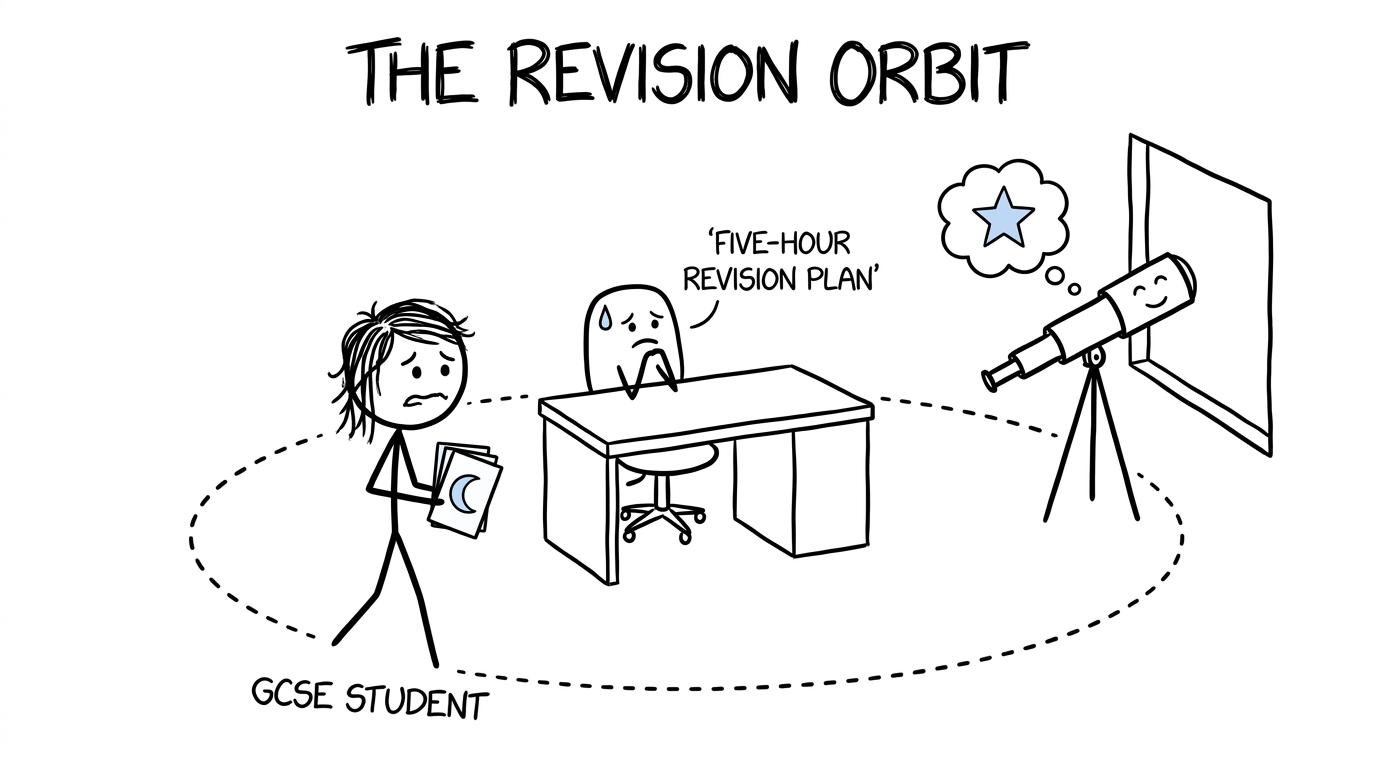 A restless student revising astronomy while orbiting a disappointed chair
Stop measuring revision by time in a chair
A long session can look impressive while producing very little learning. A shorter session can feel modest while forcing your brain to retrieve, apply and correct information. The second one is usually the more useful measure of revision.
UK physical activity guidance advises young people to break up long periods of inactivity with movement where physically possible. That does not prove that walking automatically teaches astronomy, but it does support a simple conclusion: you do not need to organise every revision session around prolonged sitting.
Try measuring completed actions instead:
- facts recalled without prompts;
- diagrams labelled from memory;
- calculations checked with correct units;
- exam questions marked;
- mistakes corrected;
- topics successfully retested.
“I revised for two hours” says little about what changed. “I recalled the stages of stellar evolution, corrected three misconceptions and answered an observation-evaluation question” tells you something useful.
Build short astronomy revision orbits
Think of each session as an orbit with a clear return point. Begin with a question, move through a task and return to check what you now know.
The recall orbit
Choose a narrow topic such as lunar features, retrograde motion, telescope design or stellar evolution. Walk slowly around the room while explaining it aloud without notes. Then stop, check the lesson and write down only what was missing or inaccurate.
Speaking is not a substitute for precise written answers. It is a quick way to expose gaps before you practise exam wording.
The diagram orbit
Place blank paper at two or three safe locations. At the first station, draw or label a diagram from memory. At the second, check it against your revision material. At the third, redraw only the part you missed.
This works well for linked systems and processes, where passive rereading can create a misleading sense of familiarity.
The question orbit
Complete one or two exam questions, stand up to mark them, then place each error into one of four categories:
- missing knowledge;
- incorrect application;
- mathematical error;
- unclear exam wording.
Your next activity should respond to the category. A missing fact needs retrieval practice. A mathematical error needs targeted skills practice. A vague extended answer needs comparison with the mark scheme.
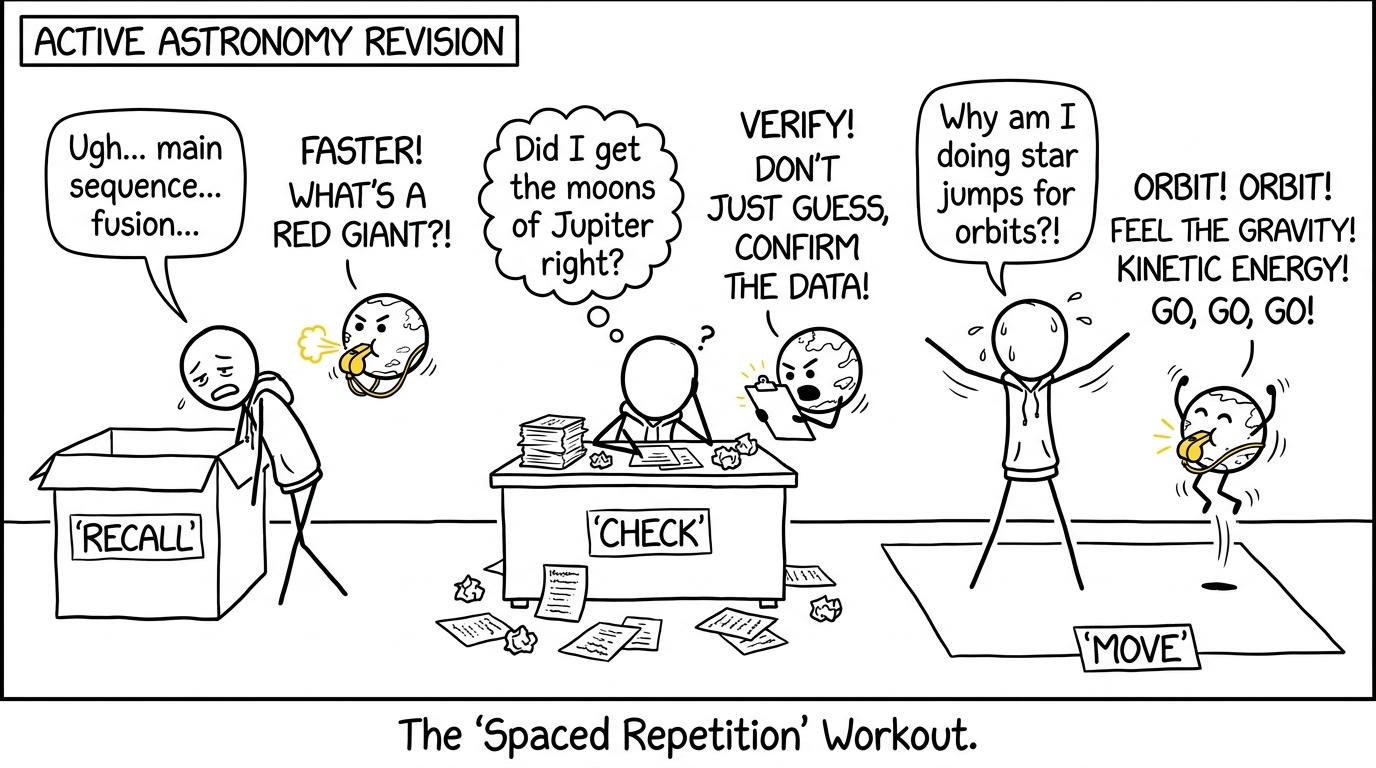 A student moving between recall, check and move revision stations
Revise what the astronomy papers actually assess
The Edexcel specification divides the course into two broad halves. Paper 111 covers naked-eye astronomy, while Paper 222 covers telescopic astronomy. Each written paper lasts 111 hour 454545 minutes, carries 100100100 marks and contributes 50%50\%50% of the qualification.
Across the qualification, the assessment objectives reward knowledge, application, and the analysis and evaluation of astronomical observations and data. At least 20%20\%20% of the marks assess mathematical skills, while observational skills account for at least 15%15\%15%.
Your revision therefore needs four distinct modes:
| Revision mode | What to practise |
|---|---|
| Knowledge | Definitions, structures, processes and scientific ideas |
| Application | Using familiar knowledge in an unfamiliar context |
| Mathematics | Calculations, graphs, units, scales and numerical reasoning |
| Observation | Planning, analysing, evaluating and improving methods |
Moving between these modes can help restless revision feel less repetitive without becoming unfocused. Variety is useful only when every activity remains tied to the specification.
Turn movement into active recall
Active recall means trying to retrieve information before looking at the answer. Movement can provide a structure for that retrieval.
Put question cards at one end of the room and answer cards at the other. Read a question, move away, give your answer, then walk over to check it. Questions might ask you to compare telescope types, explain a feature of the lunar surface or outline evidence associated with an astronomical model.
Keep cards small and specific. “Everything about cosmology” is too broad. “What does redshift tell astronomers about a distant galaxy?” gives your memory a defined target.
You can also use a staircase, hallway or safe outdoor route as a verbal sequence. Assign one stage of a process to each landmark. The method is valuable because you must produce the sequence, not because a particular place has magical learning powers.
Protect the mathematical marks
GCSE Astronomy includes decimals, standard form, ratios, percentages, inverse-square relationships, significant figures, astronomical units, light years, algebra, graphs and geometry. These marks matter, and much of the underlying technique overlaps with GCSE Maths.
If standard form or scale calculations slow you down, use MathsGenie's GCSE Maths topics by exam board and tier to identify the relevant prerequisite skill. For spatial representations, the scale drawings revision resources can strengthen your understanding of scale and conversion.
Graph interpretation also deserves deliberate practice. Astronomy questions may require you to translate between numerical and graphical information, plot data, interpret trends or calculate a gradient. The trigonometric and exponential graphs questions provide additional mathematical graph practice where appropriate.
Do not turn this into a second complete maths course. Diagnose the precise weakness, use a short lesson or question set, then return to astronomy. The mathematical skill must eventually be applied in an astronomical context.
Revise observational skills without staying at a desk
Observation is not merely looking through a telescope. The assessed cycle involves designing an observation, making it, analysing what happened and evaluating the method and evidence.
Create four stations labelled design, observe, analyse and evaluate. Move through them while discussing an observation you have completed or a method described in an exam question.
At each station, ask a different type of question:
- Design: What will be measured, controlled or recorded?
- Observe: How can the observation be carried out safely and skilfully?
- Analyse: What pattern or conclusion is supported by the data?
- Evaluate: What limits reliability, validity or accuracy, and how could the method improve?
This prevents evaluation from becoming the vague instruction to “be more accurate”. Improvements should identify a real limitation and explain how the change addresses it.
Build exam stamina in stages
Short revision blocks suit learning, but the final examination is much longer than a short block. You still need to develop the ability to remain engaged for the whole paper. Build that capacity progressively rather than jumping from flashcards to a full examination.
Start with one page or one question group. Move to a 202020-minute section, then a half-paper and eventually a complete paper under timed conditions. During full-paper practice, remain seated if that reflects your examination arrangements, but use movement before the paper and during permitted breaks between sessions.
MathsGenie's guide to starting GCSE past papers explains why papers are most useful when there is still time to act on the weaknesses they reveal. The GCSE one-week revision plan also shows how short focus cycles, marking and targeted repair can fit together.
A paper is not a verdict. It is a map of where marks are leaking.
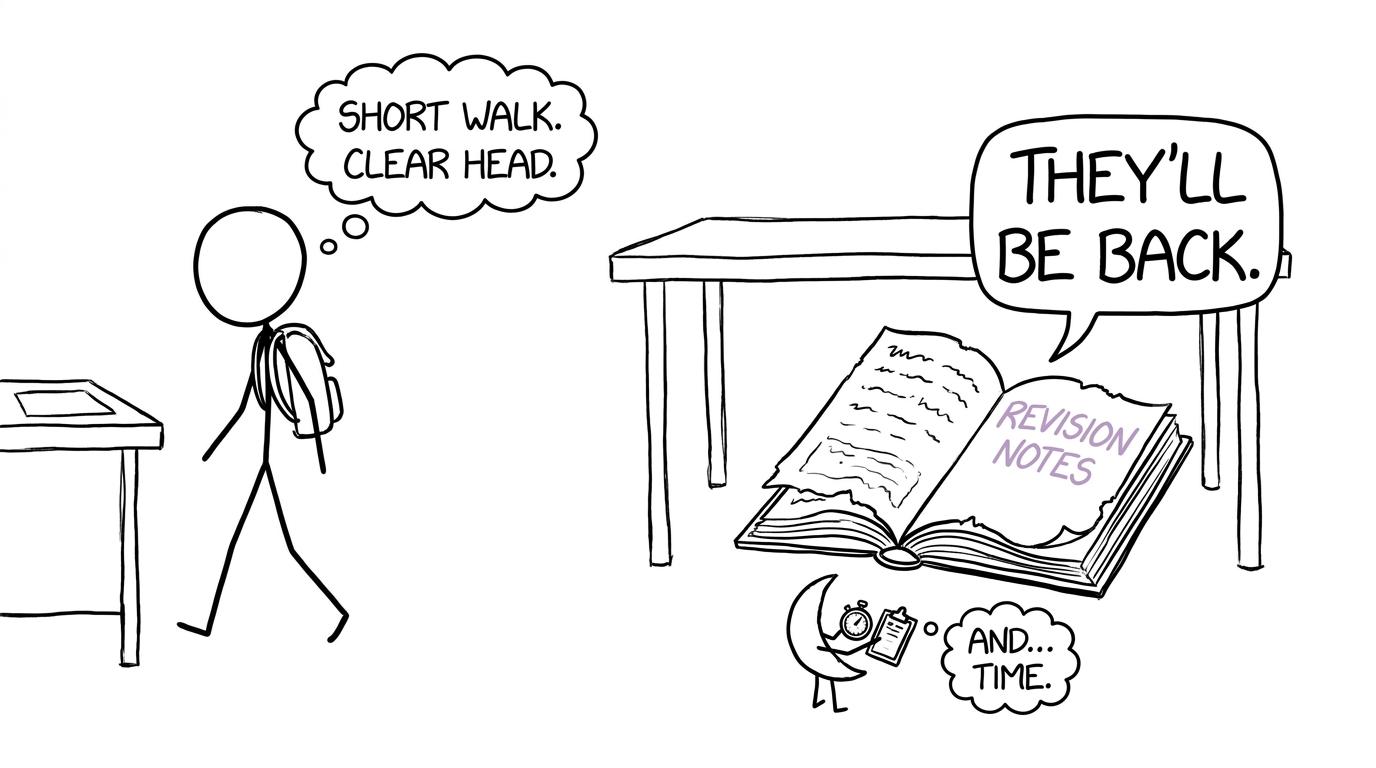 A walking break watched by a patient revision book and a moon with a stopwatch
Make breaks purposeful rather than accidental
A movement break should help you return. Decide its length and purpose before it begins: refill your water, stretch, walk around the garden or complete a small household task. Avoid opening an endless feed and calling it recovery.
A simple cycle might be:
- 151515 minutes of recall;
- 555 minutes of movement;
- 151515 minutes of questions;
- 555 minutes of movement;
- 101010 minutes of marking and correction.
These timings are a starting point, not a rule. Adjust them until the work periods are long enough to complete something meaningful but short enough to repeat consistently. Use the MathsGenie revision planner or your own calendar to assign topics in advance, so each block begins with a decision already made.
Common mistakes when revising GCSE Astronomy
Confusing movement with multitasking
Walking while recalling one idea can be productive. Trying to answer questions while messaging friends, watching a video and moving between rooms divides your attention. Keep one intellectual task at the centre of each block.
Revising only the spectacular topics
Black holes and cosmology may be memorable, but the specification also includes coordinates, time, observation, telescope design, planetary motion and data handling. Use the full astronomy topic list rather than following curiosity alone.
Reading mark schemes without attempting questions
A model answer feels obvious after you have seen it. Attempt the question first, then use the mark scheme to identify missing scientific detail. MathsGenie's Edexcel GCSE Astronomy resources include past-paper material for this attempt-mark-fix cycle.
Avoiding calculations
Do not label yourself as “better at the space part than the maths part”. At least 20%20\%20% of the qualification rewards mathematical skills. Short, regular practice is more manageable than postponing every calculation until the final week.
Never practising full-paper conditions
Movement-friendly learning and exam stamina are not opposites. Use active methods to learn the content, then gradually practise staying with longer timed sections. If a health condition or additional need affects examinations, speak to your school or college about appropriate support rather than improvising arrangements on the day.
Let your revision method fit the learner
The chair is not the qualification. Accurate knowledge, thoughtful application, secure calculations and careful evaluation are what earn marks.
Begin today with one small orbit: choose a topic from the MathsGenie GCSE Astronomy hub, retrieve what you know while moving, answer a few practice questions and check them against the mark scheme. Add past papers as your confidence grows, and use MathsGenie's free revision lessons, video solutions, mini tests and maths practice to repair the skills underneath your astronomy answers.
Predicted papers can help maths preparation near the exam period, while astronomy past papers show how the actual specification is assessed. Keep the loop simple: learn, retrieve, attempt, mark, move and return. You do not need to sit still for hours to make serious progress.