Revise GCSE Art and Design If You Can't Sit Still
Revise GCSE Art and Design can't sit still? Use short making sprints, movement breaks, AO checks and a practical plan that protects maths revision.
There is a particular kind of frustration in opening a sketchbook, arranging your pencils, and then wanting to leave the chair five minutes later. If your search was “revise gcse art and design cant sit still”, the answer is not to force yourself through hours of silent note-taking. Build revision around movement, short practical tasks and visible outcomes instead.
GCSE Art and Design is unusually suited to active revision. You can photograph, collect, arrange, sketch, test materials, annotate aloud and work at different stations. The important thing is that this activity produces relevant evidence rather than becoming creative-looking procrastination.
This guide explains how to do that while keeping enough time and energy for GCSE maths. Art does not have Foundation and Higher tiers, but your maths course does, so your wider revision plan must respect the different demands of both subjects.
Your active art revision checklist
Before making a detailed timetable, use this short checklist:
- Choose one clear outcome for each session.
- Work in short making sprints rather than waiting for a long quiet period.
- Give movement a purpose by creating separate activity stations.
- Connect every task to an assessment objective.
- Photograph experiments before clearing them away.
- Add brief, specific annotations while decisions are fresh.
- Ask your teacher which evidence is missing from your project.
- Protect separate time for active maths practice.
A useful session finishes with something you can point to: a tonal study, an edited photograph, a material test, a page layout, an artist comparison or a documented refinement. “Worked on art” is too vague. “Tested three arrangements and explained which composition best supports my intention” is evidence.
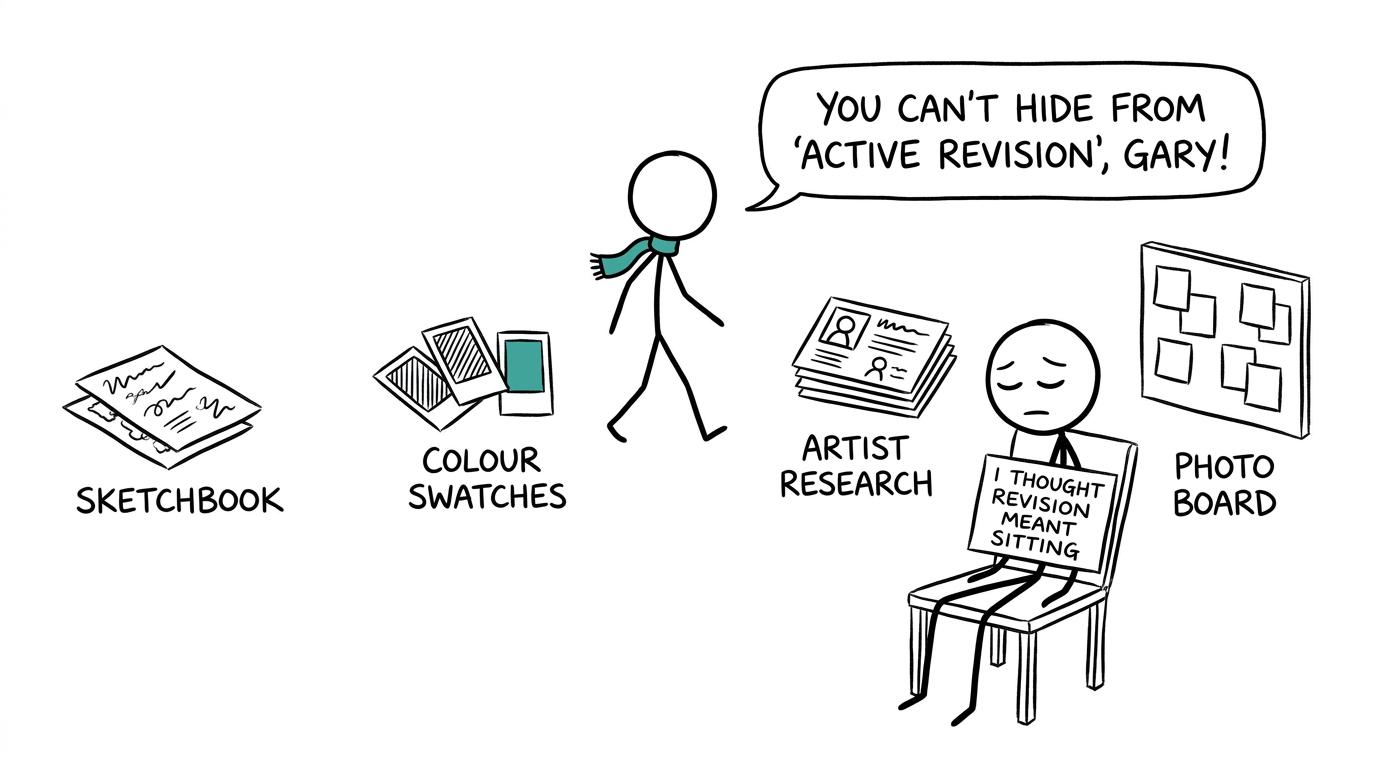 A restless student moves between four active art revision stations while an abandoned chair complains
Understand what GCSE Art and Design rewards
Activity only helps when it serves the specification. Across AQA, Pearson Edexcel, OCR and Eduqas, GCSE Art and Design uses four assessment objectives. Their wording may be presented slightly differently in supporting materials, but the underlying journey is consistent:
- AO1: develop ideas through investigation and show critical understanding of sources.
- AO2: refine work by exploring ideas and experimenting with appropriate media, materials, techniques and processes.
- AO3: record ideas, observations and insights as the work progresses.
- AO4: present a personal and meaningful response that realises your intentions.
The four objectives are equally weighted overall. For the current qualifications offered by the major boards, the portfolio contributes 60%60\%60% and the externally set component contributes 40%40\%40%. The externally set component includes preparatory work followed by 101010 hours of supervised time. Always follow your teacher’s instructions and the specification for your own board and Art and Design title.
The useful lesson is simple: GCSE Art and Design is not assessed only on a polished final piece. The development, experiments, records and decisions matter too. A restless working style can produce strong evidence if you capture the journey.
Turn the assessment objectives into movement prompts
Write AO1, AO2, AO3 and AO4 on four cards and place them around your workspace. Move to the relevant card when changing task:
- At AO1, compare a source, artist, designer or craftsperson with your own intention.
- At AO2, test a material, technique, crop, colour relationship or composition.
- At AO3, draw, photograph, measure, collect or annotate an observation.
- At AO4, make a deliberate choice that brings the project towards a resolved response.
This prevents random busyness. You are not walking around because you have lost focus; you are changing modes because the project needs a different kind of evidence.
Replace long sessions with short making sprints
A making sprint is a small block with one physical action and one finish line. Depending on the task, try 101010 to 252525 minutes. This is not a scientifically perfect duration, and there is no universal timer that suits every student. Choose a block short enough to begin without dread but long enough to produce evidence.
A sprint might involve:
- producing several thumbnail compositions;
- testing one medium on different surfaces;
- photographing an object from contrasting viewpoints;
- arranging source images into possible page layouts;
- recording textures on a walk;
- choosing one experiment and annotating why it should be developed;
- preparing materials for the next lesson.
When the timer ends, stand up and complete a reset: put away one material, photograph the result and write the next action on a sticky note. Then take a brief movement break or switch station.
UK physical activity guidance for young people recommends reducing prolonged inactivity and breaking up long periods of sitting with movement. That supports the idea of planned movement, but it does not prove that one exact pattern will transform everybody’s concentration. Treat your routine as an experiment and keep the structure that helps you return to useful work.
Build an art revision circuit
Set up three or four stations before starting. They can be different parts of one table, separate surfaces or trays that you carry between rooms.
The investigation station
Keep artist references, source photographs and vocabulary here. Your task is not to copy a biography. Identify something visible and relevant: composition, viewpoint, texture, process, scale, colour, symbolism or context. Then connect it to your own work.
The experimentation station
Place only the materials required for today’s test here. Too much choice creates delay. Decide the variable you are changing, such as surface, pressure, scale or layering, and keep the rest reasonably consistent so that the comparison means something.
The recording station
Use this area for observational drawing, photographs, contact sheets, notes and quick reflections. Record work as it develops, including useful failures. A rejected experiment can still demonstrate refinement when you explain what was learnt and what changed next.
The selection station
Lay out recent work and make decisions. What should be kept, enlarged, repeated, combined or abandoned? Selection turns production into a coherent project. Without it, a sketchbook can become a storage cupboard rather than a visible line of thought.
Use active annotation rather than long paragraphs
Annotation should reveal decisions. It does not need to become an English essay unless your teacher has asked for a more extended response.
If writing while seated causes you to drift, record a short voice note while walking around your work. Answer these prompts:
- What did I intend to explore?
- What did I change?
- What was visually successful?
- What was less effective, and why?
- Which source influenced this decision?
- What will I do next?
Return and convert the strongest ideas into concise written annotation. Avoid empty statements such as “I like this because it looks good.” Name the evidence. Perhaps the tighter crop creates tension, the limited palette unifies the composition or the rough surface supports the subject.
You can also place sticky notes beside experiments, then organise them once you have moved through the whole project. The movement helps you review the work as a connected sequence rather than as isolated pages.
Plan backwards from the missing evidence
Students often revise what feels comfortable. In art, that can mean producing another attractive drawing while avoiding artist analysis, refinement or documentation. Start instead with a gap check.
Lay out or photograph your project in order. For each assessment objective, identify:
- the strongest existing evidence;
- evidence that is present but under-explained;
- evidence that appears to be missing;
- one action your teacher has recommended.
Then ask your teacher to confirm the priorities. Assessment is based on the submitted body of work, so advice from the person who knows your project and specification is more useful than a generic online checklist.
Turn each gap into a physical task. “Improve AO2” is vague. “Test whether ink, charcoal or monoprint best communicates the worn surface in my source photographs” is actionable.
Protect your GCSE maths revision too
Art can expand to fill every available evening because there is always another page to adjust. Maths creates a different risk: it can be postponed because its unfinished work is less visible.
Give each subject a defined finish line. An art block might end after two documented experiments. A maths block might end after one short test has been completed, marked and corrected.
Start from the GCSE Maths revision hub, where you can choose your exam board and find lessons, questions and papers. If sitting still is also difficult in maths, use the same circuit principle:
- attempt a small set of questions;
- stand up to mark it;
- move to another surface to write one correction;
- explain the method aloud while walking;
- return later for a brief retest.
MathsGenie’s Edexcel GCSE Maths mini tests are useful when a full paper feels too large. Students on other boards can choose suitable short practice from the main hub. When you are ready to build stamina, use Edexcel GCSE Maths past papers and mark schemes or select your own board from the GCSE area.
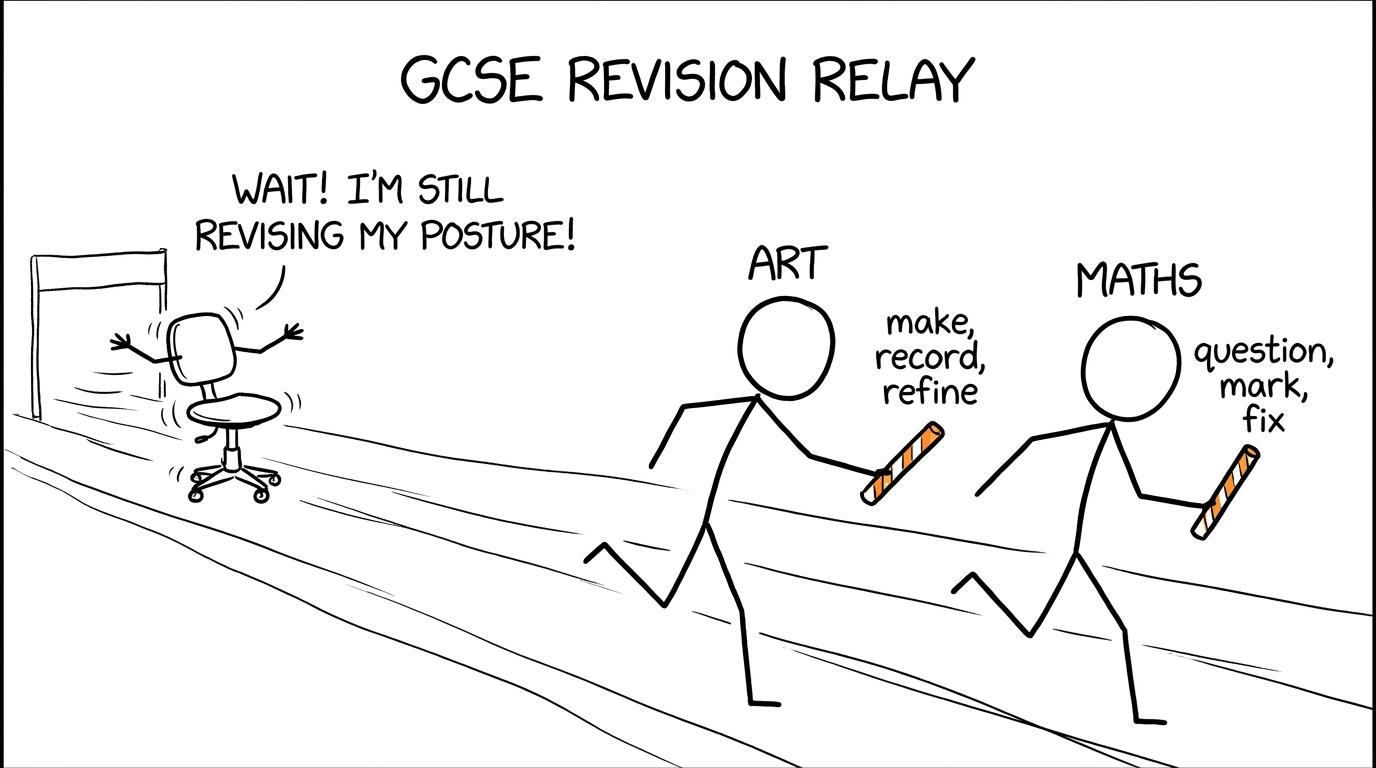 Art and maths pass revision batons in a relay while a desk chair struggles to keep up
The subjects are different, but the productive loop is similar: make an attempt, inspect the evidence, fix one weakness and return later. The guide to finding your weakest GCSE topics explains how to use mistakes rather than guesswork when choosing maths tasks.
Create a realistic weekly rhythm
Do not build a timetable for an imaginary version of yourself who enjoys three silent hours at a desk. Build one around how you genuinely work.
A practical week could contain:
- two short art circuits focused on missing evidence;
- one longer supervised or home session for sustained making;
- several brief maths topic sessions;
- one maths mini test or timed paper section;
- one review period for organising photographs, annotations and corrections.
Keep the order flexible but the outcomes specific. The GCSE maths revision timetable guide can help you balance topic work with timed practice. If exams are close, the one-month GCSE maths revision plan offers a more compressed structure.
Reserve full maths papers for times when sustained exam practice is the goal. They train a skill that short bursts cannot fully replace. The guide to starting GCSE past papers explains how to progress from smaller sections towards complete timed papers.
Common mistakes when revising art actively
Confusing movement with progress
Tidying brushes, rearranging pencils and searching endlessly for references can feel productive. Decide the deliverable before moving. Every station needs a finish line.
Making without recording
An experiment that disappears into a drawer cannot explain your development. Photograph work, label materials and record what you would change.
Producing quantity without selecting
More pages do not automatically mean stronger evidence. Compare outcomes and explain why one deserves further development.
Copying an artist without making a connection
A study becomes more useful when you identify what you learnt and apply that understanding to your own intention. Investigation should influence development.
Leaving annotation until the end
Late annotation often becomes vague because the reasons behind decisions have been forgotten. Capture a voice note or sticky note immediately, then refine it later.
Avoiding all sustained practice
Short sprints are excellent for starting and developing work, but the externally set component includes sustained supervised time. Gradually practise longer making blocks under the conditions your teacher sets, with planned posture changes where permitted.
Allowing art to consume maths time
A sketchbook can always absorb one more hour. Use clear stopping points, then move to maths questions that produce immediate feedback through answers, mark schemes and video solutions.
Make movement part of the method
Not sitting still is not the same as being unable to revise. It means the conventional picture of revision, one chair, one desk and one long block, may be the wrong design for you.
For GCSE Art and Design, create a circuit that moves from investigation to experimentation, recording and selection. Keep each task tied to the assessment objectives, document decisions and ask your teacher where the genuine gaps are. For GCSE maths, carry over the same active rhythm without avoiding the timed paper practice you will eventually need.
Start today with one art outcome and one maths outcome. Then open the MathsGenie GCSE revision hub and choose a revision lesson, a set of practice questions or a mini test matched to your board and tier. As exams approach, add past papers, predicted papers, mark schemes and video solutions. Revision does not have to be motionless to be disciplined. It simply needs to leave useful evidence behind.