Regret Picking GCSE Engineering? What to Check
Regret picking GCSE Engineering? Understand the workload, coursework and course expectations that catch students out, plus what to check before choosing.

A subject can sound perfect in an options booklet and feel very different on a wet Tuesday afternoon when a design folder, unfinished model and maths revision are all competing for your attention.
If you already regret picking GCSE Engineering, the feeling often comes from a mismatch between expectation and reality. Engineering courses can involve substantial written evidence, technical knowledge, design decisions, practical constraints and independent project management. They are rarely just lessons spent building things.
That does not make engineering a bad option. It means that the right choice depends on what you enjoy, how the course is assessed and which qualification your school actually teaches. If you have already started, understanding the source of the problem can also help you regain control.
The quick checklist before choosing engineering
Before committing, find clear answers to these questions:
- What is the qualification's full title and course code?
- Is it a GCSE, Technical Award, Cambridge National or another vocational qualification?
- Which awarding organisation provides it?
- How much assessment is completed through examinations and how much through non-examined work?
- Will you design, manufacture, evaluate, write or use computer-aided design?
- How much lesson time is available for project work?
- What happens if practical work falls behind?
- Which materials, software and manufacturing processes will you use?
- Are you comfortable applying maths, science and technical vocabulary?
- Can you see an example assignment and the official assessment criteria?
Course names and availability can change. A school may also use engineering as a convenient classroom label for a qualification with a different official title. Check the current specification rather than relying on an older sibling's experience or a course name on a display board.
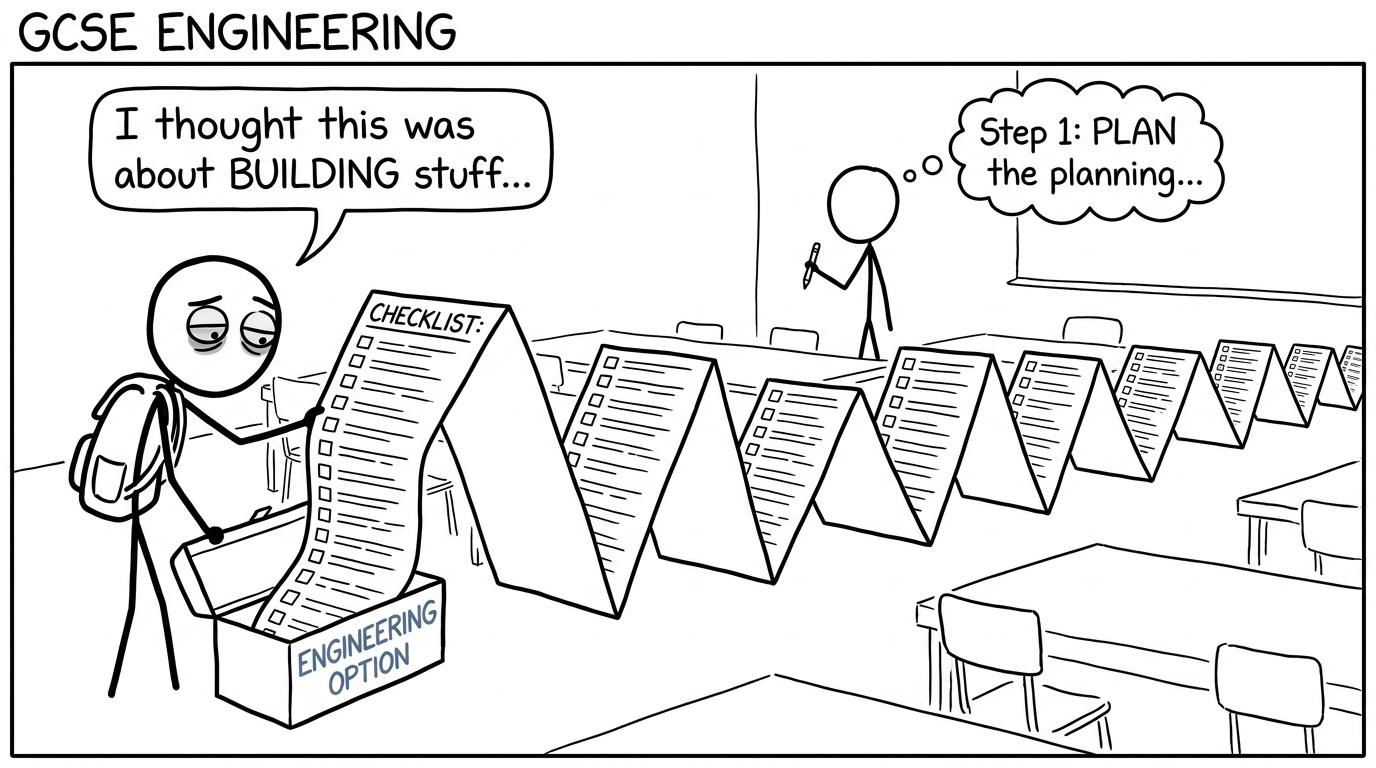 A student discovers that the engineering toolbox contains a very long checklist
Why some students regret picking GCSE Engineering
They expected constant practical work
The biggest surprise is often the amount of thinking that surrounds the making. A successful product needs a purpose, measurable requirements, appropriate materials, justified decisions, safe processes and an evaluation.
The physical object may be the most visible result, but assessors need evidence of the decisions behind it. Depending on the qualification, this can mean sketches, annotations, technical drawings, research, testing records, manufacturing plans and written evaluation.
A student who enjoys careful design and documentation may find this satisfying. Someone who chose the course mainly to escape writing may feel misled.
Project work becomes difficult to manage
A long assignment feels forgiving at first. The deadline is far away, so losing one lesson appears harmless. Then a design change takes longer than expected, equipment is busy or a missing measurement holds up manufacturing.
Project subjects reward steady progress. They can be uncomfortable for students who prefer revising intensively just before an examination because some practical tasks cannot be compressed into the final weekend. Your school will also set controlled conditions and deadlines that must be followed.
This is less about being naturally organised than creating a routine. Keep a list of the next physical task, the next piece of written evidence and anything you need to ask your teacher.
The maths is more important than expected
Engineering does not normally require mysterious mathematics beyond the course specification. It does, however, require familiar GCSE maths to be used accurately and in context.
Relevant skills can include:
- converting units;
- working with ratio and scale;
- finding lengths, areas and volumes;
- substituting into formulae;
- rearranging straightforward formulae;
- interpreting tables and graphs;
- using percentages and tolerances;
- rounding to a suitable degree of accuracy.
Relationships such as speed, distance and time may be written as:
v=dt v=\frac{d}{t} v=tdDensity can be represented by:
ρ=mV \rho=\frac{m}{V} ρ=VmThe challenge is usually not memorising a symbol. It is identifying the required quantities, using consistent units and deciding whether the result is sensible. MathsGenie's free GCSE maths revision lessons let you strengthen these underlying skills by grade and topic.
Written justification feels repetitive
In everyday conversation, saying that one material is better might seem enough. Assessment usually demands a reason connected to the design requirements. Cost, strength, mass, durability, sustainability, appearance and manufacturing method can all matter.
That level of explanation can feel repetitive because every important choice needs evidence. Yet it reflects a real engineering principle: a decision is only useful when its consequences are understood.
A practical way to improve is to connect each claim to a requirement. Avoid vague praise such as good or strong when a more precise property or comparison is available.
The course is not what friends described
Two students at different schools can both say they take engineering while completing different qualifications and assessment structures. One course may emphasise design; another may focus more heavily on manufacturing knowledge, systems or a vocational assignment.
Even mathematics exam boards do not tell you which organisation awards your engineering qualification. A student taking Edexcel Maths might have an engineering course from another awarding organisation.
Ask for the specification title, course code and current assessment breakdown. Those three details are more reliable than the subject's informal name.
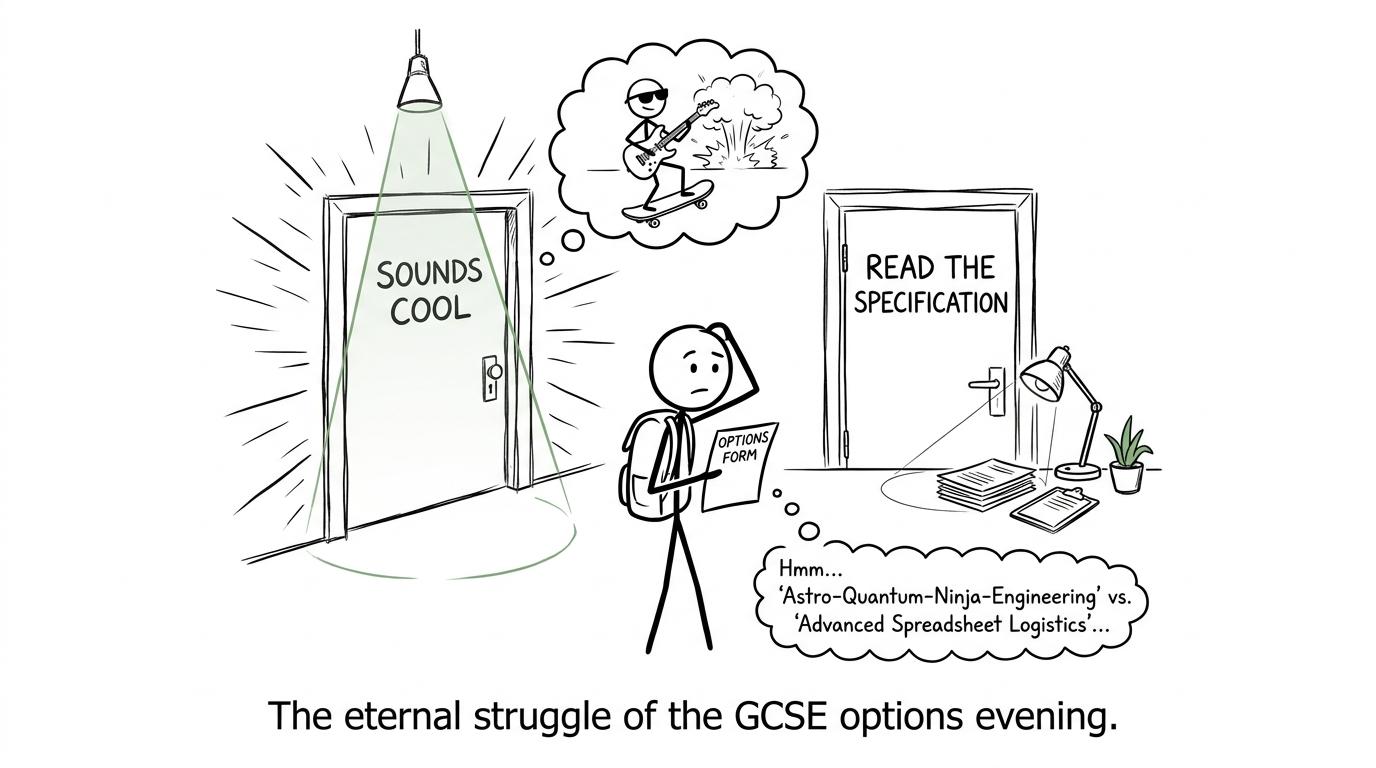 A student chooses between an exciting course name and reading the specification
What to check before you commit
Read an assignment rather than the course slogan
Options booklets must summarise. Specifications and sample assessment materials reveal the actual work.
Look at the command words. Are students expected to calculate, analyse, justify, manufacture or evaluate? Notice how often written evidence appears and whether practical outcomes are assessed alongside the development process.
Ask to see an anonymised example or a sample task if your school can provide one. You are not looking for somebody else's answer. You are trying to understand the volume and character of the work.
Find out how practical lessons operate
Workshop access matters. Ask which processes students usually complete themselves, which software is used and how missed practical sessions are managed. Find out whether materials are supplied and whether projects must remain at school.
These details affect how much control you have over your progress. A project that depends on specialist machinery needs a different plan from homework that can be finished anywhere.
Compare the course with your actual preferences
Enjoying finished products is not the same as enjoying the process that creates them. Engineering may suit you if you like improving imperfect ideas, explaining decisions, measuring carefully and responding to test results.
Be cautious if you strongly dislike extended projects, written justification or revising technical knowledge. None of those preferences makes you less capable. They simply help you choose a course whose daily work fits you.
Protect your core maths revision
An options subject should not be allowed to consume every evening before internal assessments. Make a weekly plan that gives project deadlines and core subjects separate space.
Use the MathsGenie GCSE revision page to identify weak topics, then answer questions without notes. Closer to examinations, use the correct papers for your board: Edexcel GCSE Maths past papers, AQA GCSE Maths past papers or OCR GCSE Maths past papers.
Mark schemes matter because they show whether your method is clear enough to earn marks, not merely whether the final answer looks plausible.
What to do if you already regret your choice
First, identify the precise problem. Saying the whole subject is terrible gives you nothing to change. A more useful diagnosis might be:
- I am behind on project evidence;
- I do not understand the theory;
- my measurements and calculations are unreliable;
- I misunderstood the amount of writing;
- I am struggling to balance deadlines.
Next, speak to your teacher early. Ask what is incomplete, which task has the greatest priority and what must be completed under supervised conditions. Do not assume that transferring subjects is possible; option changes depend on school policy, timetable space, course progress and whether another qualification can realistically be completed.
If the difficulty is mathematical, isolate the skill rather than revising everything. Unit conversion, percentages, scale drawings and formulae can be practised separately. Mini tests and targeted practice questions are often more useful here than rereading notes.
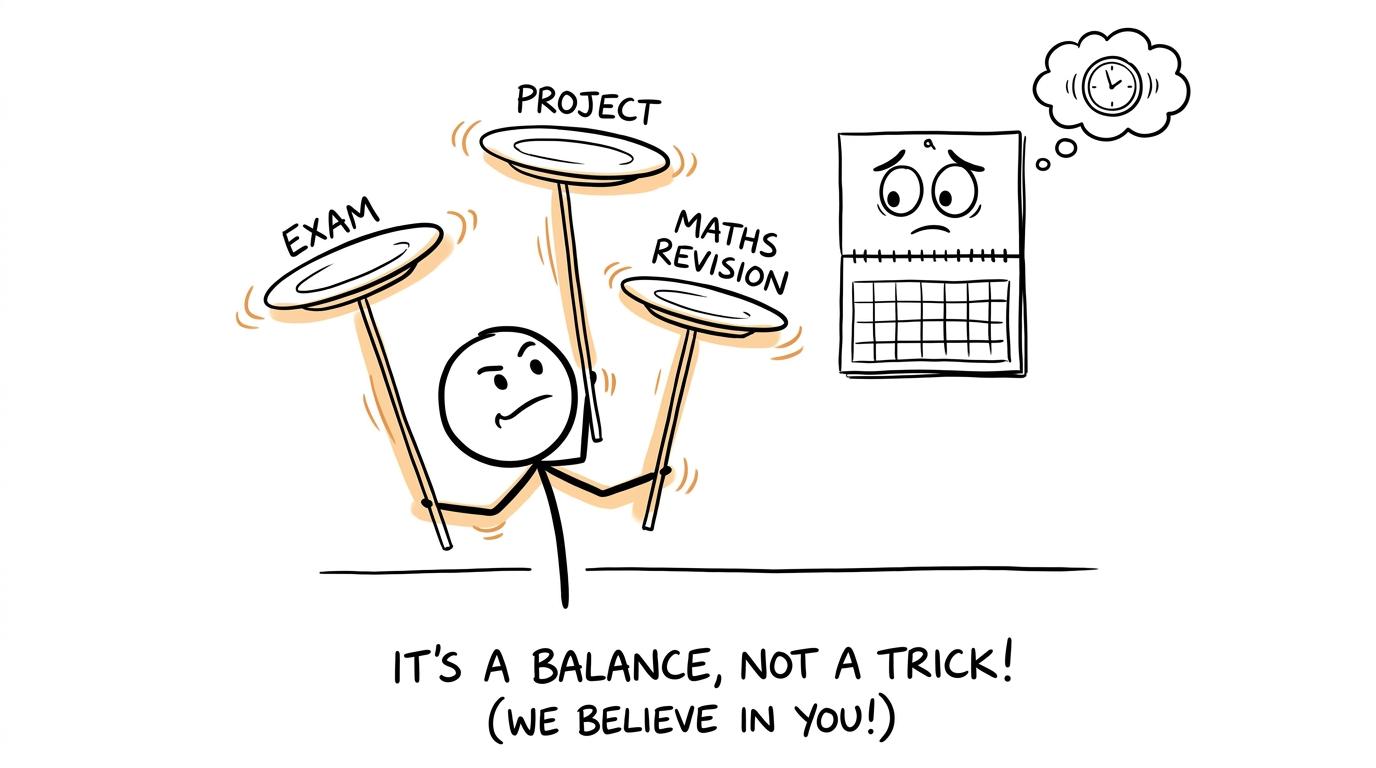 A student balances exam, project and revision plates while a calendar looks nervous
Common mistakes that make engineering feel harder
Leaving evidence until after making
Memories fade, measurements disappear and design decisions become difficult to reconstruct. Record evidence while the process is happening, subject to your qualification's assessment rules.
Using inconsistent units
A formula can be applied correctly and still produce a useless result if millimetres and metres are mixed. Write units beside measurements, convert before calculating and include an appropriate unit with the answer.
Treating the first design as final
Engineering is iterative. Testing may reveal that a dimension, material or process should change. A justified improvement is not proof that the first idea failed; it is evidence that testing informed development.
Writing description instead of evaluation
Description states what happened. Evaluation judges how well an outcome met a requirement and uses evidence to support that judgement. Keep the design requirements visible when reviewing a product.
Letting project pressure replace maths practice
Coursework can feel urgent because it is physically unfinished. Maths revision is easier to postpone because the cost is hidden until a test. Regular exam-question practice prevents that trade-off becoming expensive later.
A good decision is based on the ordinary lessons
The best question is not whether engineering sounds impressive. It is whether you can accept its ordinary work: measuring, documenting, revising theory, correcting errors and managing a project over time.
If that process interests you, engineering can be a thoughtful and demanding choice. If it does not, discovering the mismatch before committing is valuable information, not a failure of ambition.
Whatever option you take, keep your core maths moving. Start with MathsGenie's free revision lessons and practice questions, then use GCSE predicted papers, past papers, mark schemes and video solutions to turn weak areas into specific next steps. If engineering later leads you towards further study, the free A Level maths revision resources are ready for the next stage too.