Regret Picking GCSE Biblical Hebrew? What to Check
Regret picking GCSE Biblical Hebrew? Understand the workload and warning signs before choosing, while protecting enough time for effective GCSE maths revision.

Option choices can look small on a form and feel enormous a year later. If you already regret picking GCSE Biblical Hebrew, the likely issue is not that it is a bad subject. It is that the course may demand more language recall, textual analysis and independent revision than you expected. Before committing, check the actual specification, assessment format, available teaching support and effect on your wider GCSE timetable, especially maths.
There is no reliable national survey showing why students regret this particular option. However, the structure of the qualification reveals where difficulties can arise. Knowing those pressure points before you choose is far better than discovering them in an examination hall.
The quick checklist before choosing
Ask your teacher or examinations officer:
- Which exam board and specification will I follow?
- What Biblical Hebrew knowledge does the school expect at the start?
- How much vocabulary and grammar will I need to recall independently?
- Which set texts will my examination series assess?
- How much lesson time and specialist teaching will be available?
- Can I see a specimen paper and mark scheme before deciding?
- Do I enjoy close reading, translation and literary analysis?
- Will this option leave enough time for compulsory subjects such as maths and English?
- What happens if the class is very small or the teacher changes?
- Until what date does my school permit option changes?
The official Pearson Edexcel specification states that there are no formal prior-learning requirements. That does not mean every beginner will find the course equally manageable. Your school’s teaching model, starting point and timetable matter greatly.
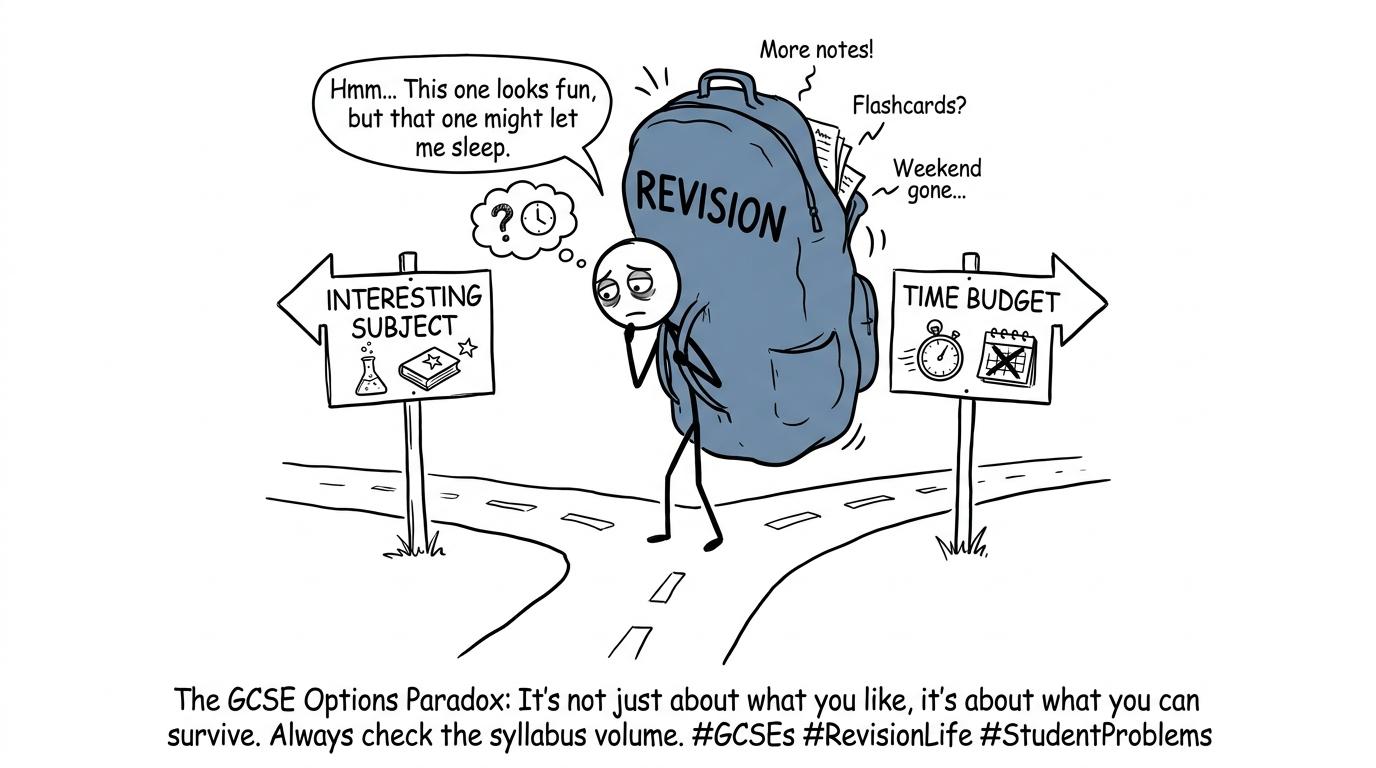 A student weighs interest against revision workload at the GCSE options crossroads
Why students may regret picking GCSE Biblical Hebrew
The subject is not simply about reading familiar stories
Recognising a narrative is different from analysing it in its original language. The course requires knowledge of vocabulary, morphology and syntax, alongside accurate translation and comprehension.
Students also study literature. They must understand content and context, recognise literary effects and support analytical responses with evidence from the prescribed texts. Familiarity with a passage may help, but it cannot replace precise language knowledge.
That distinction can create regret. A student may choose the subject because the material feels culturally or personally familiar, then discover that the examination rewards close linguistic attention rather than general knowledge of the narrative.
The assessment is concentrated in written examinations
The current Pearson Edexcel GCSE is linear and untiered. It has two externally examined components, both taken in the same May or June series:
- Language: a two-hour written examination worth 50%50\%50%.
- Literature: a two-hour written examination worth 50%50\%50%.
There is no coursework component to absorb a difficult examination day. There is also no foundation or higher tier choice, unlike GCSE maths. Every candidate follows the same assessment structure.
The Language paper includes comprehension of unseen Biblical Hebrew, translation into English and a choice involving grammar analysis or translation into Biblical Hebrew. The Literature paper tests the prescribed texts through comprehension, translation, language analysis and an extended comparison.
For some students, that structure is appealing: two clear papers and no speaking assessment. For others, four hours of examination carrying the entire qualification feels unforgiving. The point is not whether the structure is objectively easy or hard. It is whether it suits how you work.
Vocabulary and grammar need repeated retrieval
Languages expose irregular revision habits quickly. Rereading a vocabulary list can create a comforting sense of recognition, but an unseen passage demands recall without prompts. Grammar must also be recognised in context, where several details compete for attention.
This has a direct parallel with maths. Watching a method is not the same as producing it independently. MathsGenie’s guide to using GCSE past papers properly recommends a cycle of attempting, marking, repairing and retesting. The same principle can guide Biblical Hebrew revision: retrieve vocabulary, translate unseen material, check errors and return to weak forms later.
If you dislike regular recall practice and expect to revise mainly in the final weeks, regret becomes more likely.
The set texts require sustained attention
For examinations from 2026 to 2028, Pearson identifies passages from Genesis concerning Joseph’s rise to power and passages from Kings concerning the miracles of Elisha. Students should confirm the correct set texts for their own examination year rather than relying on an older textbook, inherited notes or online discussions.
The literature element is not just memorising a translation. Candidates need to engage with language, meaning, style and evidence. A passage that initially feels familiar can therefore remain demanding for months: each return reveals another grammatical choice or literary detail.
Before selecting the course, ask to see the length and presentation of the prescribed material. Spend time looking at a real assessment. A subject title tells you what the course concerns; an examination paper tells you what you will actually have to do.
Specialist support may be limited
Biblical Hebrew is a specialist subject. Provision varies between schools, so you should establish who will teach it, how frequently lessons run and what support is available when you are stuck.
A small class can offer focused teaching, but it may also mean fewer peer revision groups or fewer school-created resources. None of those outcomes is guaranteed. They are questions to investigate locally, not assumptions to make nationally.
Ask whether you will receive regular marked translations, explicit grammar teaching, timed paper practice and feedback on literary responses. Interest carries you into a subject. Feedback is what usually helps you improve within it.
How the option can affect GCSE maths revision
The hidden cost of any option is time. An hour spent learning vocabulary cannot also be spent repairing algebra, practising geometry or completing a timed maths paper. This does not mean you must choose between success in Biblical Hebrew and success in maths. It means your timetable needs to acknowledge both.
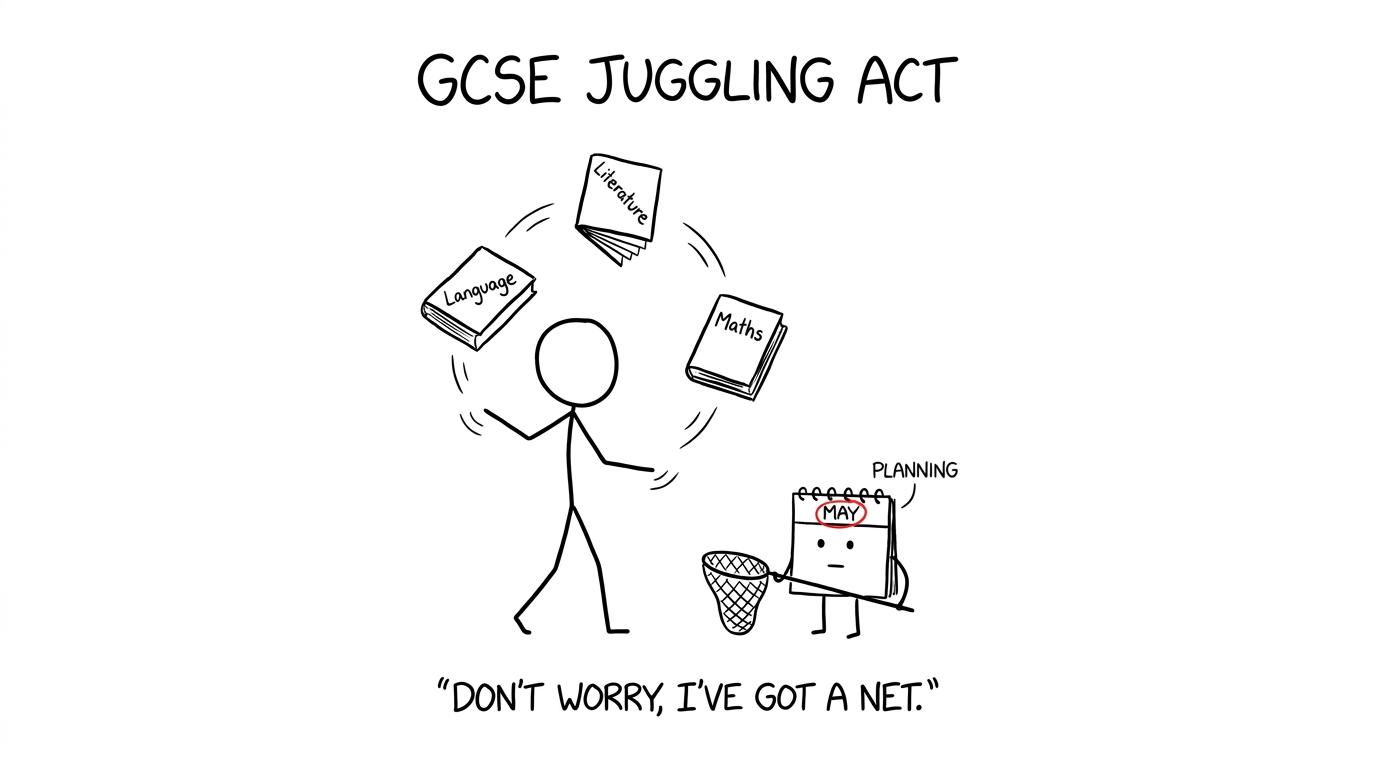 A GCSE student juggles language, literature and maths while a calendar waits with a safety net
Start by diagnosing your current maths position through the GCSE Maths revision hub. Confirm your exam board, commonly Edexcel, AQA, OCR or Eduqas, and whether you are taking foundation or higher tier. Then identify the topics that repeatedly cost you marks.
The GCSE maths topics by board and tier guide can help you see the full scope of the course. If several core areas already need attention, choosing another recall-heavy subject without a realistic schedule may add pressure.
A workable weekly plan should contain:
- short Biblical Hebrew vocabulary retrieval on several days;
- focused grammar or translation practice;
- separate time for set-text analysis;
- maths revision lessons and topic questions;
- a timed mini test or paper section;
- protected rest and catch-up time.
The GCSE maths revision timetable offers a framework for balancing topic work with timed practice. If examinations are close, the one-month GCSE maths revision plan can help turn a crowded list into manageable daily actions.
Signs the subject may still be right for you
A demanding qualification is not automatically a poor choice. Biblical Hebrew may suit you if you enjoy examining how language creates meaning, can revise vocabulary consistently and are willing to analyse texts rather than rely on familiarity.
Good signs include:
- You enjoy precise language work and noticing small changes in form.
- You can explain why a translation is accurate, not merely recognise it.
- You are interested in both the language and its literature.
- You have access to regular specialist teaching and feedback.
- You are comfortable with an untiered, examination-only qualification.
- Your wider GCSE workload remains sustainable.
Do not choose solely because friends are taking it, because it appears unusual or because you assume familiarity will make it easy. Equally, do not reject it merely because another student found it difficult. The better question is whether its demands match your interests, habits and support.
What to do if you already regret the choice
First, separate temporary difficulty from a genuine mismatch. Many subjects feel uncomfortable when the work becomes less introductory. One disappointing translation or assessment is not enough evidence that you chose wrongly.
For two weeks, keep a simple error log. Record whether each problem comes from vocabulary, grammar, unseen translation, textual knowledge, analysis, timing or lack of revision. Then discuss the pattern with your teacher.
If the problem is a specific skill gap, targeted practice may fix it. If it is a persistent mismatch involving the assessment style, available support and your overall workload, ask your school promptly about its option-change policy. Schools set their own deadlines and practical arrangements, so only your school can tell you what remains possible.
Do not quietly stop working while hoping the issue disappears. That usually turns a decision problem into a backlog problem.
Common mistakes when making the decision
Confusing Biblical Hebrew with Modern Hebrew
They are different qualifications with different aims and assessments. GCSE Biblical Hebrew is treated as an ancient language and focuses on reading, translation and literature. Modern Hebrew qualifications assess contemporary language skills and may include listening and speaking. Check the exact course title and code.
Looking only at the subject description
An options booklet explains the appeal of a course. It may not convey the experience of translating an unseen passage under time pressure. Inspect the specification, specimen papers and mark schemes before committing.
Assuming there are foundation and higher papers
The current Pearson Edexcel Biblical Hebrew GCSE is untiered. Do not transfer assumptions from GCSE maths, where foundation and higher tiers operate differently.
Ignoring the examination year
Prescribed texts can change between examination cycles. Confirm the set texts for the year in which you will sit the papers and use resources aligned with that series.
Sacrificing compulsory-subject revision
An option should not consume every flexible hour. Use MathsGenie’s GCSE Maths mini tests to check whether essential maths skills are remaining secure. Students taking another board can begin from the broader GCSE hub or, for example, the dedicated OCR GCSE Maths revision area.
 An exam paper finally meets a student carrying an early-practice clipboard
Make the choice with evidence, not fear
Regret often begins in the gap between what a course sounded like and what it repeatedly asks you to do. Close that gap early. Read the current specification, inspect real papers, ask detailed questions about teaching and calculate honestly how the subject will fit beside maths, English and your other GCSEs.
If you have already chosen it, gather evidence before deciding what comes next. Diagnose the precise difficulty, seek feedback and speak to your school while practical choices may still exist.
Meanwhile, keep maths revision moving. Start with the MathsGenie GCSE Maths hub, use revision lessons and practice questions to repair weak topics, then test yourself through past papers with mark schemes. Add mini tests, predicted papers and video solutions as examinations approach. A thoughtful option decision matters, but so does the quiet weekly routine that protects the grades you are already working towards.