Read Answers Aloud: GCSE Sociology Revision
Read answers aloud GCSE sociology: discover how your voice exposes weak structure, vague evidence and missing links, then revise responses effectively.
A GCSE Sociology answer can look perfectly sensible when you read it silently. You know what you meant, so your brain quietly supplies the connections that never reached the page. Then you read the same paragraph aloud. A sentence runs out of breath. Evidence arrives without explanation. The conclusion appears before the argument is ready.
If you searched read answers aloud GCSE sociology, the short answer is yes: reading your own response aloud can reveal unclear sentences, abrupt transitions and structural gaps that silent reading misses. However, it is a checking method, not a complete revision strategy. It cannot tell you automatically whether your sociological knowledge is accurate or whether your evaluation meets the mark scheme.
The best approach is to read aloud, annotate what sounds wrong, compare the response with the question and mark scheme, then rewrite the weakest section.
Your read-aloud revision checklist
Use this quick process after completing an extended response:
- Put the answer aside briefly so that it feels less familiar.
- Read it aloud at a natural speaking pace.
- Mark every place where you pause unexpectedly, stumble or lose the argument.
- Check that each paragraph answers the exact question.
- Underline sociological concepts, evidence and named perspectives.
- Circle explanations showing why the evidence supports the argument.
- Identify evaluation rather than assuming that disagreement alone counts.
- Compare the answer with your exam board's mark scheme.
- Rewrite one weak paragraph before attempting another question.
The important word is rewrite. Noticing a problem is useful; repairing it is where improvement begins.
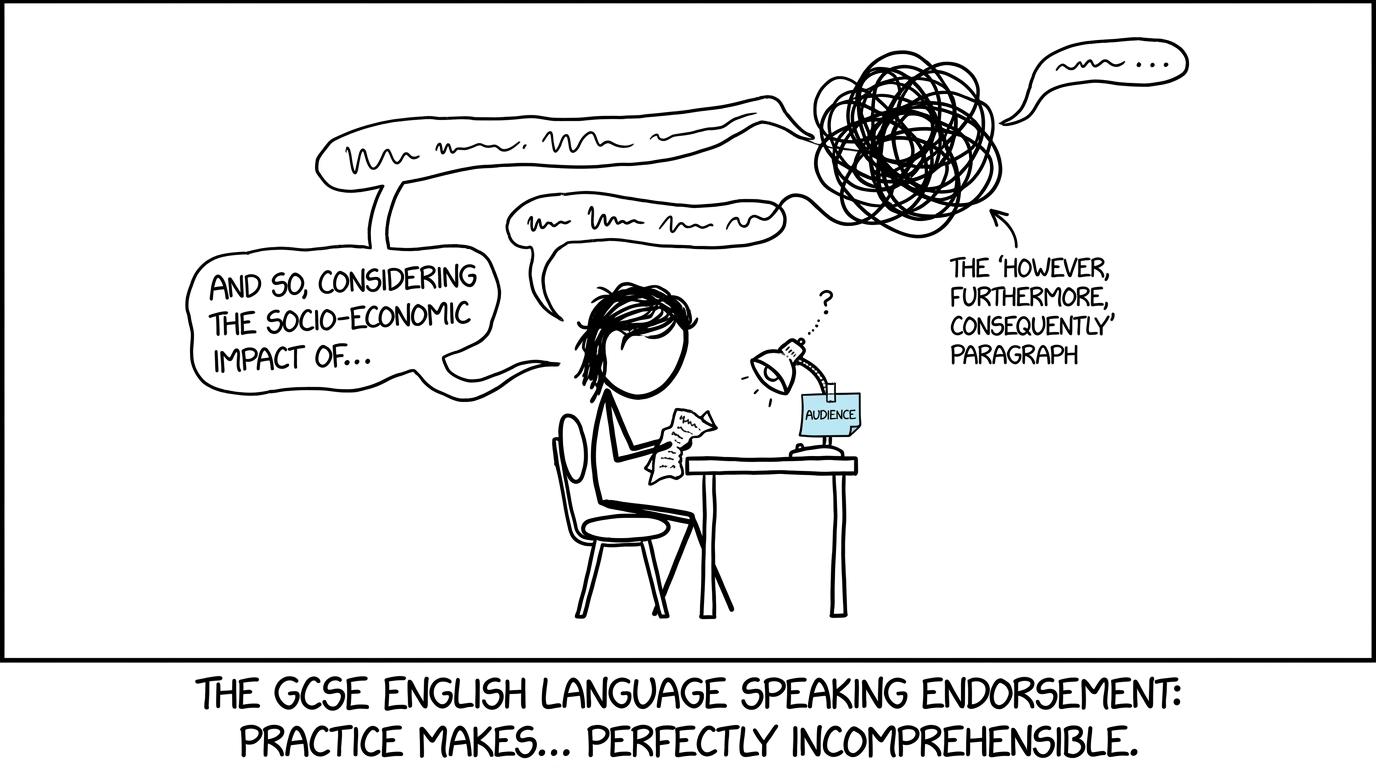 A student discovers an overlong essay sentence turning into tangled string while reading aloud
Why reading aloud exposes hidden structure problems
Silent reading is fast and forgiving. Because you wrote the answer, you already know the intended argument. That familiarity can encourage you to read the idea in your head rather than the words actually on the page.
Reading aloud introduces auditory feedback and forces you to process the response in sequence. You cannot jump as easily from the beginning of a paragraph to the meaning you intended at the end. Every missing connection has to be spoken.
Research on proofreading supports this limited but useful benefit. A controlled study published in the Journal of Applied Research in Memory and Cognition found that reading aloud improved the detection of typographical and contextual errors compared with silent proofreading. Earlier research also suggests that auditory feedback can support error detection in familiar text.
That does not prove that reading aloud will directly raise a GCSE Sociology grade. The research concerns proofreading more broadly, not GCSE Sociology assessment specifically. It does provide a sensible explanation for why your voice may reveal features your eyes overlook.
You hear overloaded sentences
A sentence may contain a theory, an example, a criticism and a conclusion without making the relationship between them clear. On the page, that can look impressively detailed. Aloud, it often sounds crowded.
If you need to restart a sentence or cannot remember its opening by the time you reach the end, ask whether it should be divided. The goal is not to make every sentence short. It is to give each sentence a clear job.
You notice missing logical links
An answer may name a sociologist or study and then move immediately to the next point. Reading aloud makes the jump easier to hear.
After presenting evidence, you should be able to say what it demonstrates, why it is relevant and how it affects the argument. If the paragraph moves from evidence to conclusion without that reasoning, the structure is incomplete.
Repetition becomes obvious
Repeated ideas can hide behind slightly different wording. When spoken, the repetition becomes harder to ignore. You may discover that three sentences all make one point without developing it.
Remove the weakest repetition and use the space for application, analysis or evaluation.
Listen for the GCSE Sociology assessment objectives
Current AQA and Eduqas specifications assess the same three broad abilities: knowledge and understanding, application, and analysis and evaluation. Reading aloud can help you inspect how these elements work together, but you need to listen deliberately.
Knowledge and understanding
Listen for accurate sociological terminology, theories, concepts, evidence and methods. Ask:
- Have I defined the central concept precisely?
- Have I represented the perspective accurately?
- Is the named evidence relevant to this question?
- Have I confused two explanations or researchers?
Your voice can reveal uncertainty, but it cannot verify a fact. Check questionable content against your specification, class materials or teacher feedback.
Application
Application means using knowledge to answer the particular issue or item rather than delivering a memorised paragraph on the general topic.
Listen for the language of the question. If you finish a paragraph without hearing the central issue mentioned or clearly implied, the response may have drifted. This is especially important when a question includes an item that should shape the answer.
Analysis and evaluation
AQA defines this objective through analysing and evaluating theories, concepts, evidence and methods to construct arguments, make judgements and draw conclusions. Eduqas uses the same core wording.
Listen for reasoning words such as because, therefore, however and this suggests. Their presence does not guarantee analysis, but their absence may expose a list of disconnected facts.
Also listen for balance. Does the answer examine an alternative explanation? Does it evaluate evidence rather than merely state that another perspective disagrees? Does the conclusion weigh the argument and answer the question?
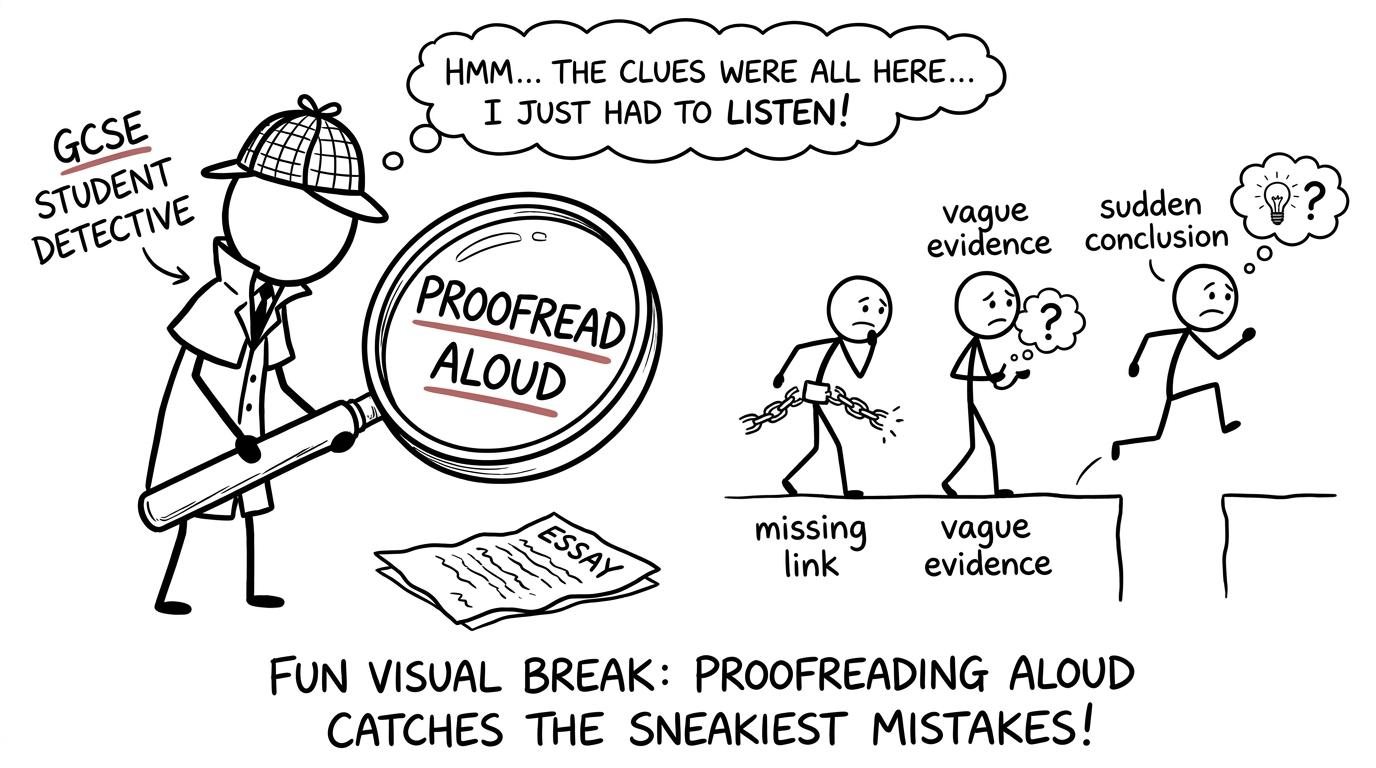 A student detective catches missing links and vague evidence escaping from an essay
A practical method for reading your answer aloud
Prepare the right answer
Use a response written under realistic conditions. A polished answer copied from notes will tell you less about your exam performance than an independent attempt.
Choose an extended response because structure matters most when several ideas must form one argument. Keep the question visible throughout the review.
Complete a first listening pass
Read without editing as you go. Use a pencil to place a small mark where:
- you stumble;
- the sentence feels too long;
- the meaning becomes vague;
- the paragraph changes direction suddenly;
- evidence seems detached from the claim;
- the conclusion sounds unearned.
Recording yourself is optional. It can help you hear the answer as an audience would, but simply speaking slowly is enough to begin.
Complete a second assessment pass
Now return to each paragraph and label its function: claim, evidence, explanation, evaluation or judgement. These labels are diagnostic prompts, not a compulsory paragraph formula.
A paragraph does not need every label in a rigid order. It does need to contribute something identifiable to the overall answer. If you cannot describe what a sentence is doing, it may not be earning its place.
Check against the mark scheme
Reading aloud detects communication and flow more readily than subject accuracy. A recent study comparing oral proofreading with teacher feedback found that reading aloud helped writers correct some surface errors, while teacher feedback was substantially more effective overall. The practical lesson is clear: use your voice as an early warning system, not as a substitute for expert feedback.
Check the exam board's level descriptors and any question-specific guidance. Then ask your teacher to review persistent weaknesses, particularly inaccurate knowledge or weak evaluation.
Rewrite and retest
Rewrite only after diagnosing the problem. Then read the revised paragraph aloud again. If the logic now sounds natural and every sentence advances the answer, the revision has done useful work.
This resembles the feedback loop used in maths revision: attempt, mark, diagnose, repair and retest. Maths students can build that habit through the GCSE Maths revision hub, then apply the same disciplined review process across written subjects.
How this technique helps with GCSE maths
The subject content is different, but the principle transfers. In maths, reading a solution aloud can reveal a missing justification, an unexplained variable or a jump between stages. It does not check whether a calculation is correct; a mark scheme or worked solution must do that.
Begin with short diagnostic practice using Edexcel GCSE Maths mini tests. When you explain why a step follows, uncertainty becomes visible. Follow this with Edexcel GCSE Maths past papers and mark schemes or the board-specific resources available from the main GCSE hub.
This is especially valuable for students balancing Sociology with Edexcel, AQA, OCR or Eduqas maths. You do not need an entirely different revision philosophy for every subject. You need the same honest loop applied to different assessment demands.
For longer-term planning, the GCSE one-month maths revision plan shows how diagnosis, focused practice and retesting can fit into a weekly routine. A Level students can use the equivalent A Level Maths revision hub.
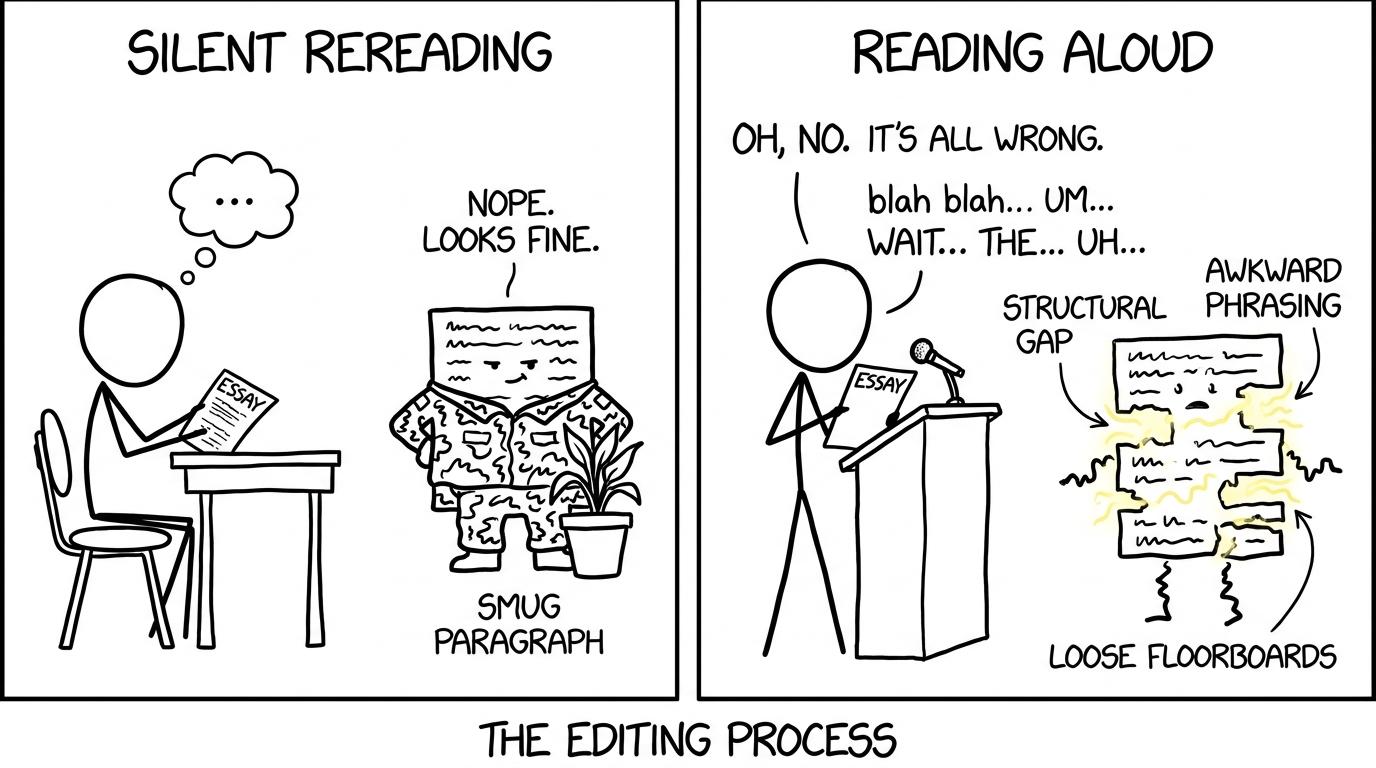 A camouflaged paragraph is exposed when a student switches from silent reading to reading aloud
Common mistakes when reading answers aloud
Correcting only grammar
Fluent grammar can carry a weak argument. Check sentence accuracy, but spend more time asking whether the response answers the question and develops a defensible judgement.
Reading in an artificial performance voice
If you add dramatic pauses and emphasis, you may disguise unclear writing. Read naturally. The written structure should guide your voice rather than relying on your voice to rescue the structure.
Treating a stumble as proof of an error
You may stumble because you are tired or unfamiliar with a name. Mark the place, then inspect it. Not every hesitation requires a rewrite.
Assuming fluent writing is accurate
A confident-sounding paragraph can still misuse a concept or describe evidence incorrectly. Verify content separately and use teacher feedback.
Skipping the rewrite
Highlighting weak sections can feel productive while changing nothing. Rewrite, compare and read again. Improvement must reach the page.
Using the technique on every sentence you write
Reading every short response aloud may consume revision time without adding much value. Prioritise extended answers, repeated weaknesses and paragraphs your teacher has identified as unclear.
Build a revision loop that changes the next answer
Reading aloud works best as one stage in a larger process:
- write independently;
- listen for structural problems;
- compare with the question and mark scheme;
- obtain feedback where possible;
- rewrite the weakest section;
- answer a fresh question later.
The same rhythm makes maths revision productive. Use MathsGenie's guide to starting past papers to choose an appropriate practice stage, then add GCSE predicted papers when you need fresh exam-style material. Predicted papers should complement official past papers rather than replace them.
Your voice is useful because it slows familiarity down. It lets you hear what the examiner will actually receive, not what you remember intending to write. Use that moment honestly, repair what it reveals and move on to a fresh attempt.
For maths preparation, make MathsGenie your free revision base: learn through revision lessons, practise with topic questions and mini tests, then test your progress using past papers, predicted papers, mark schemes and video solutions. Start with one answer or one paper today. Read the reasoning. Find the gap. Fix it.