Read Answers Aloud GCSE Russian: Does It Help?
Read answers aloud GCSE Russian revision can expose missing ideas, awkward structure and grammar slips. Learn a practical method that also helps in maths.
A written answer can look convincing simply because you know what you meant. Your eyes move across the words, your brain supplies the missing logic, and an awkward sentence passes unnoticed. Then someone else reads it and immediately asks, “What does this refer to?”
That is why the read answers aloud GCSE Russian technique can help. Hearing your own response often exposes missing words, abrupt changes of tense, overloaded sentences and ideas placed in the wrong order. It is not a complete checking system, and research has not established a special effect for GCSE Russian itself, but evidence from proofreading studies suggests that reading aloud can reveal errors that silent reading misses.
The same principle matters in GCSE maths. You may not literally read every calculation aloud in an exam, but explaining your method step by step can reveal a missing justification or an answer that does not follow from your working.
The short answer
Reading your GCSE Russian answer aloud is worth trying during revision because it changes how you process the text. Instead of recognising the answer as a familiar whole, you must produce and hear each phrase in sequence.
Use this quick checklist:
- Read exactly what is written, not what you intended to write.
- Pause whenever the meaning or sentence structure feels unclear.
- Check whether every task bullet point has been answered.
- Mark uncertain endings, agreements, tenses and word choices.
- Rewrite first, then read the revised version once more.
- Compare the result with feedback, a model response or the relevant mark scheme.
Reading aloud is best used as one layer of revision. It cannot tell you whether an unfamiliar Russian form is correct if you do not know the rule, and it should not replace teacher feedback or careful specification-based practice.
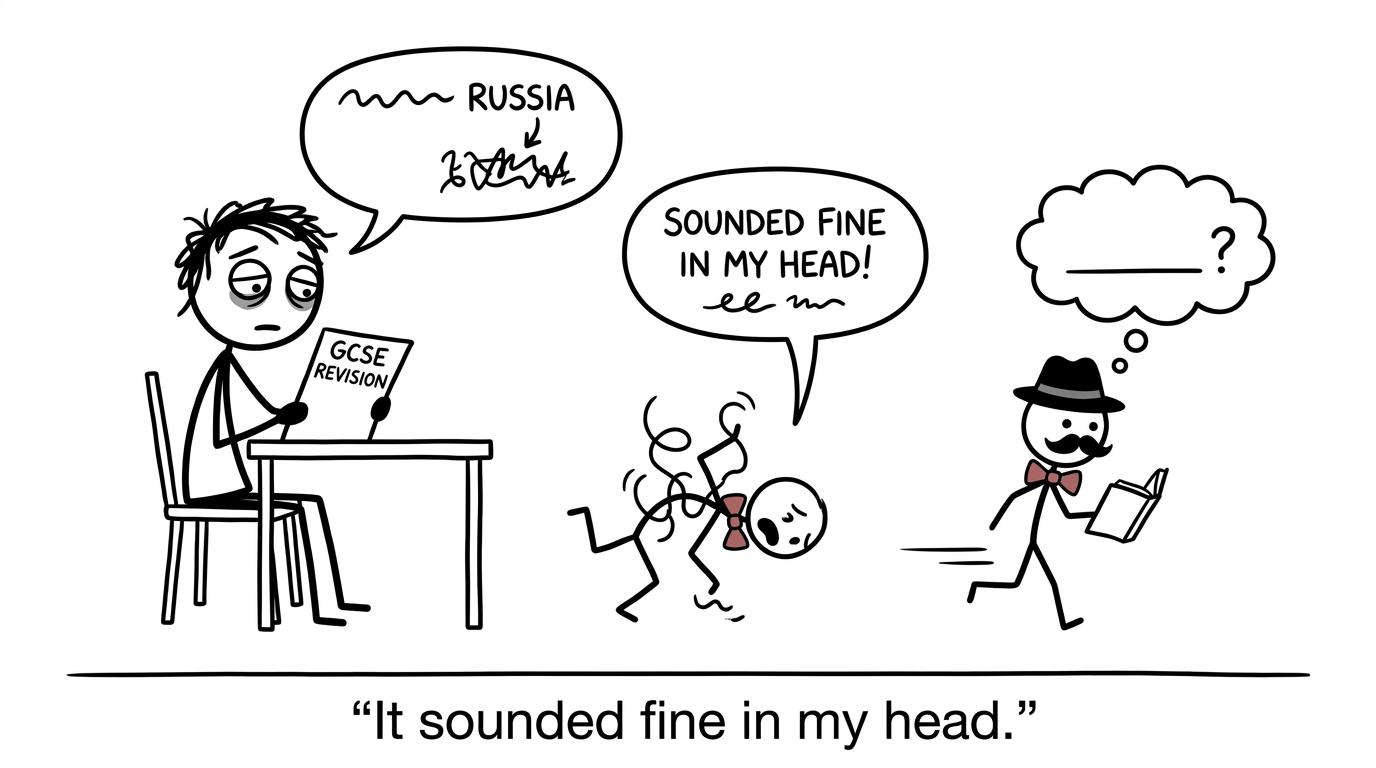 A student discovers that a sentence sounded better inside their head
Why silent reading misses problems
Silent reading is efficient. That is usually helpful, but efficiency can work against proofreading.
When you reread your own response, you already know its subject, intended meaning and planned conclusion. Your brain can smooth over a missing link because the link exists in your memory, even when it does not exist on the page. Familiarity encourages prediction: you see the opening of a phrase and assume the ending is present and correct.
Reading aloud adds two forms of feedback. You articulate the words and hear the resulting sentence. It also tends to slow the process down. These changes make it harder to skim over small omissions or accept a sentence merely because it looks familiar.
A peer-reviewed study published in the Journal of Applied Research in Memory and Cognition in 2022 found that proofreading aloud improved detection of both typographical errors and contextual errors, including problems with grammar and word choice, compared with silent reading. Earlier research has also suggested that auditory feedback can support error detection in familiar text.
There is an important limit to that evidence. The studies were not GCSE Russian examinations, and results from general proofreading cannot guarantee the same benefit for every language learner. More recent research with second-language writers suggests that reading aloud can help with some surface errors but does not replace knowledgeable feedback. Treat it as a useful diagnostic tool, not a magic correction button.
What reading aloud can reveal in GCSE Russian
Current GCSE modern foreign language requirements for Russian continue to assess listening, speaking, reading and writing, with each assessment objective carrying 25%25\%25% of the qualification. Writing requires students to communicate in the assessed language, while accurate grammar and structures contribute directly to assessment.
The exact tasks and mark allocations depend on the live specification and tier, so use materials for your own qualification rather than assuming that revised rules for French, German or Spanish automatically apply to Russian.
Missing or incomplete content
A response may be grammatically ambitious yet fail to cover a compulsory bullet point. Reading it aloud makes the sequence of ideas more noticeable. If you hear yourself move from an introduction straight to a final opinion, the missing development becomes harder to ignore.
After reading, summarise each paragraph in a few English words. Then match those summaries against the task. This is a content check, not a translation exercise.
Weak connections between ideas
Structure problems often live between sentences rather than inside them. Two sentences may each be correct but still feel disconnected when placed together.
Listen for moments when the answer suddenly changes person, topic or time frame. Ask:
- Does this sentence follow from the previous one?
- Is the reason placed beside the opinion it supports?
- Does a pronoun have an obvious reference?
- Has the response changed tense deliberately?
- Is the conclusion adding something, or merely repeating the opening?
A stumble does not prove that the Russian is wrong. It is a signal to inspect that part more carefully.
Sentences carrying too much
Students sometimes chase range by putting several clauses, opinions and time frames into one sentence. Complexity can earn credit only when it still communicates clearly.
When you run out of breath, lose track of the main verb or cannot explain the sentence’s core message, consider whether it needs simplifying. Two controlled sentences may communicate more effectively than one sentence whose ending no longer agrees with its beginning.
Endings and agreements
Reading aloud may draw attention to a phrase that does not sound like the patterns you have practised. That can prompt checks of case endings, adjective agreement, verb forms or number agreement.
Sound alone is not proof. A familiar but incorrect form may sound comfortable because you have repeated it before. Circle the doubtful section and confirm it using your class materials, grammar notes or teacher feedback.
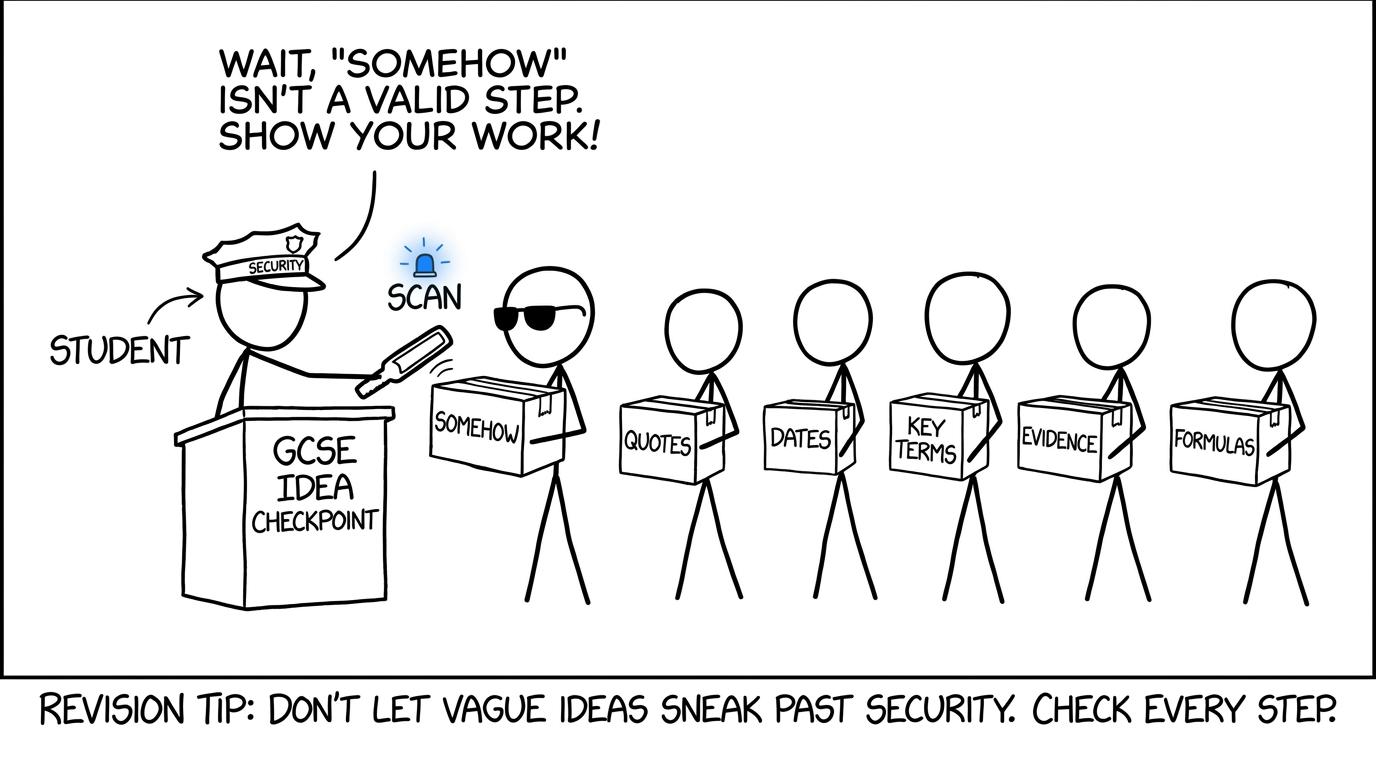 An idea tries to sneak past the structure checkpoint
A practical read-aloud revision routine
The strongest routine separates meaning, structure and accuracy. Trying to inspect everything at once places too much demand on attention.
Begin with a cold read
Leave the response for a short period before checking it. Even a different revision activity can reduce the feeling that you are still reading directly from memory.
Read the answer at a natural, controlled pace. Do not perform it dramatically and do not silently repair mistakes as you go. If a word is absent, let the gap sound absent.
Mark friction without stopping
Use a simple symbol beside any place where you hesitate, repeat a phrase or lose the thread. Finish the whole response before editing. Constantly stopping can make it difficult to judge the overall flow.
Your marks on the page are evidence of friction, not automatic corrections. Return to each one and identify whether the issue concerns content, organisation, vocabulary or grammar.
Run separate checking passes
On the second pass, check the task requirements. On the third, inspect grammar and accuracy. Finally, read only the revised sentences in context.
This resembles effective maths revision. After completing questions from the GCSE maths revision hub, you should not merely look at the total mark. You identify whether the lost mark came from understanding, method, accuracy or presentation.
A useful error log for either subject has four headings:
| Location | Problem type | What caused it? | Next action |
|---|---|---|---|
| Sentence or question | Content, structure, knowledge or accuracy | The precise reason | Rule to review or practice to complete |
The habit turns “I made a mistake” into a decision about what to do next.
How this helps students preparing for maths exams
The topic may be Russian, but the deeper skill is checking whether what appears on the page matches what exists in your head. That is central to GCSE maths at both foundation and higher tier.
After completing a maths question, quietly narrate the logic during revision: what information you used, which method you selected, why the next line follows and whether the final result answers the question asked. A gap in that explanation may reveal omitted working, an unjustified assumption or a calculator entry copied incorrectly.
Then verify your judgement objectively. Use Edexcel GCSE Maths past papers with their mark schemes, or begin from MathsGenie’s broader GCSE revision resources. The guide to using Edexcel past papers properly explains how to diagnose and revisit lost marks rather than simply collecting scores.
If you need a repeatable weekly structure, use the GCSE maths revision timetable. Students who are unsure where to begin can first find their weakest GCSE topics, then choose targeted revision lessons and practice questions.
The shared lesson is simple: producing an answer is only the first attempt. Improvement happens during the inspection that follows.
When not to read aloud
Reading aloud is primarily a revision technique. In an exam hall, speaking could disturb other candidates and breach exam conditions. Practise a silent version for the real paper: slow your inner voice, track each word with your eyes and check one feature at a time.
It may also be unhelpful if pronunciation consumes so much attention that you stop monitoring meaning. In that case, begin with short sections or use a quiet whisper during private revision. Students with access needs should follow the arrangements approved by their school or college.
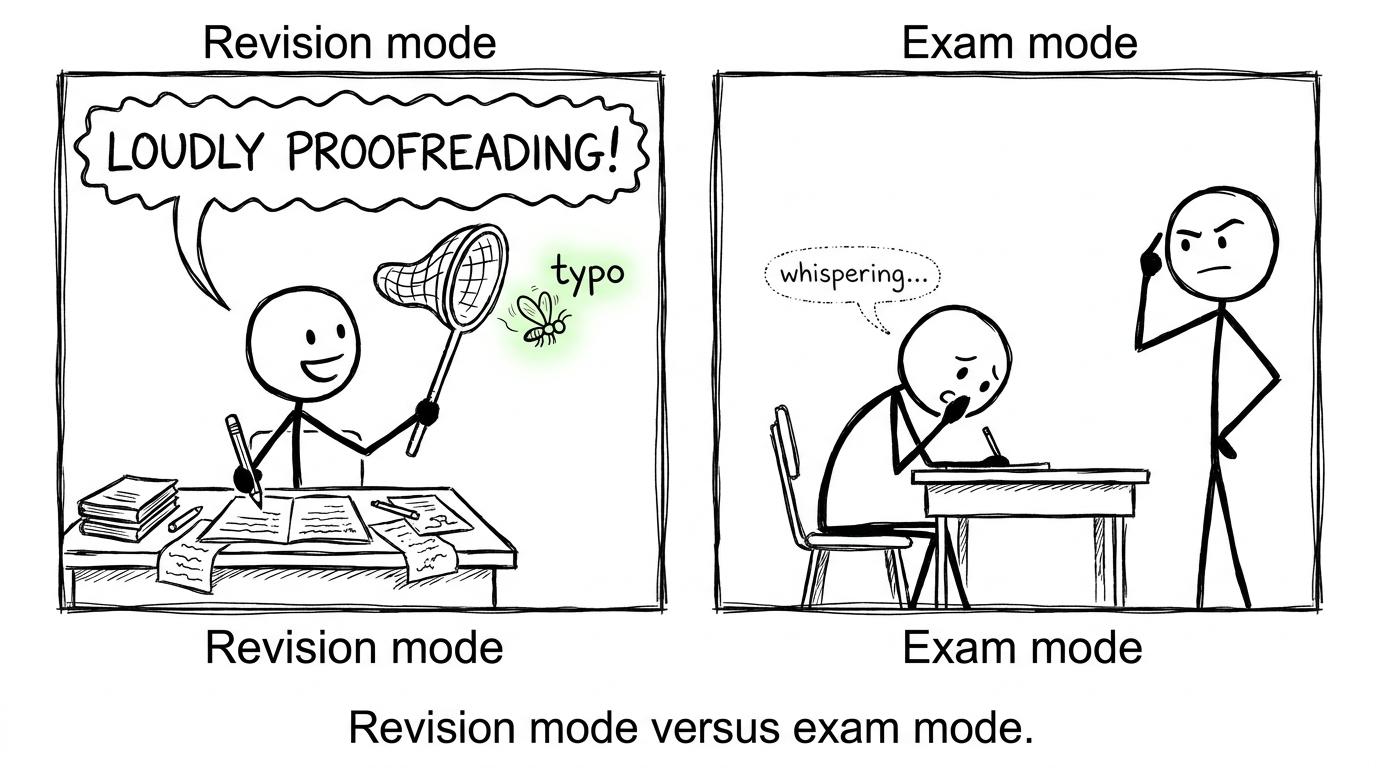 Revision mode catches a typo while exam mode stays silent
Common mistakes when reading answers aloud
Correcting from memory
Students often say the sentence they intended rather than the one they wrote. Point to each word and refuse to supply missing language automatically.
Treating every hesitation as an error
You may pause because pronunciation is difficult, not because the sentence is badly structured. Mark the location, then diagnose it separately.
Checking sound but not task coverage
A fluent answer can still omit a compulsory idea. Keep the question beside you and tick each requirement only when the response genuinely addresses it.
Trusting what sounds familiar
Repeated mistakes can sound normal. Confirm uncertain grammar using reliable notes and feedback rather than instinct alone.
Reading once and declaring the answer finished
The first read identifies possible trouble. Improvement requires rewriting, checking and later retrieval. This is also why MathsGenie recommends moving from diagnosis to targeted practice and then retesting. The GCSE past-paper timing guide can help you build that cycle into maths revision.
Make checking part of the answer
Reading your own GCSE Russian answers aloud can reveal the point where a clear idea became an unclear sentence. It slows familiarity down just enough for missing links, abrupt transitions and overloaded structures to become audible.
But the voice only raises the alarm. Grammar knowledge, task awareness, feedback and deliberate rewriting make the correction.
Bring the same discipline to maths. Start with MathsGenie’s free revision lessons, test the method with practice questions and mini tests, then use past papers, predicted papers, mark schemes and video solutions to find what your first attempt concealed. Open the MathsGenie GCSE maths revision hub, choose one weak area and make your next answer easier to follow than your last.