Read Answers Aloud for GCSE English Language & Literature
Read answers aloud for GCSE English Language and Literature to uncover weak structure, awkward sentences and missing links before your next exam.
A draft can look perfectly sensible until you hear it. Your eyes glide over a missing word. Your brain supplies a connection that never reached the page. A paragraph feels logical because you remember what you intended to say, not because the reader can actually follow it.
That is why it can help to read answers aloud for GCSE English Language and Literature. Research comparing oral and silent proofreading has found that reading aloud can improve the detection of typographical, grammatical and word-choice errors. More importantly for an exam response, hearing your writing can expose abrupt transitions, overloaded sentences and ideas placed in the wrong order.
It is not a complete editing method, and it cannot tell you whether an interpretation is convincing. But used alongside a mark scheme and teacher feedback, it is a simple way to hear what silent reading misses.
The quick answer
Reading your work aloud can help you notice:
- sentences that are too long or difficult to follow;
- missing words and repeated phrases;
- paragraphs that jump between ideas;
- quotations that have not been integrated smoothly;
- changes in tense, tone or viewpoint;
- conclusions that do not follow from the argument;
- places where punctuation does not match the intended rhythm.
For the best results, use it after writing a timed answer. Read exactly what is on the page, mark every stumble, then make one structural pass and one accuracy pass. Finally, compare the revised response with the assessment objectives and mark scheme for your board.
Students following AQA can find suitable questions and mark schemes in the AQA GCSE English Language revision area and the AQA GCSE English Literature revision area.
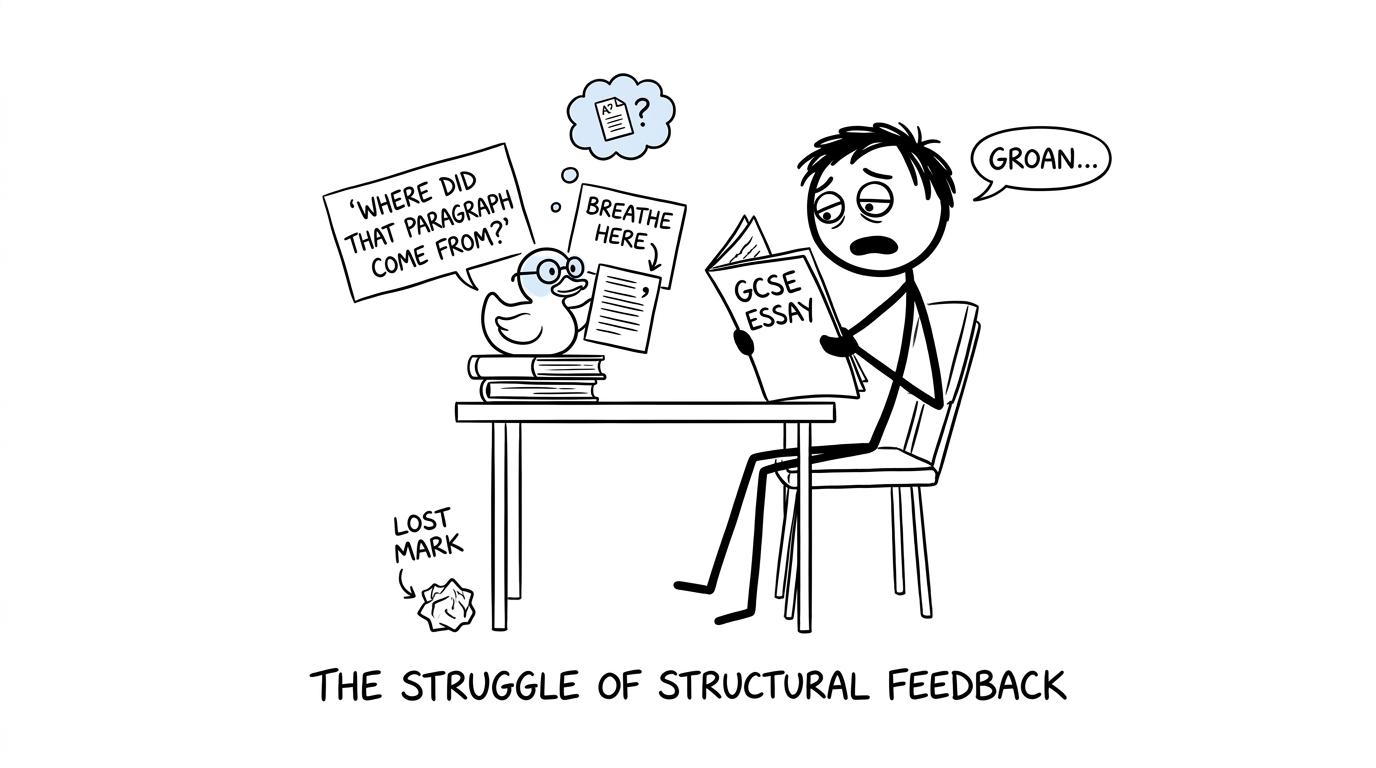 A student reads an essay to a rubber duck examiner
Why silent reading can hide problems
When you reread your own answer silently, you already know its intended destination. That familiarity is useful for remembering your argument, but it can make proofreading less reliable. Your brain may smooth over a missing connective or mentally restore a word that you forgot to write.
Reading aloud changes the task. You must process the response at the pace of speech, one sentence at a time. Awkwardness becomes harder to ignore. If you repeatedly lose your place, run out of breath or feel unsure which word to emphasise, the sentence may be carrying too many ideas.
This does not mean every long sentence is weak. Controlled complex sentences can express precise relationships between evidence and interpretation. The warning sign is loss of control: several claims joined together, an unclear subject, or a final clause that no longer connects to the opening.
Sound also makes repetition more obvious. A student may begin three consecutive paragraphs with the same phrase or repeat an interpretation without developing it. On the page, those repetitions can sit far enough apart to escape attention. Spoken one after another, they become difficult to miss.
How reading aloud reveals structural weaknesses
Structure is larger than spelling and punctuation. It is the route through your answer: what comes first, how one idea leads to another and whether the ending feels earned.
Official GCSE English Language requirements emphasise clear, coherent writing and the organisation of ideas. In Literature, exam boards including AQA, Edexcel, OCR and Eduqas assess a sustained response to the task, supported by textual references and analysis. The precise paper structure and wording of mark schemes vary, so always use resources for your own specification.
You hear jumps between paragraphs
Read the final sentence of one paragraph and immediately continue into the first sentence of the next. If the change feels like switching conversations, the relationship between the ideas may be missing.
Do not automatically add a decorative connective such as “Furthermore”. First decide what the relationship actually is. Does the next paragraph extend the argument, challenge it, shift to another stage of the text or offer an alternative interpretation? The transition should reveal that logic.
You notice when evidence arrives before the point
A quotation can appear suddenly, leaving the reader to work out why it matters. When spoken aloud, unsupported evidence often sounds like an interruption.
Check that the surrounding sentence establishes the claim, introduces the evidence naturally and explains how the writer’s choice supports your interpretation. Reading aloud will not supply the analysis, but it can reveal where the analytical chain breaks.
You can hear uneven pacing
A strong response does not need paragraphs of identical length. However, pacing can reveal misplaced emphasis. If a minor observation takes a large section while the main argument is rushed into two sentences, the answer may not reflect the importance of its ideas.
This is particularly useful for English Language creative or viewpoint writing. A rushed opening, an overextended middle or an ending that appears without preparation often becomes obvious when the whole piece is heard continuously.
You expose conclusions that merely repeat
A conclusion should bring the reasoning together, not copy the introduction in slightly different words. Read the opening claim and conclusion consecutively. If nothing has changed, ask what the analysis has allowed you to understand more precisely.
For a broader system covering planning, timed responses and assessment objectives, use MathsGenie’s guide to revising GCSE English Literature efficiently.
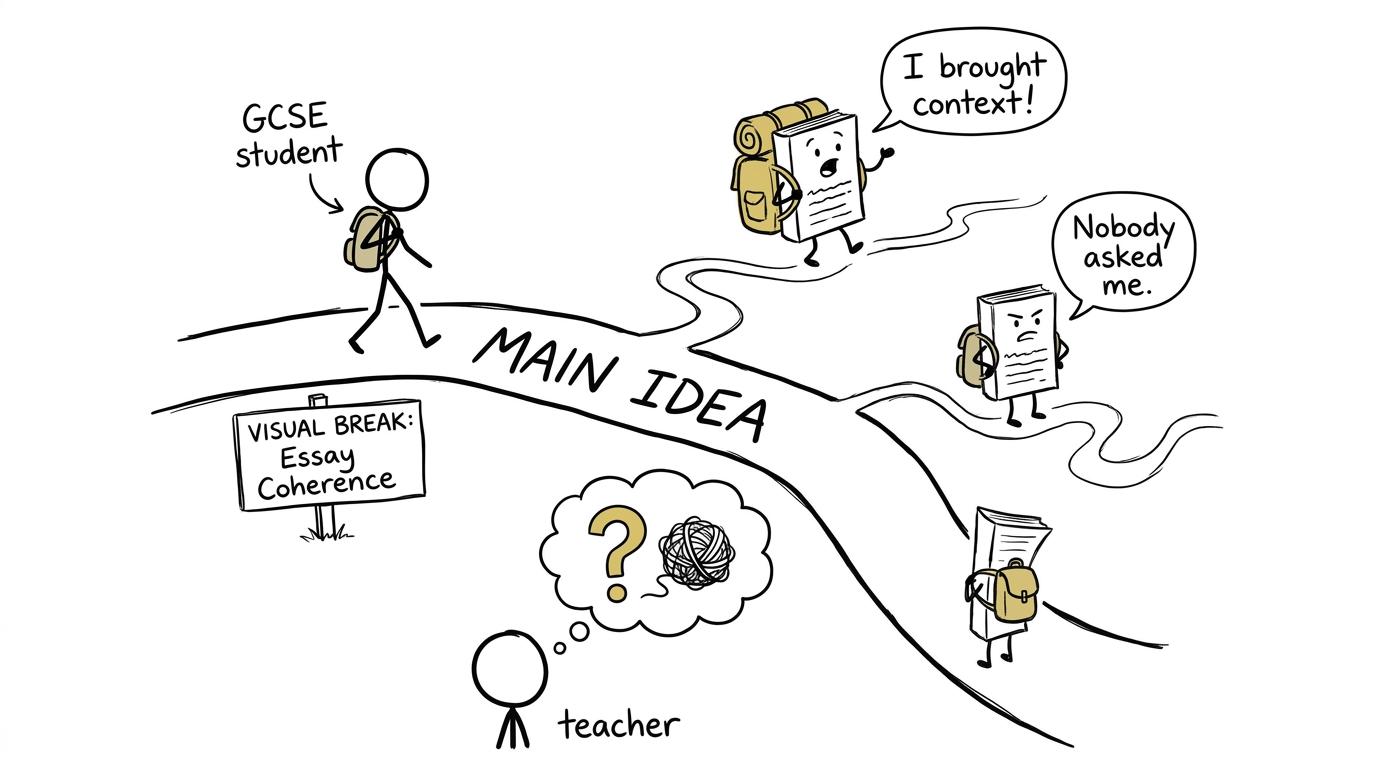 Paragraphs wander away from the main argument
A practical read-aloud revision routine
Reading aloud works best as a focused diagnostic, not as a performance. You do not need a dramatic voice. You need to resist correcting the answer while you read it.
Leave a short gap first
If possible, put the response aside before checking it. Even a short break can reduce your attachment to what you intended to write. When you return, use a pen or a duplicate digital copy so that the original remains visible.
Read exactly what is written
Do not silently insert missing words or improve clumsy phrases as you speak. If a sentence only works after you have changed it instinctively, mark that point. Your examiner receives the words on the page, not the improved version in your head.
Use simple symbols in the margin:
- a slash where a sentence needs a pause or split;
- an arrow where an idea may belong elsewhere;
- a question mark where the logic is unclear;
- a circle around repeated or vague vocabulary;
- a star beside a claim that needs evidence or analysis.
Review structure before accuracy
Make the large decisions first. Check the order of paragraphs, the development of the argument and the balance of the response. There is little value in polishing a sentence that you later remove.
Then complete a separate accuracy pass for spelling, punctuation, grammar and missing words. In GCSE English Language, technical accuracy is explicitly assessed within the writing objectives. Accuracy also matters in Literature, although its precise weighting and location vary by specification.
Check against the mark scheme
Fluency is not the same as quality. An answer may sound polished while remaining descriptive, unsupported or unfocused. After the oral check, use the relevant mark scheme to ask:
- Have I answered the exact question?
- Is each interpretation supported by an appropriate reference?
- Have I analysed language, form or structure where required?
- Is context relevant rather than bolted on?
- Does the response remain coherent from beginning to end?
The cycle should be write, hear, revise, mark and rewrite. MathsGenie’s guide to finding weak English Literature skills can help you classify what is holding an answer back.
Language and Literature need different listening priorities
For an English Language writing task, listen for audience, purpose and register. Does a speech sound as though it addresses listeners? Does a narrative maintain its viewpoint and tense? Does descriptive writing develop rather than become a list of images? You should also hear whether sentence lengths are deliberately varied or simply uncontrolled.
For English Language reading responses, concentrate on the sequence of explanation. A useful paragraph should move logically from claim to evidence to analysis. If you find yourself adding an explanation aloud that is absent from the page, you have found a gap.
For Literature, listen for the argument across the whole essay. Ask whether each paragraph advances the central interpretation or merely reports another event from the text. Context should deepen an interpretation, not interrupt it with an isolated historical fact.
If English Language is your current priority, the GCSE English Language revision guide explains how to combine short writing tasks, mark schemes and timed paper practice.
When reading aloud is not enough
Oral proofreading is a supplement, not a replacement for informed feedback. It is good at exposing surface errors and awkwardness, but it cannot reliably judge whether your textual evidence is accurate, your interpretation is perceptive or your response satisfies a particular level descriptor.
You may also read a familiar draft with the intonation you intended, accidentally making weak punctuation sound convincing. One useful alternative is to ask text-to-speech software to read a typed response. Its neutral delivery may reveal missing words and strange sentence boundaries, although your school’s rules should guide the use of technology.
Most importantly, treat this as a revision method rather than an exam-hall strategy. Speaking aloud during a written examination would disturb other candidates and may conflict with centre arrangements. In the exam, use silent rereading and follow all invigilator instructions and approved access arrangements.
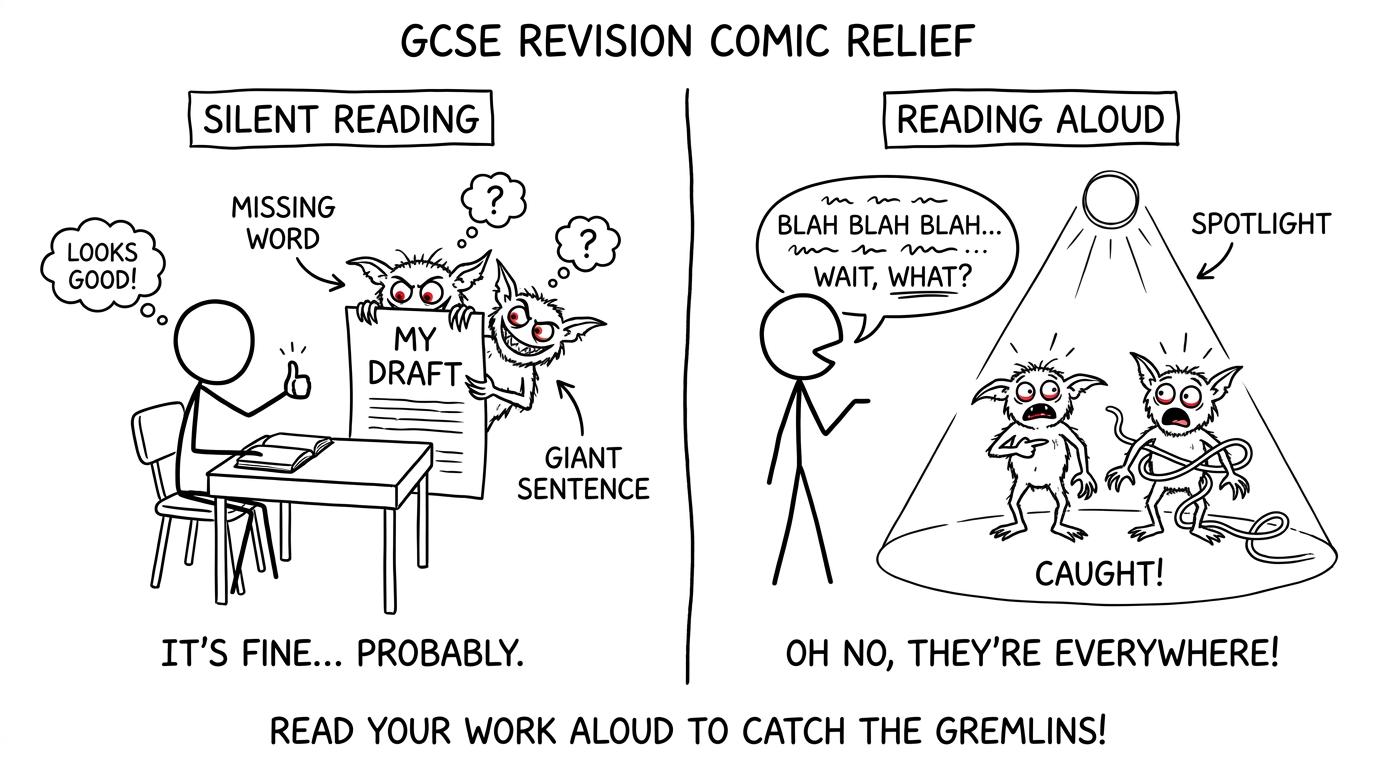 Hidden proofreading gremlins are exposed by reading aloud
Common mistakes when reading answers aloud
Correcting automatically as you speak
This hides the evidence. Stop, mark the exact location and continue with the original wording. Edit only after finishing the section.
Focusing only on punctuation
A misplaced comma matters, but an irrelevant paragraph matters more. Check argument and organisation before sentence-level accuracy.
Assuming smooth writing must earn high marks
A fluent answer can still lack evidence or analysis. Always return to the question, assessment objectives and mark scheme.
Reading immediately after writing
The intended meaning is still too fresh. Build in some distance where your revision timetable allows it.
Rewriting the whole answer
Improvement needs a specific target. Rewrite the weakest paragraph or transition, then compare both versions. This makes progress visible without consuming an entire evening.
Using the wrong specification
AQA, Edexcel, OCR and Eduqas do not use identical papers or mark allocations. Confirm your board before choosing questions, timings or mark schemes.
Protecting your maths revision while improving English
Students preparing for maths exams cannot give every evening to rewriting essays. A small, repeatable English routine is usually more manageable: complete one timed response, read it aloud, improve one weak section and log one target for next time.
Then return to the same evidence-led cycle in maths. Use the GCSE Maths revision hub for lessons and topic questions, GCSE Maths mini tests for short checks, and GCSE Maths predicted papers when you are ready for timed exam-style practice.
The subjects look different, but the improvement loop is remarkably similar: attempt something, expose the weakness, use feedback and try again.
Hear the answer your examiner will read
Your first draft carries two versions of the same answer: the words you wrote and the meaning you hoped they conveyed. Silent reading often blends them together. Reading aloud creates some distance between the two.
Use that distance carefully. Listen for missing links, misplaced emphasis and sentences that cannot carry their own weight. Then check the substance against the question and mark scheme.
Start with a MathsGenie English past-paper question, revise one response using the routine above, and keep your wider exam preparation moving through MathsGenie’s free revision lessons, practice questions, mini tests, past papers, predicted papers, mark schemes and video solutions. Improvement rarely comes from one dramatic rewrite. It comes from noticing one problem clearly enough not to repeat it.