

Quadratic Inequalities GCSE Maths Mock Revision
Quadratic inequalities GCSE maths revision made clear. Learn the method, see two exam-style examples and prepare confidently for your Year 11 mock.
A quadratic inequality can feel like several topics arriving at once. You must rearrange, factorise, solve and then decide which intervals work. Under mock pressure, it is easy to stop after finding two roots and forget that the question asks for a range of values.
The reliable method for quadratic inequalities GCSE maths questions is simple: move everything to one side, find the boundary roots, split the number line into intervals, and identify where the expression has the required sign. This guide follows a Year 11 student preparing for December mocks, with two exam-style questions and the common slips that lose marks.
Your quadratic inequalities mock revision checklist
Before attempting a full set of questions, make sure you can:
- rearrange an inequality so that one side is 000;
- factorise a quadratic expression;
- solve the related quadratic equation;
- mark the roots in the correct order on a number line;
- test the intervals or use the shape of the graph;
- include roots for ≤\leq≤ and ≥\geq≥;
- exclude roots for <<< and >>>;
- state the final answer as an inequality, not merely as two roots.
If factorising is the uncertain step, revisit expanding and factorising quadratics before continuing. You can also practise factorising harder quadratics when the coefficient of x2x^2x2 is greater than 111.
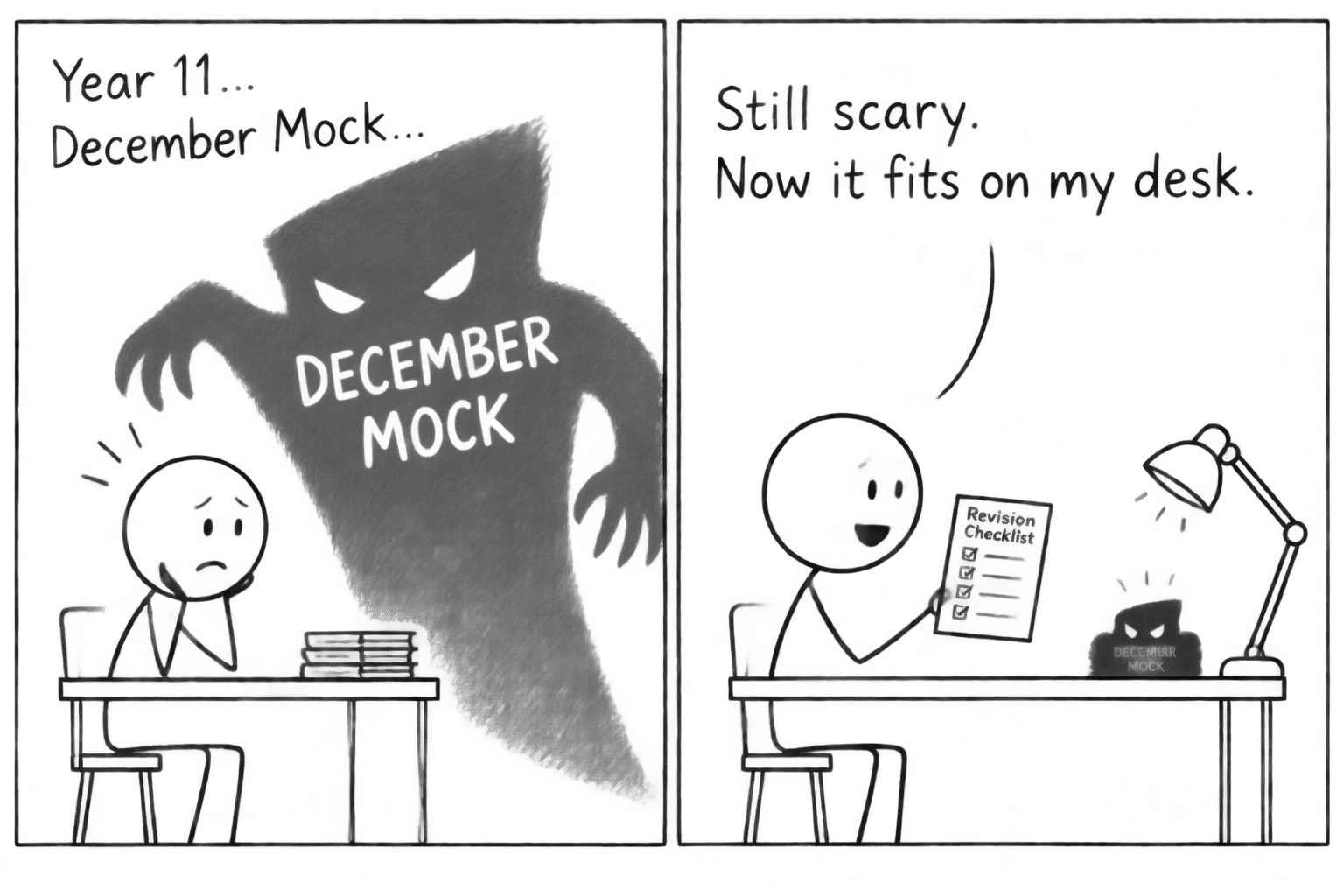 A Year 11 student makes the December mock feel smaller by using a revision checklist
The method for solving a quadratic inequality
Suppose you need to solve:
x2−x−6≤0x^2-x-6\leq 0x2−x−6≤0The central idea is that the roots divide the number line into regions. Within each region, the quadratic expression remains either positive or negative. You are not looking for one value of xxx. You are looking for every interval where the inequality is true.
Use this process:
Rearrange the inequality
Write the inequality with 000 on one side. For example:
x2+4x>5x^2+4x>5x2+4x>5becomes:
x2+4x−5>0x^2+4x-5>0x2+4x−5>0This makes the boundary equation clear.
Find the boundary roots
Replace the inequality sign temporarily with an equals sign and solve:
x2+4x−5=0x^2+4x-5=0x2+4x−5=0These roots are boundaries. They are not automatically the complete answer.
Divide the number line into intervals
Two distinct roots usually create three intervals. If the roots are aaa and bbb, where a<ba<ba<b, the intervals are:
x<a,a<x<b,x>bx<a,\qquad a<x<b,\qquad x>bx<a,a<x<b,x>bDecide which intervals work
Choose a test value from each interval and substitute it into the quadratic expression. Keep every interval that produces the sign required by the question.
Alternatively, sketch the quadratic graph. An upward-opening parabola is below the xxx-axis between its roots and above the axis outside them. A downward-opening parabola behaves in the opposite way.
Check whether the roots are included
The equality bar matters:
- ≤\leq≤ and ≥\geq≥ include boundary roots;
- <<< and >>> exclude boundary roots.
This final check often separates a complete answer from one that drops a mark.
Exam-style question: solution between the roots
Solve:
x2−x−6≤0x^2-x-6\leq 0x2−x−6≤0First factorise:
(x−3)(x+2)≤0(x-3)(x+2)\leq 0(x−3)(x+2)≤0Find the boundary roots by solving:
(x−3)(x+2)=0(x-3)(x+2)=0(x−3)(x+2)=0Therefore:
x=3orx=−2x=3\qquad\text{or}\qquad x=-2x=3orx=−2Place the roots in numerical order. They create the intervals x<−2x<-2x<−2, −2<x<3-2<x<3−2<x<3 and x>3x>3x>3.
Test one value from each interval:
- For x=−3x=-3x=−3, (x−3)(x+2)=(−6)(−1)=6(x-3)(x+2)=(-6)(-1)=6(x−3)(x+2)=(−6)(−1)=6, which is positive.
- For x=0x=0x=0, (x−3)(x+2)=(−3)(2)=−6(x-3)(x+2)=(-3)(2)=-6(x−3)(x+2)=(−3)(2)=−6, which is negative.
- For x=4x=4x=4, (x−3)(x+2)=(1)(6)=6(x-3)(x+2)=(1)(6)=6(x−3)(x+2)=(1)(6)=6, which is positive.
The question asks where the expression is less than or equal to 000. That is the middle interval, including both roots:
−2≤x≤3\boxed{-2\leq x\leq 3}−2≤x≤3The graph interpretation says the same thing. The coefficient of x2x^2x2 is positive, so the parabola opens upwards and lies on or below the xxx-axis between its roots.
For more guided practice, use the quadratic inequalities GCSE revision lesson, which includes exam-style questions and supporting resources.
Exam-style question: solution outside the roots
Solve:
2x2+x−6>02x^2+x-6>02x2+x−6>0Factorise the quadratic:
(2x−3)(x+2)>0(2x-3)(x+2)>0(2x−3)(x+2)>0Now find the boundary roots:
2x−3=0orx+2=02x-3=0\qquad\text{or}\qquad x+2=02x−3=0orx+2=0So:
x=32orx=−2x=\frac{3}{2}\qquad\text{or}\qquad x=-2x=23orx=−2The roots divide the number line into three intervals. Test a convenient value from each:
- For x=−3x=-3x=−3, (2x−3)(x+2)=(−9)(−1)=9(2x-3)(x+2)=(-9)(-1)=9(2x−3)(x+2)=(−9)(−1)=9, which is positive.
- For x=0x=0x=0, (2x−3)(x+2)=(−3)(2)=−6(2x-3)(x+2)=(-3)(2)=-6(2x−3)(x+2)=(−3)(2)=−6, which is negative.
- For x=2x=2x=2, (2x−3)(x+2)=(1)(4)=4(2x-3)(x+2)=(1)(4)=4(2x−3)(x+2)=(1)(4)=4, which is positive.
The expression is greater than 000 outside the roots. Because the inequality is strict, the roots are excluded:
x<−2orx>32\boxed{x<-2\quad\text{or}\quad x>\frac{3}{2}}x<−2orx>23Notice the word “or”. The solution consists of two separate intervals, so they must not be joined into one chained inequality.
If the factorisation was the hardest part, work through the solving quadratics exam booklet before returning to inequalities.
How to revise before the December mock
Quadratic inequalities mock revision works best when it moves from accuracy to independence.
Start with one revision lesson. Write the method from memory, then compare it with the lesson. Next, complete a short group of questions without notes. Mark them immediately and classify each error: rearranging, factorising, roots, interval choice or notation.
A useful short session could be:
- 101010 minutes reviewing the method;
- 151515 minutes answering focused questions;
- 101010 minutes marking and correcting;
- 101010 minutes reattempting mistakes without the solution.
Two days later, answer another small set under timed conditions. This spacing matters because recognition during a video is not the same as recalling the method in a mock.
Use resources for your own specification where possible. MathsGenie has an Eduqas quadratic inequalities revision page, and its GCSE topic list by exam board and tier can help you check what belongs in your revision plan.
Common mark-losing slips
These are the mistakes examiners commonly encounter when marking quadratic inequalities exam questions:
- Stopping at the roots. Values such as x=−2x=-2x=−2 and x=3x=3x=3 are boundaries, not usually the complete solution.
- Choosing the wrong region. Test values prevent you from guessing whether the answer is between or outside the roots.
- Ignoring the equality bar. Include roots for ≤\leq≤ or ≥\geq≥, but exclude them for <<< or >>>.
- Writing roots in the wrong order. On a number line, −2-2−2 comes before 32\frac{3}{2}23.
- Using “and” instead of “or”. Two separate outside intervals require “or”.
- Factorising incorrectly. Expand your brackets quickly to check that they reproduce the original quadratic.
- Testing the equation instead of the expression. Substitute into the quadratic expression and determine whether its value is positive or negative.
- Losing the original inequality. Keep the required sign visible throughout your working.
Turn the method into mock-ready marks
A quadratic inequality is less mysterious once you see what the roots really do. They divide the number line into regions. Your task is to decide which regions satisfy the required sign and whether their boundaries belong in the answer.
Now turn that understanding into exam practice. Use the free GCSE Mock Exam Builder to build a targeted practice paper containing the topics you need most. Sit it without notes, mark your work, then return to MathsGenie's revision lessons, practice questions, mark schemes and video solutions for anything that still feels uncertain. That cycle is how a difficult-looking topic becomes a dependable source of marks.















