

Podcasts Audiobooks GCSE English Language: Do They Help?
Podcasts audiobooks GCSE English Language revision can support vocabulary and ideas, but do they improve exam marks? Learn how to use audio effectively.
Revision can look productive long before it becomes useful. Headphones are on, an educational voice is speaking, and an hour passes without the resistance of opening an exam paper. Yet the important question is not whether listening feels like revision. It is whether podcasts audiobooks GCSE English Language revision helps you perform the reading and writing tasks that earn marks.
The short answer is yes, but mainly as a supplement. Podcasts and audiobooks can broaden vocabulary, expose you to different voices and perspectives, model fluent expression and make good use of otherwise empty time. They cannot replace close reading, timed writing, source comparison or practice with your exam board's questions.
For students also preparing for maths exams, the principle is familiar: hearing someone explain a method may build understanding, but you still have to answer questions yourself. English Language works in much the same way.
The quick listening-based revision checklist
Use audio when it has a clear purpose:
- Choose material connected to a reading, writing or spoken-language skill.
- Listen with full attention rather than while scrolling.
- Pause regularly and retrieve the main ideas from memory.
- Record useful vocabulary, arguments or structural choices.
- Turn something you heard into a short written response.
- Check the response against your exam board's assessment objectives.
- Keep practising unseen extracts and timed writing on paper.
The central rule is simple: audio should lead to an action. If the episode ends and nothing is recalled, discussed, planned or written, its revision value is limited.
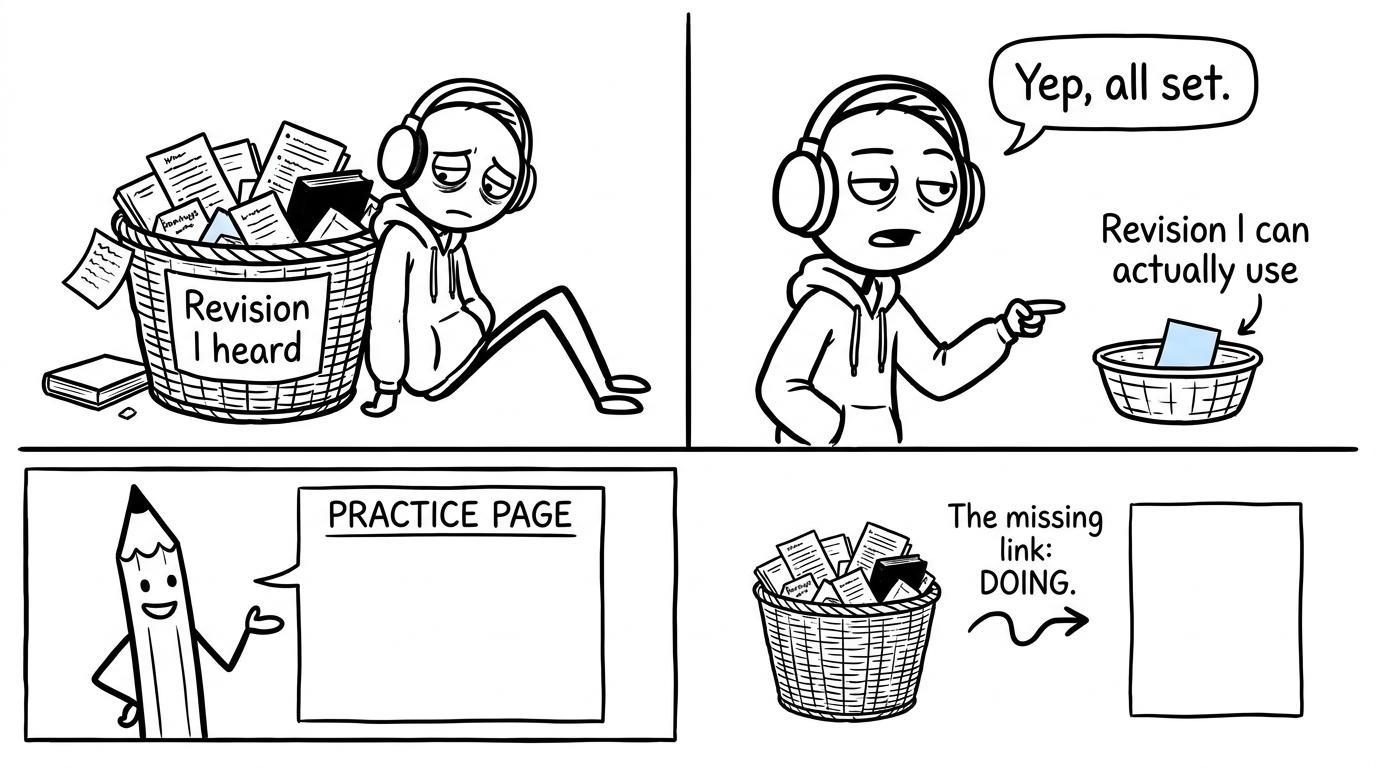 A student discovers the gap between revision heard and revision they can use
What GCSE English Language actually assesses
Across AQA, Edexcel, OCR and Eduqas, exact paper structures and question wording differ. However, the regulated assessment objectives share the same broad destination: students must read critically and write effectively.
Reading accounts for half of the qualification and writing accounts for the other half. The reading objectives cover identifying and interpreting information, analysing language and structure, comparing perspectives and evaluating texts with references. Writing is assessed through communication, organisation, vocabulary, sentence control, spelling and punctuation.
English Language is untiered. Unlike GCSE maths, there is no separate foundation or higher paper. Students across the grade range face the same assessment, although exam boards arrange texts and tasks differently. Spoken Language is assessed separately and does not contribute to the final numerical grade.
This matters because listening overlaps with only part of what you need. It can strengthen language comprehension and your awareness of tone, argument and voice. The final written examinations still require you to read unseen material, select evidence and construct responses under time pressure.
How podcasts can help GCSE English Language revision
A good podcast can expose you to ideas, opinions and speaking styles that would be difficult to collect from a revision guide alone. Interviews may reveal how speakers adapt their tone. Documentaries can present contrasting perspectives. Carefully produced educational episodes may clarify terms such as inference, register, rhetoric and narrative viewpoint.
Podcasts are particularly useful for developing three areas.
Building knowledge and viewpoints
Transactional writing becomes easier when you have something meaningful to say. Listening to thoughtful discussions about technology, education, the environment, sport or culture can expand the examples and arguments available to you.
That does not mean memorising a presenter's opinion. Notice how a claim is introduced, supported, qualified and challenged. Then decide whether the argument is convincing. This turns listening into critical thinking rather than background entertainment.
Hearing tone and rhetorical delivery
Audio makes pace, emphasis, pauses and shifts in tone immediately noticeable. These features can help you understand how language influences an audience, particularly when preparing speeches or considering a writer's voice.
A podcast may also support the Spoken Language endorsement because you can hear how speakers organise an opening, signal a transition and respond to questions. Remember, though, that your presentation must still be planned and delivered by you.
Making revision more accessible
Audio can reduce the barrier to beginning a session. It is portable and may be helpful for students who find sustained print reading tiring. Research reviews suggest that listening and reading can produce broadly comparable comprehension in some contexts, while outcomes vary with the learner, text and level of control over pacing.
That is a reason to use audiobooks confidently, not a reason to abandon print. GCSE English Language asks you to operate directly on a written source. That specific skill needs specific practice.
How audiobooks can support reading and writing
Audiobooks offer sustained exposure to vocabulary, syntax, description and narrative voice. A strong narrator can make changes in mood or character immediately audible. Hearing complete texts can also help students experience writing as a connected whole rather than a collection of isolated techniques.
They may be particularly valuable when used alongside the printed text. You can follow the words, pause at an interesting sentence and consider why it works. Evidence reviews have found that audio-supported reading may help some struggling readers, although the findings are not uniform and should not be treated as a guaranteed advantage for every student.
For English Language, choose audiobooks for their craft rather than because you expect the same book to appear in the exam. The examined extracts are unseen. Your goal is to become more sensitive to choices involving voice, structure, imagery, sentence length and perspective.
Do not confuse this with English Literature revision. Listening to a set text may support familiarity with its plot and characters, but English Language primarily tests transferable analysis and writing skills.
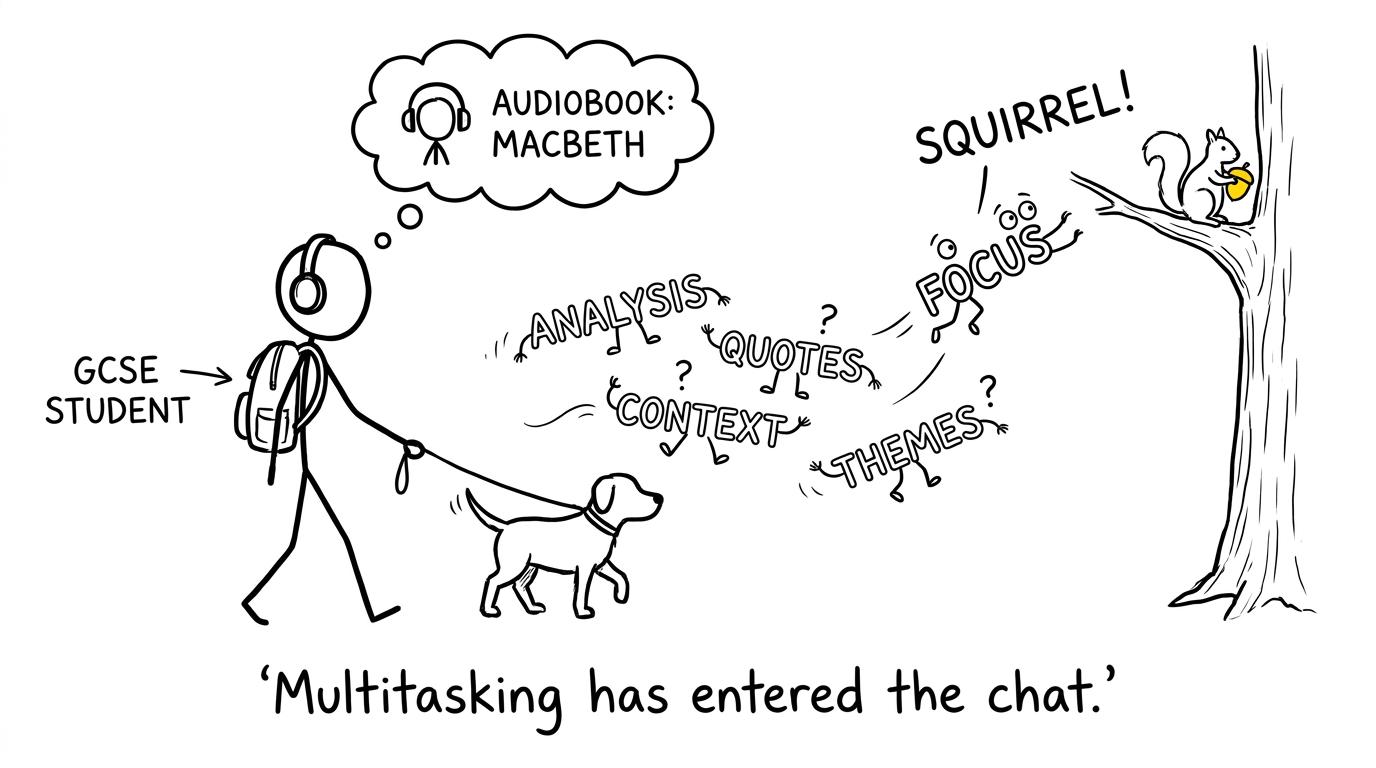 Vocabulary attempts to keep up with a multitasking listener
Why audio works better as a supplement
Listening is receptive. The exam is productive.
During an audiobook, the narrator controls the pace unless you deliberately pause or rewind. During reading, you can slow down at a difficult sentence, scan backwards, underline evidence and compare two passages visually. Those actions are central to answering questions on unseen texts.
Written accuracy creates another limit. Hearing an ambitious word does not guarantee that you can spell it. Recognising a persuasive argument does not prove that you can organise one. Understanding a description does not automatically produce controlled descriptive writing.
Educational research consistently supports retrieval practice: trying to recall information tends to strengthen learning more effectively than simply encountering it again. That principle explains why replaying an episode is usually weaker than pausing and summarising it without help.
Use this audio revision loop:
- Listen: choose a short, focused section.
- Pause: stop before the next section begins.
- Retrieve: say or write the main claim, technique or idea from memory.
- Transform: turn it into a question plan, paragraph outline or vocabulary note.
- Check: return to the audio or transcript and correct omissions.
- Apply: complete a relevant written task.
This is the English equivalent of moving from a maths revision video to independent questions. The MathsGenie GCSE maths revision hub is built around that same learn-practise-check rhythm, with lessons, questions, papers and solutions kept together.
Fitting English audio around maths revision
Students preparing for maths exams often have several subjects competing for the same evening. Audio can help, but it should fill low-demand spaces rather than displace the work that requires a desk.
A short podcast during a walk may be sensible. Listening while attempting algebra is not. Both tasks use attention, and divided attention makes it easier to miss the argument in English and the detail in maths.
Separate your modes of revision:
- Use audio during a walk, simple journey or quiet break.
- Reserve desk time for English annotation and timed writing.
- Use separate desk sessions for maths practice questions and papers.
- Plan both subjects before the week becomes crowded.
The GCSE maths revision timetable guide can help you allocate focused sessions, while the one-month GCSE maths revision plan offers a shorter structure when exams are close.
The important distinction is between additional revision and replacement revision. A podcast heard on a journey may add useful exposure. A podcast used instead of a necessary timed response creates a gap.
Choosing useful podcasts and audiobooks
Popularity is not the same as relevance. Before pressing play, ask:
- Does this develop a skill required by my specification?
- Is the speaker or publisher credible?
- Will I encounter crafted language, competing perspectives or useful vocabulary?
- Can I pause, rewind or access a transcript?
- What will I produce after listening?
For podcasts, favour episodes with a defined subject and clear structure. For audiobooks, select varied fiction and non-fiction rather than listening only to one familiar genre. Speeches, memoirs, travel writing and narrative journalism can broaden your sense of form and audience.
Be cautious with generic episodes promising secret phrases or guaranteed grades. Exam boards reward responses to the particular task and text. A memorised paragraph that ignores either one is unlikely to demonstrate genuine analysis.
Common mistakes with audio revision
Treating listening time as proof of learning
Finishing three episodes measures completion, not recall. Close the app and explain the key ideas without prompts. If you cannot, revisit a shorter section and listen more actively.
Listening while doing demanding work
Walking may leave enough attention for audio. Completing a maths paper usually does not. When practising maths, use focused resources such as Edexcel GCSE maths past papers, OCR GCSE maths past papers or short Edexcel GCSE maths mini tests without another voice competing for attention.
Collecting vocabulary without learning usage
An impressive word is useful only when its meaning, spelling and register fit the sentence. Record it with a definition and an appropriate context, then use it naturally in later writing.
Replacing unseen-text practice
Audio cannot train you fully to select quotations, annotate a source or compare visible passages. Those skills require written extracts and board-specific questions.
Never writing after listening
This is the largest mistake. The headphones keep the experience comfortable, but the pen completes the training. Even a brief summary or plan forces you to organise what you understood.
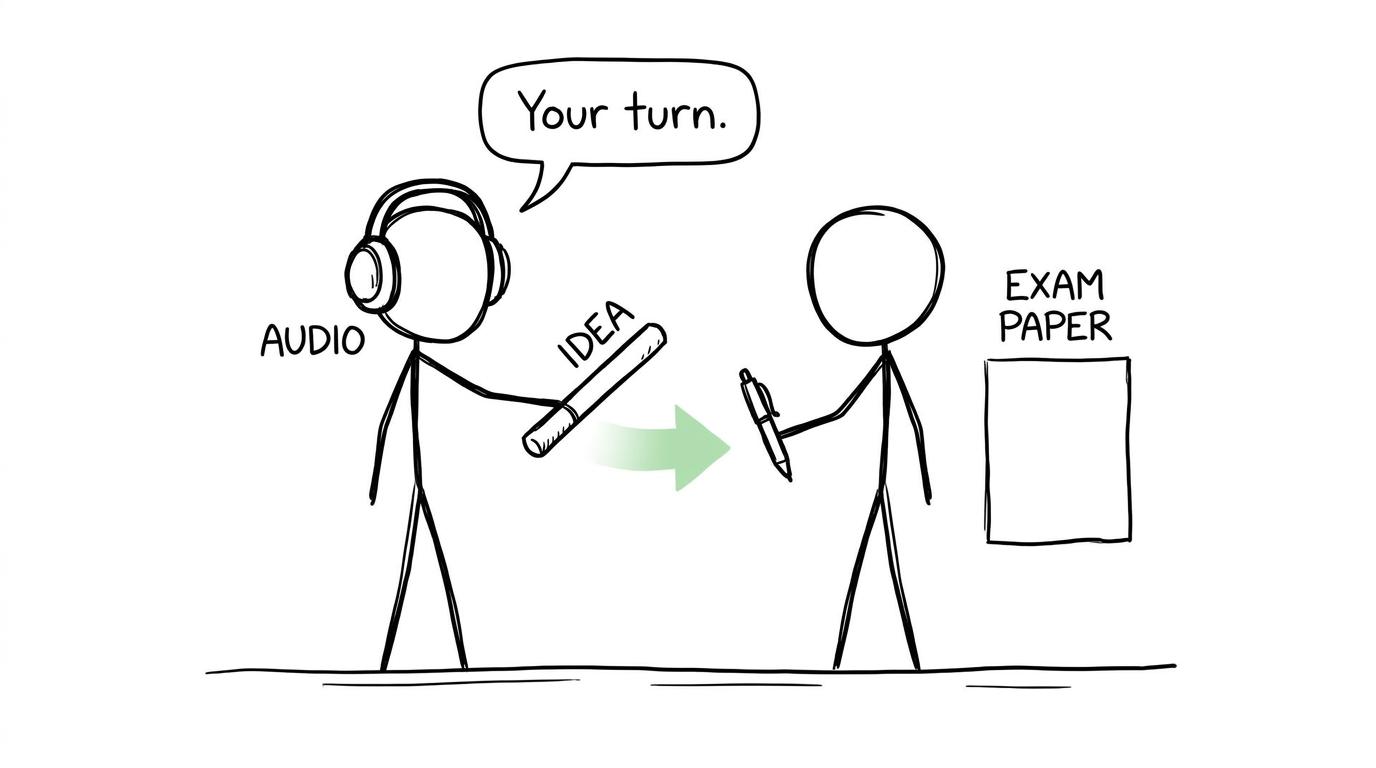 Headphones pass the revision baton to a pen
The best verdict: listen, retrieve, then practise
Podcasts and audiobooks genuinely can help with GCSE English Language. They can enrich vocabulary, develop awareness of voice, introduce viewpoints and make revision more accessible. Their weakness is equally clear: they do not reproduce the central demands of a written examination.
Use audio to widen the doorway into English, then walk through it with reading and writing practice. Pause. Retrieve. Question. Plan. Write. That sequence turns an enjoyable medium into purposeful revision.
Apply the same honesty to maths. Explanations help, but marks grow from independent practice and careful correction. Start with the free MathsGenie GCSE revision resources, follow revision lessons with practice questions, and test your progress using mini tests, past papers, predicted papers, mark schemes and video solutions. If papers feel unproductive, use the guide to using GCSE past papers properly.
Listening can support the journey. Practice is what prepares you for the destination.










