

Place Value GCSE Maths: Examples and Practice
Place value GCSE maths explained with clear worked examples, decimal comparisons and exam-style questions. Learn to spot mistakes and practise confidently.

A digit can look familiar and still cause trouble. Imagine a GCSE student, Sam, who keeps choosing the longer decimal as the larger number. In a place value GCSE maths question, Sam decides that 0.4070.4070.407 must be greater than 0.470.470.47. There are more digits, so surely there is more value?
The fix is to compare the columns. Place value means that a digit’s position determines its value. Each column is worth ten times the column immediately to its right. Once Sam starts reading positions rather than counting digits, the answers begin to make sense.
You can use the same approach to identify digits, order decimals and multiply or divide by powers of ten.
Place value GCSE maths: the essentials
Before practising, check that you can:
- Name whole-number and decimal columns.
- Explain the value of a particular digit.
- Use zeros to hold empty positions.
- Compare numbers from left to right.
- Move digits correctly when multiplying or dividing by powers of ten.
These skills support GCSE number work, including calculations with decimals, rounding and estimation. They are worth securing even if you are already revising more demanding topics.
What does place value mean?
The same digit can represent different amounts. In 555555555, the first digit represents 500500500, the second represents 505050, and the final digit represents 555.
The digit has stayed the same. Its position has changed.
| Column | Value of one unit in that column |
|---|---|
| Thousands | 100010001000 |
| Hundreds | 100100100 |
| Tens | 101010 |
| Ones | 111 |
| Tenths | 0.10.10.1 |
| Hundredths | 0.010.010.01 |
| Thousandths | 0.0010.0010.001 |
Moving one column to the left multiplies the value by 101010. Moving one column to the right divides it by 101010.
The decimal point separates the ones from the tenths. There is no “oneths” column after it: the first decimal column represents tenths, followed by hundredths and thousandths.
For another explanation to read alongside your notes, use MathsGenie’s place value revision guide.
Place value worked examples
Find the value of a digit
Question: What is the value of the digit 666 in 463.28463.28463.28?
Start at the decimal point and name the whole-number columns moving left: ones, tens, hundreds.
The 333 occupies the ones column. The 666 occupies the tens column, so its value is:
6×10=606\times 10=606×10=60The answer is 606060. If the question asked for the name of the column, the answer would be “tens”. Read that distinction carefully.
Understand a zero placeholder
Question: Write 5.0835.0835.083 as a sum showing the value of each non-zero digit.
Read each position separately:
- The 555 represents five ones.
- The 000 shows there are no tenths.
- The 888 represents eight hundredths.
- The 333 represents three thousandths.
Therefore:
5.083=5+8100+310005.083=5+\frac{8}{100}+\frac{3}{1000}5.083=5+1008+10003The zero keeps the other digits in their correct columns. Removing it would produce 5.835.835.83, which is a different number.
Compare two decimals
Return to Sam’s original question: which is larger, 0.4070.4070.407 or 0.470.470.47?
First, write the numbers with the same number of decimal places:
0.4070.4700.407\qquad 0.4700.4070.470Adding a zero at the end of the decimal does not change its value.
Next, compare from left to right. Both numbers have zero ones and four tenths. At the hundredths column, however, the first has zero hundredths and the second has seven hundredths.
That first different column decides the comparison:
0.407<0.4700.407<0.4700.407<0.470So 0.470.470.47 is larger. Sam’s useful new question is: “Where is the first column that differs?”
Use the same method yourself: align the decimal points, add trailing zeros if helpful, and compare from the left.
Start with MathsGenie’s place value lesson and Question Bank if you want to practise that column-by-column method with further questions.
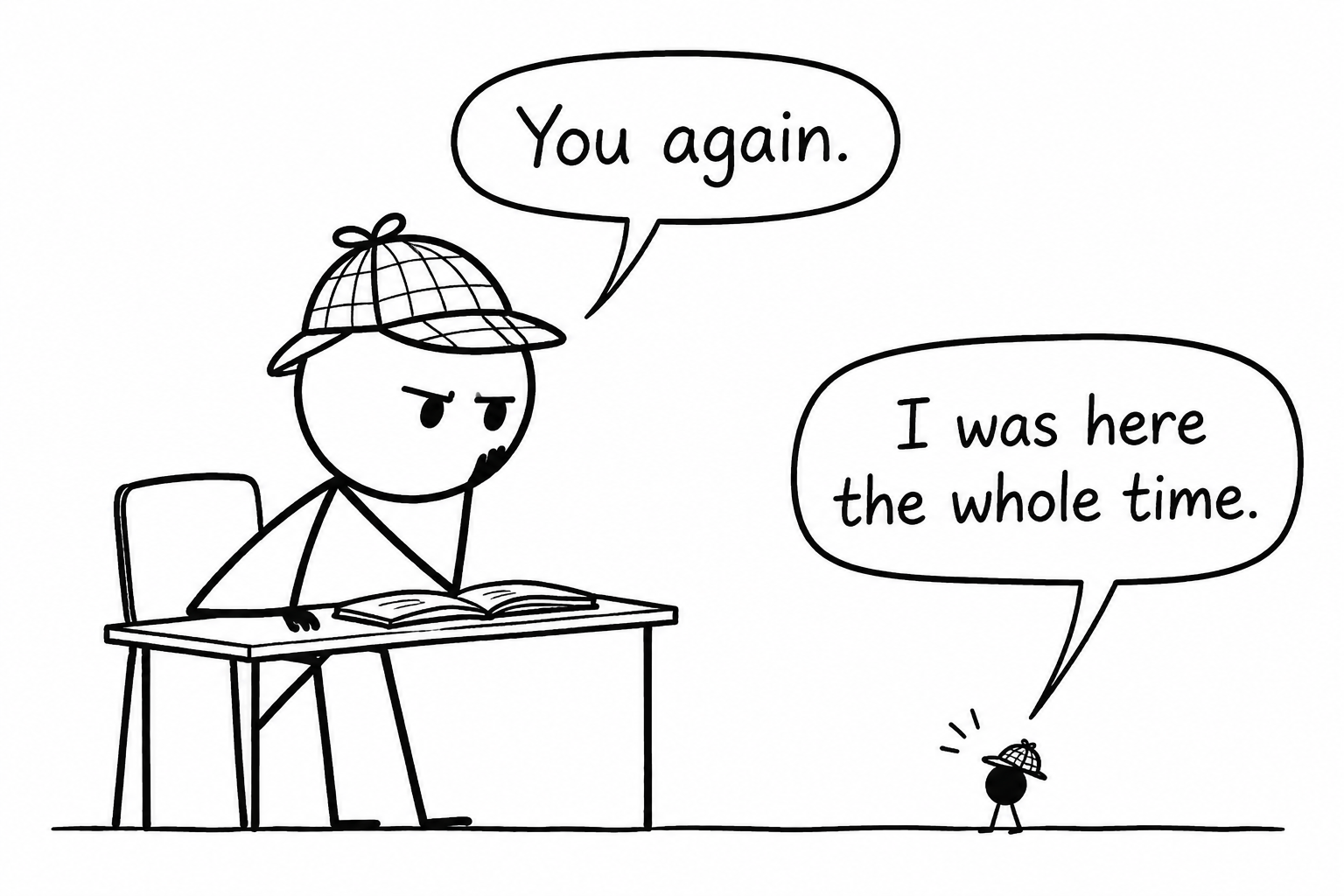 A student looks suspiciously at a decimal point wearing a detective hat, which insists it was there the whole time.
Multiply and divide using place value
Question: Calculate 3.06×1003.06\times 1003.06×100 and 3.06÷103.06\div 103.06÷10.
Multiplying by 100100100 makes every digit worth one hundred times as much. Each digit moves two columns to the left:
3.06×100=3063.06\times 100=3063.06×100=306Dividing by 101010 makes every digit worth one tenth as much. Each digit moves one column to the right:
3.06÷10=0.3063.06\div 10=0.3063.06÷10=0.306Think about the digits moving between fixed columns. This explains the calculation and helps you place any necessary zeros correctly.
If following a written method feels difficult, pause and replay the relevant explanation in the place value video lessons, then attempt the calculation independently.
Common mistakes and how to catch them
Treating the decimal part as a whole number. Comparing 0.90.90.9 and 0.120.120.12 by comparing 999 with 121212 gives the wrong result. Write 0.900.900.90 and 0.120.120.12: nine tenths is greater than one tenth.
Removing a zero from the middle. A trailing decimal zero can be removed without changing the number, so 2.50=2.52.50=2.52.50=2.5. An internal zero holds a position, so 2.05≠2.52.05\ne 2.52.05=2.5.
Confusing a digit with its value. In 7.347.347.34, the hundredths digit is 444, but its value is 0.040.040.04. Check which answer the question requests.
Adding zeros whenever you multiply. Appending a zero to 3.63.63.6 produces 3.603.603.60, which has the same value. Multiplying by 101010 gives 363636. Use the columns rather than a rule about adding zeros.
For our hypothetical student, the turning point is a small habit: naming the column before writing the answer. You can make that habit visible by pencilling column headings above any number that feels uncertain.
Exam-style place value questions
Try these without looking back at the examples. Show enough working to make your reasoning clear.
- Question A: What is the value of the digit 777 in 27.40627.40627.406?
- Question B: Write 0.6090.6090.609, 0.690.690.69 and 0.0960.0960.096 in ascending order.
- Question C: Calculate 4.08×1004.08\times 1004.08×100.
- Question D: Calculate 63.5÷100063.5\div 100063.5÷1000.
- Question E: A student says 0.52<0.5080.52<0.5080.52<0.508 because 52<50852<50852<508. Explain the error.
Check your answers
A: 777, because the digit occupies the ones column.
B: 0.096<0.609<0.690.096<0.609<0.690.096<0.609<0.69. Writing the final number as 0.6900.6900.690 makes the comparison clearer.
C: 408408408.
D: 0.06350.06350.0635.
E: Decimal digits must be compared by position. Since 0.52=0.5200.52=0.5200.52=0.520, the hundredths column shows that 0.52>0.5080.52>0.5080.52>0.508.
If you made a mistake, identify the column where your reasoning went wrong before retrying. For further written practice, use the place value exam booklet.
Turn the method into a habit
Sam’s imagined breakthrough begins with reading columns consistently; your next step is to apply that method without a reminder. Knowing why a zero matters is useful, but answering fresh questions shows whether the idea has settled. Start your place value practice with MathsGenie’s Lessons and Question Bank, naming each column before you answer.















